A 75 kg (165 lb) male is being mechanically ventilated with a microprocessor ventilator in the volume-control mode at the following settings:
Tidal Volume 550 ml
Rate 10
FiO2 0.40
PEEP 5 cm H2O
Arterial bloo
...
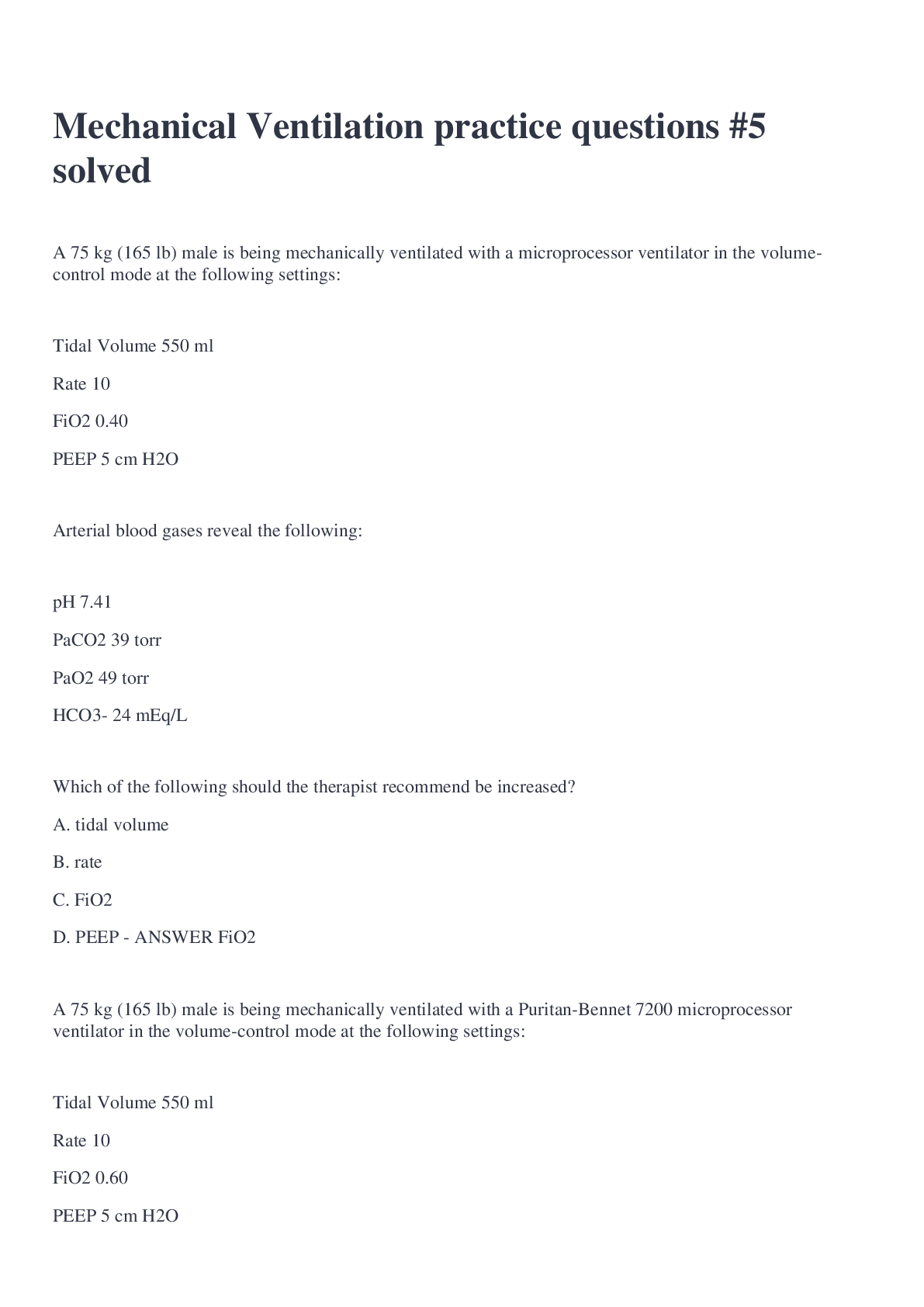
A 75 kg (165 lb) male is being mechanically ventilated with a microprocessor ventilator in the volume-control mode at the following settings:
Tidal Volume 550 ml
Rate 10
FiO2 0.40
PEEP 5 cm H2O
Arterial blood gases reveal the following:
pH 7.41
PaCO2 39 torr
PaO2 49 torr
HCO3- 24 mEq/L
Which of the following should the therapist recommend be increased?
A. tidal volume
B. rate
C. FiO2
D. PEEP - ANSWER FiO2
A 75 kg (165 lb) male is being mechanically ventilated with a Puritan-Bennet 7200 microprocessor ventilator in the volume-control mode at the following settings:
Tidal Volume 550 ml
Rate 10
FiO2 0.60
PEEP 5 cm H2O
Arterial blood gases reveal the following:
pH 7.41
PaCO2 39 torr
PaO2 49 torr
HCO3- 24 mEq/L
Which of the following should the therapist recommend be increased? - ANSWER PEEP
A 75 kg (165 lb) male is being mechanically ventilated with a Hamilton Amadeus microprocessor ventilator in the volume-control mode at the following settings:
Tidal Volume 700 ml
Rate 10
FiO2 0.40
PEEP 5 cm H2O
Arterial blood gases reveal the following:
pH 7.31
PaCO2 49 torr
PaO2 89 torr
HCO3- 22 mEq/L
Which of the following should the therapist recommend be increased?
A. tidal volume
B. rate
C. FiO2
D. PEEP - ANSWER tidal volume
A 75 kg (165 lb) male is being mechanically ventilated with a microprocessor ventilator in the volume-control mode at the following settings:
Tidal Volume 700 ml
Rate 10
FiO2 0.40
PEEP 5 cm H2O
PIP 21 cm H2O
Arterial blood gases reveal the following:
pH 7.31
PaCO2 49 torr
PaO2 68 torr
HCO3- 22 mEq/L
Which of the following should the therapist recommend be increased?
A. tidal volume
B. rate
C. FiO2
D. PEEP - ANSWER tidal volume
A 75 kg (165 lb) male is being mechanically ventilated with a Servo 300 microprocessor ventilator in the volume-control mode at the following settings:
Tidal Volume 900 ml
Rate 8
FiO2 0.35
PEEP 4 cm H2O
Arterial blood gases reveal the following:
pH 7.31
PaCO2 49 torr
PaO2 89 torr
HCO3- 22 mEq/L
Which of the following should the therapist recommend be increased?
A. tidal volume
B. rate
C. FiO2
D. PEEP - ANSWER rate
A 75 kg (165 lb) male is being mechanically ventilated with a Newport Breeze microprocessor ventilator in volume-control mode at the following settings. The following patient information is available.
Tidal Volume 550 ml
Rate 10
FiO2 0.60
PEEP 30 cm H2O
Static Compliance 60 ml/cm H2O
pH 7.37
PaCO2 44 torr
PaO2 49 torr
HCO3- 22 mEq/L
Qt 6.6 L/min
The therapist should now recommend:
A. Decrease PEEP
B. Decrease FiO2
C. Increase tidal volume
D. Increase PEEP - ANSWER Increase PEEP
A 75 kg (165 lb) male is being mechanically ventilated with a Hamilton Amadeus microprocessor ventilator in volume-control mode at the following settings. The following patient information is available.
Tidal Volume 750 ml
Rate 10
FiO2 0.40
PEEP 8 cm H2O
pH 7.39
PaCO2 42 torr
PaO2 91 torr
HCO3- 23 mEq/L
Cardiac Index 1.2 L/min/m2
The therapist should now recommend:
A. Decrease PEEP
B. Decrease FiO2
C. Maintain current settings
D. Increase PEEP - ANSWER Decrease PEEP
An 18 year-old 50 kg (110 lb) female is being mechanically ventilated with a Hamilton Veolar microprocessor ventilator in the pressure-control mode and a heat-moisture exchanger attached with a fifteen inch flex hose. Ventilator settings and arterial blood gases are as follows:
PIP 25 cm H2O
Rate 10
FiO2 0.40
Exhaled Tidal 600 ml
Volume
PEEP 3 cm H2O
pH 7.33
PaCO2 47 torr
PaO2 93 torr
HCO3- 22 mEq/L
The therapist should now recommend:
A. increase the PIP
B. decrease the deadspace
C. increase the rate
D. decrease the tidal volume - ANSWER decrease the deadspace
A 66 kg (145 lb) female is being mechanically ventilated with a Hamilton Veolar microprocessor ventilator in the pressure-control mode. Ventilator settings and arterial blood gases are as follows:
PIP 20 cm H2O
Rate 10
FiO2 0.40
Exhaled Tidal
Volume 450 ml
PEEP 3 cm H2O
pH 7.33
PaCO2 49 torr
PaO2 68 torr
HCO3- 22 mEq/L
The therapist should now recommend:
A. increase the PIP
B. decrease the FiO2
C. increase the rate
D. decrease the tidal volume - ANSWER increase the PIP
A 70 kg (154 lb) male is recieving non-invasive positive pressure ventilation (NIPPV) with a BiPAP ventilator set to 15 / 5. Arterial blood gases are as follows:
pH 7.33
PaCO2 49 torr
PaO2 83 torr
Which of the following IPAP / EPAP settings would best improve the patient's condition.
A. 10 / 2
B. 15 / 10
C. 20 / 10
D. 20 / 5 - ANSWER 20 / 5
A 75 kg (165 lb) male is being mechanically ventilated with a microprocessor ventilator in volume-control mode at the following settings. The following patient information is available.
Mode SIMV
Mandatory Rate 8
Total Rate 32
Tidal Volume 750 ml
PIP 35 cm H2O
Exhaled minute
volume 7.2 L
FiO2 0.45
PEEP 8 cm H2O
pH 7.48
PaCO2 31 torr
PaO2 89 torr
HCO3- 22 mEq/L
The therapist should now recommend:
A. Decrease PEEP
B. Increase mandatory rate to 12
C. Add pressure support
D. Initiate pressure control mode - ANSWER Add pressure support
A 80kg (176 lb) male suffering from acute respiratory distress syndrome (ARDS) is being mechanically ventilated with a Servo 300A microprocessor ventilator in volume-control mode at the following settings. The following patient information is available.
Mode Assist/control
Tidal Volume 650 ml
Mandatory Rate 10
Total Rate 10
PIP 68 cm H2O
FiO2 0.45
PEEP 8 cm H2O
pH 7.37
PaCO2 44 torr
PaO2 89 torr
HCO3- 22 mEq/L
The therapist should now recommend:
A. Decrease PEEP
B. Switch to SIMV mode
C. Add pressure support
D. Initiate pressure control mode - ANSWER Initiate pressure control mode
A premature neonate with respiratory distress syndrome is being mechanically ventilated with a pressure-limited, time-cycled ventilator at the following settings:
PIP 25 cm H2O
Rate 24/min
Flow 7 L/min
I time 0.6 sec.
FIO2 0.45
PEEP 4 cm H2O
Arterial blood gas results from an umbillical artery line are as follows:
pH 7.29
PaCO2 62 torr
PaO2 68 torr
HCO3- 22 mEq/L
The therapist should now recommend:
A. Increase PEEP
B. Increase the I time
C. Increase the rate
D. Decrease PIP - ANSWER Increase the rate
A premature neonate with respiratory distress syndrome is being mechanically ventilated with a pressure-limited, time-cycled ventilator at the following settings:
PIP 25 cm H2O
Rate 28/min
Flow 7 L/min
I time 0.5 sec.
FIO2 0.70
PEEP 4 cm H2O
Arterial blood gas results from an umbillical artery line are as follows:
pH 7.30
PaCO2 59 torr
PaO2 66 torr
HCO3- 22 mEq/L
The therapist should now recommend:
A. Increase PEEP
B. Increase the I time
C. Decrease the rate
D. Decrease PIP - ANSWER Increase the I time
A 33 week gestation neonate with respiratory distress syndrome is being mechanically ventilated with a high frequency ocillator ventilator at the following settings:
PIP 20 cm H2O
Frequency 12 Hz
I time 30%
FIO2 0.55
PEEP 4 cm H2O
Arterial blood gas results from an umbillical artery line are as follows:
pH 7.31
PaCO2 52 torr
PaO2 66 torr
HCO3- 21 mEq/L
The therapist should now recommend:
A. Increase PEEP
B. Increase the I time
C. Decrease the Frequency
D. Increase the Amplitude - ANSWER Increase the Amplitude
[Show More]