Take Survey
Review Test Submission: Test 7 updated solution
Question 1
1.5 out of 1.5 points
Low tax rates, a limited government, and free markets are all essential to creating wealth. Howe
...
Take Survey
Review Test Submission: Test 7 updated solution
Question 1
1.5 out of 1.5 points
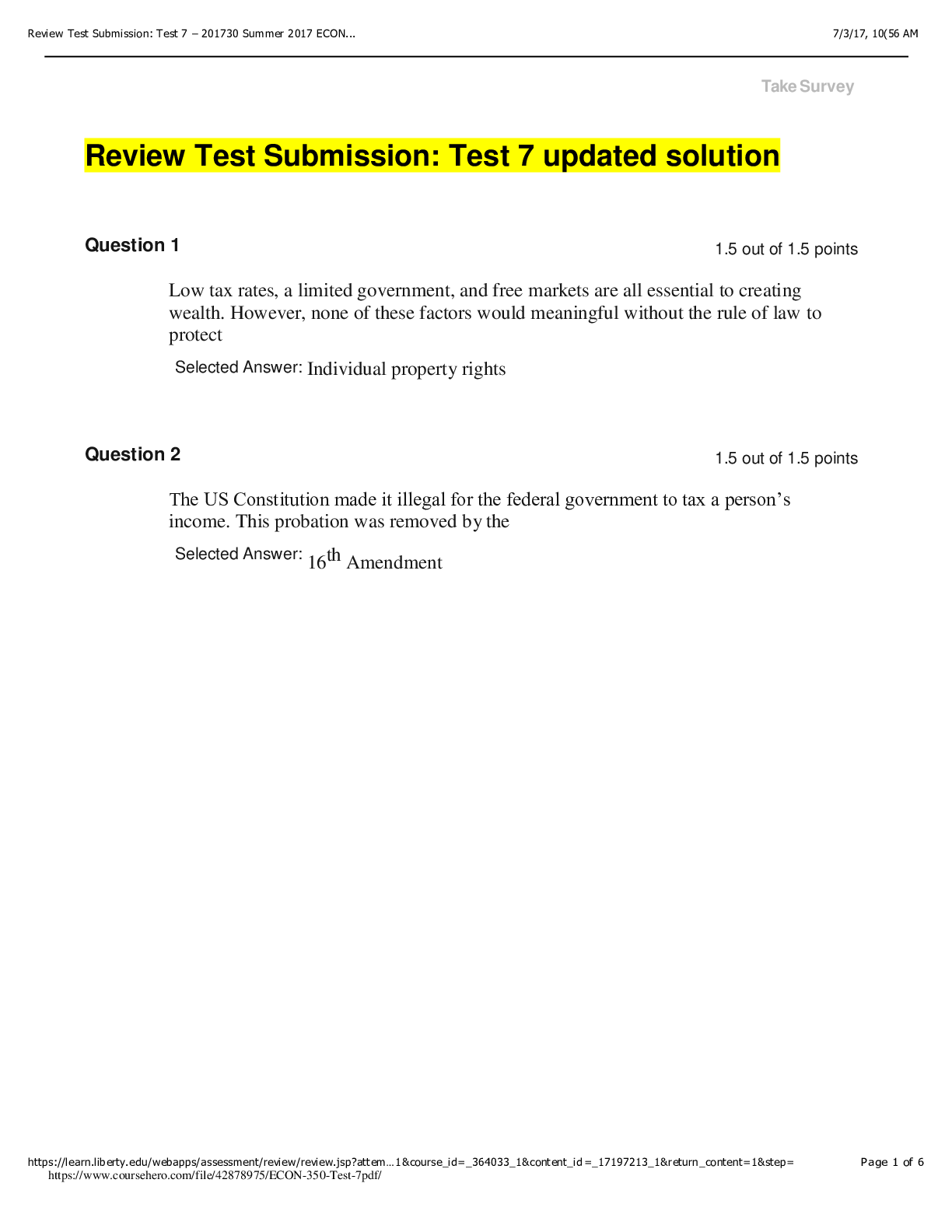
Low tax rates, a limited government, and free markets are all essential to creating wealth. However, none of these factors would meaningful without the rule of law to protect
Question 2
1.5 out of 1.5 points
The US Constitution made it illegal for the federal government to tax a person’s income. This probation was removed by the
Question 3
What are essential for the wealth of a nation
1.5 out of 1.5 points
Question 4 1.5 out of 1.5 points
The Soviet Union allocated massive amounts of resources toward future output, the bulk of these resources were wasted because
activity
Question 5
Ricardo and John Stuart Mill views economic downturns as
1.5 out of 1.5 points
Question 6
The destabilizing force in Marxian economics was
1.5 out of 1.5 points
Question 7 1.5 out of 1.5 points
“The great and chief end, therefore, of men’s uniting into commonwealth, and putting themselves under government, is the preservation of their property.” This statement was made by
Question 8 1.5 out of 1.5 points
In our text, “Marxian” refers to the ideas developed jointly by Karl Marx and
Question 9 1.5 out of 1.5 points
The Marxian “law of value” was about
Question 10 1.5 out of 1.5 points
“Our government pretends to pay us, so we pretend to work.” This describe the workers in
Question 11 1.5 out of 1.5 points
Classical economists believed that individuals who accumulated a sufficient amount of property over and above what they needed had a moral obligation to
Question 12 1.5 out of 1.5 points
Which nation first put into practice of Marxian?
Question 13 1.5 out of 1.5 points
A caterpillar grows into a bigger caterpillar; it develops into a butterfly. Not so the worker under capitalism," according to Marxian writings.
Question 14 1.5 out of 1.5 points
Without protection of individual property rights, individuals would tend to
Question 15 1.5 out of 1.5 points
During the “the hungry forties,” Marx, in an 1847 article, declared that in the course of (economic) development, the fall in wages in proportion to the development of general wealth is a fall
Question 16 1.5 out of 1.5 points
Marx and Engels expected capitalism to be transformed into socialism by
Question 17 1.5 out of 1.5 points
Marx and Engels took many concepts from the work of Hegel.
Question 18 1.5 out of 1.5 points
Marx referred to his presenting of the analysis in the three volumes of Capital in a “ ” way
Question 19 1.5 out of 1.5 points
According to Marx, “in periods of crises when credit collapses completely … nothing goes any more but ”
Question 20 1.5 out of 1.5 points
Engels thought price fluctuations reflect production among different sectors of the economy, in a way that can lead to
Question 21 1.5 out of 1.5 points
In Marx, economic crises occur in a
Question 22 1.5 out of 1.5 points
Marx argued that capitalism “attacks the individual at the very root of his life,” because of
Question 23 1.5 out of 1.5 points
In the first volume of Capital, Marx defined the value of a commodity as
Question 24 1.5 out of 1.5 points
According to Marx and Engels, knowing the world is static is key to understanding social and economic systems.
Question 25 1.5 out of 1.5 points
According to Marx, “During crises -- …. money cries out for a field of employment where it may be realized as capital.” Suggested that crises were
Question 26 1.5 out of 1.5 points
During the economic distress of 1840s, Marx and Engels expected actual real income would increase under capitalism
Selected Answer: False
Question 27
Sismondi and Malthus viewed economic downturns as
Selected Answer: Under-consumption
Question 28
1.5 out of 1.5 points
1.5 out of 1.5 points
Due to the recurrent economic crises, Marx believed that finally would revolt and ultimately threatened the existence of capitalism
Question 29
1.5 out of 1.5 points
According to classical economics, too much production of good A implied too little production of good B but not too much output in the aggregate. In other word, there is no “general glut” But, Marx argued that aggregate supply as conceived need not equal
Question 30
The US Constitution specifically protects a person’s property
1.5 out of 1.5 points
”
← OK
[Show More]




 answers.png)