Biology > STUDY GUIDE > BIO 235 midterm 1 (All)
BIO 235 midterm 1
Document Content and Description Below
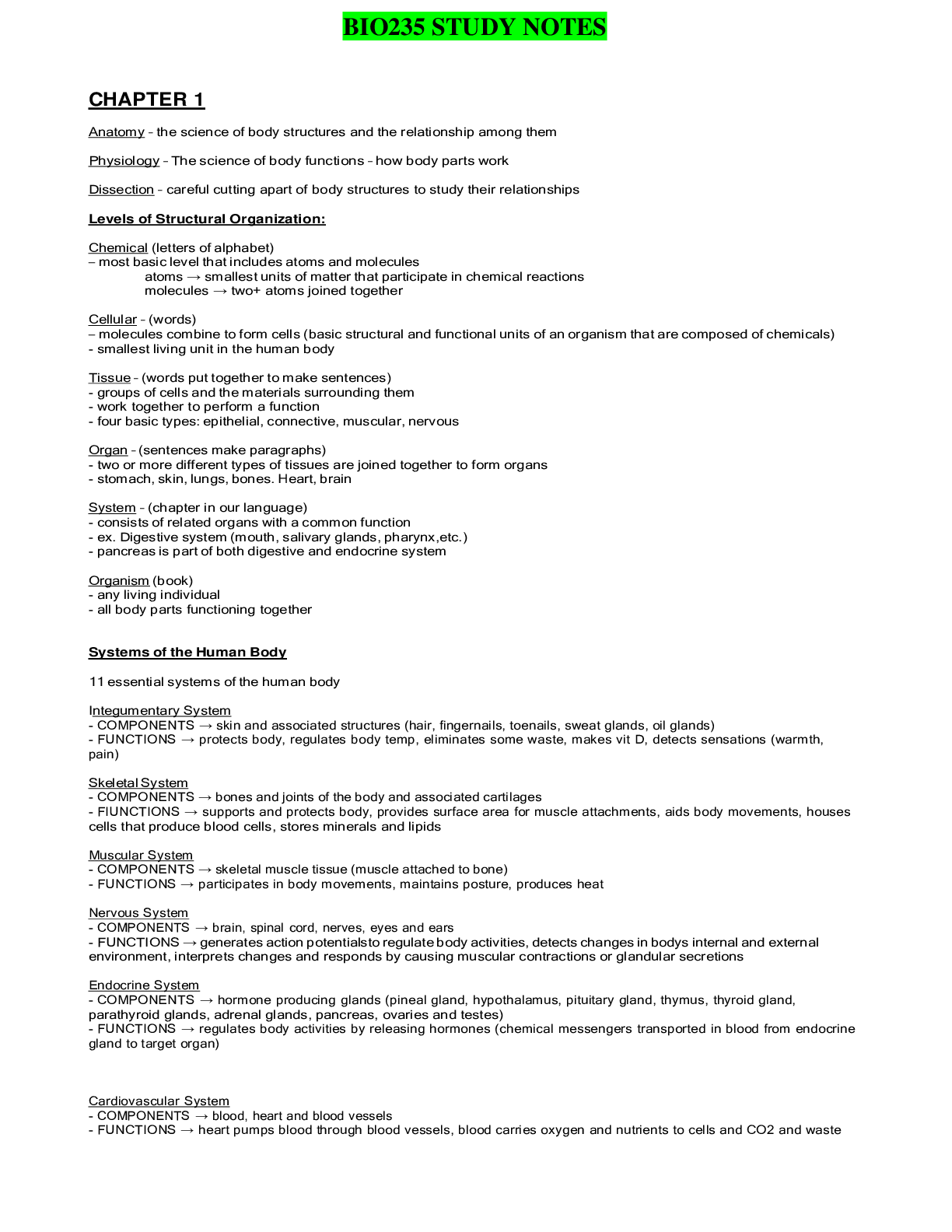
CHAPTER 1 Anatomy – the science of body structures and the relationship among them Physiology – The science of body functions – how body parts work Dissection – careful cutting apart of bod ... y structures to study their relationships Levels of Structural Organization: Chemical (letters of alphabet) – most basic level that includes atoms and molecules atoms → smallest units of matter that participate in chemical reactions molecules → two+ atoms joined together Cellular – (words) – molecules combine to form cells (basic structural and functional units of an organism that are composed of chemicals) - smallest living unit in the human body Tissue – (words put together to make sentences) - groups of cells and the materials surrounding them - work together to perform a function - four basic types: epithelial, connective, muscular, nervous Organ – (sentences make paragraphs) - two or more different types of tissues are joined together to form organs - stomach, skin, lungs, bones. Heart, brain System – (chapter in our language) - consists of related organs with a common function - ex. Digestive system (mouth, salivary glands, pharynx,etc.) - pancreas is part of both digestive and endocrine system Organism (book) - any living individual - all body parts functioning together Systems of the Human Body 11 essential systems of the human body Integumentary System - COMPONENTS → skin and associated structures (hair, fingernails, toenails, sweat glands, oil glands) - FUNCTIONS → protects body, regulates body temp, eliminates some waste, makes vit D, detects sensations (warmth, pain) Skeletal System - COMPONENTS → bones and joints of the body and associated cartilages - FIUNCTIONS → supports and protects body, provides surface area for muscle attachments, aids body movements, houses cells that produce blood cells, stores minerals and lipids Muscular System - COMPONENTS → skeletal muscle tissue (muscle attached to bone) - FUNCTIONS → participates in body movements, maintains posture, produces heat Nervous System - COMPONENTS → brain, spinal cord, nerves, eyes and ears - FUNCTIONS → generates action potentialsto regulate body activities, detects changes in bodys internal and external environment, interprets changes and responds by causing muscular contractions or glandular secretions Endocrine System - COMPONENTS → hormone producing glands (pineal gland, hypothalamus, pituitary gland, thymus, thyroid gland, parathyroid glands, adrenal glands, pancreas, ovaries and testes) - FUNCTIONS → regulates body activities by releasing hormones (chemical messengers transported in blood from endocrine gland to target organ) Cardiovascular System - COMPONENTS → blood, heart and blood vessels - FUNCTIONS → heart pumps blood through blood vessels, blood carries oxygen and nutrients to cells and CO2 and wasteaway from cells, regulates acid-base balance, temp and water content of body fluids, blood helps defend against disease and repairs damaged blood vessels Lymphatic System and immunity - COMPONENTS → lymphatic fluid and vessels (spleen, thymus, lymph nodes, tonsils, cells that carry out immune responses) - FUNCTIONS → returns proteins and fluid to blood, carries lipids from the gastrointestinal tract to blood, site for B and T cell maturation (protect against disease causing microbes) Respiratoy System - COMPONENTS → lungs, pharynx (throat), larynx (voice box), trachea (windpipe), bronchial tubes - FUNCTIONS → transfers oxygen from inhaled air to blood and CO2 vice versa, regulates acid-base balance of body fluids, produces sound through vocal cords Digestive System - COMPONENTS → organs of gastrointestinal tract (mouth, pharynx, esophagus, stomach, small/large intestine, anus) and accessory organs that assist in digestion (salivary glands, liver, gallbladder, pancreas) - FUNCTIONS → physical and chemical breakdown of food, absorbs nutrients, eliminates solid wastes Urinary system - COMPONENTS → kidneys, ureters, urinary bladder, urethra - FUNCTIONS → produces, stores, and eliminates urine, eliminates wastes and regulates volume and chemical composition of blood, maintains acid-base balance of body fluids, maintains body mineral balance, regulates production of red blood cells Reproductive Systems - COMPONENTS → gonads (testes/ovaries) and associated organs (female: uterine tubes, uterus, vagina, mammary glands, male: epididymides, ductus deferens, seminal vesicles, prostate, penis) - FUNCTIONS → gonads produce gametes (sperm/oocytes) that unite to form a new organism, gonads release hormones that regulate reproduction, associated organs transport and store gametes, mammary glands produce milk [Show More]
Last updated: 3 years ago
Preview 1 out of 40 pages
Buy this document to get the full access instantly
Instant Download Access after purchase
Buy NowInstant download
We Accept:

Reviews( 0 )
$7.00
Can't find what you want? Try our AI powered Search
Document information
Connected school, study & course
About the document
Uploaded On
Sep 12, 2021
Number of pages
40
Written in
All

Additional information
This document has been written for:
Uploaded
Sep 12, 2021
Downloads
0
Views
81