NCLEX-RN-Questions-Answers UPDATED
Document Content and Description Below
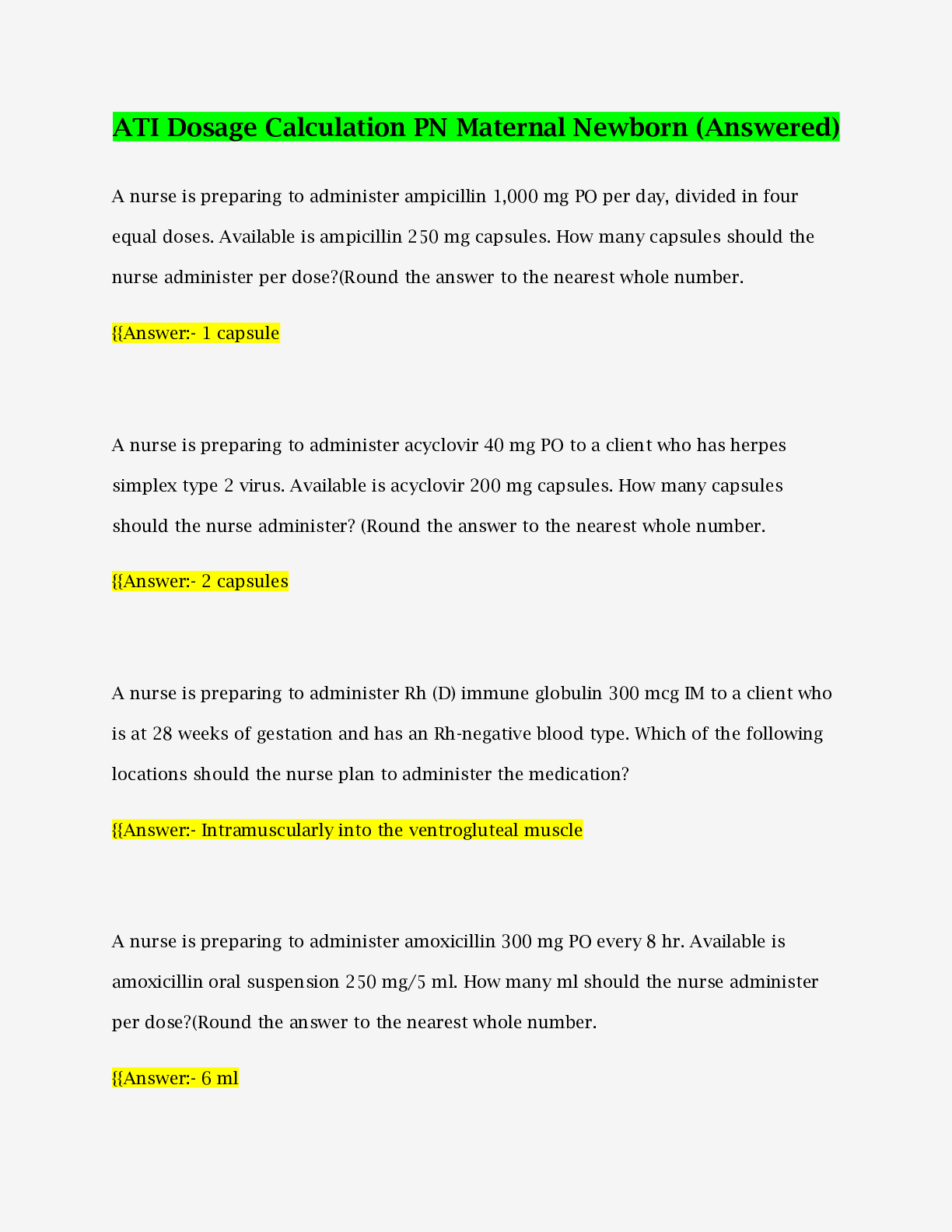
Question: 1 On the third postpartum day, the nurse would expect the lochia to be: A. Rubra B. Serosa C. Alba D. Scant Answer: A Explanation: (A) This discharge occurs from delivery through the ... 3rd day. There is dark red blood, placental debris, and clots. (B) This discharge occurs from days 4-10. The lochia is brownish, serous, and thin. (C) This discharge occurs from day 10 through the 6thweek. The lochia is yellowish white. (D) This is not a classification of lochia but relates to the amount of discharge. Question: 2 A pregnant client is having a nonstress test (NST). It is noted that the fetal heart beat rises 20 bpm, lasting 20 seconds, every time the fetus moves. The nurse explains that: A. The test is inconclusive and should be repeated B. Further testing is needed C. The test is normal and the fetus is reacting appropriately D. The fetus is distressed Answer: C Explanation: (A) The test results were normal, so there would be no need to repeat to determine results. (B) There are no data to indicate further tests are needed, because the result of the NST was normal. (C) An NST is reported as reactive if there are two to three increases in the fetal heart rate of 15 bpm, lasting at least 15 seconds during a 15-minute period. (D) The NST results were normal, so there was no fetal distress. Question: 3 Which stage of labor lasts from delivery of the baby to delivery of the placenta? A. Second B. Third C. Fourth D. Fifth Answer: B Explanation: (A) This stage is from complete dilatation of the cervix to delivery of the fetus. (B) This is the correct stage for the definition. (C) This stage lasts for about 2 hours after the delivery of the placenta. (D) There is no fifth stage of labor. Question: 4 A client develops complications following a hysterectomy. Blood cultures reveal Pseudomonas aeruginosa. The nurse expects that the physician would order an appropriate antibiotic to treat P. aeruginosa such as: A. Cefoperazone (Cefobid) B. Clindamycin (Cleocin) C. Dicloxacillin (Dycill) D. Erythromycin (Erythrocin)Answer: A Explanation: (A) Cefoperazone is indicated in the treatment of infection withPseudomonas aeruginosa.(B) Clindamycin is not indicated in the treatment of infection withP. aeruginosa.(C) Dicloxacillin is not indicated in the treatment of infection withP. aeruginosa.(D) Erythromycin is not indicated in the treatment of infection withP. aeruginosa. ............................... [Show More]
Last updated: 3 years ago
Preview 1 out of 541 pages

Buy this document to get the full access instantly
Instant Download Access after purchase
Buy NowInstant download
We Accept:

Reviews( 0 )
$18.00
Can't find what you want? Try our AI powered Search
Document information
Connected school, study & course
About the document
Uploaded On
Mar 11, 2022
Number of pages
541
Written in
All

Additional information
This document has been written for:
Uploaded
Mar 11, 2022
Downloads
0
Views
69