Walden NURS 6660 FINAL EXAM
Exam With True Answers 98%
Guarantee
Walden NURS 6660 FINAL EXAM
Exam With True Answers 98%
Guarantee
written by
solution100
The Marketplace to Buy and Sell your Study Material
On Stu
...
Walden NURS 6660 FINAL EXAM
Exam With True Answers 98%
Guarantee
Walden NURS 6660 FINAL EXAM
Exam With True Answers 98%
Guarantee
written by
solution100
The Marketplace to Buy and Sell your Study Material
On Stuvia you will find the most extensive lecture summaries written by your fellow students. Avoid
resits and get better grades with material written specifically for your studies.
www.stuvia.com
Downloaded by: ericlkey |
[email protected]
Distribution of this document is illegal1
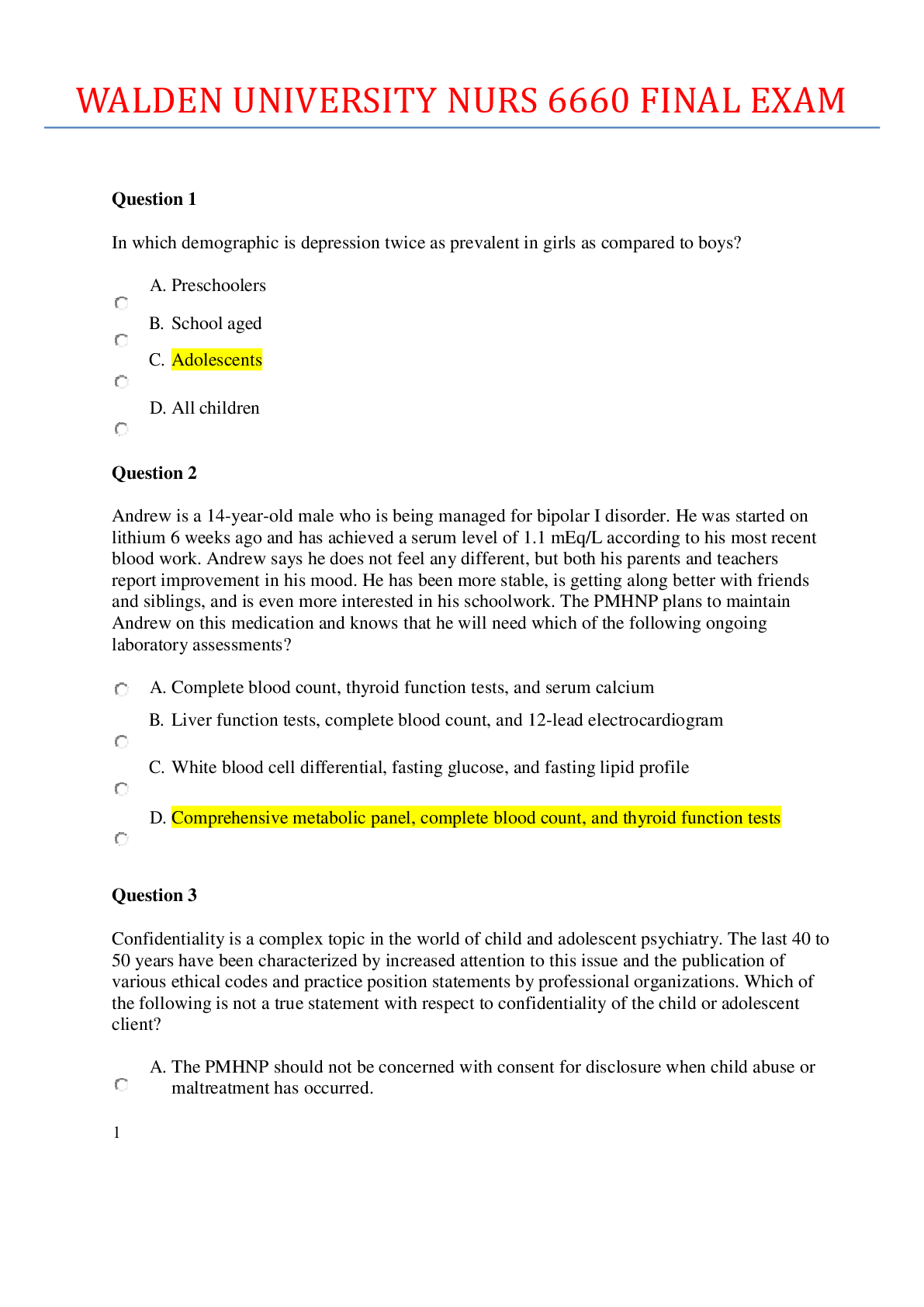
WALDEN UNIVERSITY NURS 6660 FINAL EXAM
Question 1
In which demographic is depression twice as prevalent in girls as compared to boys?
A. Preschoolers
B. School aged
C. Adolescents
D. All children
Question 2
Andrew is a 14-year-old male who is being managed for bipolar I disorder. He was started on
lithium 6 weeks ago and has achieved a serum level of 1.1 mEq/L according to his most recent
blood work. Andrew says he does not feel any different, but both his parents and teachers
report improvement in his mood. He has been more stable, is getting along better with friends
and siblings, and is even more interested in his schoolwork. The PMHNP plans to maintain
Andrew on this medication and knows that he will need which of the following ongoing
laboratory assessments?
A. Complete blood count, thyroid function tests, and serum calcium
B. Liver function tests, complete blood count, and 12-lead electrocardiogram
C. White blood cell differential, fasting glucose, and fasting lipid profile
D. Comprehensive metabolic panel, complete blood count, and thyroid function tests
Question 3
Confidentiality is a complex topic in the world of child and adolescent psychiatry. The last 40 to
50 years have been characterized by increased attention to this issue and the publication of
various ethical codes and practice position statements by professional organizations. Which of
the following is not a true statement with respect to confidentiality of the child or adolescent
client?
A. The PMHNP should not be concerned with consent for disclosure when child abuse or
maltreatment has occurred.
Stuvia.com - The Marketplace to Buy and Sell your Study Material
Downloaded by: ericlkey |
[email protected]
Distribution of this document is illegalStuvia.com - The Marketplace to Buy and Sell your Study Material
2
WALDEN UNIVERSITY NURS 6660 FINAL EXAM
B. In 1979, the American Psychiatric Association (APA) stated that children 12 years of age
or older can give consent for disclosure.
C. The American Academy of Child and Adolescent Psychiatry (AACAP) Code of Ethics
Downloaded by: ericlkey |
[email protected]
Distribution of this document is illegalStuvia.com - The Marketplace to Buy and Sell your Study Material
3
WALDEN UNIVERSITY NURS 6660 FINAL EXAM
states that consent is not required for disclosure.
D. Regardless of code or position statement by any organization, the best approach is when
the child and PMHNP agree on disclosure.
Question 4
Debi is a 15-year-old girl who is currently being treated for depression. Her parents have been
very proactive and involved in her care, and Debi has achieved remission 2 months after
beginning treatment with a combination of pharmacotherapy and cognitive behavioral therapy.
While counseling Debi’s parents about important issues in management, the PMHNP advises
that:
A. There is a > 50% likelihood that Debi’s younger sibling will develop depressive
symptoms
B. The mean length of major depressive episode in adolescents is 4 months
C. 20 to 40% of adolescents who have major depressive disorder will develop bipolar I
within 5 years
D. Adolescent-onset depression typically needs long-term pharmacologic management to
prevent relapse
Question 5
The therapeutic outcomes for children with disorders of written expression are most favorable
when they are characterized by:
Concomitant pharmacotherapy with a psychostimulant to promote attention and focus
Multimodal therapy to include group interaction with peer-to-peer feedback on writing
samples
A variety of tutors who will offer a variety of writing techniques, composition strategies,
and critiques
Intensive, continuous administration of individually tailored, one-on-one expressive and
creative writing therapy
Downloaded by: ericlkey |
[email protected]
Distribution of this document is illegalStuvia.com - The Marketplace to Buy and Sell your Study Material
4
WALDEN UNIVERSITY NURS 6660 FINAL EXAM
Question 6
When considering a diagnosis of developmental coordination disorder, the PMHNP knows that
the diagnosis may be associated with:
A. Above-average scores on performance subtests of standardized intelligence testing
B. Below-average scores on verbal subtests of standardized intelligence testing
C. Soft neurologic signs on physical examination such as slight reflex abnormalities
D. Physical findings consistent with neuromuscular disease such as muscular dystrophy
Question 7
Caylee is a 5-year-old girl who is referred for evaluation by child protective services. She was
recently removed from her biological family and placed in foster care, as her home
environment was reportedly unsafe due to conditions of extreme neglect. Her foster mother
reports that Caylee is very quiet and withdrawn and always appears sad and disinterested in her
surroundings; however, she becomes very irritable when anything unexpected or unplanned
occurs. The foster mother became very concerned when it appeared that Caylee was
hallucinating. The PMHNP considers that:
A. Caylee is at high risk for suicide and precautions should be taken
B. The hallucinations are consistent with brief psychotic disorder or schizophrenia
C. The history and reported symptoms are typical of depressive disorder in young children
D. This is a common situation when prepubertal children are removed from the biological
parents regardless of how dysfunctional they are
Downloaded by: ericlkey |
[email protected]
Distribution of this document is illegalStuvia.com - The Marketplace to Buy and Sell your Study Material
5
WALDEN UNIVERSITY NURS 6660 FINAL EXAM
Question 8
Children with gender dysphoria typically have higher rates of all the following except:
A. Depression
B. Impulse control disorders
C. Anxiety disorders
D. Eating disorder
Question 9
Eileen is a 23-month-old girl who is being evaluated for autism spectrum disorder because her
pediatrician is concerned about the presence of developmental red flags. She has just a few
words of speech and has not put together any meaningful two-word phrases. While taking a
history from Eileen’s mother the PMHNP learns that for approximately the last 2 months Eileen
has been seen eating paint chips that are peeling off the baseboard and window sills in the family
home; when she sees one she puts it in her mouth. This is a concern because they live in an old
farmhouse and there may be lead-based paint in some of the paint layers. The PMHNP considers
that which of the following is not consistent with a diagnosis of pica?
A. A diagnosis of autism spectrum disorder
B. Symptoms < 6 months duration
C. The pattern of eating
D. Lack of potential consequences
Question 10
The current scholarly consensus is that the etiology of bulimia nervosa is multifactorial to
include biological, sociocultural, family, cognitive-behavioral, and psychodynamic factors.
Downloaded by: ericlkey |
[email protected]
Distribution of this document is illegalStuvia.com - The Marketplace to Buy and Sell your Study Material
6
WALDEN UNIVERSITY NURS 6660 FINAL EXAM
When considering the etiology of bulimia nervosa, the PMHNP understands that:
Downloaded by: ericlkey |
[email protected]
Distribution of this document is illegalStuvia.com - The Marketplace to Buy and Sell your Study Material
7
WALDEN UNIVERSITY NURS 6660 FINAL EXAM
A. Family factors contributing to bulimia nervosa include emotional restraint, tight parental
control of behavior, and avoidance of conflict.
B. Lowered serotonin activity is seen in the brains of patients with bulimia nervosa.
C. There is a disproportionate incidence in childhood sexual abuse in patients with bulimia
nervosa.
D. Cultural influences are much less implicit in the development of bulimia nervosa as
compared to anorexia nervosa.
Question 11
Standardized instructional programs used in the management of reading disorders include all the
following except:
A. The Orton Gillingham and Direct Instructional System for Teaching and Remediation
B. Science Research Associates, Inc. Basic Reading Program
C. Bridge Reading Program
D. Woodcock-Johnson Psychoeducational Battery
Question 12
Which of the following symptom clusters is most likely in a 16-year-old male with major
depressive disorder?
A. Disturbance of mood, loss of interest, and mood-congruent hallucinations
B. Irritability, persistent abdominal complaints, and insomnia
C. Decreased concentration, social withdrawal, and substance abuse
D. Pervasive anhedonia, hopelessness, and severe psychomotor retardation
Downloaded by: ericlkey |
[email protected]
Distribution of this document is illegalStuvia.com - The Marketplace to Buy and Sell your Study Material
8
WALDEN UNIVERSITY NURS 6660 FINAL EXAM
Question 13
The PMHNP is working with rural primary care providers to increase awareness of mental health
disorders in infancy and early childhood. The program includes a session on screening for
feeding disorders in infants. If an infant is either observed by the provider or reported by the
parent to frequently suck the tongue rhythmically or appear to strain with his or her back arched
and then swallow, the examiner should consider the possibility of:
A. Gastroesophageal reflux disease
B. Failure to thrive
C. Iron deficiency
D. Inadequate emotional attachment
Question 14
An astute pediatrician has referred Kyle, a 5-month-old infant, for evaluation of rumination
disorder. His mother was concerned because he seemed to “want” to regurgitate every time he
ate and would even seem to “put his hand down his throat” in order to stimulate regurgitation.
Kyle had a thorough evaluation and according to the pediatrician did not have gastroesophageal
reflux or hiatal hernia. The mother-infant relationship appeared to be healthy and, via
assessment, the PMHNP could not identify any clear emotional issues. The primary treatment
strategy for Kyle will likely focus on:
A. Aversive therapies, e.g., squirting lemon juice into Kyle’s mouth when he ruminates
B. Medication therapies to include trials of first-line agents such as metoclopramine,
cimetidine, or haloperidol
C. Psychotherapy for the parents
D. Habit-reversal therapies
Downloaded by: ericlkey |
[email protected]
Distribution of this document is illegalStuvia.com - The Marketplace to Buy and Sell your Study Material
9
WALDEN UNIVERSITY NURS 6660 FINAL EXAM
Question 15
The literature indicates that boys whose fathers died before the age of 13 are at a greater
risk for the development of depression as compared to controls. This is consistent with
which general theory of depression etiology?
A. Molecular-genetic
B. Biologic
C. Psychosocial
D. Stress-diathesis
Question 16
Katelyn is a16-year-old girl who presents for therapy with her mother and father. Katelyn was
born with male genitalia but has felt like a female “all of her life.” She says she knew something
was different as far back as she can remember. She always wanted to wear her mother’s clothes
and makeup and play with other girls. Katelyn started dressing and openly identifying as a girl
when she was 13 years old, and her parents are trying to be supportive but they are struggling.
Most recently Katelyn has developed an intimate partner relationship with Jennifer, a 15-yearold girl who was gender-assigned female at birth and identifies as a female. Katelyn’s father does
not understand the relationship. The PMHNP explains that Katelyn:
A. Is responding to the male hormonal surges of puberty and will ultimately identify with
her physiologic gender
B. Does not have a clear sense of gender identity and may be a candidate for reparative
therapy to correct her gender identity issues
C. Is a transgender female who identifies as lesbian
D. Is a heterosexual male with transvestic disorder
Question 17
Downloaded by: ericlkey |
[email protected]
Distribution of this document is illegalStuvia.com - The Marketplace to Buy and Sell your Study Material
10
WALDEN UNIVERSITY NURS 6660 FINAL EXAM
All of the following are proposed etiologies of pica except:
A. Nutritional deficiencies
Downloaded by: ericlkey |
[email protected]
Distribution of this document is illegalStuvia.com - The Marketplace to Buy and Sell your Study Material
11
WALDEN UNIVERSITY NURS 6660 FINAL EXAM
B. Parental neglect
C. Compensation for oral needs
D. Autism spectrum disorder
Question 18
Christine is a 9-year-old female who presents for care after having been placed in the local foster
care system. She has been in and out of foster care for the last 4 years after her parents were
killed in an automobile accident. Christine has been placed in a variety of homes and residential
care facilities. The PMHNP recognizes that Christine is at high risk for:
A. Dissociative disorders
B. Post-traumatic stress disorder
C. Impulse-control disorder
D. Attachment disorder
Question 19
While the core features of schizophrenia are essentially the same in children as they are in adults,
the presentation or characterization is sometimes very different given developmental issues.
Unlike adults with schizophrenia, children with schizophrenia do not have:
A. Classic positive symptoms
B. Poverty of speech content
C. Social rejection
D. Delusions of persecution
Downloaded by: ericlkey |
[email protected]
Distribution of this document is illegalStuvia.com - The Marketplace to Buy and Sell your Study Material
12
WALDEN UNIVERSITY NURS 6660 FINAL EXAM
Question 20
The PMHNP is working with a couple who has been trying for years to conceive and is now
ready to pursue adoption as an option. They are considering all possibilities; private vs.
government-mediated adoption, adopting from another country, adopting a child of a different
race or ethnicity, adopting an older child rather than an infant, and adopting a child who is
currently in foster care vs. one who lives in an orphanage. While counseling this couple, the
PMHNP advises them that:
A. Younger children adopted from foster care settings have the best outcomes
B. Children adopted from abuse and neglect situations have better psychological adaptation
than those adopted as newborns
C. Transracial adoptions have demonstrated greater disruptions as compared to same-race
adoptions
D. Adoptions into families as an only child are more successful than those into families with
biological children
Question 21
Mel is a 15-year-old male with a complex psychiatric assessment. He has a long history of mood
instability, behavior problems, and trouble with schoolwork. He was an extremely active child
who, at one time, was put on medication for hyperactivity. After a comprehensive evaluation,
the PMHP recognizes that he meets diagnostic criteria for both bipolar I disorder and attention
deficit hyperactivity disorder (ADHD). The most successful approach to his management is
likely to begin with:
A. Pharmacotherapy for ADHD
B. Pharmacotherapy for bipolar I
C. Parental training and behavioral interventions for ADHD
D. Family-focused psychoeducational (FFT-A) for bipolar I
Downloaded by: ericlkey |
[email protected]
Distribution of this document is illegalStuvia.com - The Marketplace to Buy and Sell your Study Material
13
WALDEN UNIVERSITY NURS 6660 FINAL EXAM
Question 22
Bruce and Debbie have made an appointment for a psychiatric consultation for what amounts to
psychiatric genetic counseling. Bruce is 31 years old and Debbie is 28 years old. They have been
married for 3 years and want to have children. Debbie is worried because she has a diagnosis of
schizophrenia. Her symptoms first became evident when she was in her junior year of college;
fortunately, she knew about the disease due to family history and sought care quickly. She has
been very open with Bruce, and they are both well informed about the disease. Debbie is an only
child and her father had schizophrenia that was not well controlled. He committed suicide when
she was 15 years old. Debbie takes olanzapine and feels well overall. She has a part-time job,
functions well, but is concerned about the genetic nature of her disease. Counseling for Bruce
and Debbie includes which of the following pieces of information?
A. Schizophrenia is up to eight times more prevalent in first-degree relatives as compared to
the general population.
B. Schizophrenia has been isolated to chromosome number 5 and antenatal testing is
available to predict genetic predisposition of the fetus.
C. Debbie’s age of onset is more highly correlated with incidence in her offspring as
compared to early-onset schizophrenia.
D. Environment is at least as important as genetics with respect to expression of
schizophrenic symptoms.
Question 23
The PMHNP is working with a pediatrician colleague on a journal article to increase awareness
and improve diagnostic strategies for early-onset bipolar disorder. Based upon a review of the
longitudinal research on this disorder, the literature review of this article should include all the
following except:
A. Recovery rates are lower when bipolar disorder has an early-childhood onset
B. Early-onset bipolar disorder presents a greater likelihood of mixed states and rapid
cycling as compared to adolescent and adult onset
C. Higher socioeconomic status and lifetime psychosis are predictors of more rapid cycling
in early-onset bipolar disorder
D. There is a more frequent conversion from bipolar II to bipolar I in childhood as
compared to adults
Downloaded by: ericlkey |
[email protected]
Distribution of this document is illegalStuvia.com - The Marketplace to Buy and Sell your Study Material
14
WALDEN UNIVERSITY NURS 6660 FINAL EXAM
Question 24
Treatment of early-onset schizophrenia can be challenging due to the paucity of evidence-based
support for various pharmacotherapeutics and nonpharmacologic interventions. In a recent study
comparing olanzapine to clozapine, outcomes were assessed with the Clinical Global Impression
of Severity of Symptoms Scale and Schedule for the Assessment of Negative/Positive
Symptoms. Clozapine was found to demonstrate statistically significant superiority in which
outcome measure?
A. Alleviating negative symptoms
B. Occurrence of extrapyramidal effects
C. Sustained remission of symptoms
D. Remission of hallucinations and delusions
Question 25
Benjamin is a 4-year-old male who is being evaluated because his mom is afraid that he may be
schizophrenic. There is a history of schizophrenia in the mother’s family; her maternal aunt, one
sister, and one of her brother’s children were all diagnosed with schizophrenia. Today she reports
that Benjamin has episodes during which he appears to be hallucinating. Sometimes he seems to
see things that are not there, and other times he actually talks with and plays with imaginary
people. The PMHNP continues to gather information from the mother and Benjamin and plans to
do some observation of Benjamin during play. When considering a diagnosis of early-onset
schizophrenia, the PMHNP considers all of the following except:
A. There are virtually no reports of schizophrenia onset before age 5
B. Hallucinations are significantly more predictive of schizophrenia than delusions in young
children
C. Benjamin’s symptoms are more likely a consequence of developmental immaturity
D. Benjamin’s family history should always be considered, but at this point the diagnosis is
very unlikely
Downloaded by: ericlkey |
[email protected]
Distribution of this document is illegalStuvia.com - The Marketplace to Buy and Sell your Study Material
15
WALDEN UNIVERSITY NURS 6660 FINAL EXAM
Question 26
While counseling the parents of Joshua, a 9-year-old patient with developmental coordination
disorder, the PMHNP advised that the treatment will include:
A. Modified physical education
B. Cognitive behavioral interventions
C. Group sports participation
D. Computer-generated developmental exercises
Question 27
Maria is an 11-year-old girl who has been diagnosed with early-onset schizophrenia. In writing
up her case report for publication, the PMHNP makes it a point to highlight which of the
following historical features that are often seen in schizophrenia of middle childhood?
A. Onset of hallucinations and delusions before age 6
B. Symptoms easily confused with attention deficit hyperactivity disorder
C. Delayed motor milestones and language acquisition
D. High expressed emotion characterized by overly critical family response
Question 28
Ramon is a 12-year-old male who was started on fluoxetine, 40 mg daily, for major depressive
disorder 6 weeks ago. At his 2-week follow-up, he was feeling well with no adverse drug
effects, and his dose was elevated from 20 to 40 mg. Today he presents for a routine follow-up
visit. He reports that he has been “all wound up” and is frequently agitated. He cannot sleep well
and has trouble focusing at school. His friends say that he gets upset quickly, and they are
starting to avoid him. The most appropriate approach is to:
Downloaded by: ericlkey |
[email protected]
Distribution of this document is illegalStuvia.com - The Marketplace to Buy and Sell your Study Material
16
WALDEN UNIVERSITY NURS 6660 FINAL EXAM
A. Taper the fluoxetine off and see if these symptoms improve
Downloaded by: ericlkey |
[email protected]
Distribution of this document is illegalStuvia.com - The Marketplace to Buy and Sell your Study Material
17
WALDEN UNIVERSITY NURS 6660 FINAL EXAM
B. Add a mood stabilizer to the fluoxetine
C. Increase his dose of fluoxetine to 60 mg daily
D. Continue the current dose and reassess in 2 weeks
Question 29
Taryn is a 14-year-old female who is being evaluated as a condition to return to the private
school in which she has been enrolled since fifth grade. She has an ongoing inability to focus in
school, and her mood reportedly ranges from “one extreme to the other.” Per her mother, she is
either overly excited about something and almost exaggerated in her approach, or she is
disinterested and irritable and doesn’t want to leave her bedroom. She was evaluated several
different times in childhood for ADHD, and even took medication once, but it did not help. In
considering a diagnosis of cyclothymic disorder, the PMHNP considers that:
A. Symptoms need to be present for at least 1 year
B. Symptoms need to be present for at least 2 years
C. Symptoms are not characterized by conduct disorders
D. Symptoms are not characterized by suicidal ideation
Question 30
Which of the following statements best characterized the treatment course and progression of
bulimia nervosa?
A. Cognitive behavioral therapy is considered the benchmark, first-line treatment.
B. Antidepressant medications have not been demonstrated to be effective.
C. The majority of patients will require hospitalization as an initial intervention.
D. Psychodynamic therapy is extremely successful when patients are not lost to follow-up.
Downloaded by: ericlkey |
[email protected]
Distribution of this document is illegalStuvia.com - The Marketplace to Buy and Sell your Study Material
18
WALDEN UNIVERSITY NURS 6660 FINAL EXAM
Question 31
The etiology of childhood depression is multifactorial and may include biological factors. Which
of the following is a true statement with respect to hormonal studies in depressed children?
A. Prepubertal children having a depressive episode secrete significantly more growth
hormone during sleep than nondepressed children.
B. Polysomnography demonstrates significantly reduced rapid eye movement (REM) during
depressive episodes.
C. Thyroid stimulating hormone (TSH) levels are elevated > 50% above the upper limits of
normal in the majority of children with depression.
D. Magnetic resonance imaging (MRI) studies in depressed adolescents reveals low
ventricular volume and increased frontal lobe volume.
Question 32
There is a high incidence of overlap among children with bipolar disorder, attention deficit
hyperactivity disorder, conduct disorder, and anxiety disorders. Which of the following manic
symptoms of bipolar disorder are most closely correlated to conduct disorder?
A. Insomnia and irritability
B. Physical restlessness and poor judgment
C. Hallucinations and overeating
D. Hyper sexuality and inattention
Question 33
Linda is a 5-year-old girl who has persistent pica; she was finally referred for care when her
eating of potentially toxic nonfood substances alarmed her kindergarten teacher.
Linda’s mother admits during the history that Linda has been doing this for years, but thought it
was not a big deal since Linda did not eat anything dangerous. Linda’s mother must work two
Jobs and essentially did not bother to pursue Linda’s unusual symptom because it did not seem
unsafe. While discussing management strategies with Linda’s mother, the PMHNP counsels that
the most rapidly successful treatment strategy appears to be:
Downloaded by: ericlkey |
[email protected]
Distribution of this document is illegalStuvia.com - The Marketplace to Buy and Sell your Study Material
19
WALDEN UNIVERSITY NURS 6660 FINAL EXAM
A. Aversion therapy
B. Play therapy
C. Environmental control
D. Cognitive behavioral therapy
Question 34
The leading cause of death in youths living in juvenile residential facilities is:
A. Suicide
B. Accident
C. Homicide
D. Illness
Question 35
Debbie is a 10-year-old female who has been referred to remediation therapy for her reading
disorder. While designing her treatment program, the PMHNP knows that the most current
strategies are characterized by:
A. An Individual Education Program (IEP) provided by the public school system
B. Continuous practice with flash cards, workbooks, and computer games
C. Focusing the child’s attention to the connections between speech sounds and spelling
D. Direct practice in spelling and sentence writing and review of grammatical rules
Downloaded by: ericlkey |
[email protected]
Distribution of this document is illegalStuvia.com - The Marketplace to Buy and Sell your Study Material
20
WALDEN UNIVERSITY NURS 6660 FINAL EXAM
Question 36
Justin is a 12-year-old male who was recently diagnosed with schizophrenia. He was quickly
placed into a highly regarded assessment and treatment program and began pharmacotherapy and
cognitive behavioral therapy. His parents have had a difficult time with the diagnosis as Justin
has always been very healthy, a good school performer, and has never had any developmental
concerns or delays. However, they are very supportive and committed to his recovery. Justin has
been on an atypical antipsychotic for 1 month with no intolerable adverse effects. When
counseling Justin’s parents about the prognosis, the PMHNP advises the parents that which of
the following is more correlated with good outcomes in patients like Justin?
A. His age at the time of diagnosis
B. The absence of family history
C. Justin’s level of function before diagnosis
D. Tolerance of antipsychotic medication
Question 37
Mrs. Henderson is a 24-year-old mother of 4 children under the age off 5. She has developed a
trust relationship with the PMNHP after successful evaluation and management of ADHD in her
oldest child. She now brings in her 3-year-old for an evaluation because she keeps eating things
she finds within reach – paper, dirt, and one day, the mother found this child eating from the cat
litter box. The mother says the child is up to date on her vaccines but she has not mentioned this
problem to the pediatrician. The PMHNP knows that immediate assessment must include:
A. A comprehensive family assessment to include all children
B. Laboratory assessment of hemogram, iron, zinc, and lead levels
C. Wechsler Preschool and Primary Scale of Intelligence – Revised
D. Assessment of developmental milestones
Downloaded by: ericlkey |
[email protected]
Distribution of this document is illegalStuvia.com - The Marketplace to Buy and Sell your Study Material
21
WALDEN UNIVERSITY NURS 6660 FINAL EXAM
Question 38
Kelly is a 13-year-old female who is being evaluated at the recommendation of her seventhgrade teacher. This is her first year in junior high and her teacher is concerned over what appears
to be marked social isolation. She does not appear to have any close friends or social contacts.
She eats lunch with the girl who lives next door to her, but even that is initiated more by the
other child. Her teacher also reported that Kelly seems to have certain unusual preoccupations,
such a preoccupation with religions despite the fact that her family has never been religious.
During the examination, Kelly clearly demonstrates some odd behavior. When talking about her
family, she does not express any emotion. She does not laugh at anything and appears
withdrawn, yet she will answer questions asked of her. The PMHNP, after completing his
evaluation, considers a diagnosis of schizotypal disorder because review of Kelly’s assessment
reveals:
A. The absence of any overt psychotic symptoms in the history
B. A family history of schizotypal disorder
C. An inability to be swayed from distorted perceptions
D. Neglect of personal hygiene
Question 39
The PMHNP is preparing a presentation for a conference of pediatric primary care providers.
The topic of the presentation is early identification and referral of developmental coordination
disorder. When outlining high-risk populations, the PMHNP discusses that statistically there is a
higher incidence of occurrence in children with all of the following except:
A. Speech disorders
B. Learning disorders
C. Attention deficit hyperactivity disorder (ADHD)
D. Oppositional defiant disorder (ODD)
Downloaded by: ericlkey |
[email protected]
Distribution of this document is illegalStuvia.com - The Marketplace to Buy and Sell your Study Material
22
WALDEN UNIVERSITY NURS 6660 FINAL EXAM
Question 40
Margaret is a 14-year-old girl being seen in follow-up for major depressive disorder. She
has been on a therapeutic dose of a selective serotonin reuptake inhibitor (SSRI) for 3
months and has still failed to achieve remission. Consistent with the Texas Children’s
Medication Algorithm Project (TMAP), the next action should be to:
A. Change to an SNRI
B. Change to an atypical antidepressant
C. Change to bupropion
D. Change to another SSRI
Question 41
The PMHNP is developing a brief informational pamphlet on gender dysphoria to distribute at a
local mental health awareness event for the public. The “basic facts” section of the pamphlet
correctly states that:
A. The majority of children who demonstrate nonconforming gender behavior in childhood
grow up to be transgender adults
B. The ratio of gender dysphoria in adolescent boys and girls is equal
C. A genetic basis for gender dysphoria has been identified
D. Diagnostic criteria for gender dysphoria is the same across the lifespan
Question 42
The American Adoption Congress represents the shared interests of the adoption triad, a phrase
used to represent:
A. Adoptive parents, siblings, and adoptees
Downloaded by: ericlkey |
[email protected]
Distribution of this document is illegalStuvia.com - The Marketplace to Buy and Sell your Study Material
23
WALDEN UNIVERSITY NURS 6660 FINAL EXAM
B. Birth parents, adoptive parents, and adoptees
C. Adoptive parents, birth parents, and state government
D. Birth parents, adoptees, and federal government
Downloaded by: ericlkey |
[email protected]
Distribution of this document is illegalStuvia.com - The Marketplace to Buy and Sell your Study Material
24
WALDEN UNIVERSITY NURS 6660 FINAL EXAM
Question 43
Susan is a 12-year-old girl who is referred for psychiatric evaluation because she is having social
problems at school. She is always picked last for teams in physical education, and she is
becoming exceedingly depressed about the lack of social interaction at school. A detailed history
reveals that Susan has always had delayed developmental milestones, including delayed sitting
without support and transferring objects hand to hand. She did not walk until she was 20 months
old, and for years afterward had persistent issues with falling. Now, at age 12, she is having
trouble with her handwriting. The PMHNP considers which of the following diagnoses as most
likely?
A. Disorder of written expression
B. Autism spectrum disorder
C. Developmental coordination disorder
D. Learning disorder not otherwise specified
Question 44
Bipolar I disorder is being diagnosed with increasing frequency in prepubertal children. Which
of the following is a true statement with respect to this trend?
A. Better awareness and screening practices promote earlier diagnosis and management.
B. The diagnosis is controversial because few children this age exhibit discrete mood
cycles.
C. The majority of children diagnosed with bipolar I have a history of attention deficit
hyperactivity disorder.
D. Prepubertal children with bipolar I are extremely sensitive to mood stabilizers.
Question 45
Early-onset schizophrenia is quite rare as compared to adolescent and adult onset. Certain
Downloaded by: ericlkey |
[email protected]
Distribution of this document is illegalStuvia.com - The Marketplace to Buy and Sell your Study Material
25
WALDEN UNIVERSITY NURS 6660 FINAL EXAM
features are unique to early-onset schizophrenia and include all the following except:
Downloaded by: ericlkey |
[email protected]
Distribution of this document is illegalStuvia.com - The Marketplace to Buy and Sell your Study Material
26
WALDEN UNIVERSITY NURS 6660 FINAL EXAM
A. Extremely high rates of comorbid psychiatric disorders
B. Marked deficits in intelligence quotient (IQ)
C. Significant delay in perceptuomotor skills
D. Better long-term outcomes with early intervention
Question 46
Conventional antipsychotics are not first-line interventions in early-onset schizophrenia due to
the risk of dystonic reactions. However, when children are not responsive to first-line therapy
with atypical antipsychotics, which of the following is the most appropriate conventional choice?
A. Haloperidol
B. Trifluoperazine
C. Risperidone
D. Chlorpromazine
Question 47
Cameron is a 7-year-old boy who has been diagnosed with ADHD and started on
psychostimulants. Two months later there has been no meaningful improvement of symptoms,
and he is referred from primary care to a PMHNP. While reviewing his records, the PMHNP
notes that Cameron has been living with his aunt and uncle and their four children since the
death of his mother 6 months ago. Cameron, who reportedly was always a happy and welladjusted only child, developed symptoms shortly after these major life changes. His symptoms
were characterized primarily by temper tantrums and an inability to sit still. He is not functioning
well in school and is having repeated stomachaches and headaches. The PMHNP considers that
the most appropriate action would be to stop the psychostimulant and assess Cameron for:
A. Bipolar I disorder
B. Agitated depression
C. Dysthymic disorder
Downloaded by: ericlkey |
[email protected]
Distribution of this document is illegalStuvia.com - The Marketplace to Buy and Sell your Study Material
27
WALDEN UNIVERSITY NURS 6660 FINAL EXAM
D. Cyclothymic disorder
Downloaded by: ericlkey |
[email protected]
Distribution of this document is illegalStuvia.com - The Marketplace to Buy and Sell your Study Material
28
WALDEN UNIVERSITY NURS 6660 FINAL EXAM
Question 48
When counseling the parents of an intersex neonate, the PMHNP recognizes that the current
standard of care is to counsel toward:
A. Male-to-female surgical procedures
B. Flexible sex rearing
C. An early and consistent decision of the child’s gender
D. Hormone augmentation of chromosomal gender
Question 49
In the juvenile justice system, the difference between delinquent acts and status offenses is:
A. Delinquent acts require detention; status offenses may be remediated in other ways
B. Delinquent acts are ordinary crimes committed by juveniles; status offenses would not be
crimes if committed by an adult
C. Delinquent acts are the first offense; status offenses are repeat commissions of the same
act
D. Delinquent acts require jury trial; status offenses are adjudicated by a judge
Question 50
There are several physiologic abnormalities that may result in ambiguous genitalia and/or an
unclear sense of gender identity leading to gender dysphoria. When an adolescent female is
found to have cryptorchid testes, this indicates a condition known as:
A. Congenital adrenal hyperplasia
B. Androgen insensitivity syndrome
C. Turner’s syndrome
D. Klinefelter’s syndrome
Downloaded by: ericlkey |
[email protected]
Distribution of this document is illegalStuvia.com - The Marketplace to Buy and Sell your Study Material
29
WALDEN UNIVERSITY NURS 6660 FINAL EXAM
Question 51
Which of the following is a true statement with respect to developmental coordination disorder?
A. The majority of children with this disorder do not have a history of significant
developmental milestone delay.
B. The clumsiness of developmental disorder generally persists into adolescence and
adulthood.
C. Most successful treatment strategies involve integrative physical education to include the
peer group in team sports.
D. Neurologic examination is very similar to patients with neuromuscular disease.
Question 52
Donna is a 16-year-old transgender female who has been through extensive individual and
family counseling and is ready to start hormone therapy with estrogen, progesterone, and
testosterone-blocking agents. When counseling her specifically about the risks, benefits, and
required monitoring of hormonal therapy, the PMHNP advises Donna that:
A. Her voice will become more consistent with the female gender
B. She will need routine lipid and diabetes screening
C. Sterility is a probable consequence of hormone therapy
D. Worsening of acne is common in the first year of treatment
Question 53
The difference between hormonal management of transgender adolescents from adults is that
which of the following has no role in adult management?
A. Estrogen
B. Gonadotropin-releasing hormone
C. Testosterone
D. Testosterone blockers
Downloaded by: ericlkey |
[email protected]
Distribution of this document is illegalStuvia.com - The Marketplace to Buy and Sell your Study Material
30
WALDEN UNIVERSITY NURS 6660 FINAL EXAM
Question 54
Jessica is a 26-month-old female who is being evaluated because she will not eat. Her parents
report that she just flat out will not eat her meals. Her mother says that she has followed all the
pediatrician’s suggestions: she has eliminated any snacks or drinks between meals, and she has
offered a variety of foods, including those that Jessica seemed to enjoy previously. Jessica is not
sick; has no problems with vomiting or elimination abnormalities. Jessica’s parent say that her
pediatrician is not concerned, but they are not comfortable with what appears to be an almost
complete absence of food intake. While considering a diagnosis of avoidant food intake disorder
the PMHNP knows that any of the following would fulfill the diagnostic criteria except:
A. An irritable, apathetic, or anxious affect
B. Failure to gain weight consistent with her trajectory since birth
C. A loss of 15% body weight
D. Use of daily nutritional supplements
Question 55
Rose is a 13-year-old girl who is being evaluated as part of a family assessment; the primary
patient is Rose’s 8-year-old brother who is demonstrating behavior of concern and is having a
Court-ordered evaluation. During the family assessment, it becomes apparent that Rose’s mother
is very concerned that Rose is a tomboy. The mother, who is very elegant, is distressed by
Rose’s persistent “tomboy” behavior and worries that Rose might become a lesbian, which
would be “unacceptable” to the family. More detailed evaluation of Rose reveals that she is
experiencing some sexual reflection. She excels at sports and has always preferred rough and
tumble play, but she doesn’t see anything wrong with that. She thinks she is sexually attracted to
one of her female teachers, and sometimes fantasizes about her. Rose just began menstruating 3
months ago, and while she has had a boyfriend at school, she is not sexually active in any way;
they have kissed a few times, and she likes it, but she has no plans to take it any further.
Otherwise, Rose seems well adjusted, worries about her brother, and dismisses her mother’s
concerns as “silly.” Which of the following statements best characterizes Rose?
A. Rose should be evaluated for gender dysphoria as she meets the criteria of “strong
preference for activities stereotypically engaged in by the other gender.”
B. Rose is probably a lesbian and family therapy should include working with the mother to
accept Rose’s sexual orientation.
C. Rose may be a candidate for conversion therapy as her preferences are ambiguous at this
point in her development.
D. Rose does not appear to have concerns about her gender identity of sexuality and no
Downloaded by: ericlkey |
[email protected]
Distribution of this document is illegalStuvia.com - The Marketplace to Buy and Sell your Study Material
31
WALDEN UNIVERSITY NURS 6660 FINAL EXAM
further evaluation is indicated.
Downloaded by: ericlkey |
[email protected]
Distribution of this document is illegalStuvia.com - The Marketplace to Buy and Sell your Study Material
32
WALDEN UNIVERSITY NURS 6660 FINAL EXAM
Question 56
Learning disorders affect at least 5% of all school-aged children in the United States. Since 1975,
Public Law 94-142 mandates that all states provide free, appropriate services to all children.
Among the various types of learning disorders, the PMHNP knows that the overwhelming
majority are:
A. Reading disorders
B. Mathematics disorders
C. Disorders of written expression
D. Learning disorders not otherwise specified (NOS)
Question 57
The PMHNP has been trained in custody evaluations and is preparing to perform his first
evaluation as a guardian ad litem. The case involves a 6-year-old boy and his 4-year-old sister.
The parents are very angry and not able to talk or come to any agreements at all. Both parents
want full custody and support from the other parent, both of whom are working professionals.
After interviewing each party alone and then conducting a family interview, the PMHNP reviews
all records made available, including the legal filings and petitions. There are no allegations of
abuse or neglect or unsuitability from either parent; they just each want full custody. In addition
to considering the best interests of the children, the PMHNP knows that the elements considered
by the court will include all the following except the:
A. Children’s current adjustment to home, school, and community
B. Wishes of the children and parents
C. Physical health of parents and children
D. Parent’s degree of financial resources
Question 58
Marion is a 17-year-old female who has been referred by her high school guidance counselor for
evaluation. The counselor is concerned that Marion has an eating disorder because she has seen
her in the bathroom on several occasions vomiting, but there is no other indicator of illness like
Downloaded by: ericlkey |
[email protected]
Distribution of this document is illegalStuvia.com - The Marketplace to Buy and Sell your Study Material
33
WALDEN UNIVERSITY NURS 6660 FINAL EXAM
fever or missing school days. When considering the diagnosis of anorexia nervosa, the PMHNP
knows that all of the following must be present except:
Downloaded by: ericlkey |
[email protected]
Distribution of this document is illegalStuvia.com - The Marketplace to Buy and Sell your Study Material
34
WALDEN UNIVERSITY NURS 6660 FINAL EXAM
A. A voluntary, unhealthy degree of weight loss and maintenance
B. An intense fear of becoming fat
C. Some form of disorder of menstruation
D. Symptoms present for at least 3 months
Question 59
Ryan is a 6-year-old male who is being evaluated because his pediatrician is concerned that he
demonstrates a marked inability to perform the daily motor skills consistent with what is
expected at his age. At the age of 3 he was assessed due to delay in developmental milestones
and was found to have an IQ of 68, consistent with mild mental retardation. When interpreting
his motor coordination today, the PMHNP considers that:
A. Deficits in coordination are consistent with mental retardation; mental retardation
precludes a diagnosis of developmental coordination disorder
B. This diagnosis is unlikely for Ryan as developmental coordination disorder is almost
exclusively a diagnosis of females
C. Gross motor problems are often associate with comorbid language disturbance
D. Secondary peer relationship problems are common in children with developmental
coordination disorder
Question 60
Kelly is a 14-year-old female who has finally been referred for management of anorexia nervosa.
She was diagnosed almost 1 year ago with the food-restricting subtype, but attempts to get her
into psychiatric care were unsuccessful. She continues to be resistant but her caloric intake is
now < 400 daily and she finally appears to be unable to sustain the supraphysiologic levels of
exercise that she has maintained to try and “keep her weight down.” She is 5’2” tall and weighs
82 lbs., which is approximately 75% of ideal body weight for her height. Her vital signs are
stable and surprisingly there are no profound laboratory or ECG abnormalities. When counseling
Kelly and her parents about the recommended course of treatment, the PMHNP advises that
Kelly will require:
A. Intensive dynamic psychotherapy to alter eating behavior
Downloaded by: ericlkey |
[email protected]
Distribution of this document is illegalStuvia.com - The Marketplace to Buy and Sell your Study Material
35
WALDEN UNIVERSITY NURS 6660 FINAL EXAM
B. Hospitalization for controlled weight gain
Downloaded by: ericlkey |
[email protected]
Distribution of this document is illegalStuvia.com - The Marketplace to Buy and Sell your Study Material
36
WALDEN UNIVERSITY NURS 6660 FINAL EXAM
C. Pharmacotherapy with selective serotonin reuptake inhibitors
D. Family therapy to include all members living in the home
Question 61
Rumination is a feeding disorder most commonly seen in infants, but it can occur at any point in
the lifespan. Characteristic findings in infants include:
A. Resultant soothing
B. Comorbid hiatal hernia
C. Failure to thrive
D. Onset at 4–6 weeks of age
Question 62
Ms. Stevenson is a 21-year-old woman who brings her 3-week-old infant to the PMHNP for an
“emergency” evaluation. Ms. Stevenson has a 2-year-old who was diagnosed with rumination
disorder when he was 10 months old and had to be hospitalized for tube feedings while the
family started treatment. Ms. Stevenson is worried now because her new baby vomits every time
he eats; she is afraid he has the same thing. The PMHNP counsels Ms. Stevenson that:
A. Rumination does not run in families and it is unlikely that the new baby has this rare
disorder.
B. The baby needs to be evaluated for pyloric stenosis and should be referred to his
pediatrician.
C. The family will likely benefit from the same psychotherapeutic interventions that were
used with the older child.
D. They will begin with a nutritional assessment to see if the new baby needs a feeding
tube.
Question 63
Which of the following is a true statement with respect to avoidant/restrictive food intake
Downloaded by: ericlkey |
[email protected]
Distribution of this document is illegalStuvia.com - The Marketplace to Buy and Sell your Study Material
37
WALDEN UNIVERSITY NURS 6660 FINAL EXAM
disorder?
Downloaded by: ericlkey |
[email protected]
Distribution of this document is illegalStuvia.com - The Marketplace to Buy and Sell your Study Material
38
WALDEN UNIVERSITY NURS 6660 FINAL EXAM
A. Onset at less than 1 year of age is correlated with growth delay.
B. Approximately 70% of infants who persistently refuse food continue to have some eating
problems during childhood.
C. In older children and adolescents, this disorder typically resolves spontaneously.
D. The diagnosis may be appropriate even without evidence of nutritional deficiency.
Question 64
Roshan is a fourth grader who is being evaluated for poor scholastic performance in
mathematics. He has always been a happy, healthy child, has socialized with friends at school,
and presents no behavioral concerns at home. However, his math performance has always been
below the average for his grade, and now he is performing so far below his peers that he is really
beginning to be upset about it. While being evaluated for a learning disorder, the PMHNP
appreciates that Roshan has had a marked deficit in his ability to recognize and understand
symbols and order clusters of numbers. This suggests a deficit in:
A. Linguistic skills
B. Perceptual skills
C. Mathematic skills
D. Attention skills
Question 65
Regarding pediatric suicide, which of the following is a true statement?
A. Worldwide, suicide very rarely occurs in children who have not reached puberty.
B. In the last 15 years, both suicidal ideation and completed suicide rates have increased
among adolescents.
C. Cognitive immaturity is significantly correlated with risk of completed suicide in
children of all ages.
D. Approximately 75% of suicidal children communicate intent or ideation to a friend or
relative within 24 hours of the attempt.
Downloaded by: ericlkey |
[email protected]
Distribution of this document is illegalStuvia.com - The Marketplace to Buy and Sell your Study Material
39
WALDEN UNIVERSITY NURS 6660 FINAL EXAM
Question 66
The PMHNP is having a family meeting with 8-year-old Hunter and his father and stepmother to
discuss the results of his mathematics assessment. Analysis of his performance on the KeyMath
Diagnostic Arithmetic Test reveals a performance markedly below what is expected for his age.
Hunter’s mother feels certain that his poor performance is a result of poor education; apparently
Hunter’s mother was homeschooling him, but subsequently she was found to be so neglectful of
all of his needs that his father and stepmother were given full custody. When discussing the
course and prognosis for Hunter’s mathematics disorder, the PMHNP advises that:
A. Compared to other learning disorders, mathematics disorder does not appear to depend
on the amount or quality of instruction
B. Mathematics disorders are not stable over time, and early intervention may lead to
improvement of skills
C. The remediation program will emphasize computational skills
D. Pharmacotherapy with remediation produces the best outcomes
Question 67
While not currently indicated for the treatment of early-onset bipolar disorder, which of the
following medications has demonstrated utility in clinical trials without any associated weight
change, rash, or other adverse events?
A. Lamotrigine
B. Olanzapine
C. Valproic acid
D. Lithium
C
Question 68
Rose is a 12-year-old female who is being evaluated for declining school performance and an
Downloaded by: ericlkey |
[email protected]
Distribution of this document is illegalStuvia.com - The Marketplace to Buy and Sell your Study Material
40
WALDEN UNIVERSITY NURS 6660 FINAL EXAM
increasing tendency to try to avoid going to school. Historically she has been an average student,
although she has particularly struggled with writing exercises and has actually failed assignments
this year. She consistently ignores rules of grammar, and her teacher says that her writing
Downloaded by: ericlkey |
[email protected]
Distribution of this document is illegalStuvia.com - The Marketplace to Buy and Sell your Study Material
41
WALDEN UNIVERSITY NURS 6660 FINAL EXAM
submissions look as if they were written by a much younger child. The PMHNP knows that the
initial evaluation of Rose must include all the following except:
A. The Wechsler Intelligence Scale for Children III
B. Assessment for pervasive developmental disorder
C. The Test of Early Written Language
D. Screening for ADHD
Question 69
All the following are true with respect to making a diagnosis of major depressive disorder in
children except:
A. There must be a change from previous level of functioning.
B. There must be social or academic impairment.
C. There must be somatic or psychomotor complaints.
D. There must be depressed or irritable mood.
Question 70
Tiana is a 10-year-old girl who is being referred for evaluation because her school performance
is appreciably below what is expected at her age. Historically she has been a very happy child,
likes school, and looks forward to going. However, over the last several months her teacher
reports that she is much slower than her peers in reading, and she appears to be upset and
withdrawn when asked to read in class. The PMHNP would expect additional report from the
teacher to include all the following except:
A. Inability to copy correctly from a printed text
B. Poorly established left-to-right tracking
C. Omissions and distortions of words when reading aloud
Downloaded by: ericlkey |
[email protected]
Distribution of this document is illegalStuvia.com - The Marketplace to Buy and Sell your Study Material
42
WALDEN UNIVERSITY NURS 6660 FINAL EXAM
D. Compensation with use of memory and inference
Downloaded by: ericlkey |
[email protected]
Distribution of this document is illegalStuvia.com - The Marketplace to Buy and Sell your Study Material
43
WALDEN UNIVERSITY NURS 6660 FINAL EXAM
Question 71
The PMHNP has completed the initial assessment of Bruce, a 14-year-old boy who was initially
presented to care by his parents because of progressive social withdrawal. Upon completion of
the patient interview, mental status exam, and family assessment, review of all information
reveals that for the past 15 months Bruce has been progressively “moody.” His parents say that
he has become so irritable that his little brother and sister are afraid to talk to him anymore.
Additionally, he has become socially withdrawn, now not even wanting to go to school. Bruce
says he is tired all the time and just doesn’t feel like doing anything. He often does not complete
homework assignments. When considering a diagnosis of dysthymic disorder, the PMHNP
knows that which other history finding must be present?
A. Depressed mood most of the time for at least 2 weeks
B. Symptoms not resolved for more than 2 months at a time
C. Intermittent episodes of anger disproportionate to the stimulus
D. Concomitant substance abuse
Question 72
The PMHNP is working with the parents of a 13-month-old male who is diagnosed with
avoidant/restrictive food intake disorder. The toddler will eat, but he seems to tire both
physically and emotionally very quickly and is easily distracted; once distracted, he will not
return to the meal. His weight trajectory has dropped and he has gone from a weight of 60
percentile for age/height to 10 percentile for age/height. As part of the transactional plan of care,
the parents will be encouraged to:
A. Allow the child to determine the eating schedule, and feed him whenever he appears
hungry
B. Offer high calorie liquid supplements between scheduled meals
C. Present playful stimuli during and immediately after meals
D. Give attention and praise to positive eating behaviors
Question 73
Jared is a 6-year-old boy who comes to the PMHNP for an evaluation with his father. The father
reports that he is worried about Jared because he has had problems fitting in at school ever since
he started kindergarten. He does not have any friends at school and does not seem to know how
Downloaded by: ericlkey |
[email protected]
Distribution of this document is illegalStuvia.com - The Marketplace to Buy and Sell your Study Material
44
WALDEN UNIVERSITY NURS 6660 FINAL EXAM
to play with others. Dad reports that Jared has never been “very talkative” and sometimes
switches from one topic to another without any reason. When considering early-onset
schizophrenia, the PMHNP recognizes that which of the following must be present?
Downloaded by: ericlkey |
[email protected]
Distribution of this document is illegalStuvia.com - The Marketplace to Buy and Sell your Study Material
45
WALDEN UNIVERSITY NURS 6660 FINAL EXAM
A. Visual or auditory hallucinations
B. Deteriorating function over the last several months
C. A history of normal developmental milestones
D. Negative symptom onset before age 5 years
Question 74
The PMHNP suspects that Wesley, an 8-year-old male, has a reading disorder. In kindergarten
his teacher documented some suspicion for a disorder, but throughout first grade and now into
second grade, he is clearly functioning below expected levels.. He becomes increasingly anxious
when asked to read in school. Which aspect of Wesley’s history would support the risk for this
diagnosis?
A. Visual perceptual deficits
B. Social anxiety disorder
C. Inadequate schooling
D. Attention deficit hyperactivity disorder
Question 75
The PMHNP is treating Pam, a 13-year-old female, for moderate-to-severe major depressive
disorder. In addition to cognitive behavioral therapy, the PMHNP discusses with the patient and
her father the plan to begin sertraline, 50 mg daily, then titrate the dose up when tolerance is
established. Pam’s father has researched this medication and is concerned because he read about
the risk of increased suicidal ideation. The most appropriate response is to tell Pam’s father that:
A. His research is correct and they can use another drug class if he is more comfortable with
that
B. The risk is actually decreased when sertraline is used with cognitive behavioral therapy
C. More recent research suggests that this is not accurate and that treatment actually
decreases risk of suicide
D. Sertraline is the only drug in its class indicated for adolescents and it does not carry this
risk
Powered by TCPDF (www.tcpdf.org)
Downloaded by: ericlkey |
[email protected]
Distribution of this document is illegal











 (Diane Pacitti etc.png)