1/29/2018 Week 5 - Final Exam: MGT330: Management for Organizations (BAC1750C)
https://ashford.instructure.com/courses/15268/quizzes/59640 1/12
Week 5 - Final Exam
Due Jan 29 at 11:59pm Points 25 Questions 25 Time Lim
...
1/29/2018 Week 5 - Final Exam: MGT330: Management for Organizations (BAC1750C)
https://ashford.instructure.com/courses/15268/quizzes/59640 1/12
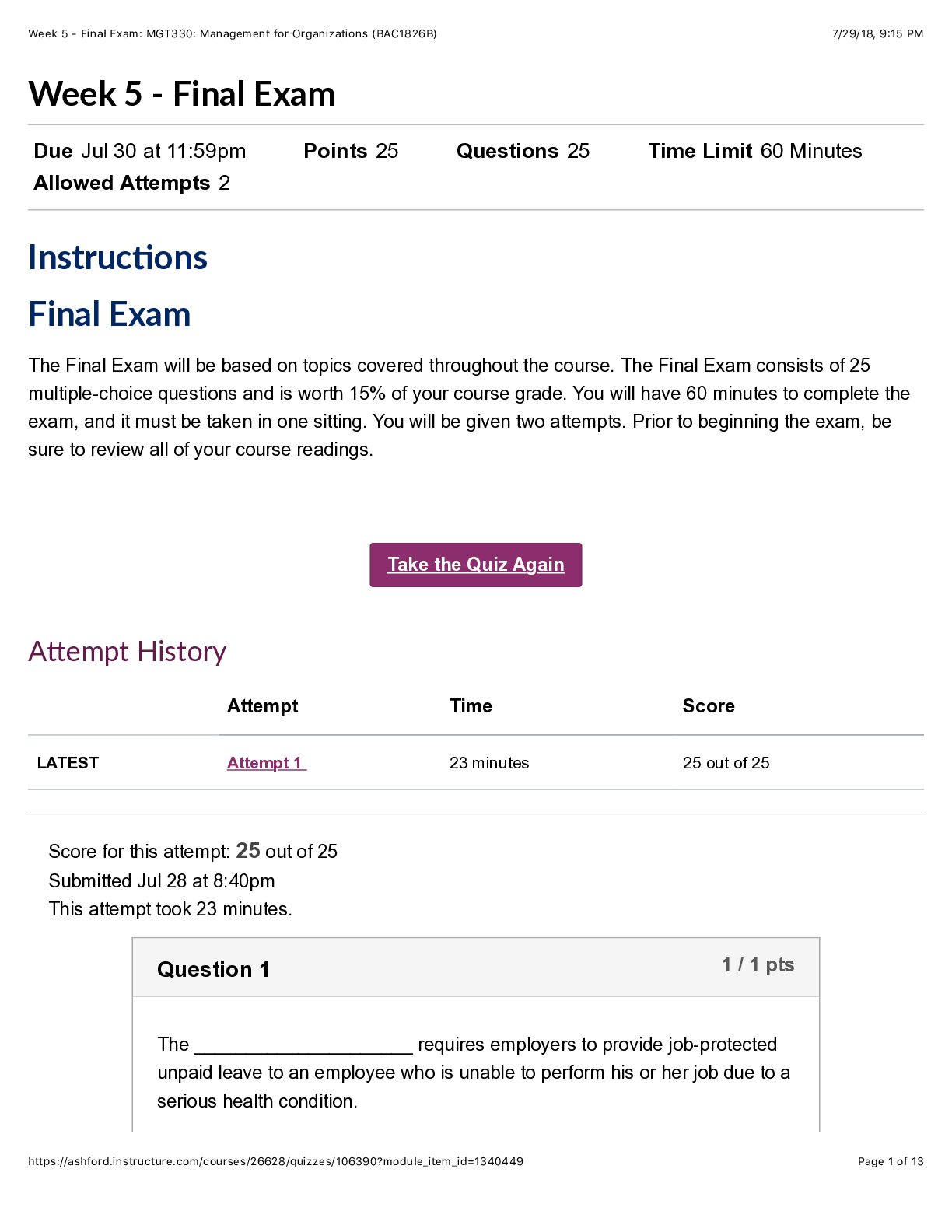
Week 5 - Final Exam
Due Jan 29 at 11:59pm Points 25 Questions 25 Time Limit 60 Minutes
Allowed Attempts 2
Instrucƭons
Azempt History
Attempt Time Score
LATEST Attempt 1 27 minutes 24 out of 25
Score for this attempt: 24 out of 25
Submitted Jan 29 at 7:51pm
This attempt took 27 minutes.
Final Exam
The Final Exam will be based on topics covered throughout the course. The Final Exam consists of 25
multiple-choice questions and is worth 15% of your course grade. You will have 60 minutes to complete the
exam, and it must be taken in one sitting. You will be given two attempts. Prior to beginning the exam, be
sure to review all of your course readings.
Take the Quiz Again
Question 1 1 / 1 pts
Internal sourcing and external sourcing are part of the process of
__________________.
Correct! Correct! recruiting
employee orientation1/29/2018 Week 5 - Final Exam: MGT330: Management for Organizations (BAC1750C)
https://ashford.instructure.com/courses/15268/quizzes/59640 2/12
employee selection
job design
Question 2 1 / 1 pts
Which of the following laws give workers the right to join a union without fear
of discrimination or retribution?
The Norris–LaGuardia Act of 1932
Correct! Correct! The Wagner Act of 1935
The Taft-Hartley Act of 1948
The Landrum-Griffin/Labor-Management Reporting and Disclosure Act of 1959
Question 3 1 / 1 pts
Vanessa starts her new job as a marketing strategist for Orion Food and
Beverage today. As part of her orientation, she is told to study the position
duties on her own, and she uses an online training manual to familiarize
herself with company processes. What kind of employee training method is
Vanessa most likely engaged in?
film and classroom
simulation
Correct! Correct! vestibule
demonstration1/29/2018 Week 5 - Final Exam: MGT330: Management for Organizations (BAC1750C)
https://ashford.instructure.com/courses/15268/quizzes/59640 3/12
Question 4 1 / 1 pts
What is the main difference between the equity and exchange philosophies
of compensation?
The equity philosophy is based on available budget; the exchange philosophy
is based on profit margins.
The equity philosophy is based on fairness; the exchange philosophy is based
on employee value.
Correct! Correct!
The equity philosophy is based on profit margins; the exchange philosophy is
based on available budget.
The equity philosophy is based on employee value; the exchange philosophy
is based on fairness.
Question 5 1 / 1 pts
Belinda works at a pharmaceutical company that has not given its employees
raises in nearly seven years. Belinda peacefully pickets her company in the
hopes they will raise employee salaries. Which law protects Belinda’s right to
do this?
Correct! Correct! The Norris–LaGuardia Act of 1932
The Wagner Act of 19351/29/2018 Week 5 - Final Exam: MGT330: Management for Organizations (BAC1750C)
https://ashford.instructure.com/courses/15268/quizzes/59640 4/12
The Taft-Hartley Act of 1948
The Landrum-Griffin/Labor-Management Reporting and Disclosure Act of 1959
Question 6 1 / 1 pts
Jennifer consults the Dictionary of Occupational Titles to figure out how to
define job duties for her store’s Floor Manager position. What job analysis
task is Jennifer engaged in?
Correct! Correct! comparison with other companies
experimentation
job specification
reflective planning
Question 7 1 / 1 pts
What is unique about staffing practices at the online shoe company Zappos?
New hires are trained by employees of other successful shoe companies.
Employees are trained to do every job in the company.
Correct! Correct! Trainees are offered up to $2,000 to quit the company at any time.
The CEO personally trains every single employee.1/29/2018 Week 5 - Final Exam: MGT330: Management for Organizations (BAC1750C)
https://ashford.instructure.com/courses/15268/quizzes/59640 5/12
Question 8 1 / 1 pts
Performance appraisal consists of assessing an employee’s performance
and providing him or her with feedback. Which of the following actions is
NOT part of the performance evaluation process?
informal appraisals
customer evaluations
self-appraisal
Correct! Correct! physical examination
Question 9 1 / 1 pts
Which of the following scenarios describes the 360-degree assessment
technique?
David’s performance is evaluated by his work over the last calendar year.
David’s performance is evaluated using a BARS scale.
David’s performance is evaluated based on the areas in which he has made
the most progress.
David’s performance is evaluated by peers, subordinates, customers, and
himself.
Correct! Correct!
Question 10 0 / 1 pts1/29/2018 Week 5 - Final Exam: MGT330: Management for Organizations (BAC1750C)
https://ashford.instructure.com/courses/15268/quizzes/59640 6/12
Martin is well liked by his peers and influences them using his personality,
attitude, and behavior. What kind of power does Martin most likely have?
legitimate
expertise
Y You Answered ou Answered coercive
orrect Answer orrect Answer referent
The answer can be found in Section 5.1, Introduction.
Question 11 1 / 1 pts
What is a key difference between managing and leading?
Managers help people do their jobs by problem solving, while leaders help
people do their jobs through planning and budgeting.
Managers help people do their jobs by providing direction, while leaders help
people do their jobs through planning and budgeting.
Managers help people do their jobs by problem solving, while leaders help
people do their jobs by providing direction.
Correct! Correct!
Managers help people do their jobs by providing direction, while leaders help
people do their jobs by accomplishing organizational agendas.1/29/2018 Week 5 - Final Exam: MGT330: Management for Organizations (BAC1750C)
https://ashford.instructure.com/courses/15268/quizzes/59640 7/12
Question 12 1 / 1 pts
The __________ dictates that leaders should adapt their style in response to
how prepared their audience is to follow them.
Correct! Correct! Hersey and Blanchard Situational Leadership Model
Fiedler Contingency Model
Attribution Model
University of Michigan Leadership Model
Question 13 1 / 1 pts
Fred E. Fiedler’s LPC test requires a subject to describe a coworker
they________.
have never interacted with
like the most
Correct! Correct! like the least
work very closely with
Question 14 1 / 1 pts
All of the following statements are examples of attributions EXCEPT1/29/2018 Week 5 - Final Exam: MGT330: Management for Organizations (BAC1750C)
https://ashford.instructure.com/courses/15268/quizzes/59640 8/12
“Going to college affords me more job opportunities.”
Correct! Correct! “My birthday is May 30.”
“Taking vitamins keeps me healthy.”
“Treating others with respect will cause them to treat me respectfully.”
Question 15 1 / 1 pts
Elissa is a mediator whose job is to arbitrate negotiations between unions
and corporations. What kind of power does Elissa have?
Correct! Correct! boundary-spanning power
referent power
closeness over production
tactical power
Question 16 1 / 1 pts
Which theory was born from the great man theory of leadership?
situational theory
behavioral theory
transformational theory
Correct! Correct! trait theory1/29/2018 Week 5 - Final Exam: MGT330: Management for Organizations (BAC1750C)
https://ashford.instructure.com/courses/15268/quizzes/59640 9/12
Question 17 1 / 1 pts
Which of the following five sources of power or means of influence have
French and Raven identified as available to leaders of organizations?
legitimate, reward, expert, referent, and boundary spanning
reward, coercive, expert, referent, and closeness to production
Correct! Correct! legitimate, reward, coercive, expert, and referent
legitimate, reward, coercive, referent, and control over policy making
Question 18 1 / 1 pts
What is a consequence of too much cohesion in a group?
Correct! Correct! Groups tend to have decreased levels of effort.
Groups tend to lack cooperation.
Group members tend to argue.
Group members tend to overstep each other’s boundaries.
Question 19 1 / 1 pts
Of the following goals, which is considered to be the most crucial for leaders
who want to succeed at team-building?
Correct! Correct! Build trust among members.1/29/2018 Week 5 - Final Exam: MGT330: Management for Organizations (BAC1750C)
https://ashford.instructure.com/courses/15268/quizzes/59640 10/12
Reduce personal conflict inside a group or team.
Develop effective channels of communication among members.
Increase effective support between members.
Question 20 1 / 1 pts
That communication within an organization is continuous means that
___________.
sometimes it is better for managers to say nothing
it is possible to eliminate barriers to interpersonal communication
the same message is continuously repeated to different people
Correct! Correct! managers are always communicating, whether they speak or not
Question 21 1 / 1 pts
Which of the following individuals would most likely NOT be considered a
group’s gatekeeper?
Jim, who is informally regarded as the group’s leader
Gary, who is always willing to express the group’s values
Correct! Correct! Karl, who helps carry out the group’s activities
Juan, who is a “member in good standing”1/29/2018 Week 5 - Final Exam: MGT330: Management for Organizations (BAC1750C)
https://ashford.instructure.com/courses/15268/quizzes/59640 11/12
Question 22 1 / 1 pts
All of the following factors increase group cohesion EXCEPT
the presence of an outside threat
member interdependence
Correct! Correct! member heterogeneity
high status
Question 23 1 / 1 pts
At which stage of a group- or team-building process do close relationships
develop, giving rise to unity?
Correct! Correct! norming
forming
storming
performing
Question 24 1 / 1 pts
Which of the following statements is TRUE about both teams and groups?
Both teams and groups usually have an unlimited number of members.1/29/2018 Week 5 - Final Exam: MGT330: Management for Organizations (BAC1750C)
https://ashford.instructure.com/courses/15268/quizzes/59640 12/12
Teams usually have an unlimited number of members, while groups have
between two and 10 members.
Teams usually consist of between two and 10 people, while groups can have
unlimited members.
Correct! Correct! Both teams and groups usually consist of between two and 10 people.
Question 25 1 / 1 pts
According to the text, the difference between a group and a team
relies on which of the following ideas?
Team members share a common commitment, while group members solely
share common norms and an identity.
Correct! Correct!
Teams go through different phases of development, while groups remain static
over the course of time.
Groups go through different phases of development, while teams remain static
over the course of time.
Teams should be formed with 10 members or less, while groups have an
unlimited number of members.
Quiz Score: 24 out of 25
[Show More]
.png)






.png)
.png)







![Preview of Walden University - NURS 6660/NURS 6660 final COMPLETED A [Completed for 2022/2023]](https://scholarfriends.com/storage/Walden UniversityWalden University - NURS 6660NURS 6660 final.png)