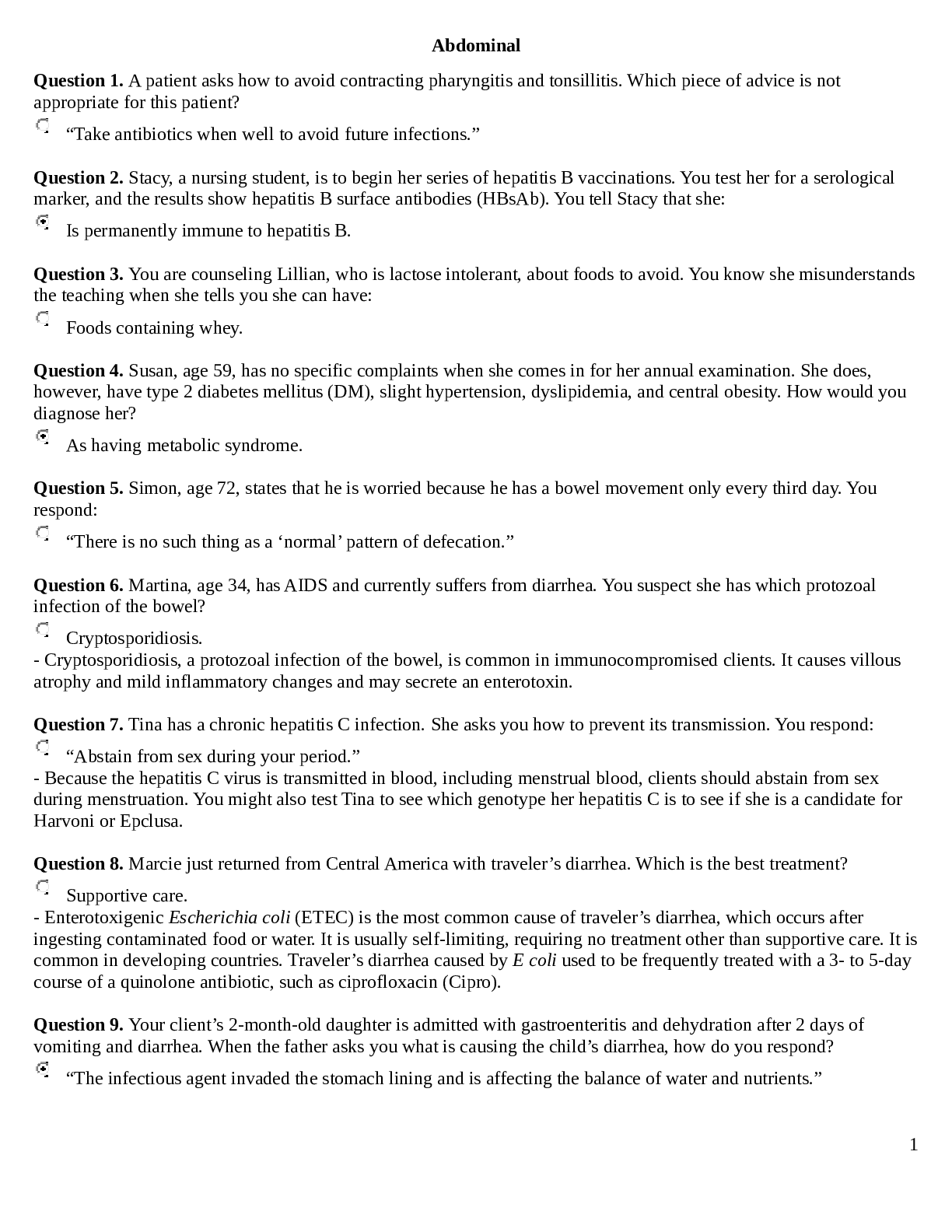
Abdominal
Question 1. A patient asks how to avoid contracting pharyngitis and tonsillitis. Which piece of advice is not appropriate for this patient?
Question 2. Stacy, a nursing student, is to begin her series of he
...
Abdominal
Question 1. A patient asks how to avoid contracting pharyngitis and tonsillitis. Which piece of advice is not appropriate for this patient?
Question 2. Stacy, a nursing student, is to begin her series of hepatitis B vaccinations. You test her for a serological marker, and the results show hepatitis B surface antibodies (HBsAb). You tell Stacy that she:
Question 3. You are counseling Lillian, who is lactose intolerant, about foods to avoid. You know she misunderstands the teaching when she tells you she can have:
Question 4. Susan, age 59, has no specific complaints when she comes in for her annual examination. She does, however, have type 2 diabetes mellitus (DM), slight hypertension, dyslipidemia, and central obesity. How would you diagnose her?
Question 5. Simon, age 72, states that he is worried because he has a … only every third day. You respond:
Question 6. Martina, age 34, has AIDS and currently suffers from diarrhea. You suspect she has which protozoal infection of the bowel?
Question 7. Tina has a chronic hepatitis C infection. She asks you how to prevent its transmission. You respond:
Question 8. Marcie just returned from Central America with traveler’s diarrhea. Which is the best treatment?
Question 9. Your client’s 2-month-old daughter is … with gastroenteritis and dehydration after 2 days of vomiting and diarrhea. When the father asks you what is causing the child’s diarrhea, how do you respond?
Question 10. Sandy, age 52, presents with jaundice, dark urine, and light-colored stools, stating that she is slightly improved over last week’s symptoms. Which stage of viral hepatitis do you suspect?
Question 11. When Sammy asks you what he can do to help his wife, who has dumping syndrome, what do you suggest he encourage her to do?
Question 12. You suspect that Harry has a peptic ulcer and tell him that it has been found to be strongly associated with:
Question 13. You are trying to differentiate between functional (acquired) constipation and Hirschsprung disease in a neonate. Distinguishing features of Hirschsprung disease include which of the following?
Question 14. Shelby has recently been … with pancreatitis. Of the following objective findings that can result from the pancreatic inflammatory process, which is known as Grey Turner sign?
Question 15. You suspect that Nikki has a gastroduodenal ulcer caused by Helicobacter pylori and plan to treat her empirically. What medications should you order?
Question 16. A 45-year-old homeless man presents to your urgent care clinic for evaluation. His chief complaint is diarrhea. The patient states he started to have diarrhea 2-3 days ago, and it is getting progressively worse. He also notes nausea without vomiting, dry mouth, and double vision. On exam you notice his pupillary reflex is absent. The patient states he lives on the street and eats mostly canned goods that he scavenges from a grocery store dumpster. What is the likely cause of the patient’s symptoms?
Question 17. A 75-year-old male presents for a routine physical. He is obese and has no abdominal pain or recent injuries or problems. He has no complaints. He lies supine for his abdominal exam. He is nontender to palpation and has a normal exam. When he sits up you see a large mass protrude from his abdomen. It is central to his abdomen and inferior to his rib cage. It disappears when he is sitting up fully. What is the patient’s … ?
Question 18. A 50-year-old female presents to the urgent care clinic complaining of left lower quadrant pain. She has associated nausea and vomiting, and her vital signs are as follows: temperature 102.5°F, pulse 110, blood pressure 150/90, pulse oximetry 99% on room air. What is the best test to evaluate this patient?
Question 19. The screening guidelines for colon cancer recommend which of the following for the general population?
Question 20. Which of the following is not a risk factor for cholecystitis?
Question 21. Zena just had a hemorrhoidectomy. You know she has not understood your teaching when she tells you she will:
Question 22. Timothy, age 68, complains of an abrupt change in his defecation pattern. You evaluate him for:
Question 23. Anson tells you he thinks his antacids are causing his diarrhea. You respond:
Question 24. Lucy, age 49, has pain in both the left and right lower quadrants. What might you suspect?
Question 25. You elicit costovertebral angle tenderness in Gordon, age 29. Which condition do you suspect?
Question 26. A mother brings in her 4-year-old child, who she states has acute abdominal pain and a rash. Which of the following do you initially rule out?
Question 27. Harvey just came back from Mexico. Which pathogen do you suspect is responsible for his diarrhea?
Question 28 To differentiate among the different diagnoses of inflammatory bowel diseases, you look at the client’s histological, culture, and radiological features. Mary has transmural inflammation, granulomas, focal involvement of the colon with some skipped areas, and sparing of the rectal mucosa. What do you suspect?
Question 29. Which of the following medications/drugs are not known to cause heartburn or dyspepsia?
Question 30. Icterus due to hyperbilirubinemia is seen when the serum level of bilirubin is greater than?
Question 31. What is the best diagnostic test to confirm the … of celiac disease?
Question 32. All of the following medications are used for the control of nausea and vomiting. Which medication works by affecting the chemoreceptor trigger zone, thereby stimulating upper gastrointestinal motility and increasing lower esophageal sphincter pressure?
Question 33. You auscultate Julie’s abdomen and hear a peritoneal friction rub. Which condition do you rule out?
Question 34. Which is the most common presenting symptom of gastric cancer?
Question 35. Tom has just been … with celiac disease. Which of the following might you tell him?
Question 36. Samantha, age 28, is 100 lb overweight and wants to have a gastroplasty performed. In discussing this with her, you explain that by having this procedure she may:
Question 37. Rose has gastroesophageal reflux disease (GERD). You know she misunderstands your teaching when she tells you she will:
Question 38. In a 2-month-old infant with vomiting and diarrhea, the most effective way of determining a fluid deficit is to check for:
Question 39. Olive has an acute exacerbation of Crohn’s disease. Which laboratory test value(s) would you expect to be decreased?
Question 40. You are doing routine teaching with a patient who has a family history of colorectal cancer. You know she misunderstands the teaching when she tells you she will:
Question 41. Dottie brings in her infant, who has gastroesophageal reflux. What do you tell her about positioning her infant?
Question 42. To differentiate among the different … of inflammatory bowel diseases, you look at the client’s histological, culture, and radiological features. Mary has transmural inflammation, granulomas, focal involvement of the colon with some skipped areas, and sparing of the rectal mucosa. What do you suspect?
Question 43. Marian, age 52, is obese. She complains of a rapid onset of severe right upper quadrant abdominal cramping pain, nausea, and vomiting. Your differential … :
Question 44. Which of the following is not true regarding hepatitis C?
Question 45. What is the recommended treatment to eradicate a Helicobacter pylori infection?
Question 46. A 25-year-old male presents complaining of hematochezia. The patient states he has noticed this for 2 days. He states there is a streak of bright blood along his stool every time he has a bowel movement. The patient has no pain with his bowel movements. He admits to eating a poor diet. The patient has no abdominal pain, nausea, or vomiting. On physical exam the patient has a positive fecal occult blood test but has no noticeable rectal bleeding or lesions. What is the likely … ?
Question 47. Margie, age 52, has an extremely stressful job and was just given a … of gastric ulcer. She tells you she is sure it is going to be malignant. How do you respond?
Question 48. Cydney has been given a … of ascariasis. Which symptoms would you expect to see?
Question 49. You suspect appendicitis in Andrew, who is 18. With his right hip and knee flexed, you slowly rotate his right leg internally to stretch a muscle. He states that it is painful over his right lower quadrant. Which sign did you elicit?
Question 50. Marty, age 52, notices a bulge in his midline every time he rises from bed in the morning. You tell him that it is a ventral hernia, also known as an:
Question 51. Bobby, age 6, has constant periumbilical pain shifting to the right lower quadrant, vomiting, a small volume of diarrhea, absence of headache, a mild elevation of the white blood cell count with an early left shift, and white blood cells in the urine. You suspect:
Question 52. Melva, age 63, presents with an acute exacerbation of pancreatitis, and you are going to admit her to the hospital. Which is the most important factor in determining a negative long-term outcome for her?
Question 53. A 54-year-old female presents to your primary care office for routine reevaluation for gastroesophageal reflux disease (GERD). She has been treated with diet modifications and 6 weeks of omeprazole without improvement of her symptoms. What is the next step in management of this patient’s GERD?
Question 54. What would you expect to see on an abdominal series that would lead toward a … of small-bowel obstruction?
Question 55. Nausea is difficult to discern in a young child. What question might you ask to determine if a child has nausea?
Question 56. Matt, age 26, recently returned from a camping trip and has gastroenteritis. He says that he has been eating only canned food. Which of the following pathogens do you suspect?
Question 57. Ruby has a colostomy and complains that her stools are too loose. What food(s) do you suggest to help thicken the stools?
Question 58. Ellie, age 42, has a seizure disorder and has been taking phenytoin (Dilantin) for years. Which supplement should she also be taking if no other problems exist?
Question 59. Melva, age 63, presents with an acute exacerbation of pancreatitis, and you are going to admit her to the hospital. Which is the most important factor in determining a negative long-term outcome for her?
Question 60. Which of the following is the most common cause of acute pancreatitis?
Question 61. Treatment for achalasia may include:
Question 62. A 7-year-old male presents with his mother to the urgent care clinic complaining of abdominal pain. He started to complain of pain prior to going to bed; however, it has gotten progressively worse and is now preventing him from sleeping. He is nauseous but hasn’t vomited and didn’t eat dinner due to the pain. The patient appears pale and is complaining of right-sided abdominal pain. His vitals are as follows: blood pressure 130/85, pulse 120, temperature 100.5°F, pulse oximetry 98% on room air. On physical exam he is tender in the right lower quadrant. His complete blood count (CBC) shows a white blood cell count (WBC) of 17.0. What is the patient’s likely … ?
Question 63. Which oral medication might … to treat a client with chronic cholelithiasis who is a poor candidate for surgery?
Question 64. The metabolism of which drug is not … in Marsha, age 74?
Question 65. Rose, a client with gastroesophageal reflux disease (GERD), has many other concurrent conditions. In teaching Rose about medications to avoid, what do you recommend she refrain from using?
Question 66. Marvin, a known alcoholic with cirrhosis, is frequently admitted for coagulopathies and occasionally receives blood transfusions. His wife asks you why he has bleeding problems. How do you respond?
[Show More]









 (1).png)
 q&a.png)

.png)