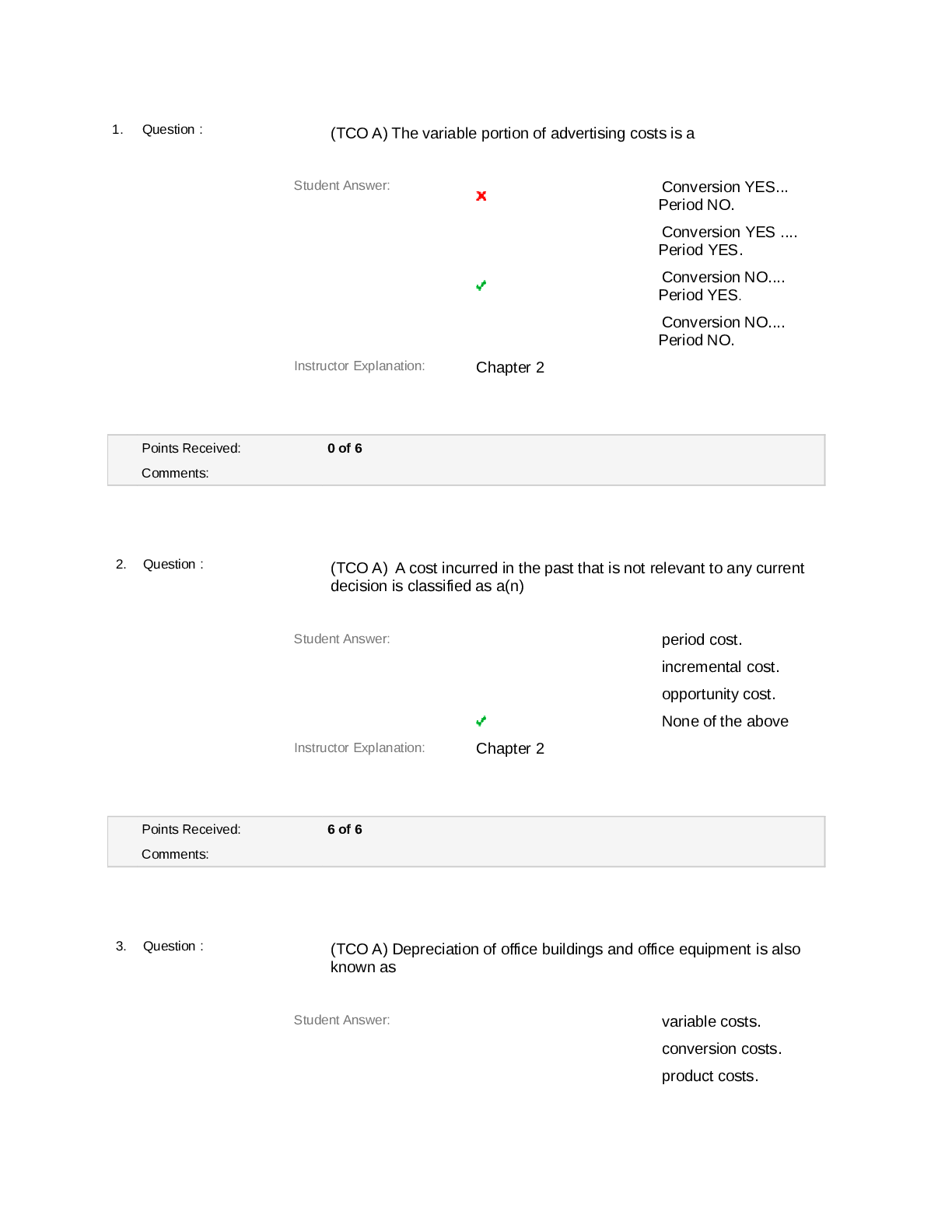
Question : (TCO A) The variable portion of advertising costs is a
Student Answer: Conversion YES...
Period NO.
Conversion YES ....
Period YES.
Conversion NO....
Period YES.
Conversion NO....
Period NO.
Instructo
...
Question : (TCO A) The variable portion of advertising costs is a
Student Answer: Conversion YES...
Period NO.
Conversion YES ....
Period YES.
Conversion NO....
Period YES.
Conversion NO....
Period NO.
Instructor Explanation: Chapter 2
Points Received: 0 of 6
Comments:
2. Question : (TCO A) A cost incurred in the past that is not relevant to any current
decision is classified as a(n)
Student Answer: period cost.
incremental cost.
opportunity cost.
None of the above
Instructor Explanation: Chapter 2
Points Received: 6 of 6
Comments:
3. Question : (TCO A) Depreciation of office buildings and office equipment is also
known as
Student Answer: variable costs.
conversion costs.
product costs.
period costs.
Instructor Explanation: Chapter 2
Points Received: 6 of 6
Comments:
4. Question : (TCO A) When the activity level is expected to increase within the
relevant range, what effects would be anticipated with respect to each of
the following?
Student Answer: Fixed costs per unit
increase and variable
costs per unit increase.
Fixed costs per unit
decrease and variable
costs per unit do not
change.
Fixed costs per unit do
not change
and variable costs
per unit do not change.
Fixed costs per
unit do not change
and variable costs
per unit increase.
Instructor Explanation: Chapter 5
Points Received: 6 of 6
Comments:
5. Question : (TCO F) Emco Company uses direct labor cost as a basis for computing
its predetermined overhead rate. In computing the predetermined
overhead rate for last year, the company included in direct labor cost a
portion of indirect labor. The effect of this misclassification will be to
Student Answer: understate the
predetermined overhead
rate.
overstate the
predetermined overhead
rate.
have no effect on the
predetermined overhead
rate.
This cannot be
determined from the
information given.
Instructor Explanation: Chapter 3
Points Received: 6 of 6
Comments:
6. Question : (TCO F) Which of the following statements about the process-costing
system is incorrect?
Student Answer: In a process-costing
system, each processing
department has a workin-process account.
In a process-costing
system, equivalent units
are separately computed
for materials and for
conversion costs.
In a process-costing
system, overhead can
be under- or overapplied
just as in job-order
costing.
In a process-costing
system, materials costs
are traced to units of
products.
Instructor Explanation: Chapter 4
Points Received: 6 of 6
Comments:
7. Question : (TCO F) The FIFO method only provides a major advantage over the
weighted-average method in that
Student Answer: the calculation of
equivalent units is less
complex under the FIFO
method.
the FIFO method treats
units in the beginning
inventory as if they were
started and completed
during the current
period.
the FIFO method
provides measurements
of work done during the
current period.
the weighted-average
method ignores units in
the beginning and
ending work-in-process
inventories.
Instructor Explanation: Chapter 4
Points Received: 6 of 6
Comments:
8. Question : (TCO B) The contribution margin equals
Student Answer: sales - expenses.
sales - cost of goods
sold.
sales - variable costs.
sales - fixed costs.
Instructor Explanation: Chapter 6
Points Received: 6 of 6
Comments:
9. Question : (TCO B) To obtain the break-even point in terms of dollar sales, total
fixed expenses are divided by which of the following?
Student Answer: Variable expense per
unit
Variable expense per
unit/Selling price per unit
Fixed expense per unit
(Selling price per unit -
Variable expense per
unit) /Selling price per
unit.
Instructor Explanation: Chapter 6
Points Received: 6 of 6
Comments:
10. Question : (TCO E) In an income statement prepared using the variable costing
method, fixed manufacturing overhead would
Student Answer: not be used.
be used in the
computation of the
contribution margin.
be used in the
computation of net
operating income but not
in the computation of the
contribution margin.
be treated the same as
variable manufacturing
overhead.
Instructor Explanation: Chapter 7
Points Received: 6 of 6
Comments:
1. Question : (TCO A) The following data (in
thousands of dollars) have been
taken from the accounting
records of Larden Corporation for
the just-completed year.
Sales
Purchases of raw materials
Direct labor
Manufacturing overhead
Administrative expenses
Selling expenses
Raw materials inventory, beginning
Raw materials inventory, ending
Work-in-process inventory, beginning
Work-in-process inventory, ending
Finished goods inventory, beginning
Finished goods inventory, ending
Required: Prepare a Schedule of
Cost of Goods
Manufactured statement in the
text box below.
Student Answer: Schedule of Cost of Goods
Manufactured for the Larden
Corp. Direct Materials:
Beginning raw materials
inventory ...............$70 Add:
purchases raw
material....................... 170
Raw materials available for
use ...................240 Deduct
ending raw
materials .........................80
Raw materials used in
production .................160
Direct
Labor ....................................
...........210 Manufacturing
Overhead:............................
220 Total Manufacturing
Costs........................... 590
Add beginning work in
process
inventory ........30 ..................
...............................................
.620 Deduct ending work in
process inventory ........20
Cost Of Goods
Manufactured........................
600
Instructor Explanation: Schedule of Cost of Goods Manufactured for the
Larden Corp.
Direct materials:
Beginning raw materials inventory $70
Add: purchases raw material 170
Raw materials available for use 240
Deduct ending raw materials 80
Raw materials used in production 160
Direct labor 210
Manufacturing overhead 220
Total manufacturing costs 590
Add beginning work-in-process inventory 30
620
Deduct ending work-in-process inventory 20
Cost Of goods manufactured 600
Points Received: 15 of 15
Comments:
2. Question : (TCO F) The Illinois Company manufactures a product that goes through
three processing departments. Information relating to activity in the first
department during June is given below.
Percentage Completed
Units Materials Conversion
Work in process, June 1 150,000 75% 55%
Work in process, Jun 30 145,000 85% 75%
The department started 475,000 units into production during the month
and transferred 480,000 completed units to the next department.
Required: Compute the equivalent units of production for the first
department for June, assuming that the company uses the weightedaverage method of accounting for units and costs.
Student Answer: Equivalent
Units .....................................
.....................Materials
Conversion Units transferred
to the next department
480,000 480,000 Ending
Work in process:
Materials......................
145000 * .85 123,250
Conversion............................
.......................... 145000 x .
75 108,750 Equivalent units
of production...............
603,250 588,750
Instructor Explanation: Equivalent
Units
Materi
[Show More]