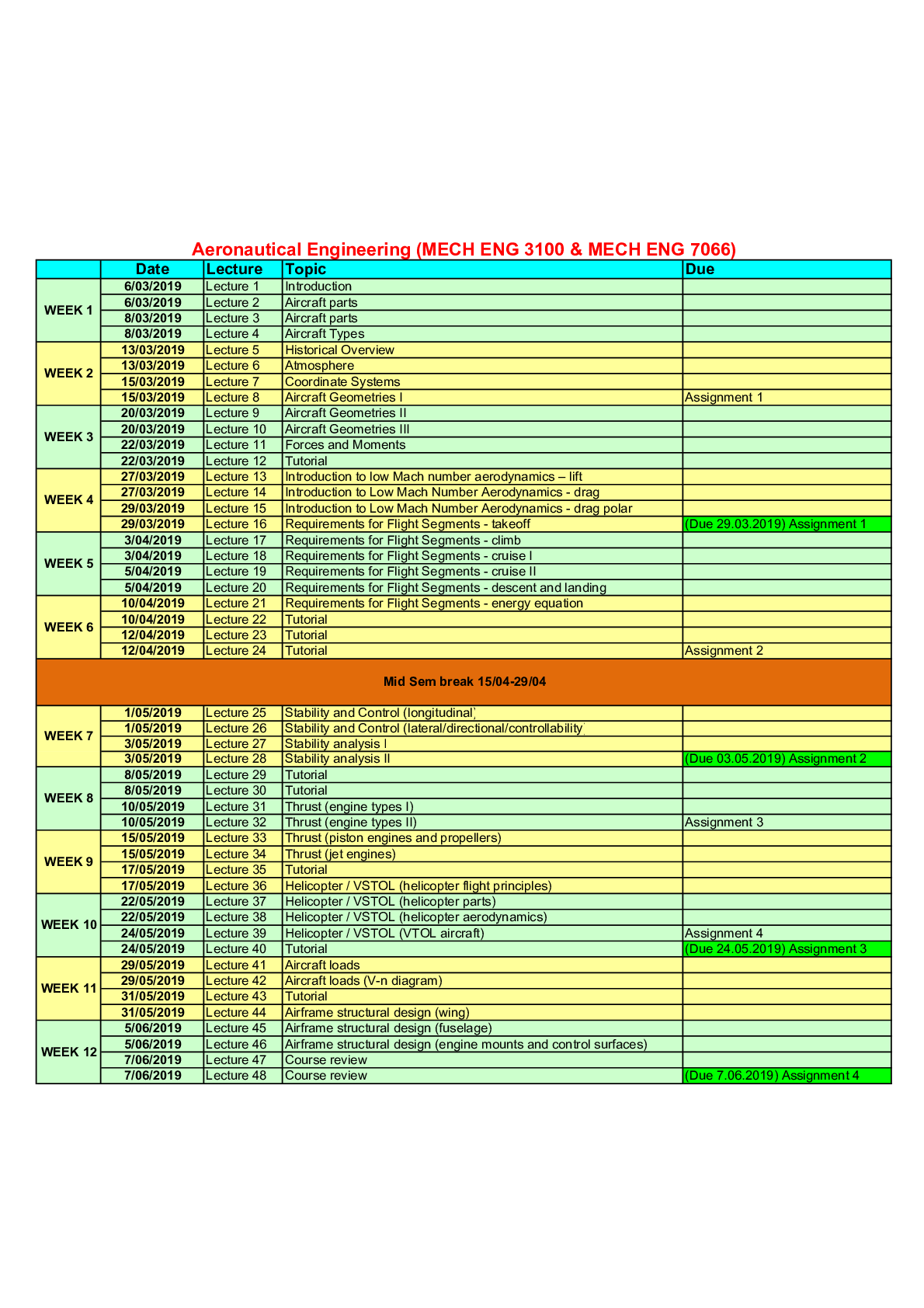
Lecture Topic Due
6/03/2019 Lecture 1 Introduction
6/03/2019 Lecture 2 Aircraft parts
8/03/2019 Lecture 3 Aircraft parts
8/03/2019 Lecture 4 Aircraft Types
13/03/2019 Lecture 5 Historical Overview
13/03/2019 Lectur
...
Lecture Topic Due
6/03/2019 Lecture 1 Introduction
6/03/2019 Lecture 2 Aircraft parts
8/03/2019 Lecture 3 Aircraft parts
8/03/2019 Lecture 4 Aircraft Types
13/03/2019 Lecture 5 Historical Overview
13/03/2019 Lecture 6 Atmosphere
15/03/2019 Lecture 7 Coordinate Systems
15/03/2019 Lecture 8 Aircraft Geometries I Assignment 1
20/03/2019 Lecture 9 Aircraft Geometries II
20/03/2019 Lecture 10 Aircraft Geometries III
22/03/2019 Lecture 11 Forces and Moments
22/03/2019 Lecture 12 Tutorial
27/03/2019 Lecture 13 Introduction to low Mach number aerodynamics – lift
27/03/2019 Lecture 14 Introduction to Low Mach Number Aerodynamics - drag
29/03/2019 Lecture 15 Introduction to Low Mach Number Aerodynamics - drag polar
29/03/2019 Lecture 16 Requirements for Flight Segments - takeoff (Due 29.03.2019) Assignment 1
3/04/2019 Lecture 17 Requirements for Flight Segments - climb
3/04/2019 Lecture 18 Requirements for Flight Segments - cruise I
5/04/2019 Lecture 19 Requirements for Flight Segments - cruise II
5/04/2019 Lecture 20 Requirements for Flight Segments - descent and landing
10/04/2019 Lecture 21 Requirements for Flight Segments - energy equation
10/04/2019 Lecture 22 Tutorial
12/04/2019 Lecture 23 Tutorial
12/04/2019 Lecture 24 Tutorial Assignment 2
1/05/2019 Lecture 25 Stability and Control (longitudinal)
1/05/2019 Lecture 26 Stability and Control (lateral/directional/controllability)
3/05/2019 Lecture 27 Stability analysis I
3/05/2019 Lecture 28 Stability analysis II (Due 03.05.2019) Assignment 2
8/05/2019 Lecture 29 Tutorial
8/05/2019 Lecture 30 Tutorial
10/05/2019 Lecture 31 Thrust (engine types I)
10/05/2019 Lecture 32 Thrust (engine types II) Assignment 3
15/05/2019 Lecture 33 Thrust (piston engines and propellers)
15/05/2019 Lecture 34 Thrust (jet engines)
17/05/2019 Lecture 35 Tutorial
17/05/2019 Lecture 36 Helicopter / VSTOL (helicopter flight principles)
22/05/2019 Lecture 37 Helicopter / VSTOL (helicopter parts)
22/05/2019 Lecture 38 Helicopter / VSTOL (helicopter aerodynamics)
24/05/2019 Lecture 39 Helicopter / VSTOL (VTOL aircraft) Assignment 4
24/05/2019 Lecture 40 Tutorial (Due 24.05.2019) Assignment 3
29/05/2019 Lecture 41 Aircraft loads
29/05/2019 Lecture 42 Aircraft loads (V-n diagram)
31/05/2019 Lecture 43 Tutorial
31/05/2019 Lecture 44 Airframe structural design (wing)
5/06/2019 Lecture 45 Airframe structural design (fuselage)
5/06/2019 Lecture 46 Airframe structural design (engine mounts and control surfaces)
7/06/2019 Lecture 47 Course review
7/06/2019 Lecture 48 Course review (Due 7.06.2019) Assignment 4
Aeronautical Engineering (MECH ENG 3100 & MECH ENG 7066)
WEEK 5
WEEK 7
WEEK 12
WEEK 1
WEEK 2
WEEK 3
WEEK 4
Mid Sem break 15/04-29/04
WEEK 8
WEEK 9
WEEK 10
WEEK 11
WEEK 6Introduction Copyright - The University of Adelaide Slide Number 1
School of Mechanical Engineering
Aeronautical Engineering
Introduction
Dr. MAZIAR ARJOMANDI
Semester I
Introduction Copyright - The University of Adelaide Slide Number 2
Aeronautical Engineering School of Mechanical Engineering
About myself:
• Education:
– PhD in Aerospace Engineering (Aircraft Design) from Moscow Aviation Institute (MAI), 1999
– ME in Aerospace Engineering (Aircraft Design) from Moscow Aviation Institute (MAI),1996
– BE in Mechanical Engineering (Design) from Iran University of Science and Technology
(IUST), 1992
• Research Area:
– Aircraft design
– Active and passive flow control
– Plasma aerodynamics
– Vortex flow
– Heat transfer
– Sustainable energy production
– Wind and wave energy
– Solar thermal energy
• Contacts:
– Room S232, email:
[email protected], phone: 83138128
Page 2 of 251Introduction Copyright - The University of Adelaide Slide Number 3
Aeronautical Engineering School of Mechanical Engineering
What we are trying to do in this course:
• In teaching Aeronautical Engineering, we require students, who want to learn
Leading Edge Technology and familiarize them with the fundamental
aspects of Aeronautical Engineering.
Course objectives:
• Understand the physical concepts of flight!
• Implement “lateral thinking” instead of “by the book”
• Introduction to Aeronautical Engineering (what we really
signed up to do)
Introduction Copyright - The University of Adelaide Slide Number 4
Aeronautical Engineering School of Mechanical Engineering
1. Aircraft parts and types
2. Short history
3. Atmosphere
4. Coordinate systems
5. Aircraft geometries
6. Forces and moments
7. Introduction to low Mach number
aerodynamics
8. Aircraft performance
9. Aircraft stability and control
10. Propulsion and thrust
11. Aircraft loads
12. Introduction to helicopters, VTOL and
STOL
13. Aircraft structure design
Course specific objectives:
1. To familiarise students with the
technical characteristics of modern
aircraft
2. To familiarise Aeronautical
Engineering students with the aircraft
types and parts
3. To introduce the students the basic
theories in Aeronautical Engineering
4. To enable students to understand and
analyse the design and performance
aspects of aircraft
5. To familiarise students with the basic
knowledge of aerospace structure
design
Course main objectives:
Page 3 of 251Introduction Copyright - The University of Adelaide Slide Number 5
Aeronautical Engineering School of Mechanical Engineering
References:
• Introduction to aeronautics: a design perspective; Steven Brandt
• Aircraft performance and design; John Anderson
• Introduction to flight; John Anderson
• Aircraft flight; R Barnard
• Aerodynamics, aeronautics and flight mechanics; B McCormick
• An introduction to general aeronautics; C Van Deventer
• Airframe structural design; Michael Niu
• Composite airframe structures; Michael Niu
• Airframe stress analysis and sizing; Michael Niu
• Aircraft structures for engineering students; T Megson
• Aeroplane design, vol I-VIII; John Roskam
• Aircraft design: a conceptual approach; Daniel Raymer
Introduction Copyright - The University of Adelaide Slide Number 6
Aeronautical Engineering School of Mechanical Engineering
Course mark:
• Final exam: 60%
• Open book + Closed book, three hours, 5-10 questions (short answers, multiple
choice, essay type, calculation)
• Assignments: 20% (4x5%)
• Individual assignments
• Laboratory (Structural Analysis laboratory): 10% - compulsory (if you do not
attend or do not submit the lab report you fail the course)
• Laboratory (Flight Simulator laboratory): 10% - compulsory (if you do not attend
or do not submit the lab report you fail the course)
• To pass the course you need to get at least 35% of the total possible lab mark
• If you missed a lab session for no important reason you might be allowed to attend
a catch-up session, but you could only receive up to 50% of the total lab mark.
Page 4 of 251
• ALL Submissions are online via MyUni before the deadline.Introduction Copyright - The University of Adelaide Slide Number 7
Aeronautical Engineering School of Mechanical Engineering
Nomenclature:
Trevor Thom, The Student Pilot’s Manual, ISBN 1 875537 23 6, p.1-2
Introduction Copyright - The University of Adelaide Slide Number 8
Aeronautical Engineering School of Mechanical Engineering
Nomenclature:
http://www.grc.nasa.gov/WWW/K-12/airplane/airplane.html
Page 5 of 251Introduction Copyright - The University of Adelaide Slide Number 9
Aeronautical Engineering School of Mechanical Engineering
Aircraft motions - pitch:
http://www.colorado-aeronautics.org/AvEd/
•The pitch axis is perpendicular to the aircraft centreline and lies in the plane of the wings.
•A pitch motion is an up or down movement of the nose of the aircraft as shown in the animation
http://www.grc.nasa.gov/WWW/K-12/airplane/pitch.html
Introduction Copyright - The University of Adelaide Slide Number 10
Aeronautical Engineering School of Mechanical Engineering
Aircraft motions - roll:
http://www.colorado-aeronautics.org/AvEd/
•The roll axis lies along the aircraft centreline.
•A roll motion is an up and down movement of the wings of the aircraft as shown in the animation.
http://www.grc.nasa.gov/WWW/K-12/airplane/pitch.html
Page 6 of 251Introduction Copyright - The University of Adelaide Slide Number 11
Aeronautical Engineering School of Mechanical Engineering
Aircraft motions - yaw:
http://www.colorado-aeronautics.org/AvEd/
•The yaw axis is perpendicular to the wings and lies in the plane of the aircraft centreline.
•A yaw motion is a side to side movement of the nose of the aircraft as shown in the animation.
http://www.grc.nasa.gov/WWW/K-12/airplane/pitch.html
Introduction Copyright - The University of Adelaide Slide Number 12
Aeronautical Engineering School of Mechanical Engineering
Intentionally left blank for your notes
Page 7 of 251Aircraft parts Copyright - The University of Adelaide Slide Number 1
School of Mechanical Engineering
Aeronautical Engineering
Aircraft parts
Dr. MAZIAR ARJOMANDI
Semester I
Aircraft parts Copyright - The University of Adelaide Slide Number 2
Aeronautical Engineering School of Mechanical Engineering
Aircraft parts – wing:
• To produce lift for flight and
manoeuvring
• To make aircraft laterally
stable
• To help in roll motion
generation (bank)
• To use as a mounting for
engines and landing gears
• To place fuel
• To carry weapons
http://www.math.ksu.edu/main/events/KSU-REU/
www.btc.bismarck.k12.nd.us/teacher_pages
http://www.bredow-web.de/
http://www.acclaimimages.com
http://www.n523rv.com/wings/ http://www.defense-update.com/ http://www.aviation.ru/
Page 8 of 251Aircraft parts Copyright - The University of Adelaide Slide Number 3
Aeronautical Engineering School of Mechanical Engineering
Aircraft parts – fuselage:
• To place crew
• To place payload
• To place systems and
instruments
• To use as a mounting for
engines and landing gears
• To place fuel
• To generate lift
• To help in generation of pitch
and yaw motions
From book: Airplane Design by Roskam
http://www.aerospace-technology.com/
http://studweb.studserv.uni-stuttgart.de/
http://www.militaryfactory.com/
www.machtres.com
web.nps.navy.mil
www.chevron.com
selair.selkirk.bc.ca
http://www.bredow-web.de
Aircraft parts Copyright - The University of Adelaide Slide Number 4
Aeronautical Engineering School of Mechanical Engineering
Intentionally left blank for your notes
Page 9 of 251Aircraft parts Copyright - The University of Adelaide Slide Number 5
Aeronautical Engineering School of Mechanical Engineering
Aircraft parts – empennage:
• To make aircraft stable
• To make aircraft controllable and
manoeuvrable in pitch and yaw
• To place fuel
• To use as a mounting for
engines and landing gears
• To carry weapons
Lift
Center of Pressure/Lift
Center of
Pressure
Center of
Gravity
Center of Gravity
Tail Down
Force
Tail Down
Force
Effects of C.G. Location
Properly Loaded
Effects of C.G. Location
Too Far Loaded
Effects of C.G. Location
Too Far Aft
http://us.airliners.net/
www.btc.bismarck.k12.nd.us
http://www.aircraft-info.net/
www.steehovwer.com
www.airconsult.com/eurofoxD.htm
http://www.velocityaircraft.com/
Aircraft parts Copyright - The University of Adelaide Slide Number 6
Aeronautical Engineering School of Mechanical Engineering
Aircraft parts – landing gear:
• To run aircraft to the required
speed for generating lift
before takeoff
• To make the aircraft
manoeuvrable on the ground
• To absorb the impact energy
during landing
• To use as a stand for
grounding an aircraft
• To provide braking capability
• To provide towing capability
texasbestgrok.mu.nu
http://www.f16demoteam.be/
http://www.airliners.net/
www.tomcat521.com https:/.../webpages/pfeatures/
http://www.aerospace-technology.com/
www.greatplainsas.com http://www.tupolev.ru/
www.fly-net.org
www.altay.com.tr
Page 10 of 251Aircraft parts Copyright - The University of Adelaide Slide Number 7
Aeronautical Engineering School of Mechanical Engineering
Aircraft parts – primary control surfaces:
• Aileron: To generate
required moment for rolling
• Elevator: To generate
required moment for
pitching
• Rudder: To generate
required moment for
yawing
http://www.answers.com/topic/flight-controls
Aileron
Elevator
Rudder
http://www.aviation-history.com/theory/flt_ctl.htm
Aircraft parts Copyright - The University of Adelaide Slide Number 8
Aeronautical Engineering School of Mechanical Engineering
Aircraft parts – Secondary control surfaces:
• Trim tab: To generate required moment for balancing/rolling
• Flap: To generate additional lift during take-off and landing
• Spoiler and airbrake: To generate additional drag during
landing and manoeuvres
www.airwar.ru
http://www.weekendcfii.com/
http://www1.istockphoto.com/
http://www2.tech.purdue.edu/
Page 11 of 251Aircraft types Copyright - The University of Adelaide Slide Number 1
School of Mechanical Engineering
Aeronautical Engineering
Aircraft types
Dr. MAZIAR ARJOMANDI
Semester I
Aircraft types Copyright - The University of Adelaide Slide Number 2
Aeronautical Engineering School of Mechanical Engineering
Aircraft Types:
• Home built propeller driven airplanes
• Single engine propeller driven airplanes
• Twin engine propeller driven airplanes
• Agricultural airplanes
• Business jets
• Regional turbo propeller driven airplanes
• Transport jets
• Military trainers
• Fighters
• Military patrol, bomb & transport airplanes
• Flying boats, amphibious and float airplanes
• Supersonic cruise airplane
• Flying Wing
• Sport & Gliders
• RPV (Remotely Piloted Vehicle) & UAV (Unmanned Air Vehicle)
• MAV (Micro Air Vehicle)
Page 12 of 251Aircraft types Copyright - The University of Adelaide Slide Number 3
Aeronautical Engineering School of Mechanical Engineering
http://www.strongware.com/dragon/ http://my.execpc.com/~cjh/rv9a.html
Home built propeller driven airplanes:
From book: Airplane Design by Roskam
Aircraft types Copyright - The University of Adelaide Slide Number 4
Aeronautical Engineering School of Mechanical Engineering
Intentionally left blank for your notes
Page 13 of 251Aircraft types Copyright - The University of Adelaide Slide Number 5
Aeronautical Engineering School of Mechanical Engineering
AVA202 (Basic Trainer)
Evektor Cobra VUT100
http://www.silverwing.com.au/ www.aii-co.com/en/ava202.asp
VH-CTZ GA Aircraft
http://www.airliners.net/
Single engine propeller driven airplanes:
From book: Airplane Design by Roskam
Aircraft types Copyright - The University of Adelaide Slide Number 6
Aeronautical Engineering School of Mechanical Engineering
Rockwell Turbo Commander
www.montaguemillennium.com
Twin engine propeller driven airplanes:
From book: Airplane Design by Roskam
Page 14 of 251Aircraft types Copyright - The University of Adelaide Slide Number 7
Aeronautical Engineering School of Mechanical Engineering
Agricultural airplanes:
Piper Pawnee
http://www.aeromedia.hu/bemutat/gepek.htm
http://www.casa.gov.au/casadata/register/oldpics/kdr.htm
Air Tractor
From book: Airplane Design by Roskam
Aircraft types Copyright - The University of Adelaide Slide Number 8
Aeronautical Engineering School of Mechanical Engineering
Intentionally left blank for your notes
Page 15 of 251Aircraft types Copyright - The University of Adelaide Slide Number 9
Aeronautical Engineering School of Mechanical Engineering
Business jets:
Bombardier Canadair CL-605 Challenger
http://www.canadair.com/ From book: Airplane Design by Roskam
Aircraft types Copyright - The University of Adelaide Slide Number 10
Aeronautical Engineering School of Mechanical Engineering
Regional turbo propeller driven airplanes:
http://www.airdisaster.com/cgi-bin/ http://www.zap16.com/
Fokker 50 Antonov 140
From book: Airplane Design by Roskam
Page 16 of 251Aircraft types Copyright - The University of Adelaide Slide Number 11
Aeronautical Engineering School of Mechanical Engineering
Transport jets:
http://www.zap16.com/civ%20fact/
http://www.stp-norway.com/STP/
Airbus A340
Fokker F-70
From book: Airplane Design by Roskam
Aircraft types Copyright - The University of Adelaide Slide Number 12
Aeronautical Engineering School of Mechanical Engineering
Intentionally left blank for your notes
Page 17 of 251Aircraft types Copyright - The University of Adelaide Slide Number 13
Aeronautical Engineering School of Mechanical Engineering
Military trainers:
Jet Trainer (T-45 Goshawk)
http://www.cavok-aviation-photos.net/
Pilatus PC-7
www.boeing.com
From book: Airplane Design by Roskam
Aircraft types Copyright - The University of Adelaide Slide Number 14
Aeronautical Engineering School of Mechanical Engineering
Fighters:
Grumman F-14
www.sinodefenceforum.com/
http://public.andrews.amc.af.mil/ www.math.tau.ac.il
http://www.airshowreport.com/
Lockheed Martin F-16 Mikoyan MIG-29 Lockheed Martin F-117
From book: Airplane Design by Roskam
Page 18 of 251Aircraft types Copyright - The University of Adelaide Slide Number 15
Aeronautical Engineering School of Mechanical Engineering
Military patrol, bomb & transport airplanes:
P-3C Orion
Lockheed Martin C-130
http://www.webalice.it/
http://www.fas.org/
From book: Airplane Design by Roskam
Aircraft types Copyright - The University of Adelaide Slide Number 16
Aeronautical Engineering School of Mechanical Engineering
Intentionally left blank for your notes
Page 19 of 251Aircraft types Copyright - The University of Adelaide Slide Number 17
Aeronautical Engineering School of Mechanical Engineering
Flying boats and amphibious airplanes:
Cessna Amphibious Aircraft Beriev Be-200
http://www.machtres.com/
http://www.controller.com/
From book: Airplane Design by Roskam
Aircraft types Copyright - The University of Adelaide Slide Number 18
Aeronautical Engineering School of Mechanical Engineering
Supersonic cruise airplane: www.avion-de-combat.com http://picavia.foxalpha.com/
Aerospatiale/BAC Concorde
Rockwell B1B
From book: Airplane Design by Roskam
Page 20 of 251Aircraft types Copyright - The University of Adelaide Slide Number 19
Aeronautical Engineering School of Mechanical Engineering
Flying Wing:
Northrop B-2 NASA ERAST
freehost02.websamba.com www.europa1939.com
Aircraft types Copyright - The University of Adelaide Slide Number 20
Aeronautical Engineering School of Mechanical Engineering
Sport & Gliders:
Nimbus-4
Ava 101
www.aii-co.com/
pantransit.reptiles.org
Page 21 of 251Aircraft types Copyright - The University of Adelaide Slide Number 21
Aeronautical Engineering School of Mechanical Engineering
RPV & UAV:
ALTAIR
http://www.machtres.com/predator.htm
iSOAR
Morpheus
Hy-Five
Aircraft types Copyright - The University of Adelaide Slide Number 22
Aeronautical Engineering School of Mechanical Engineering
MAVs:
24-cm MAV
http://www.darpa.mil/ http://www.mil.ufl.edu/
Black Widow MAV
UofA MAV
Page 22 of 251Historical overview Copyright - The University of Adelaide Slide Number 1
School of Mechanical Engineering
Aeronautical Engineering
Historical overview



.png)