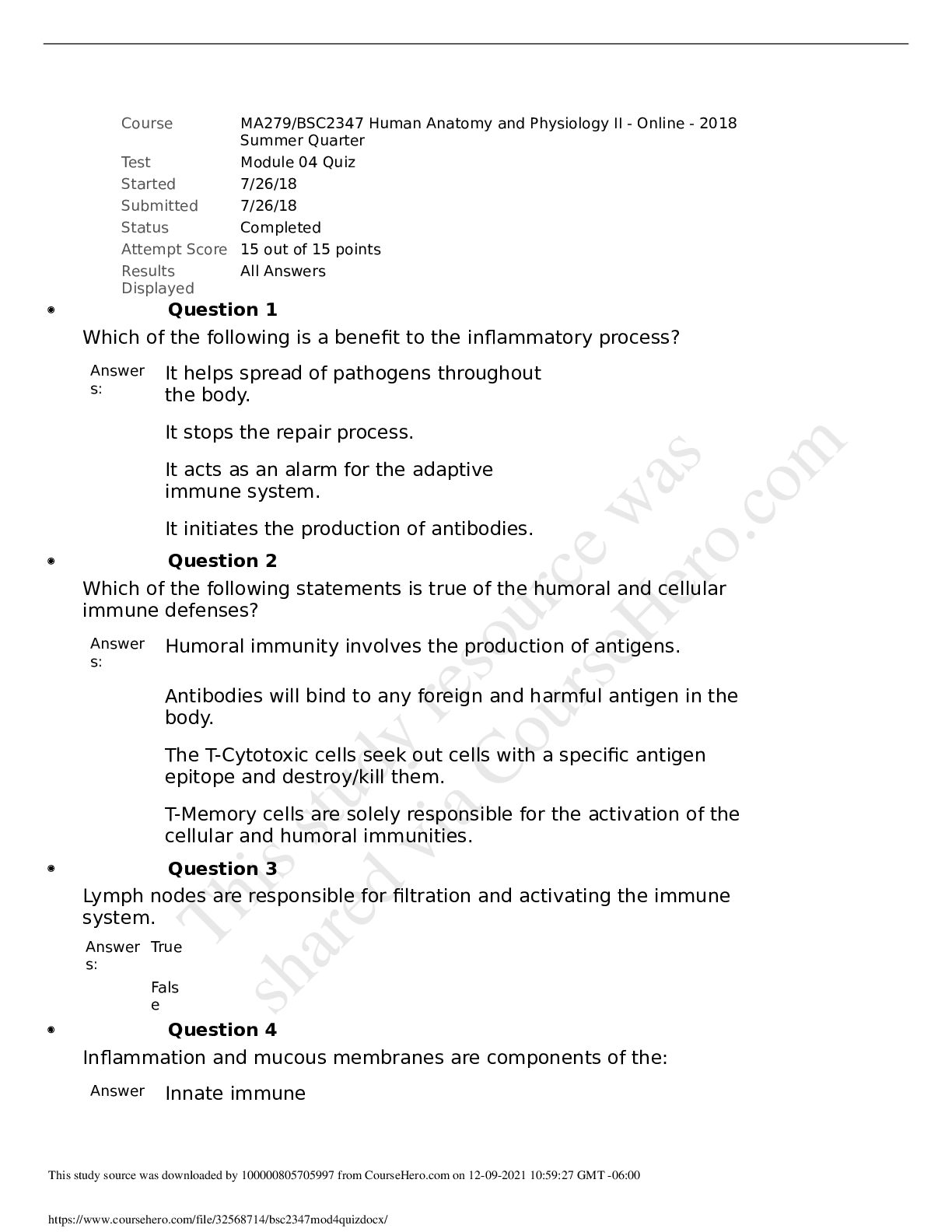
Course MA279/BSC2347 Human Anatomy and Physiology II - Online - Summer Quarter
Test Module 05 Midterm Exam
Started
Status Completed Attempt Score 48 out of 50 points
Time Elapsed 20 minutes out of 1 hour and 15 min
...
Course MA279/BSC2347 Human Anatomy and Physiology II - Online - Summer Quarter
Test Module 05 Midterm Exam
Started
Status Completed Attempt Score 48 out of 50 points
Time Elapsed 20 minutes out of 1 hour and 15 minutes
Results Displayed
All Answers, Submitted Answers, Correct Answers, Feedback, Incorrectly Answered Questions
• Question 1
Which of the following is true of cellular immunity?
• Question 2
Which factor will NOT directly affect stroke volume?
1 out of 1 points
1 out of 1 points
• Question 3
The thoracic and pulmonary volumes both have the ability to increase.
1 out of 1 points
• Question 4
0 out of 1 points
Only arteries undergo vasoconstriction and vasodilation.
• Question 5
1 out of 1 points
Stroke volume is the measure of:
• Question 6
1 out of 1 points
Which of the following is true of thrombocytopenia?
Answers:
• Question 7
1 out of 1 points
What statement is true of capillaries?
• Question 8
1 out of 1 points
Which of the following is true of polycythemia?
• Question 9
Coagulation is the final step in the hemostasis process.
1 out of 1 points
Selected Answer:
Tru e
Answers: Tru
e False
• Question 10
1 out of 1 points
Antibodies are specific to one type of epitope.
Selected Answer:
Tru e
Answers: Tru
e False
The right atrium:
Selected
• Question 11
1 out of 1 points
Answer: Receives blood from the body
circuit
Answers: Pumps blood to the pulmonary
circuit
Pumps blood to the body circuit
Receives blood from the pulmonary circuit
Receives blood from the body circuit
• Question 12
Which of the following is a role of the nasal cavity?
Selected
Answer: Filter and clean incoming air
Answers: Gas exchange
1 out of 1 points
Filter and clean incoming air Dry and warm incoming air
Concentrate the oxygen of incoming air
• Question 13
Which portion of the EKG wave pertains to the atria undergoing depolarization?
Selected Answer: P wave
Answers:
1 out of 1 points
P wave
QRS
complex T wave S wave
• Question 14
1 out of 1 points
The exposure rate of a pathogen determines the effectiveness of innate defenses.
Selected Answer:
Fals e
Answers: True
Fals
e
• Question 15
1 out of 1 points
Which type of humoral immunity is generated when an individual receives an infection from another person?
Selected
Answer: Active natural humoral
immunity
Answers:
Active natural humoral
immunity
Passive natural humoral immunity
Active acquired humoral immunity
Passive acquired humoral immunity
• Question 16
The pulmonary arteries contain deoxygenated blood.
1 out of 1 points
Selected Answer:
Tru e
Answers: Tru
e False
• Question 17
1 out of 1 points
Humoral immunity involves the production of antibodies that will attack any bacteria or virus.
Selected Answer:
Fals e
Answers: True
Fals
e
• Question 18
1 out of 1 points
Which type of plasma protein plays a role within maintaining plasma osmotic pressure, blood pressure and is the most numerous?
Selected Answer: Albumin
Answers: Globins
Albumin
Fibrinoge n
Elastin
• Question 19
The primary role of the smooth surrounding the bronchi is to provide structural support.
1 out of 1 points
Selected Answer:
Fals e
Answers: True
Fals
e
• Question 20
1 out of 1 points
The trachealis muscle is located on the posterior aspect of the trachea, facing the esophagus.
Selected Answer:
Tru e
Answers: Tru
e False
• Question 21
1 out of 1 points
What is true of gas exchange within the lungs?
Selected
Answer: Occurs at the type I alveolar cells
Answers: Occurs in the bronchioles and
alveolar sacs
Occurs at the type I alveolar cells Occurs at the type II alveolar cells
It can occur all along the respiratory tree.
• Question 22
Which of the following is true of the pleura of the lungs?
Selected
Answer: The pleural cavity allows the lungs to expand and
contract without friction.
1 out of 1 points
Answers: They are solely responsible for facilitating ventilation.
It is composed of four layers.
The pleural cavity allows the lungs to expand and contract without friction.
The pleura covers the internal surfaces of the lungs too.
• Question 23
Increased heart rate will increase the overall cardiac output.
1 out of 1 points
Selected Answer:
Tru e
Answers: Tru
e False
• Question 24
1 out of 1 points
Which of the following is true of veins?
Selected
Answer: They start forming after blood travels through a
capillary bed
Answers: They contain two-way valves
The vena cava is the smallest vein in the body They typically carry oxygenated blood
They start forming after blood travels through a capillary bed
• Question 25
1 out of 1 points
Which portion of the cardiac conduction system controls the rate at which the heart contracts?
Selected Answer: SA node
Answers: AV node
SA node
Purkinje fibers
Myocaridum
• Question 26
The pharynx assists in moistening and humidifying inhaled air?
1 out of 1 points
Selected Answer:
Fals e
Answers: True
Fals
e
• Question 27
1 out of 1 points
Which statement about the lungs and bronchi is true?
Selected
Answer: The left lung has 2 lobes.
Answers: The right lung has 4 lobes.
The left lung has 2 lobes.
The right secondary bronchi has two branches.
The left secondary bronchi has three branches.
• Question 28
1 out of 1 points
The left ventricle:
Selected
Answer: Pumps blood to the body circuit
Answers: Pumps blood to the pulmonary
circuit
Pumps blood to the body circuit
Receives blood from the pulmonary circuit
Receives blood from the body circuit
• Question 29
Which of the following is true of the hemostasis process?
Selected
1 out of 1 points
Answer: Fibrin is an insoluble protein thread that will cross link to the platelets together.
Answers: Hemoglobin activates fibrinogen to fibrin.
Fibrin is an insoluble protein thread that will cross link to the platelets together.
Vitamin C is needed for the hemostasis process to be complete.
Only the intrinisic pathway will convert prothrombin to the active form of thrombin.
• Question 30
Which of the following is true regarding the larynx?
Selected
Answer: The vestibular folds assist in closing the glottis to
prevent food and water entering the trachea.
1 out of 1 points
Answers:
The vestibular folds assist in closing the glottis to prevent food and water entering the trachea.
The vocal folds (cords) allow food and water to flow through them when open.
The epiglottis controls when food and water can enter the trachea.
The larynx is located inferior to the trachea.
• Question 31
1 out of 1 points
Anemia is classified and defined as the body being iron deficient.
Selected Answer:
Fals e
Answers: True
Fals
e
• Question 32
1 out of 1 points
What is secreted by the alveoli cells that prevent the lungs from collapsing between each breath by reducing surface tension?
Selected
Answer: Surfactant
Answers:
Surfactant Mucous
Pulmonary fluid
Water
• Question 33
1 out of 1 points
The bronchial tree allows for passage of air and gasses to reach the alveolar sacs where gas exchange occurs.
Selected Answer:
Tru e
Answers: Tru
e False
• Question 34
1 out of 1 points
Arterioles are the smallest form of an artery and is where gas exchange occurs.
Selected Answer:
Fals e
Answers: True
Fals
e
• Question 35
1 out of 1 points
Which portion of the EKG wave pertains ventricles contracting during the cardiac cycle?
Selected Answer: QRS
complex
Answers: P wave
QRS
complex T wave S wave
• Question 36
Which of the following is NOT a benefit to the inflammatory process?
Selected
Answer: Initiates the production of T-cytotoxic
cells
Answers: It helps prevent the spread of pathogens.
It helps initiate the repair process.
Acts as an alarm for the adaptive immune system
Initiates the production of T-cytotoxic cells
• Question 37
Which of the following is the most numerous type of leukocyte?
Selected
Answer: Neutrophil
Answers:
1 out of 1 points
1 out of 1 points
Neutrophil Basophil
Eosinophil
Lymphocy te
• Question 38
1 out of 1 points
Which of the following choices is the correct pathway of the cardiac conduction system?
Selected
Answer: SA node – AV node – Bundle of His – Right/Left bundle
branches – Purkinje fibers
Answers:
SA node – AV node – Bundle of His – Right/Left bundle branches – Purkinje fibers
AV node – Bundle of His – Right/Left bundle branches
– Purkinje fibers
SA node – AV node – Bundle of His – Purkinje fibers – Right/Left bundle branches
Bundle of His – AV node - SA node – Purkinje fibers – Right/Left bundle branches
• Question 39
1 out of 1 points
Which of the following is true of the intercalated discs?
Selected
Answer: They allow cardiac muscle cells to share nutrients and electrical impulses.
Answers: There are found in smooth muscle and cardiac muscle.
They are found only in the SA node cells.
They allow cardiac muscle cells to share nutrients and electrical impulses.
They are the contractile filaments of the cardiac muscle cells.
• Question 40
1 out of 1 points
Type O blood is the universal recipient blood type.
Selected Answer:
Fals e
Answers: True
Fals
e
• Question 41
1 out of 1 points
Which anatomical structure ensures the heart valves only open and close in one direction?
Selected Answer: Chordae
tendinae
Answers: Cusps
Trabeculae carneae
Chordae tendinae
Epicardium
• Question 42
T Helper cells are involved in cellular and humoral immunity activation.
1 out of 1 points
Selected Answer:
Tru e
Answers: Tru
e False
• Question 43
1 out of 1 points
Which of the following is true of the trachea?
Selected
Answer: Its lumen is lined with cilia.
Answers: It has over 30 supportive cartilage rings.
Its lumen is lined with cilia.
The respiratory cilia within the lumen move the mucus downward, toward the lungs.
The trachea is posterior to the esophagus.
• Question 44
1 out of 1 points
Cardiac output is the amount of blood ejected from both ventricles with each contraction.
Selected Answer:
Fals e
Answers: True
Fals
e
• Question 45
1 out of 1 points
For inspiration to occur, intrapulmonary pressure must be higher than atmospheric pressure?
Selected Answer:
Fals e
Answers: True
Fals
e
• Question 46
1 out of 1 points
For expiration to occur, the intrapulmonary pressure has to:
Selected
Answer: Increase compared to atmospheric air
pressure
Answers:
Increase compared to atmospheric air pressure
Decrease compared to atmospheric air pressure
• Question 47
1 out of 1 points
An abnormal clot formation within a blood vessel is referred to as:
Selected Answer: Thrombi
Answers: Emboli
Thrombi
Hemosta sis
Sclerosis
• Question 48
Which of the following is true regarding the heart valves?
Selected
1 out of 1 points
Answer: The Lub sound of the heart is produced when the AV valves close.
c. The right AV valve has only two cusps.
Answers: The heart contains 5 heart valves.
The left AV valve is also called the pulmonary valve.
The Lub sound of the heart is produced when the AV valves close.
c. The right AV valve has only two cusps.
• Question 49
0 out of 1 points
As the inspiratory muscles contract, the thoracic volume increases leading to an increase of pulmonary volume, which increases the intrapulmonary pressure.
Selected Answer:
True
Answers: True
Fals
e
• Question 50
1 out of 1 points
Oxygen and carbon dioxide gas exchange in the lungs occurs due to:
Selected Answer: Diffusion
Answers: Active transport
Diffusion Osmosis
Facilitated transport
[Show More]