Chapter 15- Judiciaries MULTIPLE-CHOICE QUESTIONS
1. Unlike natural law, positive law uses .
2. Which of the following issues is a civil concern?
3. International law consists of and established customs recogn
...
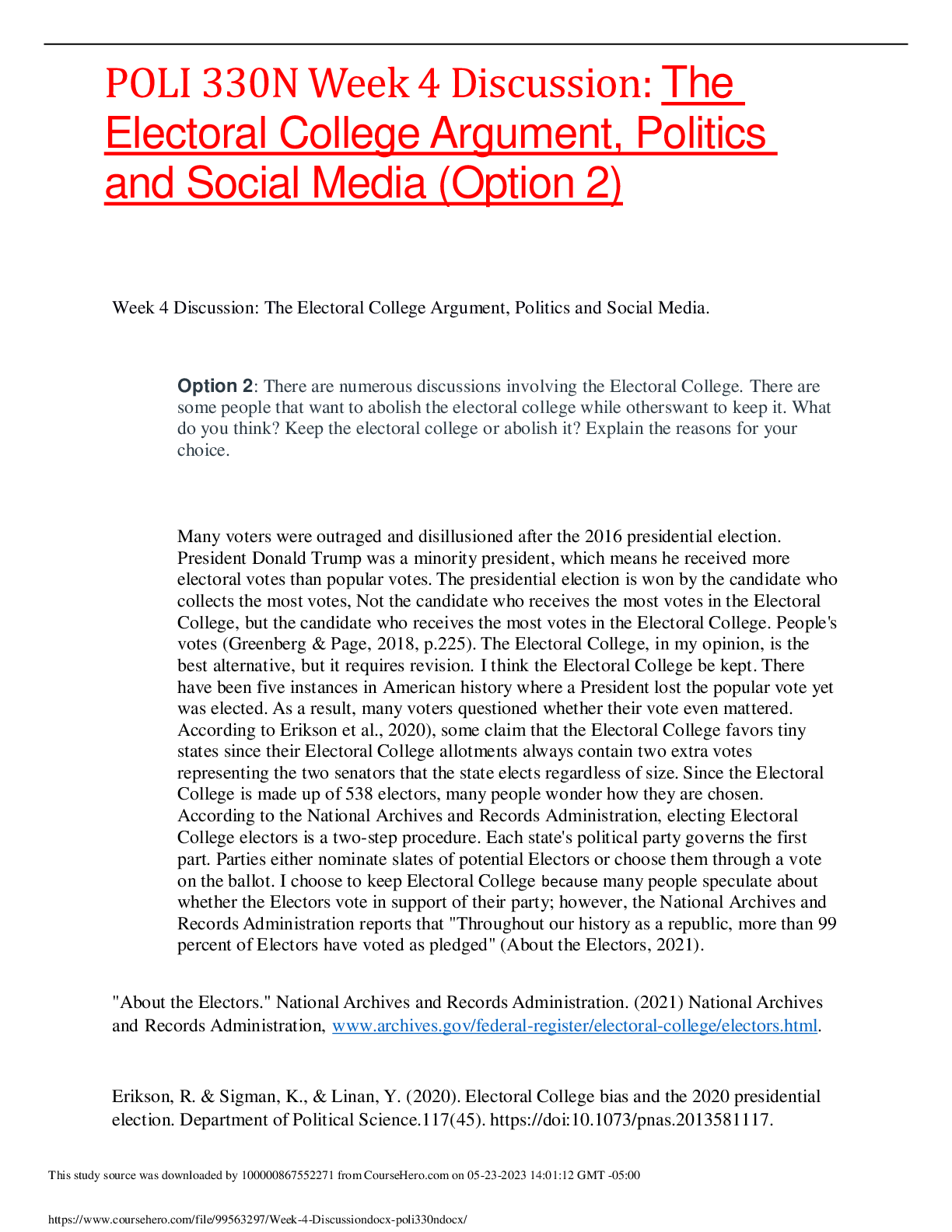
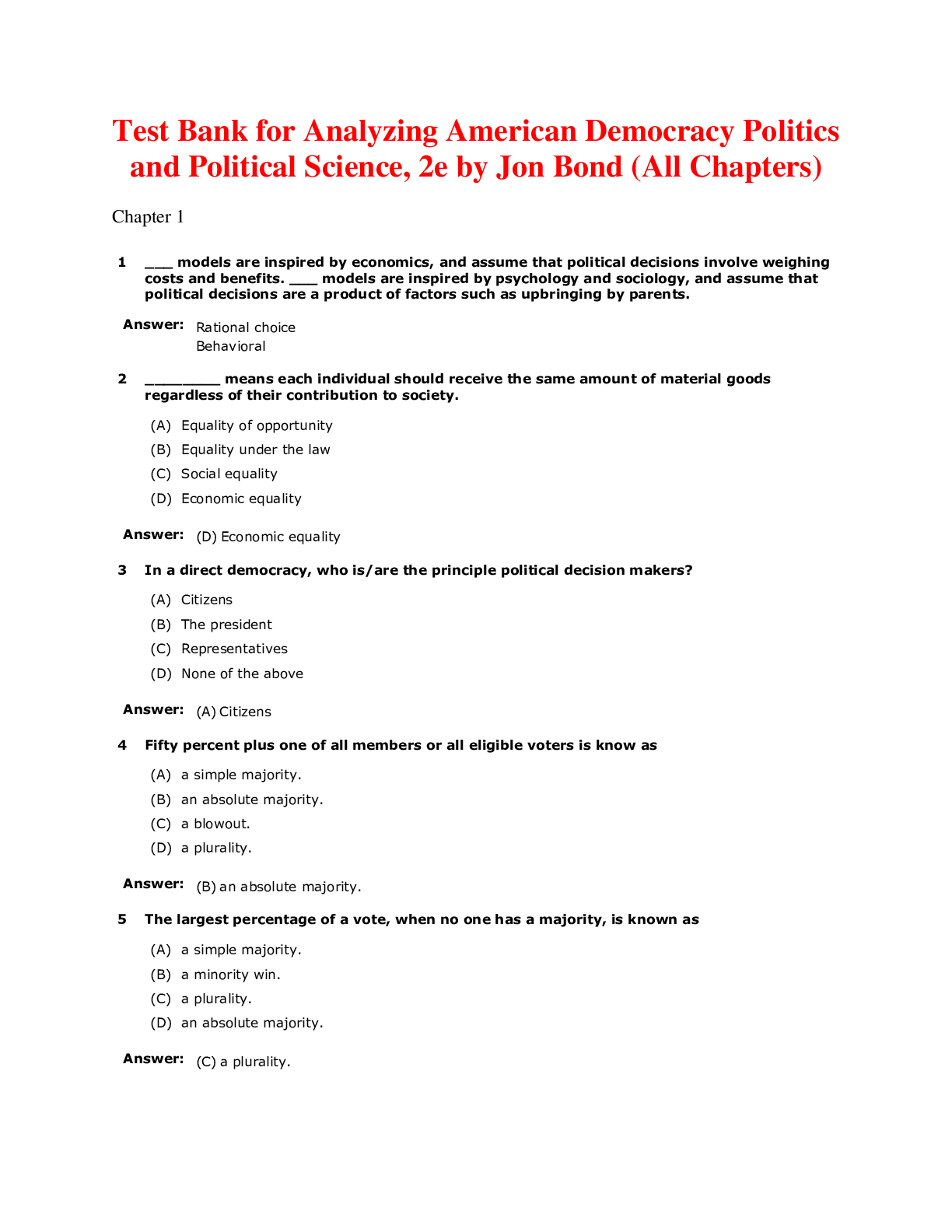
Chapter 15- Judiciaries MULTIPLE-CHOICE QUESTIONS
1. Unlike natural law, positive law uses .
2. Which of the following issues is a civil concern?
3. International law consists of and established customs recognized by most nations.
4. Which of the following is an important role of U.S. courts and their greatest contribution to governance?
5. Developed by medieval Catholic theologians, what type of law argues that observing nature reveals God’s will?
6. What are the key mechanisms of international law?
7. What is the U.S. Supreme Court ruling regarding state obligation to international treaties?
8. Which of the following U.S. Supreme Court rulings reversed the Plessy v. Ferguson decision?
9. Distinguish between primitive and modern judicial systems.
10. Under which of the following circumstances might a case be pursued as both a criminal and a civil case?
Page Reference: 243 A-Head: Types of Law Skill Level: Analyze It
11. How many judicial structures comprise the U.S. court system?
A) 23
B) 47
C) 51
D) 75
Answer: C
Learning Objective: 15.2
Page Reference: 245
A-Head: The Courts, the Bench, and the Bar
Skill Level: Remember the Facts
12. To what judicial authority can federal court decisions be appealed?
A) Department of Citizen Security
B) Secretary of Judicial Revisions
C) Federal Oversight Commission
D) U.S. Court of Appeals
Answer: D
Learning Objective: 15.2
Page Reference: 245
A-Head: The Courts, the Bench, and the Bar
Skill Level: Remember the Facts
13. State court systems handle about of the nation’s legal business.
A) 30%
B) 50%
C) 70%
D) 90%
Answer: D
Learning Objective: 15.2
Page Reference: 246
A-Head: The Courts, the Bench, and the Bar
Skill Level: Remember the Facts
14. The English common law stressed the rights of free and equal men and was developed on the basis of precedent set by earlier judges, known today as .
A) judge-made law
B) judicial precedent
C) example by trial
D) court-generated
Answer: A
Learning Objective: 15.2
Page Reference: 246
A-Head: The Courts, the Bench, and the Bar
Skill Level: Understand the Concepts
15. Who nominates and approves federal judges in the U.S. court system?
A) The President and the Senate
B) The Senate and the House
C) The President and Speaker of the House
D) The Senate and the Secretary of State
Answer: A
Learning Objective: 15.2
Page Reference: 247
A-Head: The Courts, the Bench, and the Bar
Skill Level: Understand the Concepts
16. What legal agency in the United States generates reputation-based ratings of prospective federal judges?
A) Judicial Ratings Bureau
B) Federal Bureau of Judicial Review
C) American Bar Association
D) Office of Legal Assessment
Answer: C
Learning Objective: 15.2
Page Reference: 247
A-Head: The Courts, the Bench, and the Bar
Skill Level: Understand the Concepts
17. What did President Obama do to counterbalance the U.S. Supreme Court’s Conservative tilt?
A) He appointed one African American justice and one Hispanic justice.
B) He appointed two liberal women justices.
C) He reinforced executive privilege.
D) He appointed one conservative and one moderate justice.
Answer: B
Learning Objective: 15.2
Page Reference: 248
A-Head: The Courts, the Bench, and the Bar
Skill Level: Apply What You Know
18. Describe the primary jurisdiction of the U.S. Supreme Court.
A) It makes initial rulings on all federal cases, civil and criminal.
B) It rules on high penalty cases, including those with life sentences and the death penalty.
C) Its jurisdiction is almost entirely appellate, from lower federal or state supreme courts.
D) Its jurisdiction is broad, ranging from appellate rulings to original rulings in federal crimes.
Answer: C
Learning Objective: 15.2
Page Reference: 246
A-Head: The Courts, the Bench, and the Bar
Skill Level: Apply What You Know
19. Compare the election cycles of federal and state judges.
A) State judges are elected directly, while federal judges go through an electoral college.
B) State judges are elected based on population, while federal judges are elected per state.
C) State judges are elected, while federal judges are appointed.
D) The election process is nearly identical.
Answer: C
Learning Objective: 15.2
Page Reference: 248
A-Head: The Courts, the Bench, and the Bar
Skill Level: Analyze It
20. Evaluate the political lean of President Eisenhower’s U.S. Supreme Court nominees.
A) He exclusively nominated members of his own party, tipping the balance in his favor.
B) He nominated candidates from both parties, seeking a balanced court.
C) He nominated two Republicans and one independent, the first to be nominated to the Supreme Court.
D) He nominated ethnic minorities, including one African American and the first Jewish justice.
Answer: B
Learning Objective: 15.2
Page Reference: 247
A-Head: The Courts, the Bench, and the Bar
Skill Level: Analyze It
21. Anglo-American courts function on a(n) and process.
A) adversarial; authoritarian
B) accusatorial; ambivalent
C) authoritarian; removed
D) accusatorial; adversarial
Answer: D
Learning Objective: 15.3
Page Reference: 248
A-Head: Comparing Courts
Skill Level: Remember the Facts
22. In the European court system, the prosecutor is an official who forwards evidence to the
.
A) investigating judge
B) judicial panel
C) case review board
D) district attorney
Answer: A
Learning Objective: 15.3
Page Reference: 249-250
A-Head: Comparing Courts
Skill Level: Remember the Facts
23. “The only lawyer around here is a Kalashnikov,” despaired one Russian, referring to the
.
A) district attorney
B) prosecutor
C) assault rifle
D) Putin administration
Answer: C
Learning Objective: 15.3
Page Reference: 251
A-Head: Comparing Courts
Skill Level: Remember the Facts
24. Describe the significance of Marbury v. Madison.
A) The ruling laid precedent for judicial review.
B) The ruling stated that the president is subject to the court’s decisions.
C) The ruling decreed that current administrations must honor the appointments of previous administrations.
D) The ruling claimed that federal taxes could not be levied on the states.
Answer: A
Learning Objective: 15.3
Page Reference: 250
A-Head: Comparing Courts
Skill Level: Understand the Concepts
25. Identify the role of French lawyers.
A) They listen to the opposing argument and attempt to demonstrate logical or factual mistakes, hoping to sway the lay jury in the summation argument.
B) They question witnesses to bring evidence to light, laying the groundwork for a closing argument.
C) They listen passively as the opposing side questions the witness, interjecting only on grounds of mistaken procedure.
D) They procure evidence for indictment but allow the judge to question witnesses, playing no active role in the trial process.
Answer: A
Learning Objective: 15.3
Page Reference: 250
A-Head: Comparing Courts
Skill Level: Understand the Concepts
26. How long is the tenure of British judges?
A) Six years
B) Eight years
C) Twelve years
D) Life
Answer: D
Learning Objective: 15.3
Page Reference: 250
A-Head: Comparing Courts
Skill Level: Understand the Concepts
27. Examine the ideal role of American judges.
A) Judges should intervene frequently, interpreting the law according to their expertise and ensuring a fair trial.
B) Judges should act as umpires, passively watching the legal drama and ruling only on disputed points of procedure.
C) Judges should not intervene unless attorneys object, at which point they may either overrule or sustain the objection.
D) Judges should take an active role, questioning witnesses, eliciting evidence, and commenting on procedure.
Answer: B
Learning Objective: 15.3
Page Reference: 248
A-Head: Comparing Courts
Skill Level: Apply What You Know
28. Describe the role of theft on the post-Stalin Russian legal system.
A) Theft was punished severely: a mere indictment almost certainly assured a 10-year prison sentence.
B) With strict punishments set in place, theft greatly declined in the years after Stalin’s rule.
C) Theft became the norm for Soviet economic life and helped bring down the system.
D) Because all government property “belong[ed] to the people,” private citizens could legally steal from the government.
Answer: C
Learning Objective: 15.3
Page Reference: 251
A-Head: Comparing Courts
Skill Level: Apply What You Know
29. Compare Anglo-American courts to those in Russia.
A) Anglo-American courts include bourgeois concepts, such as property law and civil rights, whereas the Soviet-developed Russian system excludes these concepts.
B) The Russian court is a passive institution that does not seek to correct lawbreakers or to apprehend criminals, whereas the Anglo-American system is an active institution.
C) Courts in Russia frequently indict politicians disloyal to the president’s agenda, whereas Anglo-American courts remain separate from politics.
D) Russian courts represent the upper class, while American courts protect the interests of common laborers.
Answer: A
Learning Objective: 15.3
Page Reference: 248-251 A-Head: Comparing Courts Skill Level: Analyze It
30. Distinguish the roles of Russia’s Committee on State Security (KGB) and the current Federal Security Service (FSB).
A) The KGB was a corrupt organization, devoted to protecting Russia’s elite; the FSB protects the people’s interests.
B) Unlike the KGB which focused primarily on counter-cultural activities, the FSB functions more as a Secret Service to protect the president from possible threats.
C) The FSB aims to expose government corruptions, while the KGB protected it.
D) The FSB continues the KGB’s aim, to make sure those in power stay in power.
Answer: D
Learning Objective: 15.3
Page Reference: 251
A-Head: Comparing Courts
Skill Level: Analyze It
31. Which United States Federalist is famous for noting that the courts could limit legislative authority?
A) George Washington
B) John Adams
C) Alexander Hamilton
D) James Madison
Answer: C
Learning Objective: 15.4
Page Reference: 253
A-Head: The Role of the Courts
Skill Level: Remember the Facts
32. Which of the following actions comprise roles of the German Constitutional Court?
A) It maintains liberty, defends civil rights, and protects the people against autocratic rule.
B) It decides cases between states, protects civil liberties, and outlaws dangerous political parties.
C) It reviews new laws against the constitution (Basic Law), assesses criminal cases, and checks political campaign funds.
D) It preserves checks and balances, maintains separation of powers, and occasionally reverses decisions of lower courts.
Answer: B
Learning Objective: 15.4
Page Reference: 251-252
A-Head: The Role of the Courts
Skill Level: Remember the Facts
33. Strong-willed U.S. presidents have resisted the authority of the Court. Which of the following presidents notably disagreed with the Court’s decisions?
A) Thomas Jefferson, Andrew Jackson, and Abraham Lincoln
B) Dwight D. Eisenhower, Richard Nixon, and Ronald Reagan
C) John F. Kennedy, Gerald Ford, and Jimmy Carter
D) Ulysses S. Grant, William McKinley, and Calvin Coolidge
Answer: A
Learning Objective: 15.4
Page Reference: 253
A-Head: The Role of the Courts
Skill Level: Remember the Facts
34. The concept of judicial review falls under which article of the U.S. Constitution?
A) Article I: The Legislative Branch
B) Article III: The Judicial Branch
C) Article VI: Debts, Supremacy, Oaths
D) Judicial review is not mentioned in the U.S. Constitution.
Answer: D
Learning Objective: 15.4
Page Reference: 253
A-Head: The Role of the Courts
Skill Level: Understand the Concepts
35. Which of the following was an argument against granting the U.S. Supreme Court the power of judicial review?
A) Many feared that such a power would give the Court a double check and compromise its neutrality.
B) Some thought that such power would create untrustworthy judges.
C) The founding fathers argued that judicial review would lead to undue indictments by the Court.
D) Drafters of the Constitution feared that few laws would ever be set in stone.
Answer: A
Learning Objective: 15.4
Page Reference: 253
A-Head: The Role of the Courts
Skill Level: Understand the Concepts
36. Which Swiss agency determines whether a cantonal law violates the Swiss constitution?
A) National Judicial Branch
B) Swiss Supreme Court
C) Federal Tribunal
D) Constitutional Review Board
Answer: C
Learning Objective: 15.4
Page Reference: 251
A-Head: The Role of the Courts
Skill Level: Understand the Concepts
37. Compared to other countries, what is the perceived corruption in the United States, relative to income?
A) Somewhat low
B) Somewhat high
C) Extremely low
D) Extremely high
Answer: A
Learning Objective: 15.4
Page Reference: 252
A-Head: The Role of the Courts
Skill Level: Apply What You Know
38. Which of the following best articulates the stance of judicial restraint advocates?
A) Judicial review is the best and only true method of checking legislative power.
B) The court should practice restraint in cases in which legislative acts are presented for interpretation.
C) Only the executive branch can restrain the Court, keeping the power of judicial review in balance with the other governing branches.
D) Only Congress should make public policy and, unless a legislative act clearly violates the Constitution, the law should stand.
Answer: D
Learning Objective: 15.4
Page Reference: 253
A-Head: The Role of the Courts
Skill Level: Apply What You Know
39. How does the American concept of judicial review compare to the role of courts in foreign systems?
A) Most countries maintain a similar process of judicial review, which evaluates federal laws against the nation’s constitution.
B) Judicial review is more highly developed in the United States than in any other country, and Americans expect more of their courts than do other peoples.
C) The United States is the only developed nation to maintain the process of judicial review.
D) Most foreign constitutions are exempt from judicial review, stripping the courts of any power they might have in shaping legislation.
Answer: B
Learning Objective: 15.4
Page Reference: 251-252
A-Head: The Role of the Courts
Skill Level: Analyze It
40. Analyze the U.S. Supreme Court within context of Germany’s Constitutional Court.
A) Because Germany’s Constitutional Court operates within a more rigid code of law, its decisions do not have the impact of U.S. Supreme Court decisions.
B) Due to executive restraints, Germany’s Constitutional Court is less powerful than the U.S. Supreme Court.
C) Germany’s Constitutional Court is more codified than the U.S. Supreme Court, making it rival and sometimes overrule the executive branch.
D) The U.S. Supreme Court’s rulings function as the “law of the land,” while the Constitutional Court may still be overruled.
Answer: A
Learning Objective: 15.4
Page Reference: 251-252
A-Head: The Role of the Courts
Skill Level: Analyze It
41. Historically, Supreme Court justices used to be exclusively upper- or upper- middle-class males.
A) powerful
B) WASP
C) New England
D) Christian
Answer: B
Learning Objective: 15.5
Page Reference: 254
A-Head: The Supreme Court’s Political Rule
Skill Level: Remember the Facts
42. Some justices, like (one of six Jewish justices) and (the first black justice), were active in reform and civil rights causes and brought their liberalism to the bench.
A) Ruth Ginsberg; Earl Warren
B) Owen Roberts; Hugo Black
C) Arthur Goldberg; Clarence Thomas
D) Louis Brandeis; Thurgood Marshall
Answer: D
Learning Objective: 15.5
Page Reference: 254
A-Head: The Supreme Court’s Political Rule
Skill Level: Remember the Facts
43. The Supreme Court’s decision in (1954) triggered a revolution in American race relations, an area Congress had been unwilling to touch.
A) Miranda v. Arizona
B) Dred Scott v. Sandford
C) Brown v. Board of Education
D) Gibbons v. Ogden
Answer: C
Learning Objective: 15.5
Page Reference: 255
A-Head: The Supreme Court’s Political Role
Skill Level: Remember the Facts
44. In Lombard v. Louisiana (1963), the Warren Court supported , ruling that blacks who had refused to leave a segregated lunch counter could not be prosecuted.
A) boycotts
B) sit-ins
C) picket lines
D) protests
Answer: B
Learning Objective: 15.5
Page Reference: 255
A-Head: The Supreme Court’s Political Role
Skill Level: Understand the Concepts
45. Among the most famous rulings in a criminal procedure, Mapp v. Ohio (1961) ruled that
.
A) evidence seized without a warrant was inadmissible in a state court
B) police could seize any item deemed “evidence” in the absence of a warrant
C) officers may lawfully search any person under the guise of “probable cause”
D) law enforcement officers may search private residences without a warrant
Answer: A
Learning Objective: 15.5
Page Reference: 255
A-Head: The Supreme Court’s Political Role
Skill Level: Understand the Concepts
46. This 1966 case ruled that arrested persons must immediately be told of their right to remain silent and to have a lawyer present during police questioning.
A) Escobedo v. Illinois
B) Gideon v. Wainwright
C) Miranda v. Arizona
D) Hazelwood v. Kuhlmeier
Answer: C
Learning Objective: 15.5
Page Reference: 255
A-Head: The Supreme Court’s Political Role
Skill Level: Understand the Concepts
47. What have been the implications of the 2010 Citizens United case?
A) Corporations were deemed as non-persons, and thus cannot contribute directly to political campaigns.
B) Individuals, corporations, and unions may now contribute unlimited campaign funds through so-called “super-PACs.”
C) Despite being considered collections of people by the Court, corporations may not donate to political campaigns.
D) Individuals may donate unlimited campaign funds, but corporations face a stiff $100,000 cap.
Answer: B
Learning Objective: 15.5
Page Reference: 256-257
A-Head: The Supreme Court’s Political Role
Skill Level: Apply What You Know
48. What was perhaps the most conservative shift of the Roberts Court?
A) The Court took on notably fewer cases than before, reversing the tendency to use the Court at a back-up legislature.
B) The Court ruled conservatively on abortion cases, whereas the previous Court tended to rule on the pro-choice side.
C) Roberts and colleagues seemed more heavily influenced by outside opinion, lessening the Court’s ostensible objectivity.
D) Despite its liberal rulings on gun control, the Court ruled conservatively on gay rights and immigration issues.
Answer: A
Learning Objective: 15.5
Page Reference: 257
A-Head: The Supreme Court’s Political Role
Skill Level: Apply What You Know
49. Analyze the series of court decisions in 1962 and 1964 finding that unequal representation denied citizens their Fourteenth Amendment rights.
A) The Court ordered that state legislatures apply the principle of “one person, one vote” in redrawing electoral lines.
B) State legislatures were ordered to redraw district lines to better represent African Americans.
C) The Republican party was censured for excluding the black vote using voter ID laws.
D) States were forced to add one representative per 100,000 people to better serve impoverished areas.
Answer: A
Learning Objective: 15.5
Page Reference: 256
A-Head: The Supreme Court’s Political Role
Skill Level: Analyze It
50. Compare the Warren Court to those immediately succeeding it.
A) The Warren Court was generally considered conservative, but subsequent courts were seen as more liberal.
B) Subsequent courts were conservative, but not nearly as conservative as the Warren Court.
C) Succeeding Courts failed to represent the conservative agenda of the Warren Court.
D) While the Warren Court was rather progressive, subsequent courts were viewed as conservative.
Answer: D
Learning Objective: 15.5
Page Reference: 256
A-Head: The Supreme Court’s Political Role
Skill Level: Analyze It
TRUE/FALSE QUESTIONS
51. With only 2.3 million people in U.S. jails, we rarely hear about the criminal law system.
Answer: FALSE
Learning Objective: 15.1
Page Reference: 243
A-Head: Types of Law
Skill Level: Remember the Facts
52. Because in the United States the ultimate responsibility of interpreting the Constitution rests with the U.S. Supreme Court, laws cannot change once they’ve been ruled on.
Answer: FALSE
Learning Objective: 15.1
Page Reference: 244
A-Head: Types of Law
Skill Level: Remember the Facts
53. The federal courts hear many diversity jurisdiction cases, in which the issue deals with state law but residents are from different states.
Answer: TRUE
Learning Objective: 15.2
Page Reference: 245
A-Head: The Courts, the Bench, and the Bar
Skill Level: Understand the Concepts
54. The pinnacle of the federal court system is the U.S. Supreme Court, consisting of one chief justice and six associate justices.
Answer: FALSE
Learning Objective: 15.2
Page Reference: 246
A-Head: The Courts, the Bench, and the Bar
Skill Level: Understand the Concepts
55. In British and American criminal cases, the police investigate and report to a public prosecutor, often a county’s district attorney. The case is then passed to a judge who must decide whether to prosecute.
Answer: FALSE
Learning Objective: 15.3
Page Reference: 248
A-Head: Comparing Courts
Skill Level: Remember the Facts
56. British judges are nominally appointed by the prime minister, but the choice is really the monarch’s, based on recommendations of the lord chancellor.
Answer: FALSE
Learning Objective: 15.3
Page Reference: 249
A-Head: Comparing Courts
Skill Level: Remember the Facts
57. Court structures in other Western democracies largely parallel the U.S. system, but tend not to do as much in terms of governing.
Answer: TRUE
Learning Objective: 15.4
Page Reference: 251
A-Head: The Role of the Courts
Skill Level: Remember the Facts
58. The U.S. Supreme Court’s power to review the constitutionality of federal legislative enactments is not mentioned specifically in the Constitution and has been vehemently challenged.
Answer: TRUE
Learning Objective: 15.4
Page Reference: 253
A-Head: The Role of the Courts
Skill Level: Understand the Concepts
59. Richard Nixon in the 1968 campaign championed the Warren Court, claiming that its decisions had cracked down on crime and better secured the nation’s streets.
Answer: FALSE
Learning Objective: 15.5
Page Reference: 253
A-Head: The Supreme Court’s Political Role
Skill Level: Understand the Concepts
60. Under the Roberts Court, Brown v. Board of Education and Roe v. Wade received some limits, marking the Court as generally conservative, but federal authority to curb greenhouse gases was affirmed, and liberals celebrated.
Answer: TRUE
Learning Objective: 15.5
Page Reference: 256
A-Head: The Supreme Court’s Political Role
Skill Level: Apply What You Know
FILL-IN-THE-BLANK
61. Criminal offences are divided into three categories, petty offences, misdemeanors, and
.
Answer: felonies
Learning Objective: 15.1
Page Reference: 243
A-Head: Types of Law
Skill Level: Remember the Facts
62. In the United States, we focus on law, that which is written and compiled by humans over the centuries.
Answer: positive
Learning Objective: 15.1
Page Reference: 243
A-Head: Types of Law
Skill Level: Remember the Facts
63. As French kings overturned feudalism in favor of absolutism, legal scholars revived
to bolster central government and encourage commerce.
Answer: Roman law
Learning Objective: 15.2
Page Reference: 247
A-Head: The Courts, the Bench, and the Bar
Skill Level: Understand the Concepts
64. Appellate courts base their majority-vote verdict primarily on submitted by the attorneys for both parties; oral arguments are limited.
Answer: briefs
Learning Objective: 15.2
Page Reference: 246
A-Head: The Courts, the Bench, and the Bar
Skill Level: Understand the Concepts
65. Russia’s post-Soviet legal system has continued much of its former legal structure because most personnel were trained under the .
Answer: Communists
Learning Objective: 15.3
Page Reference: 250
A-Head: Comparing Courts
Skill Level: Remember the Facts
66. Unlike British courts, European ones are influenced by the French , and thus do not maintain separate criminal and civil divisions.
Answer: Code Napoléon
Learning Objective: 15.3
Page Reference: 249
A-Head: Comparing Courts
Skill Level: Remember the Facts
67. In the 1950s, Germany’s Constitutional Court ruled against both the Communist and
parties, finding that they wanted to overthrow the constitutional order.
Answer: Neo-Nazi
Learning Objective: 15.4
Page Reference: 252
A-Head: The Role of the Courts
Skill Level: Remember the Facts
68. Scandals are standard in Italy, Japan, and France, rendering those countries more corrupt than their wealth suggests. They are therefore on the Corruption Perception Index.
Answer: outliers
Learning Objective: 15.4
Page Reference: 252
A-Head: The Role of the Courts
Skill Level: Understand the Concepts
69. 1963’s Gideon v. Wainwright held that defendants must be provided with legal counsel.
Answer: indigent
Learning Objective: 15.5
Page Reference: 255
A-Head: The Supreme Court’s Political Role
Skill Level: Understand the Concepts
70. In 1978’s case, the Burger Court ruled that reserving quotas for black medical school applicants violated equal protection for whites.
Answer: Bakke
Learning Objective: 15.5
Page Reference: 256
A-Head: The Supreme Court’s Political Role
Skill Level: Apply What You Know
SHORT ANSWER QUESTIONS
71. What is positive law and how is it different from natural law?
Learning Objective: 15.1
Page Reference: 243
A-Head: Types of Law
Skill Level: Understand the Concepts
72. How does the opposition party oppose and sometimes block the president’s Supreme Court nominations?
Learning Objective: 15.2
Page Reference: 247
A-Head: The Courts, the Bench, and the Bar
Skill Level: Apply What You Know
73. How does the Russian court’s theoretical role differ from its practiced role?
Learning Objective: 15.3
Page Reference: 250
A-Head: Comparing Courts
Skill Level: Apply What You Know
74. Discriminate between countries with low-perceived corruption and high-perceived corruption. How do these perceptions correlate with wealth?
Learning Objective: 15.4
Page Reference: 252
A-Head: The Role of Courts
Skill Level: Analyze It
75. Analyze and evaluate presidential methods of dealing with undesirable Supreme Court rulings.
Learning Objective: 15.5
Page Reference: 253
A-Head: The Supreme Court’s Political Role
Skill Level: Analyze It
ESSAY QUESTIONS
76. Identify the influence of natural law on the American legal system. To what extent do we base our laws on objective rationale? To what extent is it influenced by religious or spiritual thought? Be sure to evaluate the latter using specific examples from your text.
Answer: The ideal answer should include:
1. Explain that natural law influences the American legal system indirectly through religious convictions held by large demographics.
2. Identify the perceived frequency of objective rationale as it is implemented in U.S. legislation.
3. Estimate the extent of natural law’s influence on U.S. written law.
4. Evaluate whether or not the large influence of natural law on national policies has a positive or negative affect on our country’s legal welfare.
Learning Objective: 15.1
Page Reference: 243-245
A-Head: Types of Law
Skill Level: Understand the Concepts
77. Examine the process by which U.S. judges are nominated and confirmed. Does this seem like a fair process? What extent does it have on the political lean of the Court, and therefore, on United States law? Cite specific examples.
Answer: The ideal answer should include:
1. Note that judges are nominated by the president and confirmed by the Senate.
2. Evaluate the fairness of this process.
3. State whether or not the process of nomination and confirmation takes a political toll on the Court, and the extent to which that lean influences law.
4. Specific examples might include the progressive bent of Chief Justice Earl Warren or moderate Justice Sandra Day O’Connor.
Learning Objective: 15.2
Page Reference: 245-248
A-Head: The Courts, the Bench, and the Bar
Skill Level: Apply What You Know
78. Compare the role of Anglo-American courts to the role of the courts in Europe. In what ways are the similar? How do they differ? Which system exerts stronger influence on legislation, and which system better serves the welfare of its people?
Answer: The ideal answer should include:
1. Explain that Anglo-American courts are passive institutions that do not look for injustices to correct or lawbreakers to apprehend; moreover, a state attorney (prosecutor) examines witnesses during trial.
2. Note that European courts do not have separate criminal and civil divisions. Furthermore, European judges sit as a panel to rule on points of law and procedure, but at the conclusion of the trial they retire with a jury to consider the verdict and the sentence.
3. Contrast the role of judges in each system, stating that European judges exert much more influence on individual cases, but that higher courts (equivalent to the U.S. Supreme Court) do little to influenced law.
4. Evaluate the two systems, stating which system “better serves” the welfare of its people.
Learning Objective: 15.3
Page Reference: 248-251
A-Head: Comparing Courts
Skill Level: Apply What You Know
79. Consider the process by which the U.S. Supreme Court gained the power of judicial review. Does this power, as some founding fathers argued, upset the balance of powers? Cite specific examples to determine whether or not today’s Court reveals any bias, and whether or not that bias negatively affects citizens’ rights.
Answer: The ideal answer should include:
1. Explain that the courts gained judicial review through Marbury v. Madison.
2. Examine the Court’s potential to upset the balance of powers by overruling legislation drafted by elected officials.
3. Identify bias in the court, citing such liberals as Louis Brandeis or conservatives such as John Roberts.
4. Evaluate the impact of this bias, stating whether or not it limits the rights of citizens whose only official representation consists of elected officials who ultimately do not get the last say concerning the legality of legislation.
Learning Objective: 15.4
Page Reference: 251-253
A-Head: The Role of the Courts
Skill Level: Analyze It
80. Analyze the political impact of the Warren Court (1953-1969). What were some of the major reforms instigated by Chief Justice Warren? How did successive courts revise Warren’s precedent concerning the Supreme Court’s political role in governance?
Answer: The ideal answer should include:
1. Examine some of Warren’s progressive decisions concerning civil rights, as well as his attempts to rewrite criminal procedure and legislative reappointment.
2. Cite specific examples to support the above assertion, including Brown v. Board of Education
or Lombard v. Louisiana.
3. Note the conservative political bent of succeeding courts, including the Burger Court (1969- 1986) and the Rehnquist Court (1986-2005).
4. Explain how, despite their conservative politics, those courts influenced the political role of the Court by opting to take fewer cases, thus reducing the Court’s more liberal role as a political tool.
Learning Objective: 15.5
Page Reference: 253-257
A-Head: The Supreme Court’s Political Role
Skill Level: Analyze It
[Show More]
.png)