Midterm Study guide NR 599 Informatics
General principles of Nursing Informatics
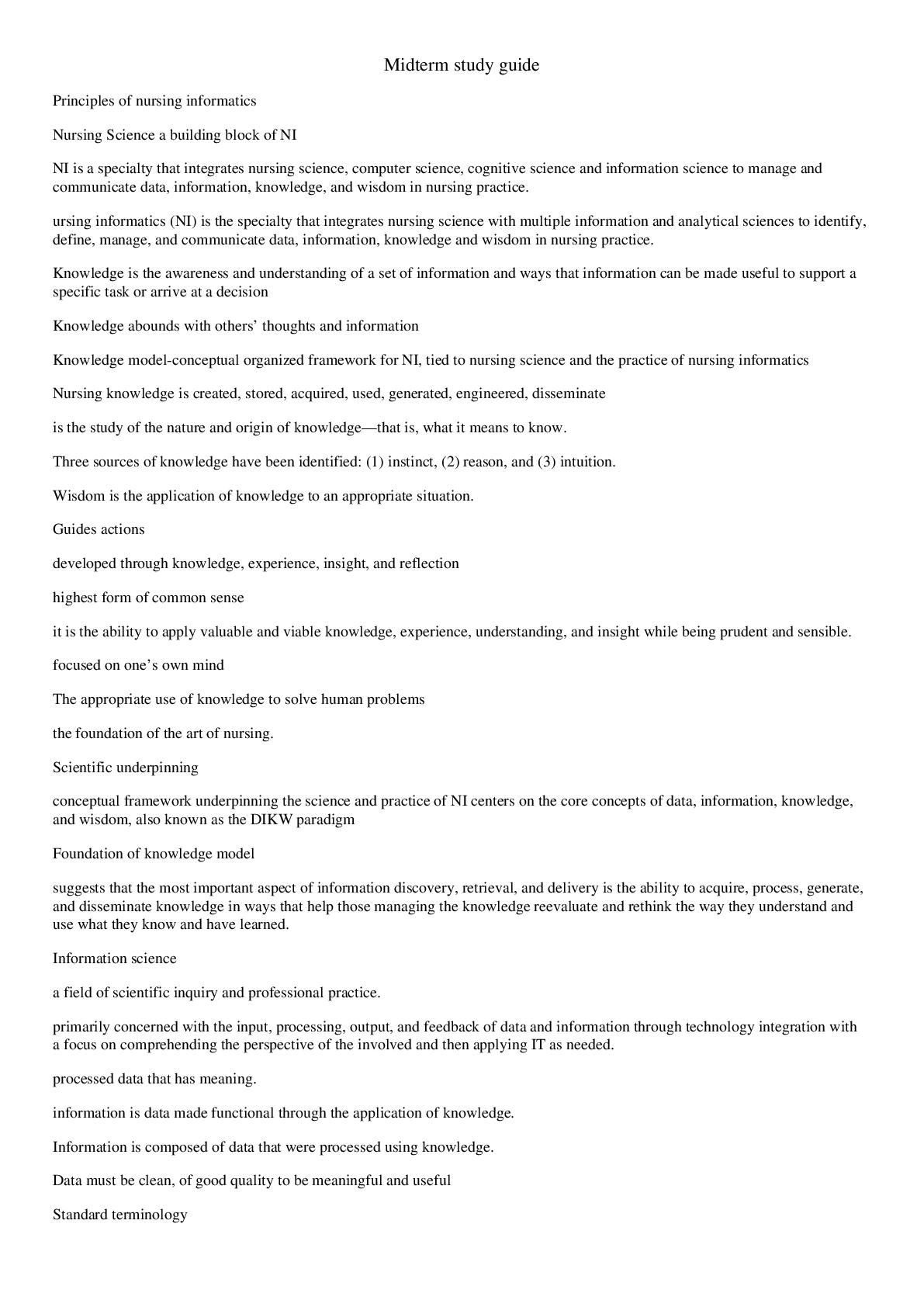
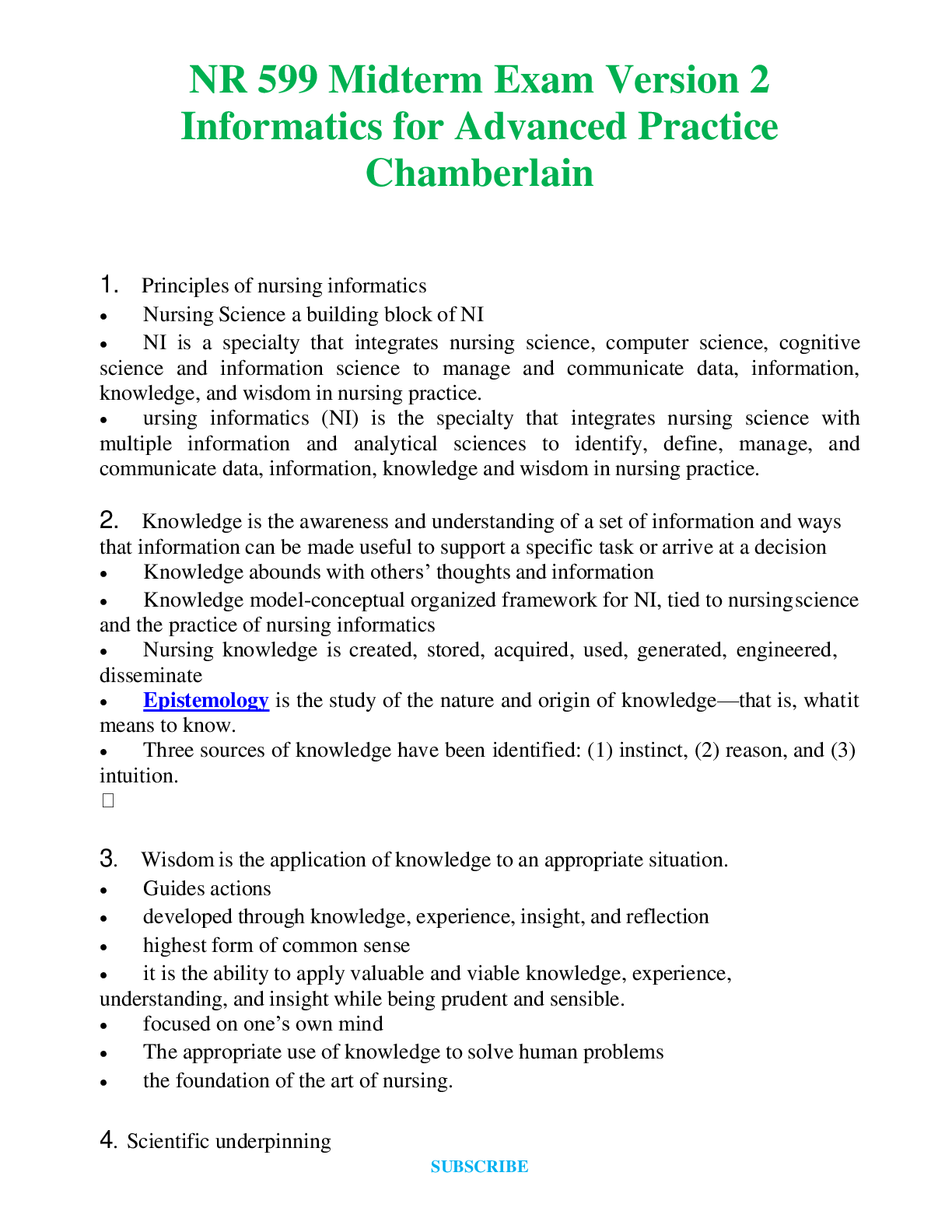
Nursing informatics is the specialty that integrates nursing science with multiple
information management and analytical sciences to ide
...
Midterm Study guide NR 599 Informatics
General principles of Nursing Informatics
Nursing informatics is the specialty that integrates nursing science with multiple
information management and analytical sciences to identify, define, manage, and
communicate data, information, knowledge, and wisdom in nursing practice.
One of the most frequently quoted and widely accepted definitions of nursing informatics is
that it is a combination of nursing science, information science and computer science
· Knowledge
•All nurses have the opportunity to be involved in the formal dissemination of knowledge via
their participation in professional conferences either as presenters or attendees.
•All nurses, regardless of the practice arena, must use informatics and technology to inform
and support that practice.
· Wisdom
•Wisdom is the application of knowledge to an appropriate situation.
•In the practice of nursing science, we expect action and/or actions directed by wisdom.
•Wisdom uses knowledge and experience to heighten common sense and insight to exercise
sound judgment in practical matters. It is developed through knowledge, experience, insight
and reflection.
· Scientific Underpinning
The scientific underpinnings of practice provide the basis of knowledge
for advanced nursing practice. These scientific underpinnings include
sciences such as biology, physiology, psychology, ethics, and nursing.
· The Foundation of Knowledge Model
According to Mastrain and McGonigle (2009), one of the most prominent models
associated with nursing informatics is the Foundation of Knowledge model. This
theory involves integrating four main kinds of knowledge, which are: knowledge
acquisition, knowledge dissemination, knowledge generation and knowledge
processing.
Knowledge acquisition: application of knowledge acquired through
education, research, and practice to provide services and interventions to
patients to maintain, enhance, or restore their health, and to acquire,process, generate, and dis- seminate nursing knowledge to advance the
nursing profession.
Knowledge Dissemination: Disturbing and sharing of knowledge learned
Knowledge Generation: Creating new knowledge by changing and evolving
knowledge based on your experience, education and input from others
Knowledge Processing: The activity or process of gathering, collecting or
perceiving, analyzing, saving and transmitting knowledge
The Foundation of Knowledge model specifically prompts nurses to extend their
theoretical and metaphorical knowledge into practical, holistic determinations based on
a variety of factors and contexts. Because competencies in informatics include but are
not limited to information literacy, computer literacy, and the ability to use strategies
and system applications to manage data, knowledge, and information, the ability of
nursing students to use computer-mediated communication skills is essential to their
success in the nursing field and as a means to improve patient safety.
•Organizing conceptual framework for text
•Helps to explain the ties between nursing science and informatics and knowledge
•Informatics is viewed as a tool for founding knowledge
· Computer science
· Computer science is introduced through a focus on computers and the
hardware and software that make up these evolving systems; computer science is one
of the building blocks of nursing informatics. Computer science offers extremely
valuable tools that, if used skillfully, can facilitate the acquisition and manipulation of
data and information by nurses, who can then synthesize these into an evolving
knowledge and wisdom base.
Data storage, management, retrieval, and processing.
· Cognitive science
Interdisciplinary field that studies the mind, intelligence, and behavior from an
information processing perspective. A field that involves both cognitive informatics and
artificial intelligence. The science of understanding what information is housed in and
processed by the brain (Cognitive informatics)
· Information science
the science of information studying the application and usage of information and
knowledge in organizations and the interfacing or interaction between people,organizations and information systems. Integrates features from cognitive science,
communication science, computer science, library science and social sciences
· Informatics Competencies
Have been developed to encompass all levels of practice and ensure that entrylevel nurses are ready to enter the more technologically advanced field of nursing. And
establish advanced competencies for specialty practice. These competencies may be
used to determine the educational needs of current staff members
· Information literacy
Ability to recognize when info is needed as well as the skills to evaluate and use
needed info effectively. this nurse can recognize significant, relevant research and
know how to apply it to practice. ability to recognize when information is needed as
well as the skills to find, evaluate, and use needed information effectively
· Health literacy
degree to which individuals can obtain, process, and understand basic health
information and services needed to make appropriate health decisions
· Meaningful Use
use of health information technology to collect specific data with the intent to improve
care, engage patients, improve population health, and ensure the privacy and security
· Patient-centered Information Systems
supports the use and documentation of nursing activities
-provides tools for managing and delivery of nursing care
-two goals: nursing functions and nursing practice
Clinical Decision support systems
A computer-based program designed to assist clinicians in making clinical decisions by
filtering or integrating vast amounts of information and providing suggestions for clinical
intervention.
· Electronic Medical Records
legal record created in hospitals and ambulatory environments that is the source of
data for the EHR
-long referred to as single episode treatment-comprised of structured and unstructured data
· Human-Technology Interface
The hardware and software through which the user interacts with any technology (e.g.,
computers, patient monitors, telephone, etc.).
· Health Information Technology
Management and processing of information with the assistance of computers.
Computers and IT provide tools that aid data collection and the analysis associated
with research to support the overall work of nurses.
· Alarm fatigue
You get so many alerts that you get numb to them and begin ignoring them
· Digital natives
Not computer smart, unable to navigate through computers easily. Lack of
computer skills.
· Information Literacy Competency Standards for Nursing
Developed by the TIGER initiative. Three components identified: (1) information
literacy, (2) computer literacy, and (3) clinical information management
1. Information literacy
a. Ability to identify when information is needed as well as the skills to find,
evaluate, and effectively use the same
b. Evaluation of online resources for quality
c. Able to search literature databases effectively
2. Computer literacy
a. Basic familiarity with computer uses and common applications
b. Ability to navigate hyperlinks
c. Able to set up and use a database
3. Clinical information management
a. Uses clinical decision making (CDS) and system safeguards to protect
patients and protected health information (PHI)
b. Able to request and evaluate reports for the purpose of informed decision
making
c. Participate in the selection, design, and evaluation of clinical information
systems and patient-care technologies
d. Uses available technologies to appropriately and effectively communicate
· HITECH Actpush for more technology to be used especially for education
· TIGER-based Nursing Informatics Competencies Model
The work of the Technology Informatics Guiding Education Reform team. This team of
nursing leaders developed a vision for utilizing information technology to transform
nursing practice. Pillars of the TIGER vision include: management and leadership,
education, communication and collaboration, informatics design, information
technology, policy, and culture.
WEEK ONE READING/KEY POINTS
McGonigle, D. & Mastrian, K. (2018).
● Chapter 1
○ Nursing informatics: specialty that integrates nursing science, computer
science, cognitive science, and information science
○ For information to be valuable & quality it must be:
■ Accessible & Utility: right user obtain right information at the right
time in the right format
■ Accurate:
■ Timely: available when needed for the right purpose at the right
time
■ Complete: contains all necessary essential data
■ Cost-effective
■ Flexible: information may be used for a variety or purposes
■ Reliable: authoritative or credible source
■ Relevant: subjective descriptor that has relevant information that is
useful
■ Simple
■ Verifiable
■ Transparency: allows user to apply their intellect to accomplish
tasks while tools housing the information disappears into the
background
■ Secure
■ Reproducibility: ability to produce the same information again
● Chapter 2
○ Data: raw facts
○ Information: processed data that has meaning
○ Data integrity: whole, complete, correct, and consistent data
○ Dirty data: database that contains errors such as duplicate, incomplete, or
outdated records○ Information science: study of information science-- concerned with input,
processing, output, and feedback of data and information through
technology integration with a focus on comprehending the perspective of
the stakeholders involved and then applying IT as needed.
■ Systemically based-- deals with big picture, opposed to individual
pieces of technology
■ Integrates communication science, computer science, cognitive
science, library science, and social science
■ Links people and technology
■ Machines (inorganic ISs) Humans (organic ISs)
■ Focuses on why and how technology can be put to best use to
serve the information flow within an organization
○ Information systems: handle the needs of the entire organization
(communication, tracking, and research)
○ Input: collecting and acquiring raw data
■ Keyboards, touch screen, mice, light pens, automatic scanners
○ Processing: retrieval, analysis, synthesis of data-- transforms data into
useful information and outputs
■ Storing for future use, making calculations, comparing data
○ Output: dissemination-- produces helpful information
■ Reports, documents, summaries, alerts, outcomes
● Chapter 3
○ Motherboard: central nervous system of the computer-- facilitates
communication among all components of the computer
○ Hard disk: permanent data storage area that holds gigabytes of data,
information, documents even when the computer is turned off. Backing up
important files are important because disk drives are not infallible
○ Random-access memory: temporary storage that allows the processor to
access program codes and data while working on a task--the contents of
RAM are lost once the system is rebooted or shuts off
○ Software: application programs
■ OS software
● Most important software on any computer
● Very first program to load on computer start-up and is
fundamental for the operation of all other software and the
computer hardware
● Allows user to multitask with ease
● Described in 6 basic processes: Memory, device, processor,
and storage management, application and user interface
■ Productivity software● Provide all the basic programs that a user needs to do their
work (word, spreadsheet, email, etc)
■ Creativity software
● Allows user to draw, paint, render, record music and sound,
and incorporate multimedia in professional aesthetic ways to
share and convey information and knowledge
■ Communication software
● Allows user to share, dialogue, and network with other users
via exchange of email or instant message
○ Cloud computing: web-browser based login-accessible data, software, and
hardware that you can access and use
■ Public cloud: owned and operated by companies offering public
access to computing resources
■ Private cloud: operated for a single organization with the
infrastructure being managed internally or outsourced to a third
party
[Show More]











.png)