1. Question : (TCO 1) Vitamins are classified into two groups, ________ and
________.
Student Answer: fat soluble; water soluble
microsoluble; macrosoluble
nutritive; nonnutritive
major; trace
Instructor
Explanati
...
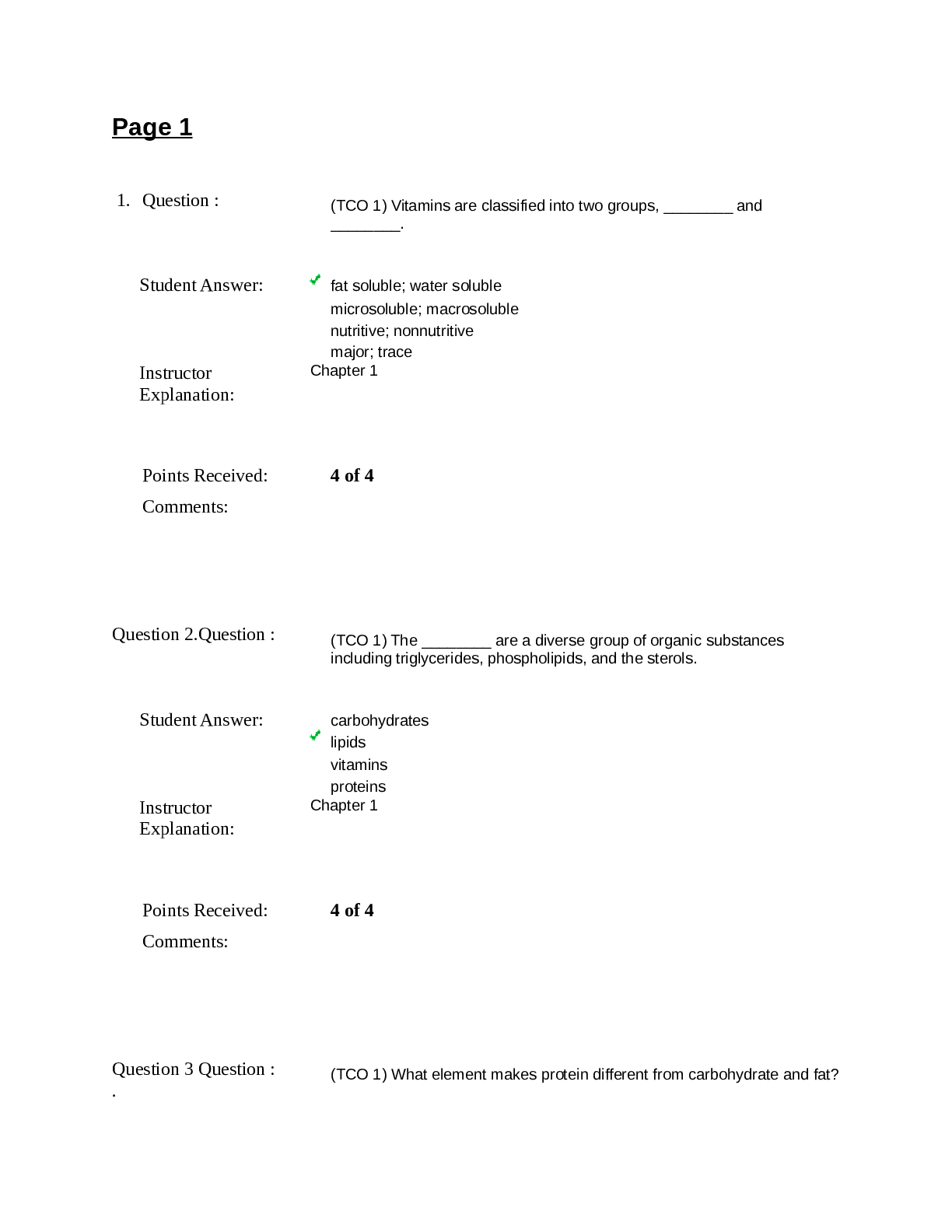
1. Question : (TCO 1) Vitamins are classified into two groups, ________ and
________.
Student Answer: fat soluble; water soluble
microsoluble; macrosoluble
nutritive; nonnutritive
major; trace
Instructor
Explanation:
Chapter 1
Points Received: 4 of 4
Comments:
Question 2.Question : (TCO 1) The ________ are a diverse group of organic substances
including triglycerides, phospholipids, and the sterols.
Student Answer: carbohydrates
lipids
vitamins
proteins
Instructor
Explanation:
Chapter 1
Points Received: 4 of 4
Comments:
Question 3
.
Question : (TCO 1) What element makes protein different from carbohydrate and fat?Student Answer: Carbon
Hydrogen
Nitrogen
Oxygen
Instructor
Explanation:
Chapter 1
Points Received: 4 of 4
Comments:
Question 4
.
Question : (TCO 1) Which of the following is an example of disease that is directly
caused by a nutritional deficiency?
Student Answer: Anemia
Cancer
Osteoporosis
Heart disease
Instructor
Explanation:
Chapter 1
Points Received: 0 of 4
Comments:
Question 5.Question : (TCO 1) Jane consumed a breakfast that contained 85 grams of
carbohydrate, 20 grams of protein, and 18 grams of fat. How many
kilocalories did Jane eat at breakfast?
Student Answer: 492 kilocalories
582 kilocalories
917 kilocalories1,107 kilocalories
Instructor
Explanation:
Chapter 1
Points Received: 4 of 4
Comments:
Question 6
.
Question : (TCO 1) Which of the following nutrients is organic?
Student Answer: Minerals
Water
Protein
Both minerals and water
Instructor
Explanation:
Chapter 1
Points Received: 0 of 4
Comments:
Question 7
.
Question : (TCO 2) ________ are inorganic nutrients that are not broken down by
the human body or destroyed by heat.
Student Answer: Vitamins
Minerals
Proteins
Fats
Instructor
Explanation:
Chapter 1
Points Received: 4 of 4Comments:
Question 8
.
Question : (TCO 2) The percent daily values (%DV) on food labels are based on the:
Student Answer: DRIs.
RDIs.
DRVs.
all of these
Instructor
Explanation:
Chapter 2
Points Received: 4 of 4
Comments:
Question 9.Question : (TCO 2) The standard used to estimate the daily nutrient needs of half of
all healthy individuals is:
Student Answer: EAR.
AI.
RDA.
UL.
Instructor
Explanation:
Chapter 1
Points Received: 4 of 4
Comments:Question 10
.
Question : (TCO 2) The dietary standard that has been established regarding
nutrients about which more research is needed to determine human
requirements is the:
Student Answer: DRI.
RDA.
AI.
UL.
Instructor
Explanation:
Chapter 1
Points Received: 4 of 4
Comments:
Question 11.Question : (TCO 2) Which federal agency conducts the National Health and Nutrition
Examination Survey (NHANES) and the Behavioral Risk Factor
Surveillance System (BRFSS)?
Student Answer: USDA (United States Department of Agriculture)
CDC (Centers for Disease Control and Prevention)
ADA (American Dietetic Association)
NIH (National Institutes of Health)
Instructor
Explanation:
Chapter 1
Points Received: 4 of 4
Comments:
Question 12.Question : (TCO 2) Which two pancreatic hormones are responsible for maintaining
blood glucose levels?Student Answer: estrogen and testosterone
neuropeptide Y and leptin
insulin and glucagon
bicarbonate and HCl
Instructor
Explanation:
Chapter 2
Points Received: 4 of 4
Comments:
Question 13
.
Question : (TCO 3) What is chyme?
Student Answer: ulcerations of the esophageal lining
healthy bacteria of the small intestine
mixture of partially digested food, water, and gastric juices
substance that allows for the emulsification of dietary lipid
Instructor
Explanation:
Chapter 3
Points Received: 4 of 4
Comments:
Question 14
.
Question : (TCO 3) Responding to the presence of protein and fat in our meal,
cholecystokinin (CCK) signals the gallbladder to release a substance
called:
Student Answer: lipase.
pepsin.
chyme.
bile.
Instructor Chapter 3Explanation:
Points Received: 4 of 4
Comments:
Question 15.Question : (TCO 3) Bob eats his breakfast and his GI tract will now begin the
process of digesting and absorbing the nutrients from this meal. What is
the order in which each of the organs of the GI tract will work to achieve
this process?
Student Answer: mouth: esophagus: small intestine: stomach: large intestine
mouth: esophagus: stomach: small intestine: large intestine
mouth: stomach: esophagus: small intestine: large intestine
mouth: stomach: esophagus: large intestine: small intestine
Instructor
Explanation:
Chapter 3
Points Received: 4 of 4
Comments:
Question 16
.
Question : (TCO 3) Bicarbonate is released into the duodenum during the process of
digestion. Why?
Student Answer: to neutralize the acidic chyme
to activate hormonal release of bile
to digest fats/oils
to lubricate the villi of the small intestine
Instructor
Explanation:
Chapter 3
Points Received: 4 of 4Comments:
Question 17
.
Question : (TCO 3) Which large vessel transports absorbed nutrients to the liver?
Student Answer: portal vein
pulmonary vein
aorta
subclavian vein
Instructor
Explanation:
Chapter 3
Points Received: 4 of 4
Comments:
Page 2
1. Question : (TCO 4) Which of the following is NOT characteristic of type 2 diabetes?
Student Answer: arises most commonly during adulthood
insulin resistance or insensitivity
often associated with obesity
the least common form of diabetes
Instructor
Explanation:
Chapter 4
Points Received: 4 of 4
Comments:Question 2.Question : (TCO 4) Yogurt is tolerated better than milk by many lactase-deficient
people because:
Student Answer: yogurt has no lactose.
bacteria in yogurt help digest the lactose.
it has a thicker consistency.
yogurt is acidic.
Instructor
Explanation:
Chapter 4
Points Received: 4 of 4
Comments:
Question 3
.
Question : (TCO 4) Which of the following carbohydrates is the end product of
photosynthesis?
Student Answer: glycogen
galactose
lactose
glucose
Instructor
Explanation:
Chapter 4
Points Received: 4 of 4
Comments:
Question 4 Question : (TCO 4) Which of the following BESTdescribes the glycemic index?.
Student Answer: an individual's glucose/insulin ratio in a fasted state
the amount of insulin required to metabolize 100 grams of glucose
the glucose content of a given food
the extent to which a given food raises blood glucose and insulin
Instructor
Explanation:
Chapter 4
[Show More]

.png)