Modules 3, 4, & 5
Module 3 Tissue Integrity
BURNS
➢ Review RN delegation of tasks: I&O, tracking, sterile
➢ Infection prevention: sterile dressing changes
➢ Understand how to support severely burned patients from
...
Modules 3, 4, & 5
Module 3 Tissue Integrity
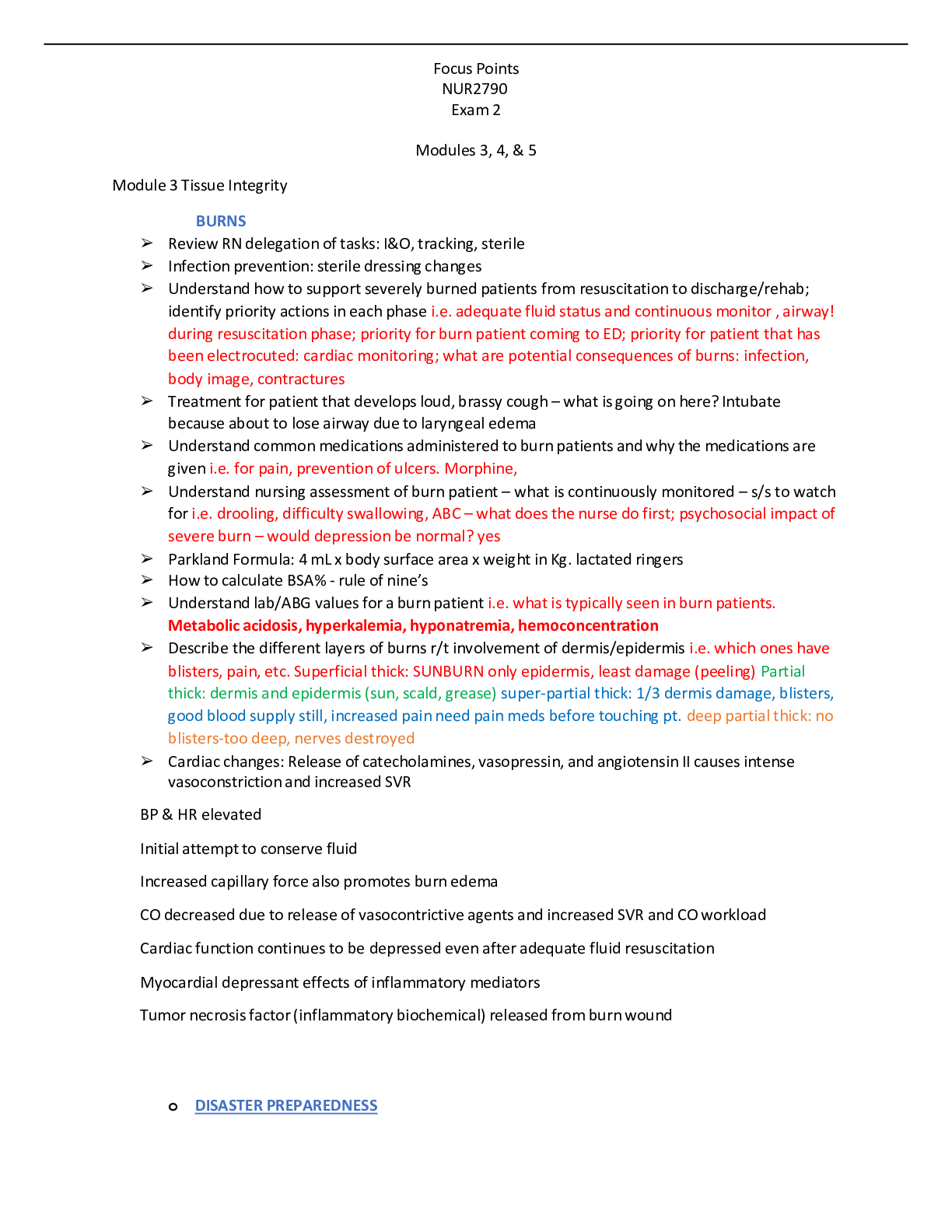
BURNS
➢ Review RN delegation of tasks: I&O, tracking, sterile
➢ Infection prevention: sterile dressing changes
➢ Understand how to support severely burned patients from resuscitation to discharge/rehab; identify priority actions in each phase
➢ Treatment for patient that develops loud, brassy cough – what is going on here? Intubate
because about to lose airway due to laryngeal edema
➢ Understand common medications administered to burn patients and why the medications are given
➢ Understand nursing assessment of burn patient – what is continuously monitored – s/s to watch for
➢ Parkland Formula: 4 mL x body surface area x weight in Kg. lactated ringers
➢ How to calculate BSA% - rule of nine’s
➢ Understand lab/ABG values for a burn patient
➢ Describe the different layers of burns r/t involvement of dermis/epidermis
➢ Cardiac changes: Release of catecholamines, vasopressin, and angiotensin II causes intense
vasoconstriction and increased SVR BP & HR elevated
Initial attempt to conserve fluid
Increased capillary force also promotes burn edema
CO decreased due to release of vasocontrictive agents and increased SVR and CO workload Cardiac function continues to be depressed even after adequate fluid resuscitation Myocardial depressant effects of inflammatory mediators
Tumor necrosis factor (inflammatory biochemical) released from burn wound
o DISASTER PREPAREDNESS
➢ Understand colored tags and how would you educate others: black tag=low chance of survival
➢ Understand personal preparedness plan – what do you include or consider. 3 days. Food water.
➢ What does the RN need to do to be prepared on the floor? Chain of command
o Emergency Nursing/Mass casualty/Trauma Nursing
➢ Role of RN in ED when there is a mass casualty? Triage, delegating, pt care
➢ Understand critical incident stress debriefing how to prevent PTSD as a nurse? Talk to someone, sleep, exercise, eat right, hydration
➢ Understand how you would triage incoming patients from mass casualty – examples know difference between traditional and mass casualty? Treat stable first, traditional treat most sick first.
➢ Mass casualty event – paramedic, Hospital incident commander, public information officer, triage officer, medical command physician – hierarchy and roles
➢ Review RN delegation of tasks: LPNs and techs can collect info but RN charge for plan of care
➢ Specialty teams available in ER: trauma stroke resp.,cardiac, code rapid, anesthesia, forensic
➢ CPR – family presence
➢ Consider vulnerable populations – establishing trust
➢ Priority assessments i.e. which color would nurse focus on; patient arrives with O2 mask on assess airway;
GAS EXCHANGE
➢ Understand Rapid Response Team role. Unstable pts
➢ Pulmonary embolus – patho, risk factors i.e. DVT, afib, immobility post surgical, preg, s/s you may see: SOB, tachy, chest pain dyspnea, anxiety., anticipated treatment intervention to prevent DVT anticoagulants. Monitor for bleeding, ptt
➢ Anticoagulants – monitoring, patient education. Electric razor, soft brush
➢ ABGs for respiratory issues i.e. COPD resp acidosis
➢ Common medications for intubated patients – what to monitor, patient education to prevent ulcers.
➢ Mechanical ventilation – assessment (5-15) PEEP of 20cm means too high can cause pneumo, treatment- prevent VAP ETT removed suction and oral care; low pressure alarm caused by losing pressure could be cuff leak, disconnection; high pressure alarm mucus plug, kink, biting tube; agitated patient what does the nurse assess for low O2, pain; dyspneic with normal O2 sat -ARDS
➢ Flail chest – anticipated interventions : pos. pressure, pain mngmt NO CHEST TUBE
➢ Understand refractory hypoxemia – wide spread inflammatory response seen in what disease process? ARDS
CARDIAC
➢ Understand ECG complex – think about what is going on in the heart if there is no P wave with every QRS, or if a segment lengthens i.e. what part of the conduction system of the heart controls the rate-SA node; what wave is not normally seen on ECG- U wave not seen
➢ Common medications cardiac pt.– Beta blockers-tachy, anticoagulants-prevent clots and stroke patient education- Take own pulse; what two meds will patient with afib have long term are above.
➢ You notice a change in rhythm on patient telemetry – what do you do? go see pt and assess!
➢ Treatment for VFib is defibulate
➢ Substance abuse: coke meth
➢ What treatments would the RN initiate for fatal dysrhythmias (think ventricular- asystole: do CPR do not shock, vtach: shock or, vfib, PEA: do not shock) remember SVT is atria, not ventricles.
➢ CHF – assessment for physiologic alterations during bradycardia: and tachycardia
➢ Asystole tx: chest compressions (CPR) drug is epinephrine
➢ Bradycardia drug, Atropine.
➢ What is normal cardiac output. 6L/min.
➢ Pacemaker patient education: do not lift, bracelet, no MRI, lab draws and BP
➢ What patient would need an external pacemaker? Waiting for a permanent. AED is an ex. Pacemaker.
➢ ICD (implantable defibrillator s) patient education : Avoid magnets!
[Show More]