Fundamental Skills - Laboratory Values
1. A client with atrial fibrillation who is receiving
maintenance therapy of warfarin sodium (Coumadin) has a
prothrombin time (PT) of 35 seconds. On the basis of the
prothrombi
...
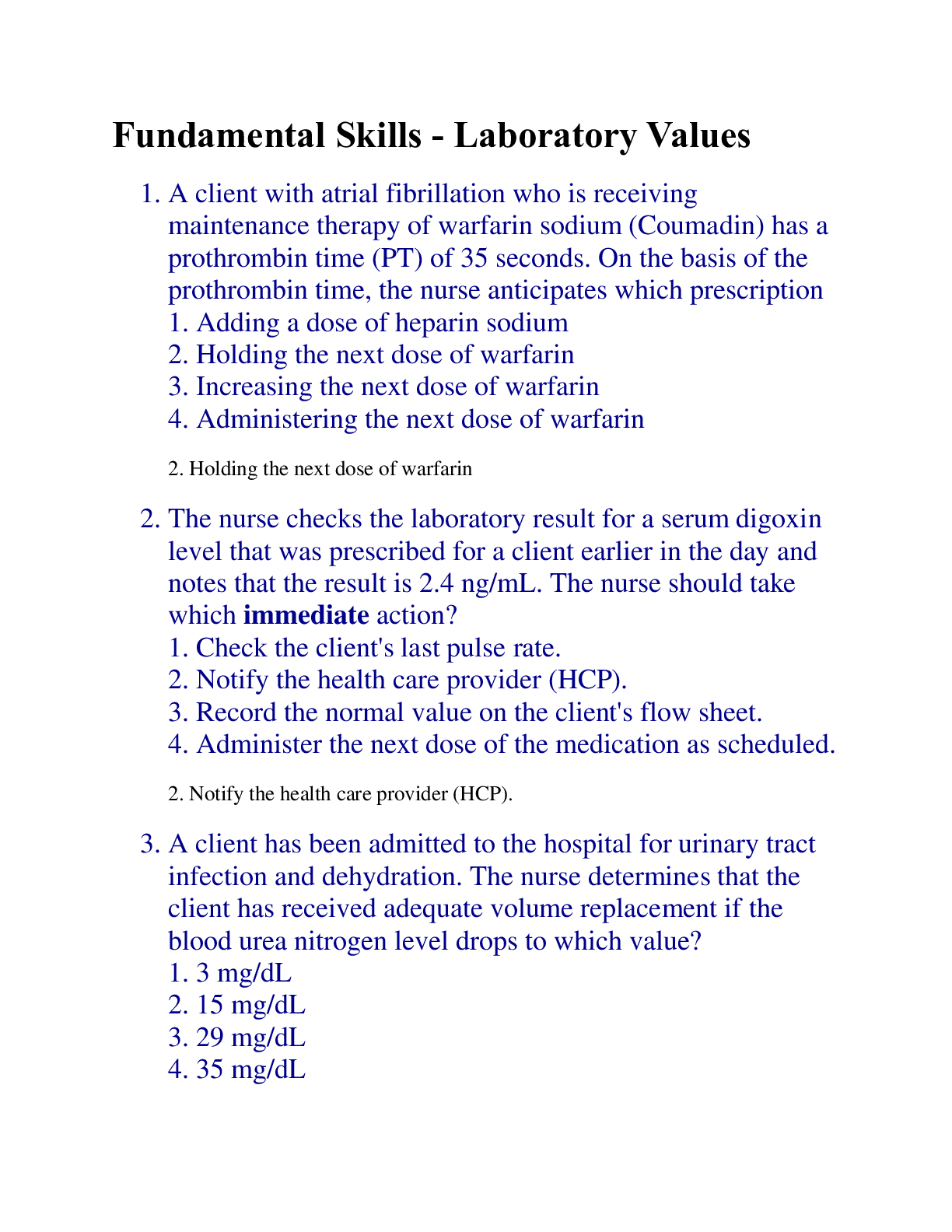
Fundamental Skills - Laboratory Values
1. A client with atrial fibrillation who is receiving
maintenance therapy of warfarin sodium (Coumadin) has a
prothrombin time (PT) of 35 seconds. On the basis of the
prothrombin time, the nurse anticipates which prescription
1. Adding a dose of heparin sodium
2. Holding the next dose of warfarin
3. Increasing the next dose of warfarin
4. Administering the next dose of warfarin
2. Holding the next dose of warfarin
2. The nurse checks the laboratory result for a serum digoxin
level that was prescribed for a client earlier in the day and
notes that the result is 2.4 ng/mL. The nurse should take
which immediate action?
1. Check the client's last pulse rate.
2. Notify the health care provider (HCP).
3. Record the normal value on the client's flow sheet.
4. Administer the next dose of the medication as scheduled.
2. Notify the health care provider (HCP).
3. A client has been admitted to the hospital for urinary tract
infection and dehydration. The nurse determines that the
client has received adequate volume replacement if the
blood urea nitrogen level drops to which value?
1. 3 mg/dL
2. 15 mg/dL
3. 29 mg/dL
4. 35 mg/dL2. 15 mg/dL
4. A client arrives in the emergency department complaining
of chest pain that began 4 hours ago. A troponin T blood
specimen is obtained, and the results indicate a level of 0.6
ng/mL. The nurse determines that this result indicates
which finding?
1. A normal level
2. A low value that indicates possible gastritis
3. A level that indicates a myocardial infarction
4. A level that indicates the presence of possible angina
3. A level that indicates a myocardial infarction
5. A client is receiving a continuous intravenous infusion of
heparin sodium to treat deep vein thrombosis. The client's
activated partial thromboplastin (aPTT) time is 65 seconds.
The nurse anticipates that which action is needed?
1. Discontinuing the heparin infusion
2. Increasing the rate of the heparin infusion
3. Decreasing the rate of the heparin infusion
4. Leaving the rate of the heparin infusion as is
4. Leaving the rate of the heparin infusion as is
6. A client with a history of cardiac disease is due for a
morning dose of furosemide (Lasix). Which serum
potassium level, if noted in the client's laboratory report,
should be reported before administering the dose of
furosemide?
1. 3.2 mEq/L
2. 3.8 mEq/L3. 4.2 mEq/L
4 .4.8 mEq/L
1. 3.2 mEq/L
7. Several laboratory tests are prescribed for a client, and the
nurse reviews the results of the tests. Which abnormal
laboratory test results should the nurse report? Select all
that apply.
1. Calcium, 7 mg/dL
2. Magnesium, 1 mg/dL
3. Phosphorus, 3.6 mg/dL
4. Neutrophils, 1000 cells/mm3
5. Serum creatinine, 1 mg/dL
6. White blood cells, 3000 cells/mm3
o 1. Calcium, 7 mg/dL
o 2. Magnesium, 1 mg/dL
o 4. Neutrophils, 1000 cells/mm3
o 6. White blood cells, 3000 cells/mm3
8. An adult client with cirrhosis has been prescribed a diet
with optimal amounts of protein. The nurse evaluates the
client's status as being most satisfactory if the total protein
is which value?
1. 0.4 g/dL
2. 3.7 g/dL
3. 6.4 g/dL
4. 9.8 g/dL
3. 6.4 g/dL
9. A client with diabetes mellitus has a glycosylated
hemoglobin A1c level of 9%. On the basis of this test
result, the nurse plans to teach the client about the need for
which measure?1. Avoiding infection
2. Taking in adequate fluids
3. Preventing and recognizing hypoglycemia
4. Preventing and recognizing hyperglycemia
4. Preventing and recognizing hyperglycemia
10. The nurse is caring for a client with a diagnosis of
cancer who is immunosuppressed. The nurse would
consider implementing neutropenic precautions if the
client's white blood cell count was which value?
1. 2000 cells/mm3
2. 5800 cells/mm3
3. 8400 cells/mm3
4. 11,500 cells/mm3
1. 2000 cells/mm3
11. A client brought to the emergency department states
that he has accidentally been taking two times his
prescribed dose of warfarin (Coumadin) for the past week.
After noting that the client has no evidence of obvious
bleeding, the nurse plans to take which action?
1. Prepare to administer an antidote.
2. Draw a sample for type and crossmatch and transfuse the
client.
3. Draw a sample for an activated partial thromboplastin
time (aPTT) level.
4. Draw a sample for prothrombin time (PT) and
international normalized ratio (INR).
4. Draw a sample for prothrombin time (PT) and international normalized ratio
(INR).12. The nurse is assigned to a 40-year-old client who has a
diagnosis of chronic pancreatitis. The nurse anticipates the
client's serum amylase level to be which value?
1. 45 units/L
2. 100 units/L
3. 300 units/L
4. 500 units/L
3. 300 units/L
13. An adult female client has a hemoglobin level of 10.8
g/dL. The nurse interprets that this result is most
likely caused by which condition noted in the client's
history?
1. Dehydration
2. Heart failure
3. Iron deficiency anemia
4. Chronic obstructive pulmonary disease
3. Iron deficiency anemia
14. A client with a history of gastrointestinal bleeding has
a platelet count of 300,000 cells/mm3. The nurse should
take which action after seeing the laboratory results?
1. Report the abnormally low count.
2. Report the abnormally high count.
3. Place the client on bleeding precautions.
4. Place the normal report in the client's medical record.
4. Place the normal report in the client's medical record.
15. A client is undergoing diagnostic tests to rule out a
diagnosis of renal disease. The laboratory results indicate aratio of blood urea nitrogen (BUN) to creatinine of 15:1.
The nurse plans care, knowing that this result indicates
which condition?
1. Liver failure
2. A normal ratio
3. A fluid volume deficit
4. A fluid volume excess
2. A normal ratio
16. An unlicensed assistive personnel (UAP) collects a
urine specimen from a client and is planning to deliver the
specimen to the laboratory after completing morning care
for other assigned clients. The registered nurse (RN)
instructs the UAP to place the collected specimen in the
unit laboratory refrigerator because which condition results
if urine is allowed to stand unrefrigerated?
1. The pH decreases.
2. The urine clumps.
3. The urine becomes more acidic.
4. Bacteria and white blood cells (WBCs) decompose.
4. Bacteria and white blood cells (WBCs) decompose.
17. A client is undergoing diagnostic testing because of
suspected renal disease. Which laboratory
test best evaluates the kidneys' ability to regulate fluid
balance?
1. Creatinine
2. Urinary protein
3. Urine specific gravity
4. Blood urea nitrogen (BUN)3. Urine specific gravity
18. A client with acute glomerulonephritis has had a
urinalysis sample sent to the laboratory. The report reveals
the presence of hematuria and proteinuria. The nurse
interprets these results as which condition?
1. Consistent with glomerulonephritis
2. Inconsistent with glomerulonephritis
3. Unclear, and no conclusion can be drawn
4. Indicative of impending acute kidney injury
1. Consistent with glomerulonephritis
19. The clinic nurse has obtained a throat culture
specimen from a client in whom a throat infection is
suspected. The nurse calls the laboratory to have the
specimen picked up and is told that the laboratory is shortstaffed and that the laboratory assistant will pick up the
specimen in 2 hours. Which is the most
appropriate nursing action?
1. Refrigerate the specimen.
2. Tell the client to return in 1 hour for a repeat throat
culture.
3. Contact the health care provider (HCP) who prescribed
the specimen.
4. Tell the laboratory that someone needs to pick up the
specimen immediately.
1. Refrigerate the specimen.
20. Ferrous sulfate (iron) has been prescribed for the
pregnant client with anemia. Before initiating the therapy,
the nurse reviews which laboratory value that reflects theneed for this dietary supplement?
1. Clotting time
2. Bleeding time
3. Prothrombin time
4. Hemoglobin level
4. Hemoglobin level
21. To detect the development of a chronic carrier state in
a client with hepatitis, which laboratory test should the
nurse assess?
1. Hepatitis B virus DNA
2. Prolonged prothrombin time
3. Hepatitis B surface antigen (HBsAg)
4. Antibody to surface antigen (anti-HBs)
3. Hepatitis B surface antigen (HBsAg)
22. Which outcome should the nurse expect to observe in
the client who is recovering from viral hepatitis without
complications?
1. Presence of asterixis
2. Increasing prothrombin time values
3. Decrease in aspartate aminotransferase (AST)
4. Decreased absorption of vitamin K in the intestine
3. Decrease in aspartate aminotransferase (AST)
23. The nurse is caring for a client who is receiving
immunosuppressant therapy, including corticosteroids, after
renal transplantation. The nurse should plan to carefully
monitor results of which laboratory test for this client?
1. Blood glucose level2. Serum calcium level
3. Serum magnesium level
4. Serum albumin concentration
1. Blood glucose level
24. A client with trigeminal neuralgia who is receiving
carbamazepine (Tegretol) 400 mg orally daily has a white
blood cell (WBC) count of 2800 cells/mm3, blood urea
nitrogen (BUN) of 17 mg/dL, sodium of 141 mEq/L, and
uric acid of 5 mg/dL. On the basis of these laboratory
values, the nurse should make which interpretation?
1. The WBC is low, indicating a blood dyscrasia.
2. The BUN is elevated, indicating nephrotoxicity.
3. The sodium level is low, indicating an electrolyte
imbalance.
4. The uric acid level is elevated, indicating the risk for
renal calculi.
1. The WBC is low, indicating a blood dyscrasia.
25. A client has a prescription to have blood drawn to
measure peak and trough vancomycin (Vancocin) levels to
determine the effectiveness of therapy with this medication.
The nurse arranges with the laboratory to have the peak
level specimen drawn at which time?
1. 1 hour before administration of the scheduled dose
2. 1.5 hours after completion of the scheduled infusion
3. Immediately after administration of the scheduled dose
4. 30 minutes before administration of the
[Show More]