Social Sciences  >  QUESTIONS & ANSWERS  >  SOCS 185 Week 2 Quiz (Multiple Choice) (All)

SOCS 185 Week 2 Quiz (Multiple Choice)

Document Content and Description Below

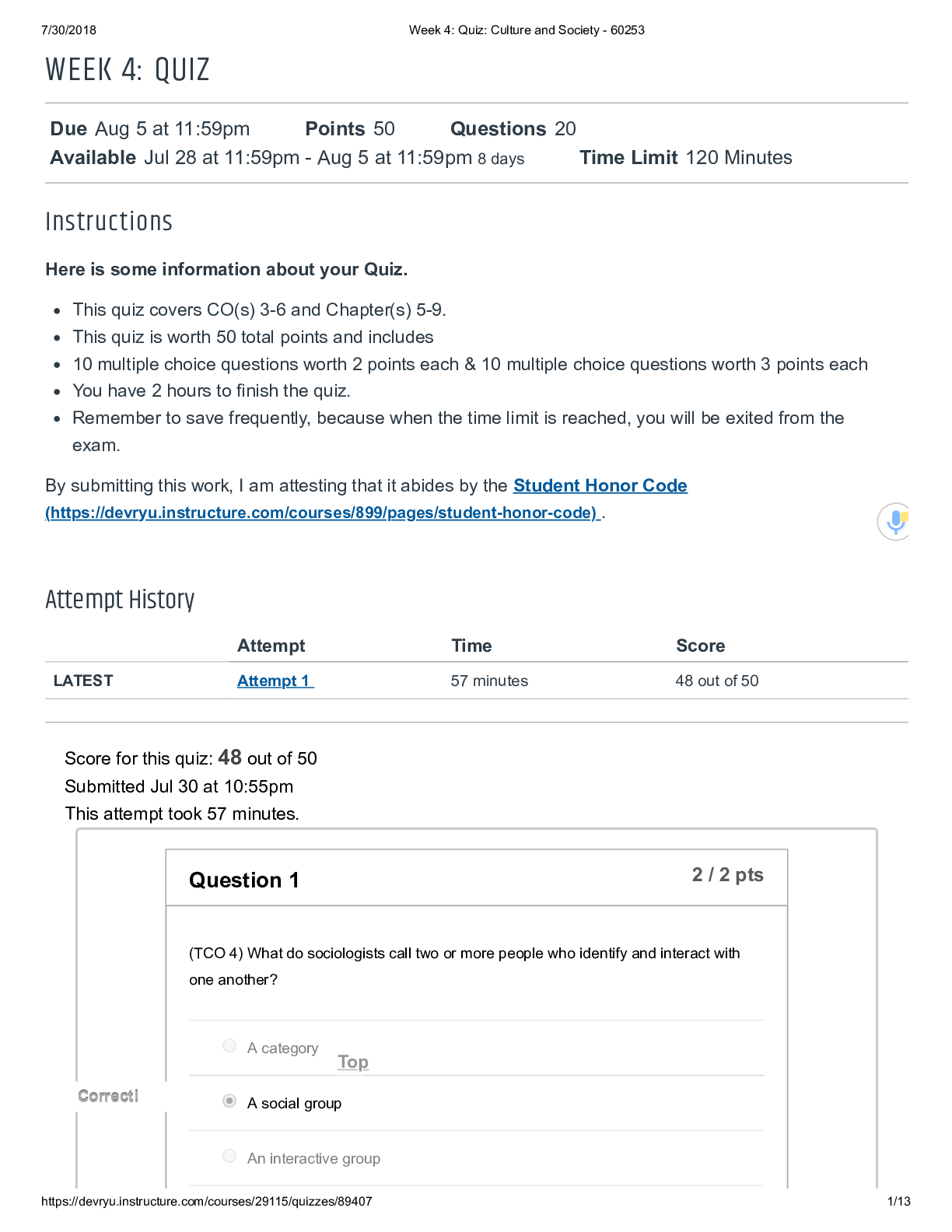
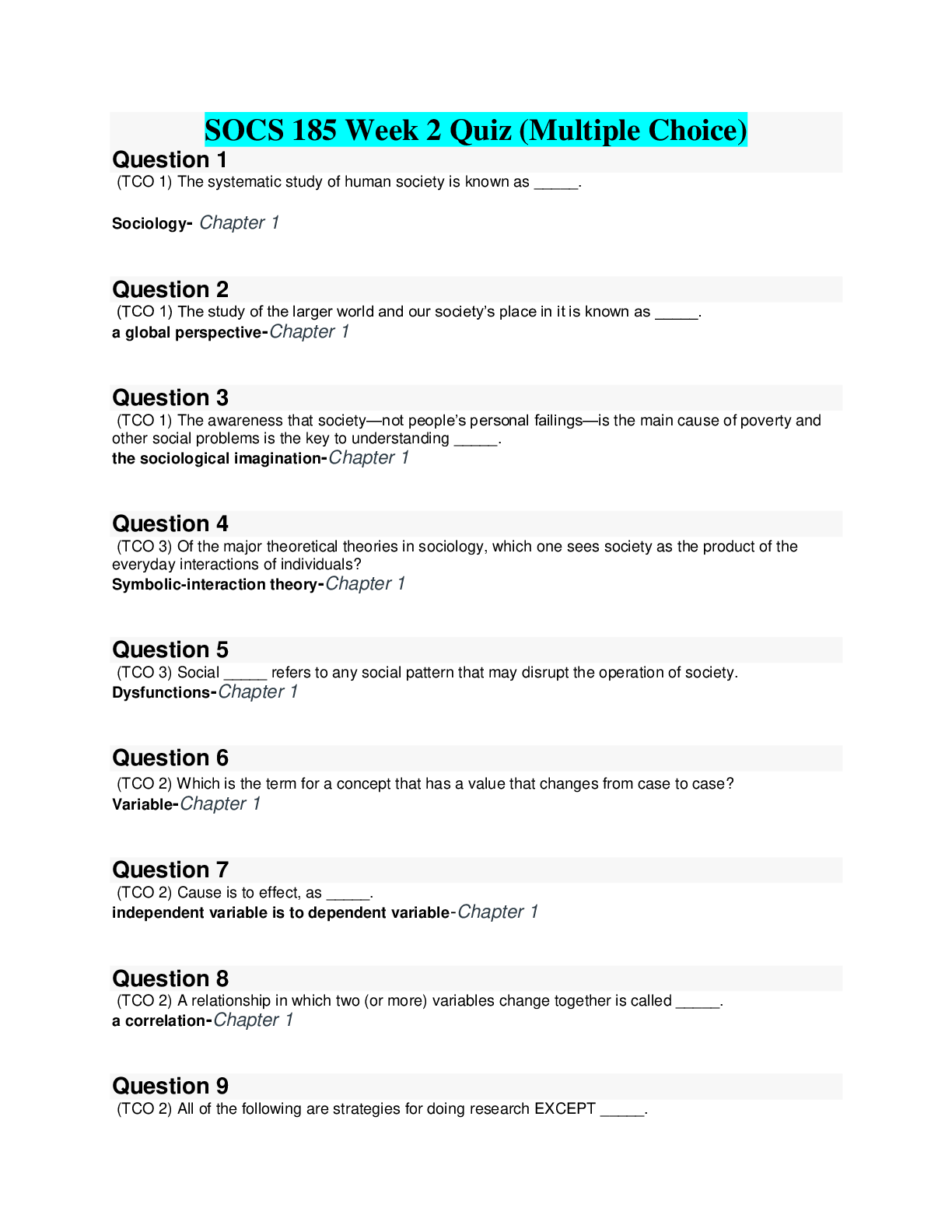
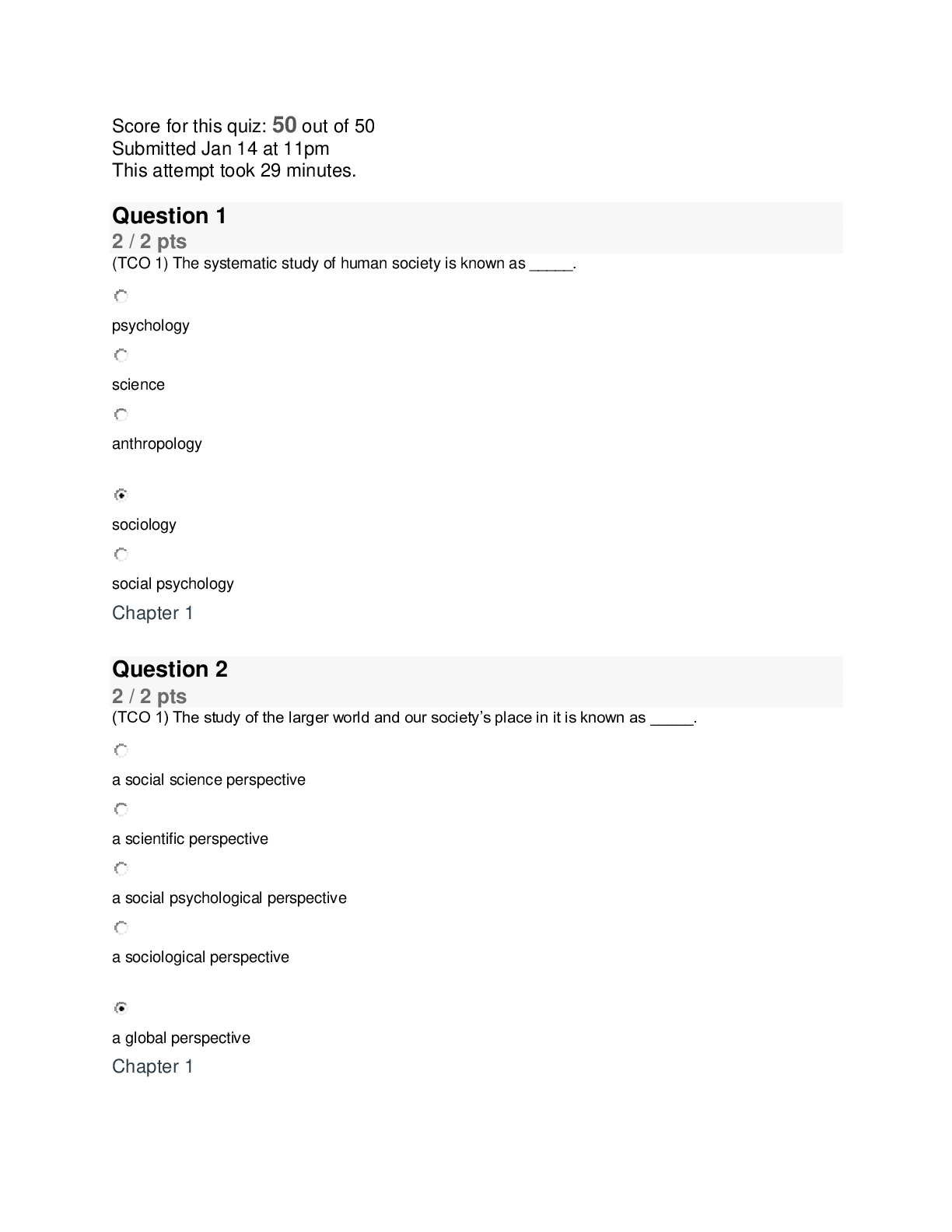
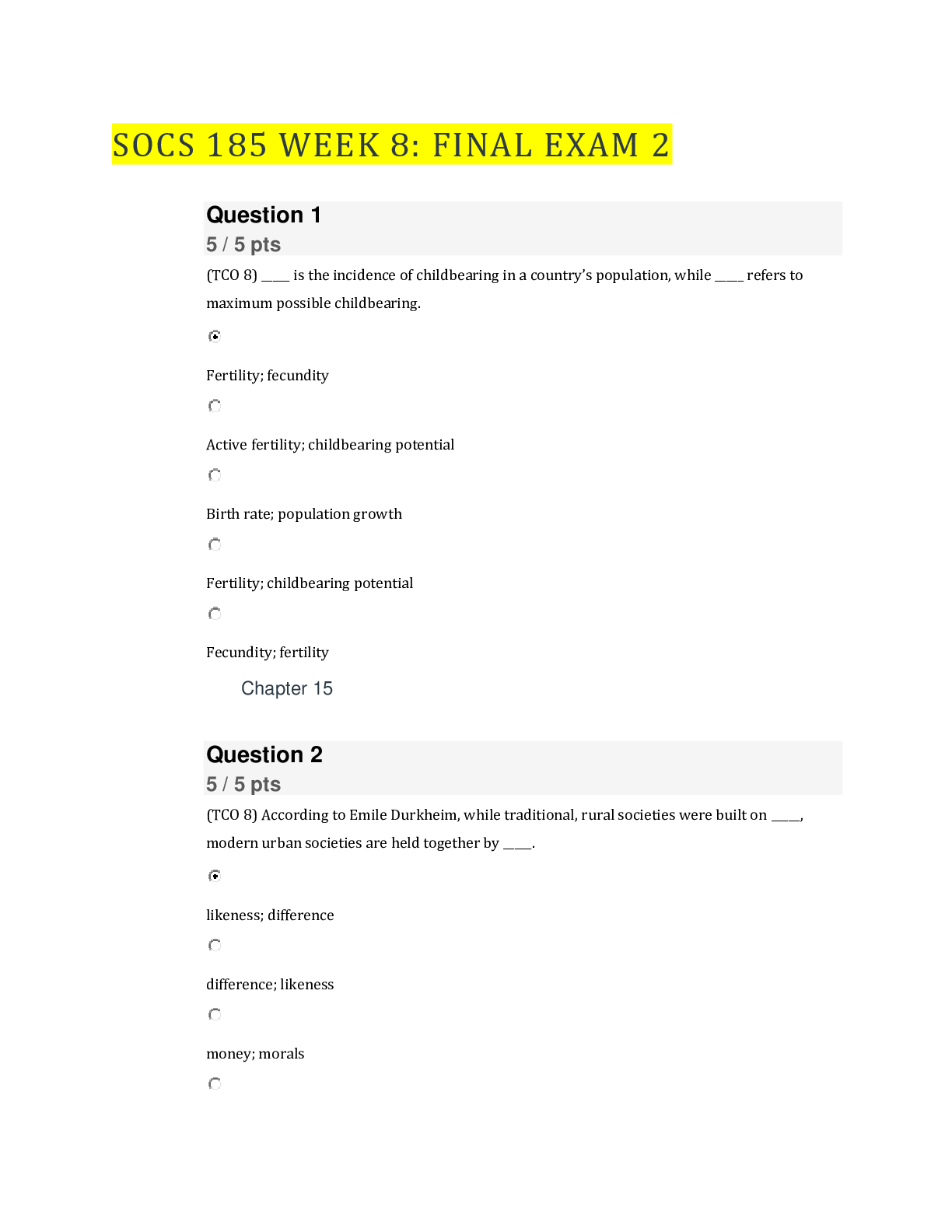
Question: (TCO 1) The systematic study of human society is known as . Question: (TCO 1) The study of the larger world and our society’s place in it is known as . Question: (TCO 1) A key element in ... the sociological imagination is the ability to _________. Question: (TCO 3) Of the major theoretical theories in sociology, which one views society as a complex system whose parts work together to promote solidarity and stability? Question: (TCO 3) Functions of an institution that unrecognized and unintended consequences of any social pattern, are known as . Question: (TCO 2) Gambling researcher Althea Andrasia runs repeated tests on her measure of addiction to check for consistency in measurement. Her goal is to ensure that the measure has_________. Question: (TCO 2) Effect is to cause, as ________. Question: (TCO 2) A relationship in which two (or more) variables change together is called _____________. Question: (TCO 2) What research method was used in Philip Zimbardo’s study, the “Stanford County Prison”? Question: (TCO 2) An apparent, although false, association between two variables that is caused by a third variable is called Question: (TCO 4) On the first day of basic training in the army, N. Terprize has his civilian clothes replaced with army “greens,” has his hair shaved off, loses his privacy, and finds that he must use a communal bathroom and other people decide when he eats, sleeps, and what job he does. Erving Goffman would say that all these humiliating activities are part of . Question: (TCO 4) Radically changing someone’s personality by carefully controlling their environment is the process of . Question: (TCO 4) Charles Horton Cooley used the following phrase to mean a self-image based on how we think others see us. Question: (TCO 4) Pavlovian researcher Isabel Ringing is a daughter, mother, sister, friend, and tennis team member. Each of those represent Isabel’s . Question: (TCO 4) When Charles Horton Cooley used the term, “the looking-glass self,” he was referring to the fact that . Question: (TCO 3) Taxi cab driver Peacup Andropov maintains that human behavior results from learning and has no gentic component. His position is the fundamental opposite of . Question: (TCO 3) The appearance of Harley-Davidson dealerships in China, or KFC franchises in Japan, is a sign of what aspect of culture? Question: (TCO 3) Judging another culture by the standards of one’s own culture is ____; while judging any culture by its own standards is . Question: (TCO 3) Which of the following is a statement based on the Sapir-Whorf hypothesis? Question: (TCO 3) What is the term to refer to the judging another culture by the standards of one’s own culture? [Show More]

Last updated: 3 years ago

Preview 1 out of 11 pages

Buy Now

Instant download

We Accept:

Payment methods accepted on Scholarfriends (We Accept)
Preview image of SOCS 185 Week 2 Quiz (Multiple Choice) document

Buy this document to get the full access instantly

Instant Download Access after purchase

Buy Now

Instant download

We Accept:

Payment methods accepted on Scholarfriends (We Accept)

Reviews( 0 )

$15.00

Buy Now

We Accept:

Payment methods accepted on Scholarfriends (We Accept)

Instant download

Can't find what you want? Try our AI powered Search

63
0

Document information


Connected school, study & course


About the document


Uploaded On

Aug 09, 2021

Number of pages

11

Written in

All

Seller


Profile illustration for Hilda
Hilda

Member since 5 years

16 Documents Sold

Reviews Received
1
0
0
0
2
Additional information

This document has been written for:

Uploaded

Aug 09, 2021

Downloads

 0

Views

 63

Document Keyword Tags


$15.00
What is Scholarfriends

Scholarfriends.com Online Platform by Browsegrades Inc. 651N South Broad St, Middletown DE. United States.

We are here to help

We're available through e-mail, Twitter, Facebook, and live chat.
 FAQ
 Questions? Leave a message!

Follow us on
 Twitter

Copyright © Scholarfriends · High quality services·