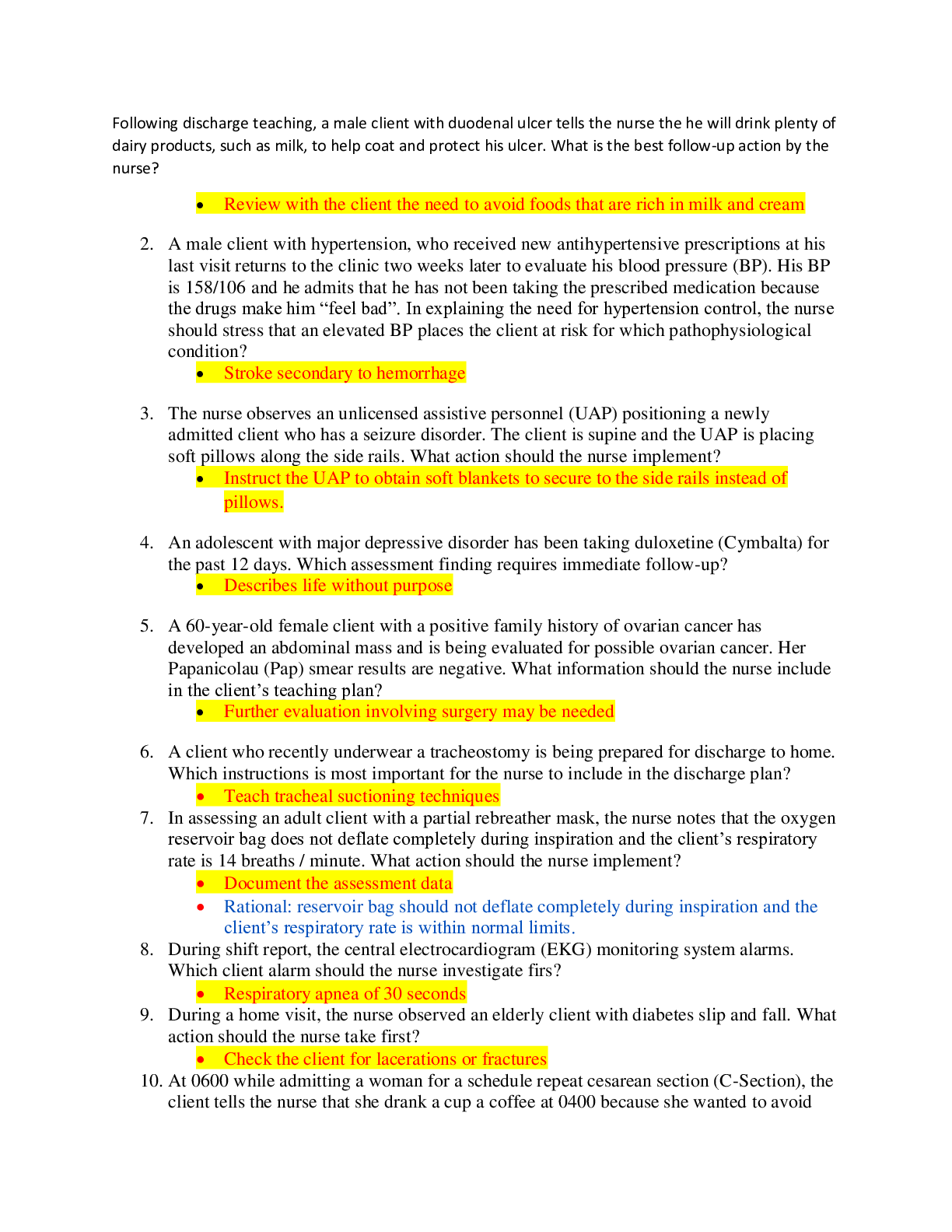
NUTRI 100 Final exam with complete solution(This is not the latest exam but it contains frequently tested questions with all the correct answers)
Question 1 (4 points)
Carbohydrates, proteins, and lipids are _______.
...
NUTRI 100 Final exam with complete solution(This is not the latest exam but it contains frequently tested questions with all the correct answers)
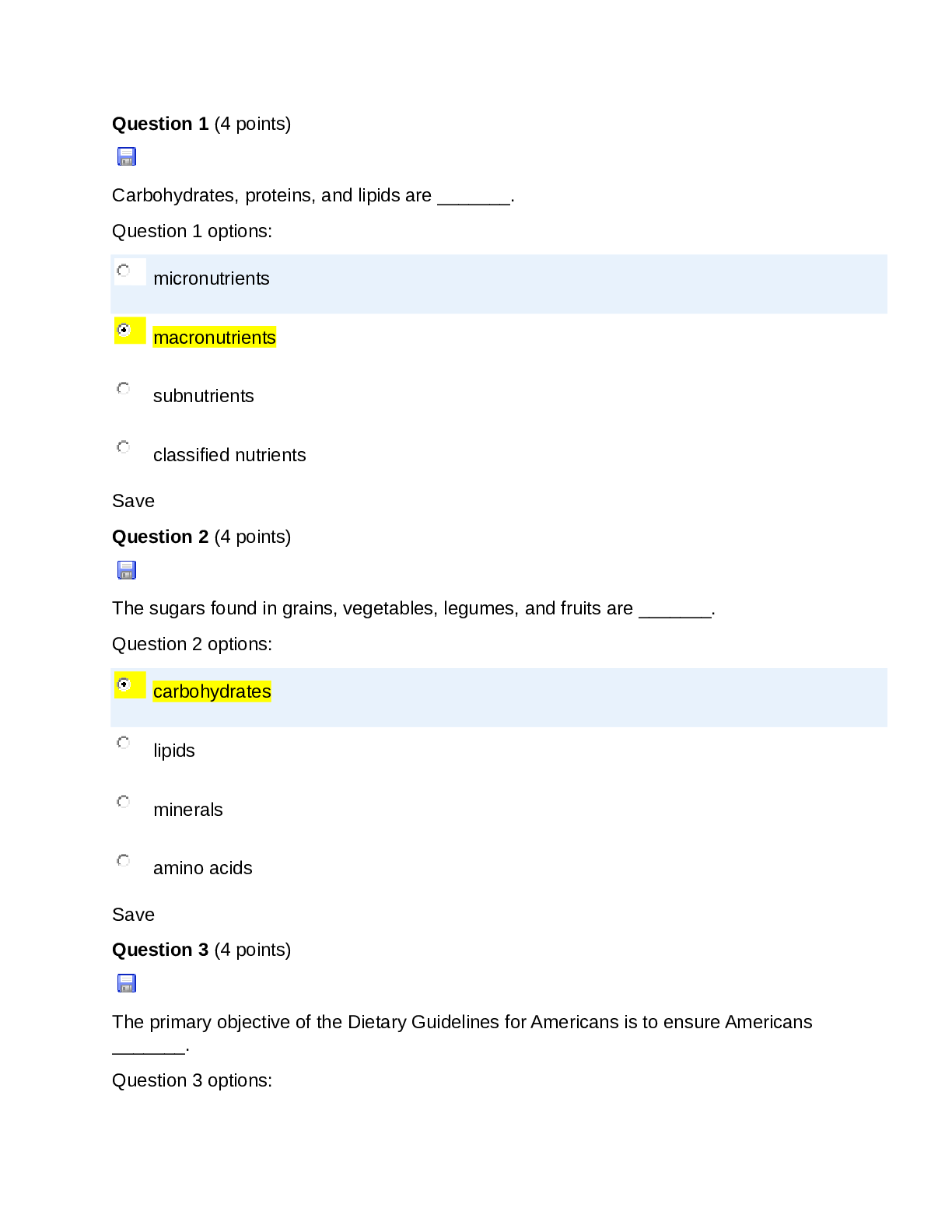
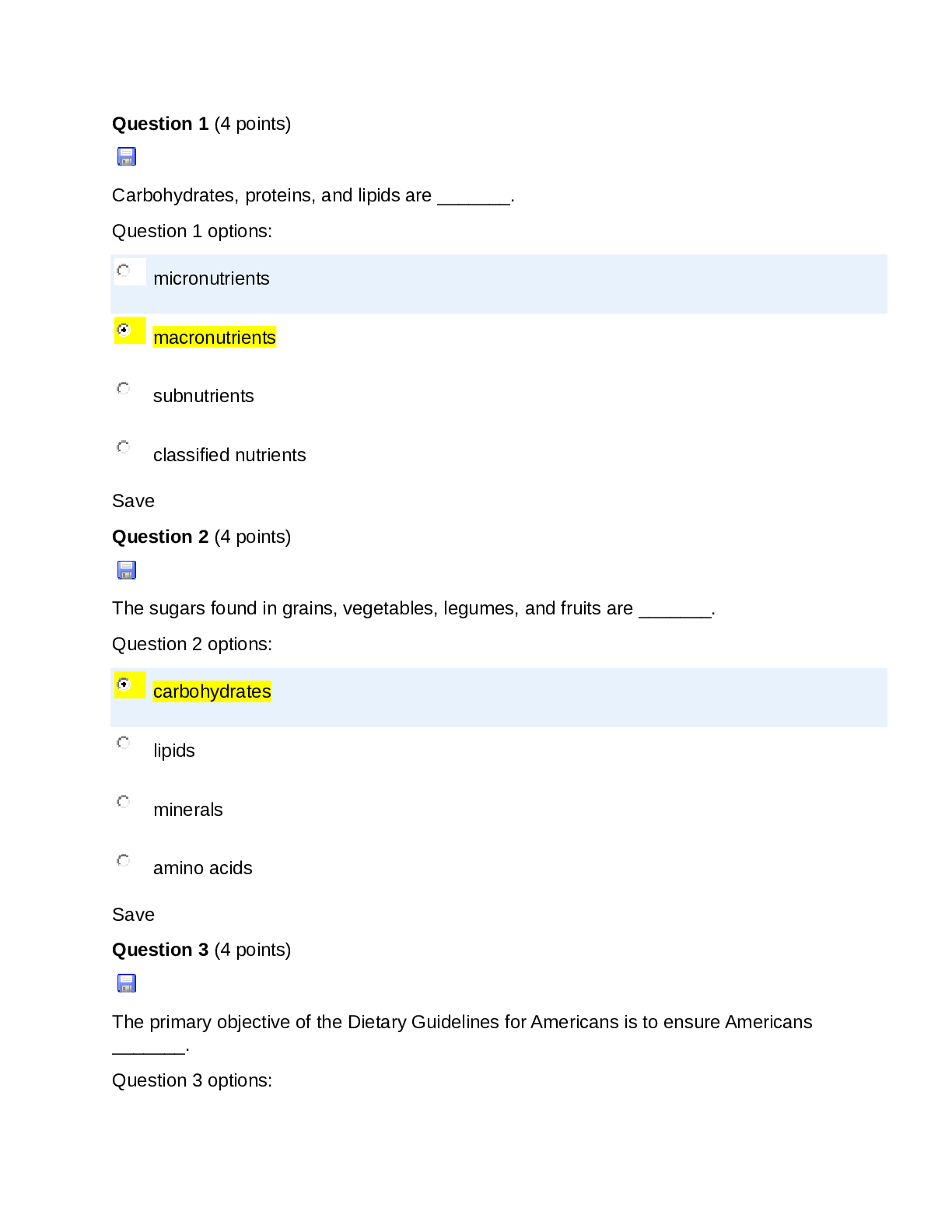
Question 1 (4 points)
Carbohydrates, proteins, and lipids are _______.
Question 1 options:
micronutrients
macronutrients
subnutrients
classified nutrients
Save
Question 2 (4 points)
The sugars found in grains, vegetables, legumes, and fruits are _______.
Question 2 options:
carbohydrates
lipids
minerals
amino acids
Save
Question 3 (4 points)
The primary objective of the Dietary Guidelines for Americans is to ensure Americans
_______.
Question 3 options:consume less than 2,300 mg of sodium per day
choose fiber-rich fruits, vegetables, and whole grains often
increase intake of fats and oils high in saturated or trans fatty acids
balance calorie intake with physical activity to manage weight
Save
Question 4 (4 points)
Which of the following is the correct order of the recommended steps to prevent
foodborne illness, according to the Dietary Guidelines for Americans?
Question 4 options:
Wash, Separate, Prepare, Store
Clean, Separate, Cook, Chill
Clean, Cook, Cool, Reheat
Wash, Separate, Heat, Freeze
Save
Question 5 (4 points)
The _______ estimates the nutrient intake level that will meet the needs of 50 percent
of the individuals in a specific life-stage or gender group.
Question 5 options:
Estimated Average Requirement
Recommended Dietary AllowanceTolerable Upper Limit
Average Needs Level
Save
Question 6 (4 points)
Essential nutrients are nutrients that _______.
Question 6 options:
can be synthesized in the body
must be obtained from dietary intake
are essential to good health
can only be obtained through taking supplements
Save
Question 7 (4 points)
The current icon to represent the food groups is known as _______.
Question 7 options:
The Food Guide Pyramid
MyPlate
MyPyramid
Idaho Plate Method
Save
Question 8 (4 points)Replacing lost nutrients in foods is called _______.
Question 8 options:
fortification
pasteurization
enrichment
modification
Save
Question 9 (4 points)
The majority of digestion takes place in the _______.
Question 9 options:
duodenum
colon
jejunum
ileum
Save
Question 10 (4 points)
Celiac disease is treated by removing gluten from the diet. Gluten is found in all of the
following EXCEPT _______.
Question 10 options:wheat
rye
barley
rice
Save
Question 11 (4 points)
Lipase is an enzyme that breaks down _______.
Question 11 options:
carbohydrate
fat
protein
all of these choices
Save
Question 12 (4 points)
In order to move food from the mouth, down the esophagus, and into the stomach, the
food must be made into _____.
Question 12 options:
chyme
a bolusa blob
an epiglottis
Save
Question 13 (4 points)
A __________ fat has two or more carbon double bonds.
Question 13 options:
saturated
bisaturated
monounsaturated
polyunsaturated
Save
Question 14 (4 points)
Which of the following is not a digestion accessory organ?
Question 14 options:
liver
gallbladder
colon
pancreas
Save
Question 15 (4 points)The AMDR for protein is______ percent of total daily calories.
Question 15 options:
5 to 10
10 to 35
20 to 35
45 to 65
Save
Question 16 (4 points)
How many kilocalories are in 24 grams of fat?
Question 16 options:
216
168
96
240
Save
Question 17 (4 points)
___________ atoms are added to unsaturated fats in order to make liquid fats more
solid at room temperature.
Question 17 options:carbon
hydrogen
sodium
lipid
Save
Question 18 (4 points)
How many amino acids can’t be synthesized in the body?
Question 18 options:
9
11
21
19
Save
Question 19 (4 points)
The AMDR for fat is _____________ percent of daily kilocalorie intake.
Question 19 options:
45 to 65
5 to 10
20 to 3510 to 35
Save
Question 20 (4 points)
An enzyme ___________ a chemical reaction.
Question 20 options:
slows down
speeds up
stops
provides stability for
Save
Question 21 (4 points)
Which of the following combines with carbon, hydrogen, and oxygen to make up the
structure of protein?
Question 21 options:
nitrogen
sulfur
pepsin
chloride
Save
Question 22 (4 points)A triglyceride is formed through a ____________reaction between a glycerol and
_______fatty acid(s).
Question 22 options:
partial hydrogenation; one
rehydration; three
lipogenesis; one
dehydration; three
Save
Question 23 (4 points)
_______ is the deficiency associated with thiamin.
Question 23 options:
scurvy
beriberi
rickets
anemia
Save
Question 24 (4 points)
Which of the following choices include all of the fat-soluble vitamins?
Question 24 options:
vitamin B12, vitamin B6, vitamin C, vitamin Dvitamin A, vitamin D, vitamin E, vitamin K
vitamin D, vitamin K, thiamin, vitamin B6
vitamin E, vitamin A, vitamin B6, niacin
Save
Question 25 (4 points)
B-complex vitamins often serve as _______.
Question 25 options:
cofactors/coenzymes
blood thinners
a source of calories
none of these choices
Save
Question 26 (4 points)
Flushing is a common side effect from which nutrient?
Question 26 options:
thiamin
vitamin C
niacin
sodiumSave
Question 27 (4 points)
The majority of sodium intake for the standard American diet comes from _______.
Question 27 options:
iodized table salt
sauces and soups
processed foods
cheese
Save
Question 28 (4 points)
Metabolism is described as the balance between __________ and _________ reactions
in the body.
Question 28 options:
steroidal; carboxylic
anabolic; synthetic
catabolic; anabolic
catabolic; amine
Save
Question 29 (4 points)
You are able to maintain your body weight when energy expended _______ calories
consumed.Question 29 options:
exceed
equals
are less than
double
Save
Question 30 (4 points)
Which of the following daily protein intakes is recommended for endurance and strength
training athletes?
Question 30 options:
0.8-1.2 grams/kg body weight
0.5-0.8 grams/kg body weight
1.2-1.7 grams/kg body weight
2.0-2.5 grams/kg body weight
Save
Question 31 (4 points)
All of the following are guidelines for reducing cancer risk EXCEPT:
Question 31 options:
Limit intake of charred foods.
Reduce intake of red meat.Increase consumption of fruits.
All of these choice are guidelines to reduce cancer risk.
Save
Question 32 (4 points)
Research studies are often used to provide evidence for CAM therapies.
Question 32 options:
True
False
Save
Question 33 (4 points)
Sodium, calcium, iron, vitamin C, and vitamin A are all required by law to be included on
the food label.
Question 33 options:
True
False
Save
Question 34 (4 points)
Peanut butter is one example of a high-quality protein.
Question 34 options:
TrueFalse
Save
Question 35 (4 points)
Supplements are approved by the FDA before reaching the market.
Question 35 options:
True
False
Save
Question 36 (4 points)
Vitamin D is a nonessential nutrient.
Question 36 options:
True
False
Save
Question 37 (4 points)
Weight loss occurs when energy balance is in equilibrium.
Question 37 options:
True
False
Save
Question 38 (4 points)A high-fiber, low-fat diet may reduce the risk of cancer
Question 38 options:
True
False
Save
Question 39 (4 points)
Body Mass Index (BMI) provides an accurate measurement of the amount of fat tissue
on the body.
Question 39 options:
True
False
Save
Question 40 (4 points)
Before exercising, athletes are encouraged to drink plenty of fluids and consume a highfat meal for energy.
Question 40 options:
True
False
Save
Question 41 (20 points)Describe two common dietary misconceptions in our society today. Write a 200 word
essay (with at least 2 references) refuting the misconceptions and using information that
you have learned in this class.
Question 41 options:
There are a lot of dietary misconceptions in our society today. The only way to changes
these misunderstandings is to debunk them. Two of the most common myths are all fats
are bad and to avoid carbohydrates to lose weight.
All fats are not bad. Per UW Medicine, “Everyone needs fat, and it aids in nutrient
absorption, nerve transmission and maintenance of cell membranes. Fats are not
created equal. Some fats promote good health while others increase the risk for heart
disease.” (2017) Polyunsaturated and monounsaturated fats such as olive oil and
avocados are good fats. In many cases, low or fat free foods are worse for you with the
additives to improve taste. (National Institute of Diabetes and Digestive and Kidney
Diseases, 2014)
Avoiding carbohydrates do not help in weight-loss is another major myth.
“Carbohydrates do not cause weight gain. The truth is that most low carb diets are also
calorie restricted… The initial weight loss seen in these diets is caused by the body
burning stored carbohydrates for energy, which releases water so the loss is only a
water shift and not an actual weight loss.” (National Institute of Diabetes and Digestive
and Kidney Diseases, 2014)
Keeping hydrated is important when dieting and exercising. Starving your body of
carbohydrates that contain essential vitamins is not healthy. Eating right, cutting
calories, and exercise is the right way to go.
References:
National Institute of Diabetes and Digestive and Kidney Diseases. 2014. Weight=loss
and Nutrition Myths. Retrieved From: https://www.niddk.nih.gov/healthinformation/health-topics/weight-control/myths/Pages/weight-loss-and-nutritionmyths.aspx
UV Medicine. 2017. Diet and Nutrition Myths. Retrieved From:
http://www.uwmedicine.org/patient-resources/nutrition-services/nutrition-mythsSave
Question 42 (20 points)
Your friend insists that it is impossible to survive long-term on a vegetarian diet (vegan).
Describe to your friend how a vegan diet can also be a "healthy diet" . Create a one day
eating plan (3 meals, 2 snacks), for a 30 year old woman of an average BMI that is an
athlete (wrestler).
Question 42 options:
Vegan diets are quite easily managed. “Vegetarian diets have a number of benefits.
Well-balanced eating plans can lower the risk of a number of chronic conditions,
including heart disease, diabetes, and obesity. They also help to promote sustainable
agriculture.” (Zimmerman & Snow, 2012) There are several ways to reach each of the
dietary needs of an athlete on this diet. Below is a meal plan for only one day. It shows
how much diversity there can be in just one day and it is easily adjustable to
accommodate any type lifestyle.
References:
Zimmerman and Snow. 2012. An Introduction to Nutrition (v. 1.0) Retrieved From:
https://umuc.equella.ecollege.com/file/eb5a3954-9f2e-4f56-869e-
0842450fbd75/1/AnIntroductionToNutrition.pdf
VEGAN MEAL PLAN
Based on an athlete dietStart the morning off right with a glass of water
Wake Up:Water 8oz
Breakfast: Oatmeal with orange juice and coffee
Water 8oz
whole grain oatmeal 1 cup
almond milk 8oz (to make with the oatmeal)
calcium fortified orange juice 8oz
coffee 8oz with ¼ cup of Almond milk
cashews
Snack: Fruit and veggies with Peanut butter
Water 8oz
Peanut Butter 2 Tbsp
Apple 1 medium
Celery 2 medium stalks
Before Lunch:
Water 8oz
Lunch: Spinach salad with veggie burger patty drizzled with balsamic
Water 8oz
Veggie Burger
balsamic vinegar 2Tbsp
spinach 2 cup
kale
quinoa
Snack: tomato slices sprinkled with cheese and balsamicWater 8oz
tomato 1 medium
balsamic vinegar 1 Tbsp
vegetarian cheese (Go Vegan Mozzarella) ¼ cup
basil 2 Tbsp
Before Dinner
Water 8 oz
Dinner: brown rice cooked with coconut milk with sautéed tofu, broccoli, and almonds
on top.
Water 8oz
broccoli 2 cups
almonds ¼ cup
brown rice 1 cup
tofu ½ cup cubed
seasoning/spices
coconut milk for c
[Show More]

.png)


.png)


.png)


.png)