*NURSING > EXAM > NUR 2755 Multidimensional Care IV / MDC 4 Exam 2 Review ( 2020 / 2021 REVISED VERSION) Rasmussen (All)
NUR 2755 Multidimensional Care IV / MDC 4 Exam 2 Review ( 2020 / 2021 REVISED VERSION) Rasmussen
Document Content and Description Below
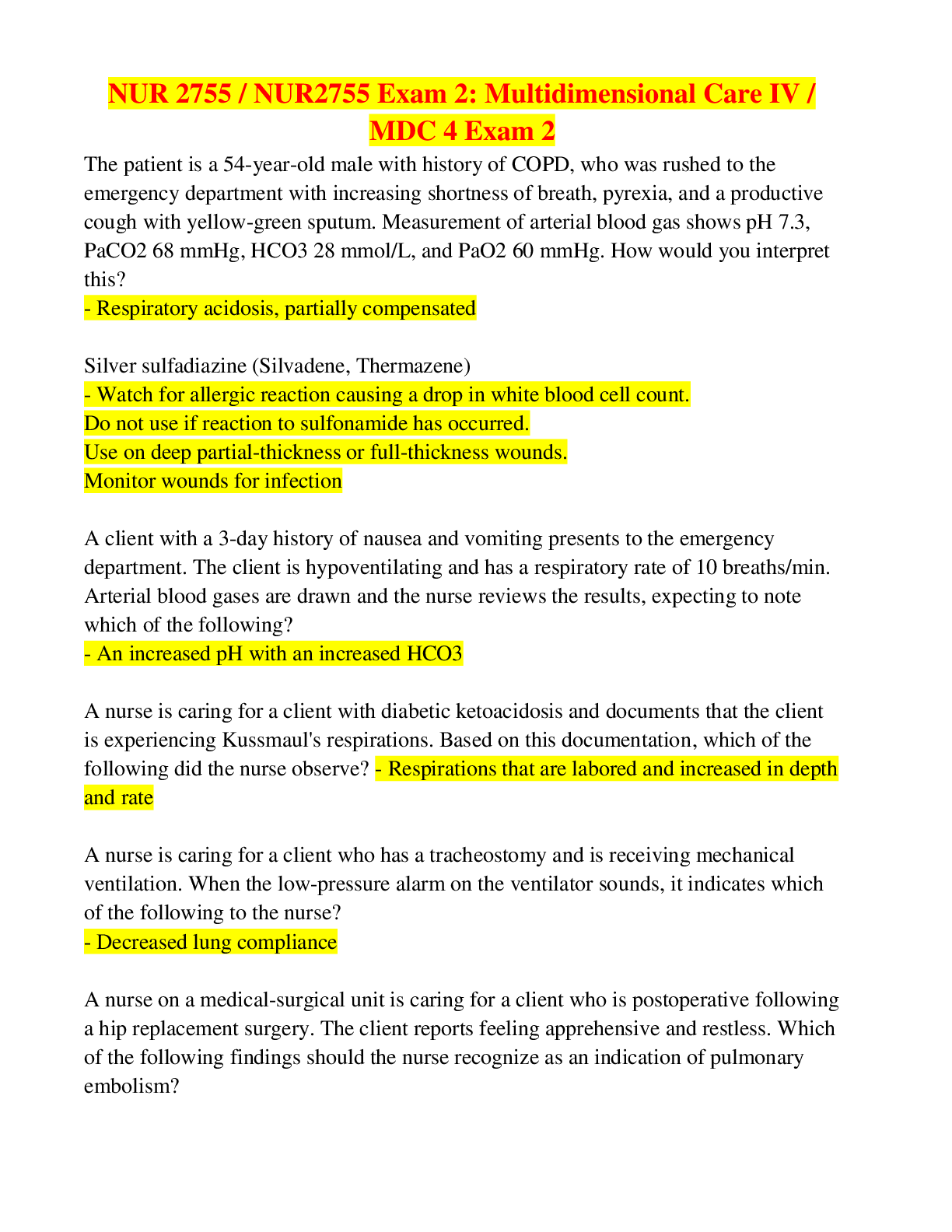
NUR 2755 Multidimensional Care IV MDC 4 Exam 2 1. The patient is a 54-year-old male with history of COPD, who was rushed to the emergency department with increasing shortness of breath, pyre xia, and ... a productive cough with yellow-green sputum. Measurement of arterial blood gas shows pH 7.3, PaCO2 68 mmHg, HCO3 28 mmol/L, and PaO2 60 mmHg. How would you interpret this? - Respiratory acidosis, partially compensated 2. Silver sulfadiazine (Silvadene, Thermazene) - 3. A client with a 3-day history of nausea and vomiting presents to the emergency department. The client is hypoventilating and has a respiratory rate of 10 breaths/min. Arterial blood gases are drawn and the nurse reviews the results, expecting to note which of the following? - 4. A nurse is caring for a client with diabetic ketoacidosis and documents that the client is experiencing Kussmaul respirations. Based on this documentation, which of the following did the nurse observe? - 5. A nurse is caring for a client who has a tracheostomy and is receiving mechanical ventilation. When the low-pressure alarm on the ventilator sounds, it indicates which of the following to the nurse? - 6. A nurse on a medical-surgical unit is caring for a client who is postoperative following a hip replacement surgery. The client reports feeling apprehensive and restless. Which of the following findings should the nurse recognize as an indication of pulmonary embolism? - 7. A client comes to the emergency department in severe respiratory distress following left-sided blunt chest trauma. The nurse notes absent breath sounds on the client's left side and a tracheal shift to the right. For which of the following procedures should the nurse prepare the client? - 8. A nurse is caring for a client who is experiencing acute opioid toxicity. Which of the following actions should the nurse identify as the priority? - 9. A nurse is caring for a client who has chronic obstructive pulmonary disease (COPD) and is experiencing shortness of breath. Which of the following actions should the nurse perform first? - 10. A nurse is assessing a client who has pharyngitis. Which of the following findings is the nurse's priority to report to the provider? - 11. A nurse is caring for a client who has a 20-year history of COPD and is receiving oxygen therapy at 2 L/min via nasal cannula. The client is dyspneic and has an oxygen saturation via pulse oximetry of 85%. Which of the following actions should the nurse take? - 12. A nurse is caring for a client who is scheduled to have his chest tube removed. Which of the following actions should the nurse take? - 13. A nurse is caring for a client with pneumonia who is experiencing thick oral secretions. Which of the following actions should the nurse take first? - 14. Rib fracture cause - 15. Rib fracture pain - 16. Flail Chest - 17. Vasodilator (Nitroprusside) - 18. Pulmonary embolism risk factors - 19. Ventilatory and Oxygenation failure - 20. Ventilatory and oxygenation failure: people - 21. Oxygenation failure - 22. Oxygenation failure causes - 23. Oxygenation failure: people - 24. Ventilatory failure - 25. Ventilatory failure: Causes - 26. Hypoxemic/oxygenation failure - 27. Hyper-carbic/ ventilatory failure - 28. Ventilatory failure: people - 29. ARDS Exudative phase - 30. ARDS Fibroproliferative Phase - 31. ARDS Resolution phase - - 32. Ventilator bundle to prevent infection - 33. Extubation - 34. What is a pneumothorax? - 35. Causes of pneumothorax - 36. Tension pneumothorax - 37. Pneumothorax assessment - 38. Tension pneumothorax s/s - 39. Hemothorax s/s - 40. Pneumothorax interventions - 41. Compensatory response in burns - 42. Local indicators - 43. Systemic indicators - 44. Hypovolemic risk factors - 45. Cardiogenic risk factors - 46. Distributive risk factors - 47. Obstructive risk factors - 48. Lactic acid level - 49. Hemoglobin levels - 50. Hematocrit levels - 51. Sepsis and SIRS early symptoms - 52. Sepsis and SIRS later symptoms - 53. Within first 3 hours of suspecting severe sepsis - 54. Within 6 hours of initial indications of suspected septic shock - Show Less [Show More]
Last updated: 3 years ago
Preview 1 out of 14 pages
Buy this document to get the full access instantly
Instant Download Access after purchase
Buy NowInstant download
We Accept:

Reviews( 0 )
$13.50
Can't find what you want? Try our AI powered Search
Document information
Connected school, study & course
About the document
Uploaded On
Aug 12, 2021
Number of pages
14
Written in
All

Additional information
This document has been written for:
Uploaded
Aug 12, 2021
Downloads
0
Views
90