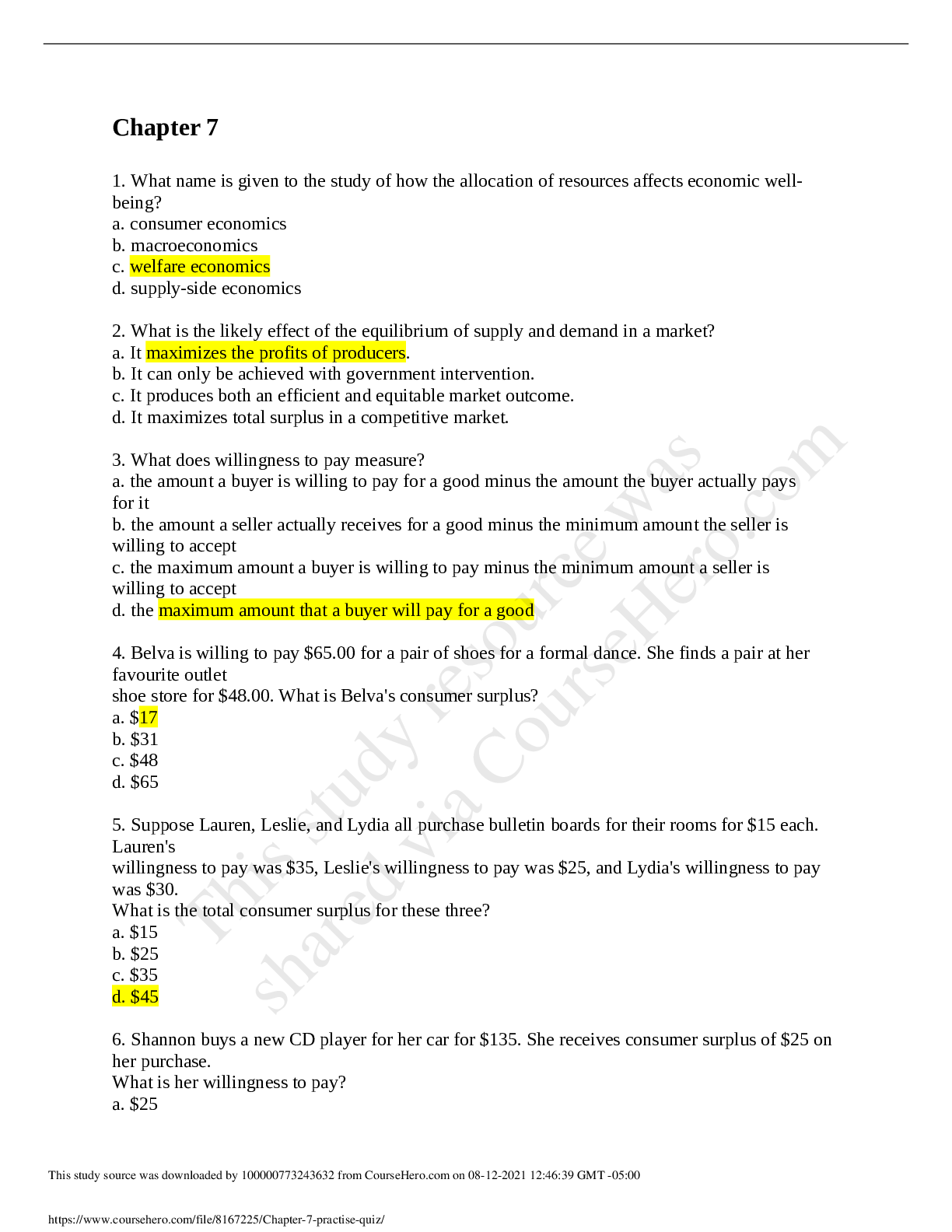
1. What name is given to the study of how the allocation of resources affects economic wellbeing?
a. consumer economics
b. macroeconomics
c. welfare economics
d. supply-side economics
2. What is the likely effect of
...
1. What name is given to the study of how the allocation of resources affects economic wellbeing?
a. consumer economics
b. macroeconomics
c. welfare economics
d. supply-side economics
2. What is the likely effect of the equilibrium of supply and demand in a market?
a. It maximizes the profits of producers.
b. It can only be achieved with government intervention.
c. It produces both an efficient and equitable market outcome.
d. It maximizes total surplus in a competitive market.
3. What does willingness to pay measure?
a. the amount a buyer is willing to pay for a good minus the amount the buyer actually pays
for it
b. the amount a seller actually receives for a good minus the minimum amount the seller is
willing to accept
c. the maximum amount a buyer is willing to pay minus the minimum amount a seller is
willing to accept
d. the maximum amount that a buyer will pay for a good
4. Belva is willing to pay $65.00 for a pair of shoes for a formal dance. She finds a pair at her
favourite outlet
shoe store for $48.00. What is Belva's consumer surplus?
a. $17
b. $31
c. $48
d. $65
5. Suppose Lauren, Leslie, and Lydia all purchase bulletin boards for their rooms for $15 each.
Lauren's
willingness to pay was $35, Leslie's willingness to pay was $25, and Lydia's willingness to pay
was $30.
What is the total consumer surplus for these three?
a. $15
b. $25
c. $35
d. $45
6. Shannon buys a new CD player for her car for $135. She receives consumer surplus of $25 on
her purchase.
What is her willingness to pay?
a. $25
This study source was downloaded by 100000773243632 from CourseHero.com on 08-12-2021 12:46:39 GMT -05:00
https://www.coursehero.com/file/8167225/Chapter-7-practise-quiz/
T
[Show More]

.png)
.png)




 (1).png)