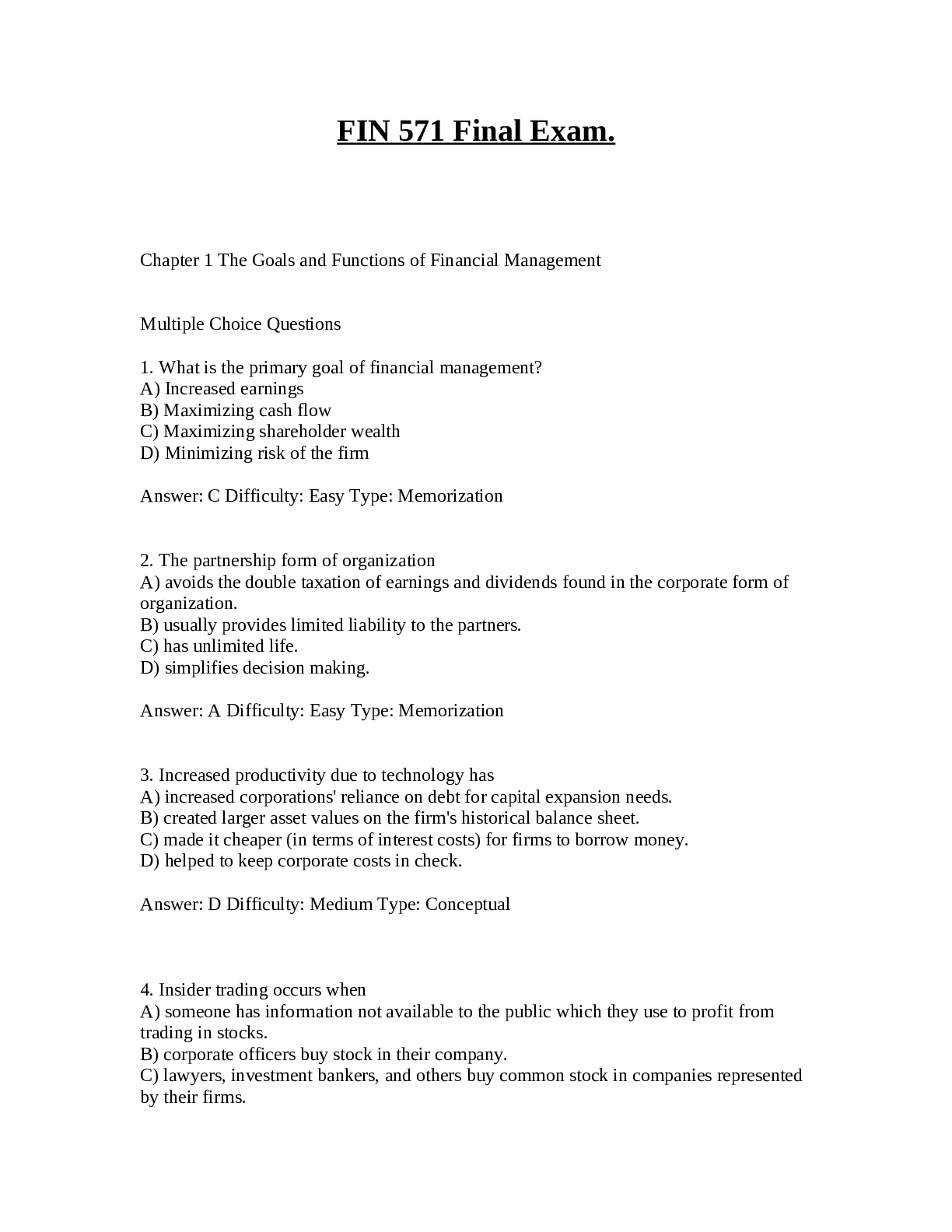
Chapter 1 The Goals and Functions of Financial Management
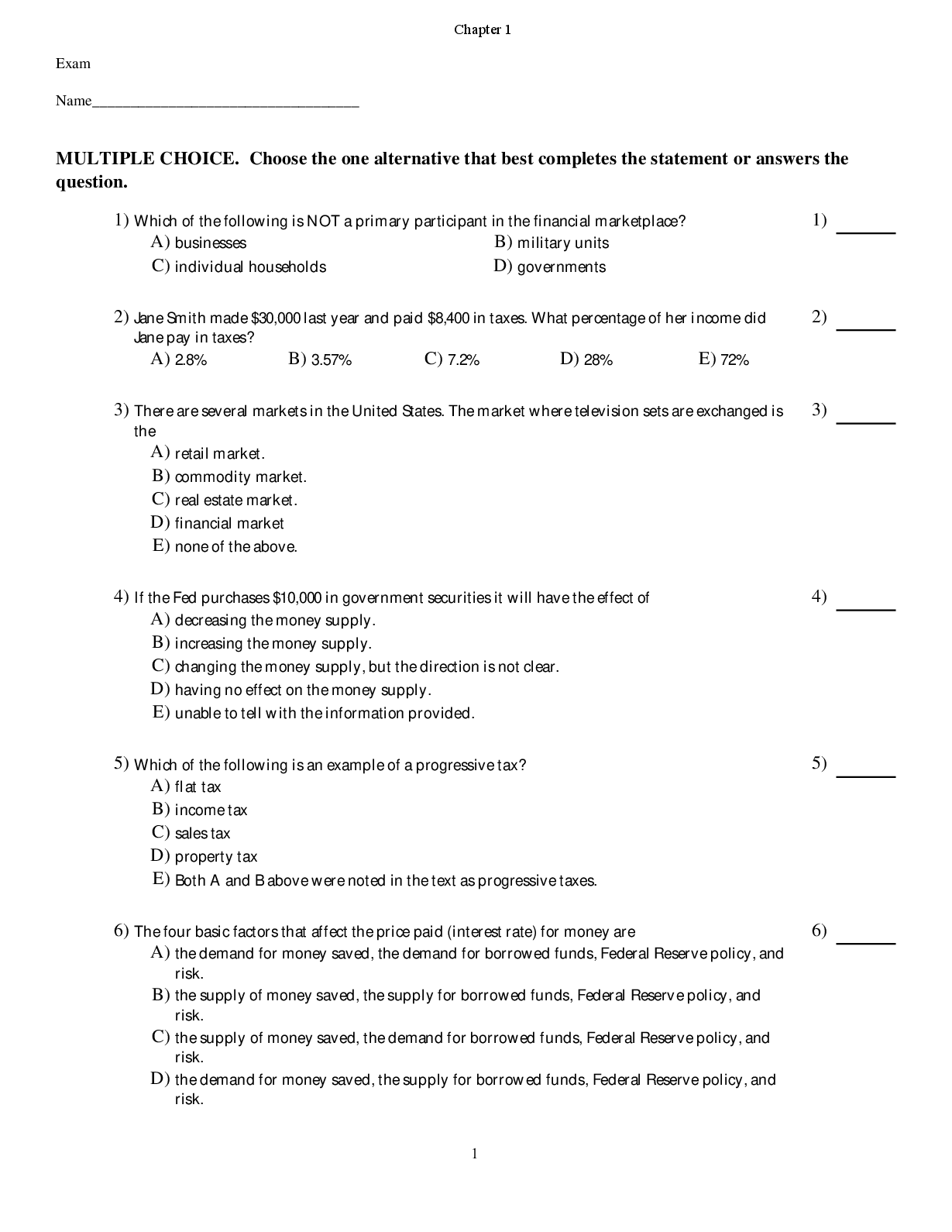
Multiple Choice Questions
1. What is the primary goal of financial management?
A) Increased earnings
B) Maximizing cash flow
C) Maximizing shareholder wealth
...
Chapter 1 The Goals and Functions of Financial Management
Multiple Choice Questions
1. What is the primary goal of financial management?
A) Increased earnings
B) Maximizing cash flow
C) Maximizing shareholder wealth
D) Minimizing risk of the firm
Answer: C Difficulty: Easy Type: Memorization
2. The partnership form of organization
A) avoids the double taxation of earnings and dividends found in the corporate form of
organization.
B) usually provides limited liability to the partners.
C) has unlimited life.
D) simplifies decision making.
Answer: A Difficulty: Easy Type: Memorization
3. Increased productivity due to technology has
A) increased corporations' reliance on debt for capital expansion needs.
B) created larger asset values on the firm's historical balance sheet.
C) made it cheaper (in terms of interest costs) for firms to borrow money.
D) helped to keep corporate costs in check.
Answer: D Difficulty: Medium Type: Conceptual
4. Insider trading occurs when
A) someone has information not available to the public which they use to profit from
trading in stocks.
B) corporate officers buy stock in their company.
C) lawyers, investment bankers, and others buy common stock in companies represented
by their firms.
D) any stock transactions occur in violation of the Federal Trade Commissions
restrictions on monopolies.
Answer: A Difficulty: Medium Type: Memorization
Chapter 2 Review of Accounting
5. When a firm's earnings are falling more rapidly than its stock price, its P/E ratio will:
A) remain the same
B) go up
C) go down
D) could go either up or down
Answer: B Difficulty: Medium Type: Conceptual
6. The net worth of a firm
A) is usually the same as the firm's market value.
B) is based on current asset costs.
C) is based on current liabilities.
D) none of the above.
Answer: D Difficulty: Medium Type: Application
7. A statement of cash flows allows a financial analyst to determine
A) whether a cash dividend is affordable.
B) how increases in asset accounts have been financed.
C) whether long-term assets are being financed with long-term or short-term financing.
D) all of the above
Answer: D Difficulty: Medium Type: Conceptual
8. A firm has $200,000 in current assets, $400,000 in long-term assets, $80,000 in current
liabilities, and $200,000 in long-term liabilities. What is its net working capital?
A) $120,000
B) $320,000
C) $520,000
D) none of the above
Answer: A Difficulty: Medium Type: Application
Chapter 3 Financial Analysis
Multiple Choice Questions
9. The ______________ method of inventory costing is least likely to lead to inflationinduced profits.
A) FIFO
B) LIFO
C) Weighted average
D) Lower of cost or market
Answer: B Difficulty: Medium Type: Conceptual
10. The Bubba Corp. had net income before taxes of $200,000 and sales of $2,000,000. If
it is in the 50% tax bracket its after-tax profit margin is:
A) 5%
B) 12%
C) 20%
D) 25%
Answer: A Difficulty: Medium Type: Application
11. XYZ's receivables turnover is 10x. The accounts receivable at year-end are $600,000.
The average collection period is 90 days (3 months). What was the sales figure for the
year?
A) $60,000
B) $6,000,000
C) $24,000,000
D) none of the above
Answer: B Difficulty: Hard Type: Application
12. A firm has total assets of $2,000,000. It has $900,000 in long-term debt. The
stockholders equity is $900,000. What is the total debt to asset ratio?
A) 45%
B) 40%
C) 55%
D) none of the above
Answer: C Difficulty: Hard Type: Application
[Show More]