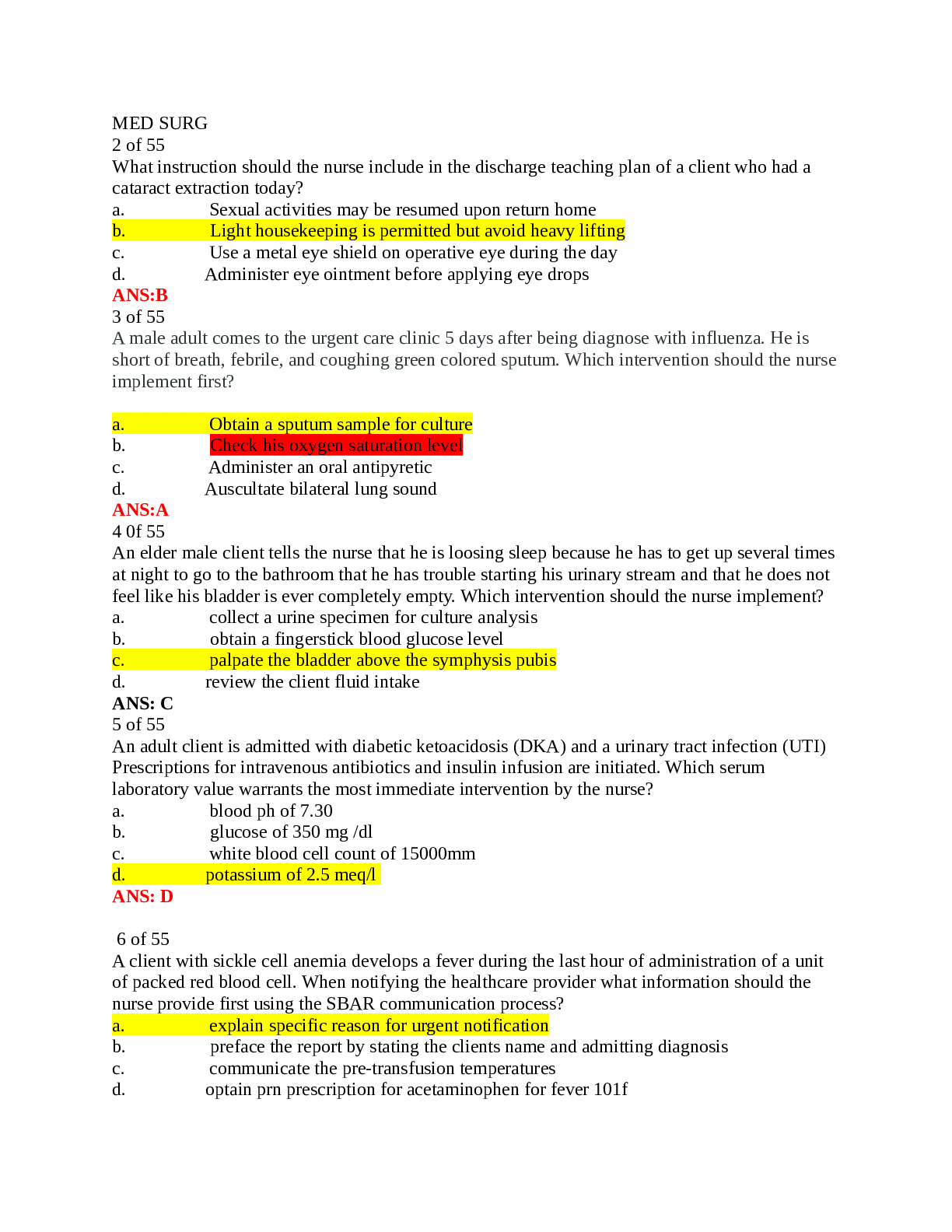
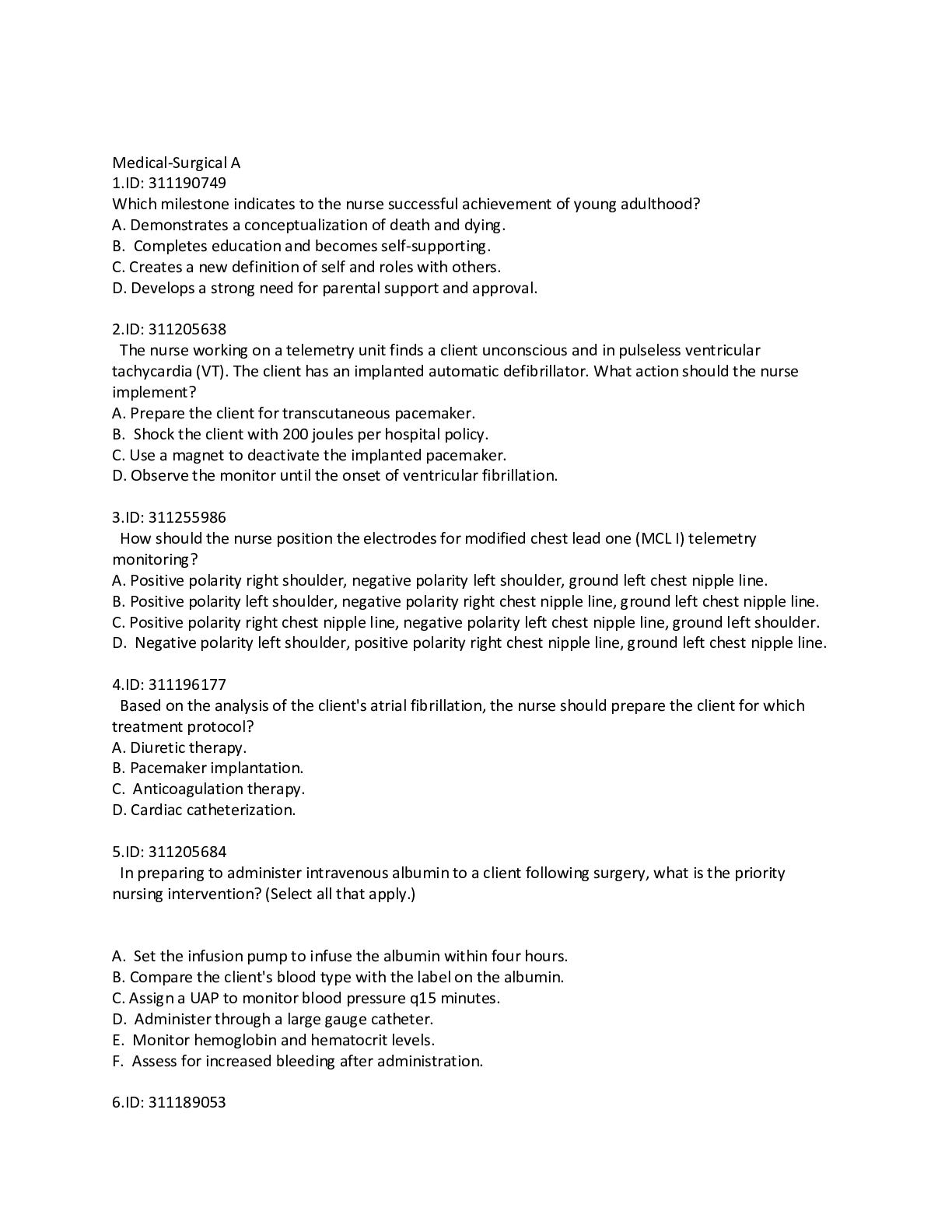
. HESI Med Surg Study Guide - Hematemesis Information Nursing Processes
Advanced Medical-Surgical Nursing (University of Rhode Island)
HESI I MEDSURG STUDY GUIDE
Please use this guide as such, a guide however remember
...
. HESI Med Surg Study Guide - Hematemesis Information Nursing Processes
Advanced Medical-Surgical Nursing (University of Rhode Island)
HESI I MEDSURG STUDY GUIDE
Please use this guide as such, a guide however remember to utilize the basics, the nursing process, ABC’s and prioritize accordingly.
• Hematemesis (vomiting blood) – typically upper GI bleed
a. What to assess?
i. Remember ABC’s (pt having diff breathing?), check vital signs first*
ii. Assess stool (blood present? – if so, what color. Dark red = upper GI bleed, usually more serious)
iii. Check if they are on iron supplements
iv. Worried about hypovolemic shock
1. S/S: restlessness, agitation, inc HR and RR, cool, pale, sweaty
• Open vs Close angle glaucoma
b. Def: condition characterized by inc intraocular pressure (IOP > 22 mmHg) r/t aqueous fluid being inadequately drained from eye gradual painless vision loss. Generally asymptomatic in early stages (seen in reg eye exam)
i. No cure, can be treated pharmacologically and surgically
c. Patient teaching
i. Develop a teaching plan that includes the following: (p. 131)
1. Careful adherence to eye-drop regimen can prevent blindness
2. Vision already lost cannot be restored
3. Eyes drops are needed for rest of life
a. Eye drops used to cause pupillary constriction – mvmt
4. ***Proper eye-drop instillation technique. Obtain a return demonstration.
a. Wash hands and external eye
b. Tilt head back slightly
c. Instill drop into lower lid, s touching the lid c the tip of the dropper
d. Release lid, and sponge excess fluid from lid and cheek
e. Close eye gentle, and leave closed for 3-5 min
f. Apply gentle pressure on inner canthus to decrease systemic absorption
g. (Caution: Vision may be blurred for 1-2 hrs post admin and adaption to dark environments difficult r/t pupillary constriction (FALL RISK))
i. Blurring tends to dec c inc use of meds
5. Safety measures to prevent injuries
a. Remove throw rugs
b. Adjust lighting to meet needs
6. Avoid activities that main inc IOP
a. Emotional upset
b. Exertion: pushing, heavy lifting, shoveling
c. Coughing severely or excessive sneezing (Get medical attn before URI worsens)
d. Wearing constrictive clothing (tight color or tie, tight belt, or girdle)
e. Straining at stool and constipation
i. Increased pressure, asymptomatic, seen at eye exam
ii. Can lead to blindness if untreated
iii. Eye drops needed for rest of their life
iv. Pt teaching – safety measures to prevent injury (remove throw rugs, adequate lighting)
• Syndrome of inappropriate anti-diuretic hormone: SIADH
o Def: excessive production/release of vasopressin (ADH). Char by dec u/o, inc specific gravity, dec sodium
Other manifestation (r/t hyponatremia)
• Anorexia, N, wt gain, weakness, confusion, irritability, sz/coma
Etiology (usually result of underlying condition, aka treat cause)
• Excess (synthetic vasopressin) DDAVP (Desmopressin) to treat DI, CNS infections, generalized sz’s, surgery to hypothalamus/pituitary
o Pt is retaining fluid but so thirsty
What else to give them? Hard piece of candy* (want them to salivate)
• Hyperthyroidism/hypothyroidism
o Signs/symptoms
Hyperthyroidism: (p pg. 96, 111)
• Exophthalmos (bulging eyes)
• Enlarger thyroid gland
• Weight loss
• T3 elevated
• T4 elevated (>12 mcg/dL)
• Diarrhea
• Tachycardia, palpitations, inc BP
• Bruit over thyroid
• Increased appetite
• Heat intolerance
• Diaphoresis, wet or moist skin
• Nervous, insomnia
Hypothyroidism: (p pg. 97, 113)
• Fatigue
• Bradycardia
• Wt gain
• Constipation
• Periorbital edema, facial puffiness
• Cold intolerance
• Low T3 (<70 ng/dL)
• Low T4 (<5 ng/dL)
• Thin, dry hair; dry skin
• Thick, brittle nails
• Hypotension
• Goiter
• Dull emotions and mental process
• Meningitis
o Def: inflammation and infection of the meninges that cover brain and spine
o Gather VS and neuro status, THEN contact HCP
o Symptoms
Stiff neck
3 classic symp:
• Fever (>100.4F) + chills
• H/a
• Nuchal rigidity (pain c flexion of the neck)
Inc ICP
Change in LOC; irritability
Photophobia (extreme sensitivity to light); blurry vision
Rash (*IF bacterial in origin – contact HCP ASAP)
Vomiting (esp in morn)
Opisthotonos (spasming of muscles causing backward arching of head, neck, spine)
[Show More]