Gizmo Warm-up Student Exploration: Covalent Bonds
Document Content and Description Below
Student Exploration: Covalent Bonds
Vocabulary: covalent bond, diatomic molecule, Lewis diagram, molecule, noble gases, nonmetal, octet rule, shell, valence, valence electron
Prior Knowledge Questions (Do these BEFOR
...
[Show More]
Last updated: 3 years ago
Preview 1 out of 6 pages
Instant download
.png)
Buy this Document to get the Full Access Instantly
Provided by Students Who Aced it
We Verify Document Content to Gurantee Accuracy
Reviews( 0 )
Document information
Connected school, study & course
About the document
Uploaded On
Aug 13, 2021
Number of pages
6
Written in
All

Additional information
This document has been written for:
Uploaded
Aug 13, 2021
Downloads
0
Views
186
Topic Tags
Related Subjects & Courses
Explore similar study resources and related concepts.
Recommended For You
Get more on GIZMOS »
$9
6 Pages
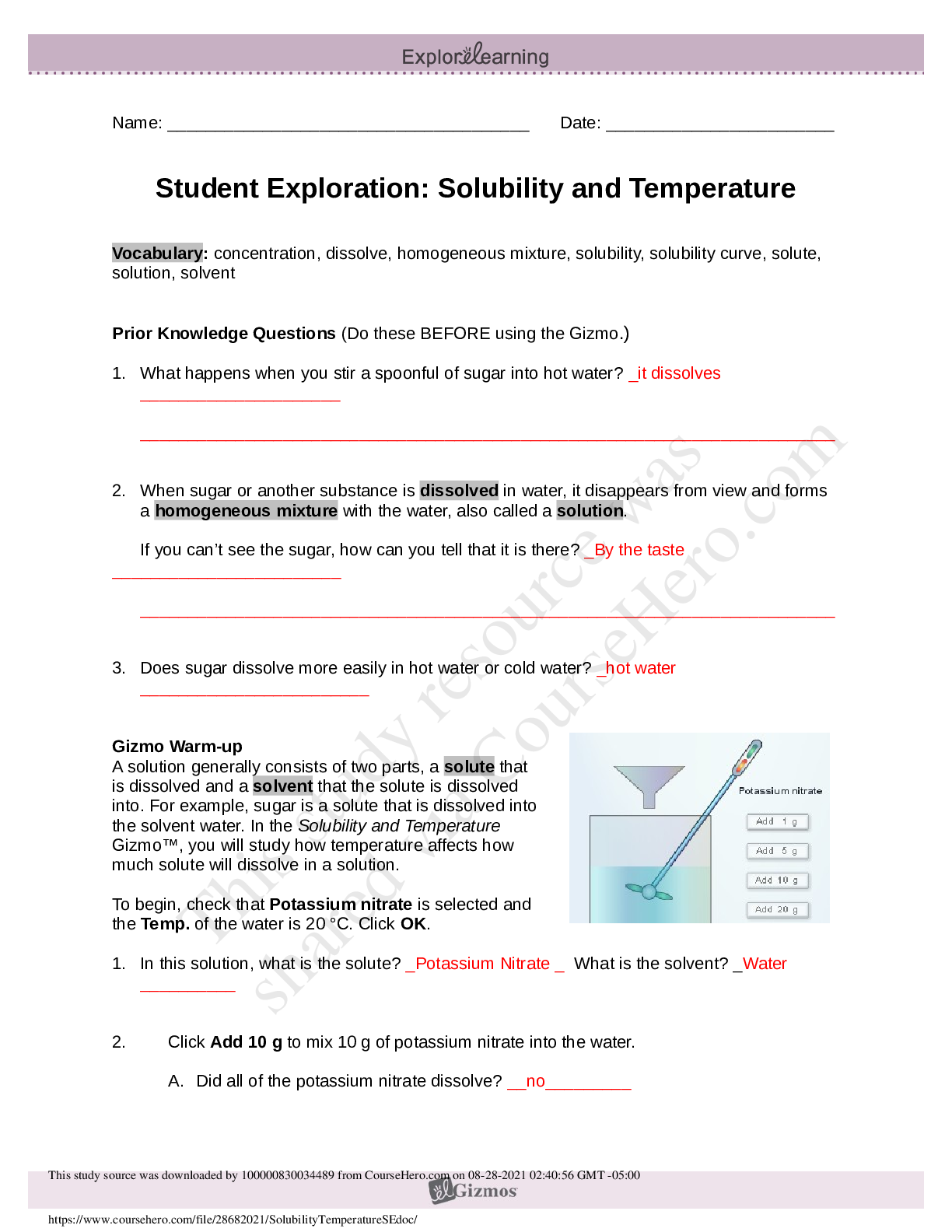
Student Exploration: Solubility and Temperature Gizmo with all...

$7
4 Pages
Student Exploration: Solubility and Temperature-GIZMO with all...

$9
7 Pages
Student Exploration: Colligative Properties GIZMOS | boiling p...

$7
7 Pages
Solubility and Temperature Gizmo Questions and 100% correct an...

$20
237 Pages
Physical Chemistry Thermodynamics Statistical Mechanics and Ki...
$15
1104 Pages
Solutions Manual for Organic Chemistry Student Study Guide 3rd...
$19
389 Pages
General Organic and Biological Chemistry 1st Edition by Kalyn...

$11
10 Pages
Equilibrium and Concentration Gizmo ( all answers correct ) VE...


More related documents below