SCIN 138 Week 5 Exam
Part 1 of 3 - 44.0/ 52.0 Points
Question 1 of 25
4.0 / 4.0 Points
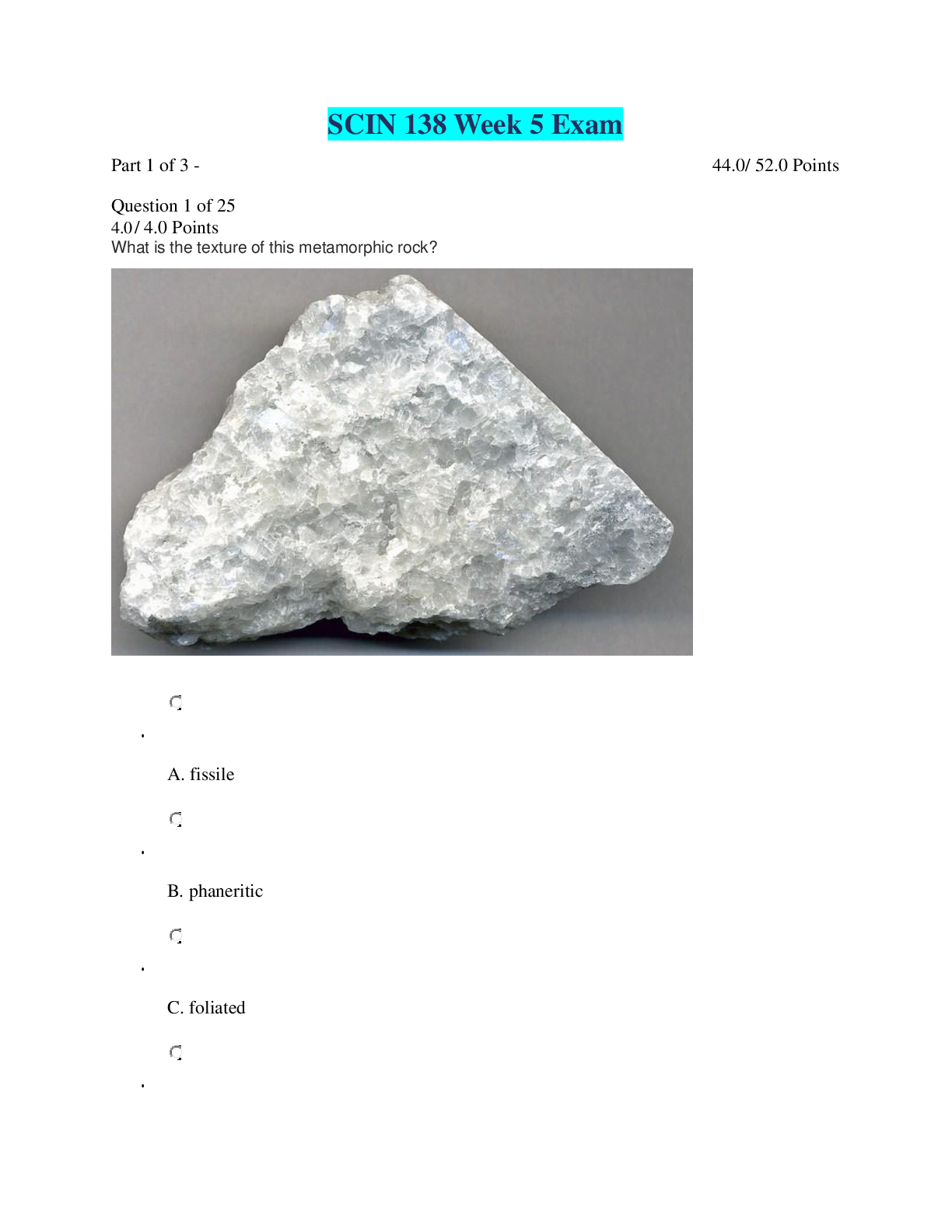
What is the texture of this metamorphic rock?
•
A. fissile
•
B. phaneritic
•
C. foliated
•
D. no
...
SCIN 138 Week 5 Exam
Part 1 of 3 - 44.0/ 52.0 Points
Question 1 of 25
4.0 / 4.0 Points
What is the texture of this metamorphic rock?
•
A. fissile
•
B. phaneritic
•
C. foliated
•
D. nonfissile
•
E. nonfoliated
Question 2 of 25
0.0 / 4.0 Points
Heat promotes recrystallization by
•
A. increasing atomic vibration
•
B. stripping away valence electrons
•
C. separating ultramafic elements from mafic ones
•
D. causing minerals to melt
Feedback: heat causes atoms to vibrate more vigorously, possibly moving from one location in the crystal to another, even moving into another crystal.
Question 3 of 25
4.0 / 4.0 Points
What are the textures of metamorphic rocks?
•
A. foliated or nonfoliated
•
B. phaneritic or aphanitic
•
C. clastic or detrital
•
D. coarse or fine
Question 4 of 25
4.0/ 4.0 Points
What is the texture of this rock?
•
A.
foliated
•
B.
non-foliated
•
C.
phaneritic
•
D.
coarse
•
E. fissile
Question 5 of 25
4.0 / 4.0 Points
Which metamorphic facies is associated with subduction zones?
•
A. greenschist
•
B. granulite
•
C. lawsonite-blueschist
•
D. epidote-eclogite
Feedback:by analyzing the Chapter 6 diagram, lawsonite-blueschist is shown on the left at a low temperature but at a high pressure. The associated diagram indicates that high pressure and low temperature minerals are found at subduction zones.
Question 6 of 25
0.0 / 4.0 Points
What are the three agents of metamorphism?
•
A. differential pressure, deep-sea smokers, and hydrothermal vents
•
B. differential pressure, heat, and temperature
•
C. differential pressure, confining pressure, and lithostatic pressure
•
D. temperature, pressure, and chemically reactive fluids
Question 7 of 25
4.0 / 4.0 Points
The core of a mountain range that formed during regional metamorphism would contain a
metamorphic facies.
•
A. blueschist
•
B. phaneritic
•
C. low-grade
•
D. high-grade
•
E. moderate-grade
Question 8 of 25
4.0 / 4.0 Points
Which of the following is true of metamorphic rocks?
•
A. They form when rocks melt under intense heat and pressure
•
B. They form as a result of volcanic processes.
•
C. They form as a result of weathering and erosion.
•
D. They form as a result of intense heat and pressure.
Question 9 of 25
4.0 / 4.0 Points
The core of a mountain range that formed during regional metamorphism would contain a
metamorphic facies.
•
A. high-grade
•
B. low-grade
•
C. moderate-grade
•
D. blueschist
Question 10 of 25
4.0 / 4.0 Points
At what temperature does diagenesis end and metamorphism begin?
•
A. 100 degrees Celsius
•
B. 3,000 kbars
•
C. 200 degrees Celsius
•
D. 1,000 bars
Feedback:Metamorphism starts at around 200 degrees Celsius. Below that temperature is considered diagenesis, which includes sediments solidifying (compacting and cementing) into sedimentary rocks.
Question 11 of 25
4.0 / 4.0 Points
Which type of metamorphism is responsible for the greatest amount of deformation?
•
A. subduction
•
B. regional
•
C. burial
•
D. contact
•
E. fault
Question 12 of 25
4.0 / 4.0 Points
The parent rock of a metamorphic rock is what?
•
A. The rock after it was subjected to metamorphism.
•
B. The rock before it was subjected to metamorphism.
•
C. The first rock formed during metamorphism.
•
D. The rock as it is subjected to metamorphism.
Question 13 of 25
4.0 / 4.0 Points
A foliated texture means what?
•
A. Fossils are visible.
•
B. layers or banding.
•
C. grains are the same size
•
D. Grains are easily seen.
Part 2 of 3 - Crustal Deformation 36.0/ 40.0 Points Question 14 of 25
0.0 / 4.0 Points
Imagine you are making a pizza, you start off with the dough for the crust in a large ball. You then begin to roll out the pizza dough with a roller. The result is flattened out dough. In this scenario, what simulates the STRAIN found in some rocks?
•
A. the shape of the dough grains
•
B. the force exerted on the dough
•
C. the stickiness of the dough
•
D. the flattening out of the dough ball
Question 15 of 25
4.0 / 4.0 Points
Which process create the world’s largest mountain ranges?
•
A. converging ocean–continental plates
•
B. diverging ocean plates
•
C. converging continental plates
•
D. diverging continental plates
Question 16 of 25
4.0 / 4.0 Points
Shear stress is primarily associated with which type of faults?
•
A. normal faults
•
B. thrust faults
•
C. strike slip faults
•
D. reverse faults
Question 17 of 25
4.0 / 4.0 Points
Forces that act to elongate the crust are associated with .
•
A. compression.
•
B. tension.
•
C. compression and tension
•
D. shear.
Question 18 of 25
4.0 / 4.0 Points
If a rock layer has a dip of 90 degrees, how is that rock layer oriented relative to a horizontal plane.
•
A. Vertical (perpendicular to level ground)
•
B. Horizontal (parallel to level ground)
•
C. Diagonal (45 degrees from level ground)
•
D. More information is required
Feedback:Dip is the angle of inclination of a rock layer from the horizontal. 90 degrees down is vertical.
Question 19 of 25
4.0 / 4.0 Points
Forces that act to shorten the crust are associated with .
•
A. compression.
•
B. compression and tension
•
C. tension.
•
D. shear.
Question 20 of 25
4.0 / 4.0 Points
Compression stress is primarily associated with which type of faults?
•
A. reverse faults
•
B. transform
•
C. strike slip faults
•
D. normal faults
Question 21 of 25
4.0 / 4.0 Points
What type of fault results from the hanging wall moving down?
•
A. normal
•
B. strike slip
•
C. thrust
•
D. reverse
Question 22 of 25
4.0 / 4.0 Points
What type of fault results from tension?
•
A. thrust
•
B. normal
•
C. strike slip
•
D. reverse
Question 23 of 25
4.0 / 4.0 Points
A rock is subjected to high stress and does not break, but it also does not return to it’s original shape when the stress is relieved. It can be said that the rock
•
A. is elastic
•
B. is brittle.
•
C. is strong
•
D. is ductile.
Part 3 of 3 - Weekly Lesson Questions 8.0/ 8.0 Points Question 24 of 25
4.0 / 4.0 Points
A foliated metamorphic rock, in order of increasing metamorphic grade, is:
•
A. Slate, phyllite, schist, gneiss
•
B. Gneiss, schist, phyllite, slate
•
C. Marble, quartzite, eclogite, gneiss
•
D. limestone, eclogite, marble
Feedback:Weekly Lesson 5 - These are the same parent rock and listed in order of increasing
grade.
Question 25 of 25
4.0 / 4.0 Points
Which situation will result in ductile deformation?
•
A. High temperature, low confining pressure, high strain rate
•
B. Low strain rate, high temperature, high confining pressure
•
C. Low strain rate, high confining pressure, low temperature
•
D. Low temperature, low confining pressure, high strain rate
Feedback:Weekly Lesson 5- These entire variables encourage ductile deformation. All of the other answers encourage brittle deformation.
[Show More]








.png)


.png)



.png)