Mike Kelly HTN case study/Mike Kelly HTN case study/Mike Kelly HTN case study
Basic Adult Health
Department of Nursing, Keiser University
...
Mike Kelly HTN case study/Mike Kelly HTN case study/Mike Kelly HTN case study
Basic Adult Health
Department of Nursing, Keiser University
Hypertension
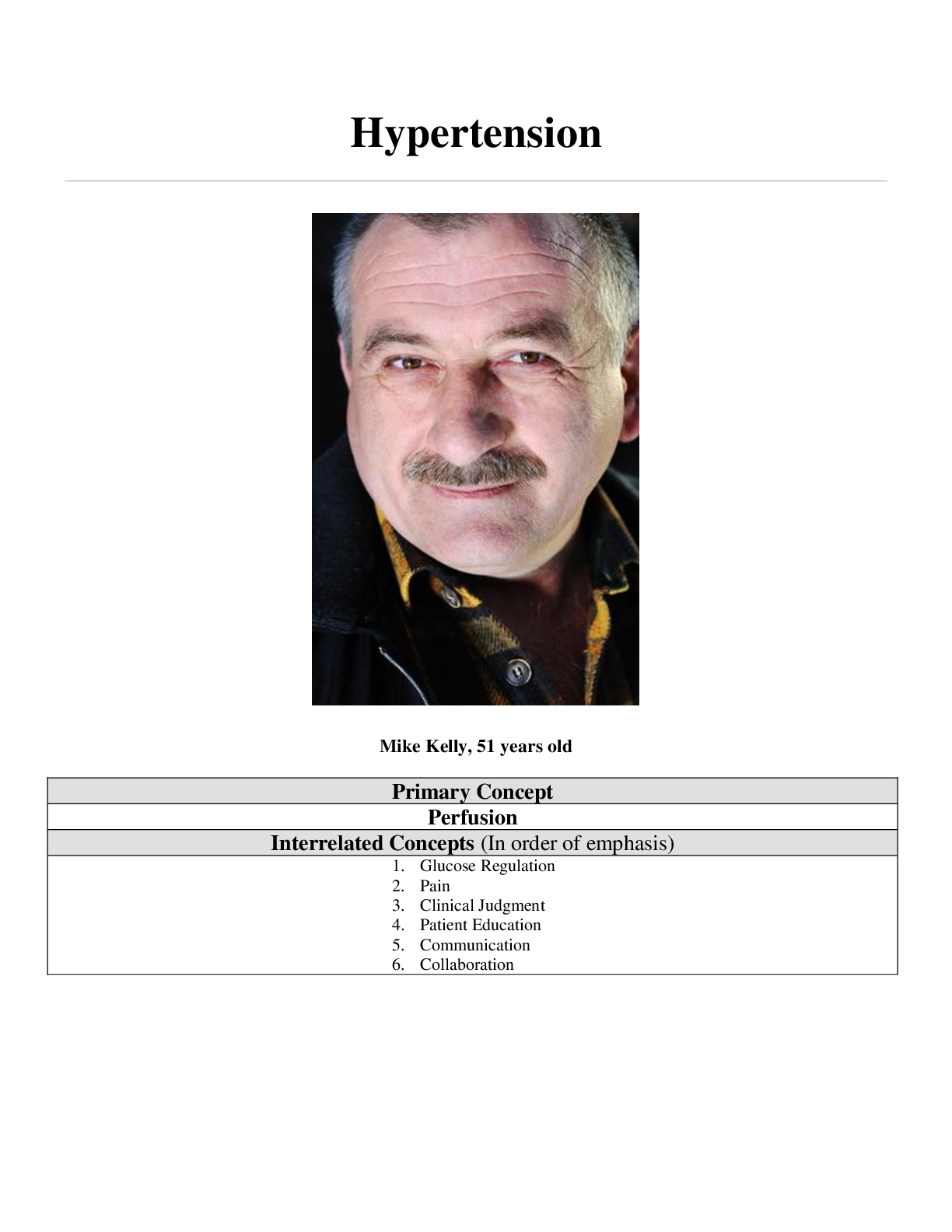
Mike Kelly, 51 years old
Primary Concept
Perfusion
Interrelated Concepts (In order of emphasis)
1. Glucose Regulation
2. Pain
3. Clinical Judgment
4. Patient Education
© 2016 Keith Rischer/www.KeithRN.com
FUNDAMENTAL Reasoning: STUDENT
History of Present Problem:
Mike Kelly is a 51-year-old Caucasian male who is 6 feet tall and weighs 275 pounds (BMI 37.3) with an abnormal distribution of weight around his abdomen. He does not regularly exercise, does not like to cook, and eats fast food three to five times during the week. He has smoked one pack per day since the age of 20 (31 pack years). He has a history of hyperlipidemia, but is unable to afford his medication (atorvastatin), and has not taken since he was diagnosed 5 years ago. He has no current diagnosed medical problems. He became concerned and came to the emergency department because he is more easily fatigued and has had a headache the past three days that has not improved.
Personal/Social History:
Mike is self-employed and owns his own auto mechanic business. He has no health insurance. His father had hypertension and died of a myocardial infarction (MI) at the age of 50. Angelina, his wife, came with him to urgent care. She shares that he is usually stoic about health problems, so this must really bother him or he is afraid. He took Excedrin and Motrin for pain and it didn’t help.
What data from the histories are RELEVANT and have clinical significance for the nurse?
RELEVANT Data from Present Problem: Clinical Significance:
• Hyperlipidemia
• Does not exercise
• Obesity
• Abnormal weight around abdomen.
• Easily fatigued, with a headache for 3 days.
• Smokes a pack a day for about 31 years
• He eats fast food 3 – 5 times a week. • Abnormal amount of weight around his abdominal section may be due to hyperlipidemia, not exercising &eating fast food 3-5 times per week..
• Body Mass Index, (BMI) of 37.3%
• Not exercising, can hyperlipidemia
• Smoking may worsen hyperlipidemia.•
RELEVANT Data from Social History: Clinical Significance:
• No health insurance because he is self- employed (auto mechanic business).
• Father had hypertension; died at age 50 from MI (increasing Mr. Kelly’s risk of developing a MI).
• Stoic about health problems. • Has no health insurance; unable to afford medication, less likely to seek medical attention.
• Family history of MI will increase his chances of having one especially since he smokes, eats fast foods frequently, does not work out and has hyperlipidemia.
• Took Motrin and Excedrin for pain, NSAIDS may raise blood pressure.
Developing Nurse Thinking by Identifying Significance of Clinical Data
Patient Care Begins:
Current VS: P-Q-R-S-T Pain Assessment (5th VS):
T: 98.9 F/37.2 C (oral) Provoking/Palliative: Nothing/Nothing
P: 88 (regular) Quality: Ache
R: 20 Region/Radiation: Global head ache (HA)
BP: 220/118 Severity: 8/10
O2 sat: 95% room air Timing: Continuous
What VS data are RELEVANT and must be recognized as clinically significant by the nurse?
Current Assessment:
GENERAL
APPEARANCE: Appears uncomfortable, body tense with occasional grimacing
RESP: Breath sounds clear with equal aeration bilaterally ant/post, non-labored respiratory effort
CARDIAC: Pink, warm and dry, no edema, heart sounds regular–S1S2, pulses bounding, equal with palpation at radial/pedal/post-tibial landmarks
NEURO: Alert and oriented to person, place, time, and situation (x4)
GI: Abdomen soft/non-tender, bowel sounds audible per auscultation in all 4 quadrants
GU: Voiding without difficulty, urine clear/yellow
SKIN: Skin integrity intact, skin turgor elastic with no tenting
What assessment data are RELEVANT and must be recognized as clinically significant by the nurse?
RELEVANT Assessment Data: Clinical Significance:
• General appearance • He appears uncomfortable, his body is tense with occasional grimacing; which indicates pain and/or discomfort.
Developing Nurse Thinking through APPLICATION of the Sciences
Fluid & Electrolytes/Lab/diagnostic Results:
Radiology Reports: Chest x-ray
What diagnostic results are RELEVANT and must be recognized as clinically significant to the nurse?
RELEVANT Results: Clinical Significance:
-The cardiac size is The enlarged heart “cardiomegaly” is a sign of another underlying condition. Since
enlarged with moderate to hyperlipidemia is linked to hypertension, it has caused the heart to strain harder exerting more
severe cardiomegaly. cardiac output. He has to get his cholesterol down, (he is at risk for heart attack, stroke, heart
-There are no focal failure, etc.).
infiltrates or
consolidations or pleural
effusions.
Lab Results:
Complete Blood Count (CBC:) Current: High/Low/WNL?
WBC (4.5–11.0 mm 3) 10.5 Normal
Hgb (12–16 g/dL) 15.3 Normal
Platelets (150–450x 103/µl) 422 Normal
Neutrophil % (42–72) 68 Normal
What lab results are RELEVANT and must be recognized as clinically significant by the nurse?
RELEVANT Lab(s): Clinical Significance:
His labs appear to be normal. • His WBC, although is within normal range, is still on the higher end. Chances are, Mr. Kelly’s underlying conditions are aiding in his increased WBC count (blood pressure, hyperlipidemia and hypertension).
• His platelets, although within normal range, are still considerably high which can cause his blood to clot, obstructing the flow of blood within the arteries, which can increase cardiac output and cardiac afterload.
• This can rule out certain disorders.
Basic Metabolic Panel (BMP:) Current: High/Low/WNL?
Sodium (135–145 mEq/L) 136 Normal
Potassium (3.5–5.0 mEq/L) 4.0 Normal
Glucose (70–110 mg/dL) 188 HIGH
BUN (7–25 mg/dl) 32 HIGH
Creatinine (0.6–1.2 mg/dL) 1.5 HIGH
What lab results are RELEVANT and must be recognized as clinically significant by the nurse?
RELEVANT Lab(s): Clinical Significance:
Elevated glucose, BUN, & creatinine levels • Glucose is 188 mg/dL which may indicate diabetes, hypoglycemia, or prediabetes, and also explains his fatigue.
• BUN is 32 mg/dL which may indicate renal failure, or high amounts of protein in urea
• Creatinine is 1.5 mg/dL which can be indicative of renal excretory function problem.
Cardiac Labs: Current: High/Low/WNL?
BNP (B-natriuretic Peptide) (<100 ng/L) 758 HIGH
What lab results are RELEVANT and must be recognized as clinically significant by the nurse?
RELEVANT Lab(s): Clinical Significance:
• BNP levels are increasingly high. • BNP is 758 ng/L indicates the heart is not pumping blood properly. These alarming levels indicate heart failure, symptomatic cardiac volume overload, or paroxysmal atrial tachycardia. BNP levels also increase with age & can be the cause of the patient feeling faint..
Lipid Panel: Current: High/Low/WNL?
Low density lipoprotein–LDL (<130 mg/dL) 260 HIGH
High density lipoprotein–HDL (>40 mg/dL) 28 LOW
Total cholesterol (<200 mg/dL) 290 HIGH
Triglycerides (30–149 mg/dL) 484 HIGH
What lab results are RELEVANT and must be recognized as clinically significant by the nurse?
RELEVANT Lab(s): Clinical Significance:
• LDL
• HDL
• Total Cholesterol
• Triglycerides • LDL is high due to being overweight, inactivity, smoking, family history, hyperlipidemia and diet. This can slow down or block blood flow to the heart.
• High cholesterol allows a greater chance for stroke and cardiovascular disease. This is due to the high LDL and triglycerides from hyperlipidemia.
• The patient has triglycerides most likely due to the fact he is overweight, inactive, smokes, a bad diet, high blood pressure, hyperlipidemia and high blood sugar.
Urine Analysis (UA:) Current: High/Low/WNL?
Color (yellow) Yellow NORMAL
Clarity (clear) Clear NORMAL
Specific Gravity (1.015–1.030) 1.018 NORMAL
Protein (neg) Moderate HIGH
Glucose (neg) Moderate HIGH
Ketones (neg) Negative NORMAL
Bilirubin (neg) Negative NORMAL
Blood (neg) Positive ABNORMAL
Nitrite (neg) Negative NORMAL
LET (Leukocyte Esterase) (neg) Negative NORMAL
MICRO:
RBCs (<5) 3 NORMAL
WBCs (<5) 2 NORMAL
Bacteria (neg) Negative NORMAL
Epithelial (neg) Negative NORMAL
What lab results are RELEVANT and must be recognized as clinically significant by the nurse?
RELEVANT Lab(s): Clinical Significance:
• Protein
• Glucose
• Blood • A moderate amount of protein the urine can mean nothing, but it can also mean the kidneys are not working properly. Proteinuria, often a sign of kidney disease (high stress can cause this also)
• High glucose in urinalysis indicates possible diabetes mellitus or kidney damage.
• Can be indicative of an underlying issue such as chronic kidney disease (depending on the amount that was observed)
Lab Planning: Creating a Plan of Care with a PRIORITY Lab:
Lab: Normal
Value: Why Relevant? Nursing Assessments/Interventions Required:
Creatinine
Value:
1.5
Critical value:
(0.6–1.2 mg/dL) May signal impaired kidney function or kidney disease. (the creatinine is not being filtered out of the kidneys causing the kidneys to absorb excess
creatinine). Assess BUN levels, cognitive and physical functions, vital signs, intake and output, weight, and skin turgor as a potential dehydration. Assess frequently for skin breakdown (high creatinine can cause “itchy skin”. Assess for fatigue, muscle weakness, nausea and vomiting. Assess sclera for possible signs of jaundice.
Lab: Normal Value: Why Relevant? Nursing Assessments/Interventions
Required:
BNP
(B-natriuretic Peptide)
Value: 758
Critical Value:
(<100 ng/L) The heart is unable to pump blood for systemic circulation. This higher the number, the more likely heart failure is present, increasing cardiac output and afterload. Monitor urinary output, sodium and potassium levels, check O2 frequently (may need to administer supplemental oxygen). Monitor renal and liver function tests, and ECG along with respirations.
Pharmacology:
Home Med: Classification: Mechanism of Action
(in own words): Nursing Considerations:
Atorvastatin HMG-CoA
reductase inhibitor; Antihyperlipidemic Reduces cholesterol and lipoprotein production in the liver, also increases the number of LDL receptors on the surface of hepatic cells • Expect to test liver function
• Expect to measure lipid levels 2 to 4 weeks after therapy has started
• Monitor diabetic patients (can affect blood glucose control)
• Do not take with grapefruit juice
• Beware of certain drug interactions (digoxin or rifampin)
Pathophysiology:
1. What is the primary problem that your patient is most likely presenting?
Mr. Kelly is most likely presenting Heart Failure due to Hyperlipidemia/Hypertension
2. What is the underlying cause/pathophysiology of this primary problem?
(Relate initial manifestations to the pathophysiology of the primary problem)
Pathophysiology of Primary Problem: Rationale/Relationship to Manifestations:
• Heart failure is a clinical syndrome that results when the heart is unable to provide sufficient blood flow to meet metabolic requirements or accommodate systemic venous return. Heart failure results from injury to the myocardium from a variety of causes including ischemic heart disease, hypertension, and diabetes. Less common etiologies include cardiomyopathies, valvular disease, myocarditis, infections, systemic toxins, and cardiotoxic drugs. • As the heart fails, patients develop symptoms which include dyspnea from pulmonary congestion, and peripheral edema and ascites from impaired venous return. Constitutional symptoms such as nausea, lack of appetite, and fatigue are also common.
Developing Nurse Thinking by Identifying Clinical RELATIONSHIPS
1. What is the RELATIONSHIP of the past medical history and current medications?
(Which medication treats which condition? Draw lines to connect)
Past Medical History (PMH): Home Meds:
• Hyperlipidemia Atorvastatin NOT currently taking would help control
Obesity; abdominal hyperlipidemia.
fat distribution
• Sedentary lifestyle
(no exercise)
• Smokes 1 pack per day
• Family history of heart disease
1. Is there a RELATIONSHIP between any disease in PMH that may have contributed to the development of the current problem? (Which disease likely developed FIRST then began a “domino effect”?)
PMH: What Came FIRST:
Uncontrolled hypertension and hyperlipidemia It is hard to assess which came first due to the fact that if you suffer from hyperlipidemia, chances are, you have developed hypertension as well. And vice versa.
3. What is the RELATIONSHIP between the primary care provider’s orders and primary problem?
Care Provider Orders: How it Will Resolve Primary Problem/Nursing Priority:
Basic metabolic panel (BMP) Complete cell count (CBC)
BNP (B-natriuretic Peptide) Lipid profile
Urine analysis (UA) 12-lead EKG
Chest X-ray
Labetalol 20 mg IV push every 10". Maximum 300 mg dose.
Goal-BP: 160/100 - Performed to identify electrolytes, fluid balance, and kidney function.
- Evaluates overall health and can detect many disorders.
- Measures levels of protein that is made by the heart and blood vessels, identifies heart failure.
- Identifies the amount of good and bad cholesterol and triglycerides in the blood, cardiac assessment.
- Can detect a range of disorders such as UTI, kidney disease, and diabetes.
- Identifies cardiac ischemia.
- Can observe vital organs & detect issues.
- To reduce the blood pressure to reduce the workload of the heart and arteries.
Developing Nurse Thinking by Identifying Clinical PRIORITIES
1. What nursing priority(ies) will guide your plan of care? (if more than one-list in order of PRIORITY)
The patient seems uncomfortable and is grimacing,` my priority is to relieve his pain and make him more comfortable. Reducing the workload of the heart by reducing the hypertension and hyperlipidemia would be my next goal which can hopefully preserve myocardial tissue.
2. What interventions will you initiate based on this priority?
Nursing Interventions: Rationale: Expected Outcome:
• Monitor BP, pulse, and results from labs • Patient’s with renal failure are most often hypertensive, which is linked to excess fluid (edema). Results from lab tests provide insight to the client’s status of disease and response to treatment. BP should be substantially lower than when patient first arrived. Pulse will be stable at 88 bpm. Labs will be monitored frequently.
• Check vitals before and after medications & Monitor O2 saturation and ABGs • Provides information regarding the heart’s ability to perfuse distal tissues with oxygenated blood. O2 saturation will be stable at 95% and above.
• Encourage periods of rest and a heart healthy diet • Encouraging rest reduces cardiac workload, encouraging a healthy lifestyle with healthy dieting will improve vascular resistance and strengthen the heart muscle (myocardium). Patient will consume a heart healthy diet, as well as walk around for 6 – 10 minutes daily. I will assess vital signs upon returning.
• Acknowledge patients perception of the situation • The wife states he does not talk about health concerns so it must be serious for him to
come. Patient will recognize feelings and express how
he feels.
3. What are the PRIORITY psychosocial needs that this patient and/or family likely have that will need to be addressed?
Answer all questions factually and encourage questions and any issues of concern. Psychosocial needs include basic needs, emotional, and mental well-being. Since the wife has mentioned Mr. Kelly is stoic about health problems this could mean he is having anxiety or fear. The change in his health will need to be addressed and lifestyle changes he will need to recover.
4. How can the nurse address these psychosocial needs?
This patient and his family will have to understand that the food Mr. Kelly consumes is what’s affecting his heart in a negative way. Promoting a healthy diet and lifestyle can and will reduce Mr. Kelly’s chance of heart failure or stroke. The healthy lifestyle includes the cessation of smoking indefinitely, and implementing a workout routine of 1.5 hr., 3x a week. Him and his family will incorporate whole grains, sodium-free seasonings, and fresh fruit and vegetables daily.
5. What educational/discharge PRIORITIES will be needed to develop a teaching plan for this patient and/or family?
Discharge teaching will include lifestyle changes and medications. The patient will need to eat a healthier diet, be more active, and stop smoking cigarettes. This is a lot for someone who does not live a lifestyle like this so you can set goals where it’s not as overwhelming. Teaching the side effects and what the medications are for also important for the patient to understand.
Caring & the “Art” of Nursing
1. What is the patient likely experiencing/feeling right now in this situation?
The patient can be feeling anxiety, fear, and even upset with themselves for not taking better care of themselves.
2. What can I do to engage myself with this patient’s experience, and show that he/she matters to me as a person?
I can engage myself with the patient by constantly checking in and not rushing conversations. Printing handouts on certain foods to eat and what to eat shows I am going out of my way to help him gain knowledge on the situation. Allowing them to be comfortable around me and to ask me anything is one of my goals.
Use Reflection to THINK Like a Nurse
Reflection-IN-action (Tanner, 2006) is the nurse’s ability to accurately interpret the patient’s response to an intervention in the moment as the events are unfolding to make a make a correct clinical judgment and transfer what is learned to improve nurse thinking and patient care in the future.
1. What did I learn from this scenario?
I learned that many underlying factors can lead to a big problem if not treated. If the patient had come in for regular checkups, then the blood pressure and hyperlipidemia could have possible been avoided if compliant. Also, many tests need to be done in order to narrow it down to the primary cause.
2. How can I use what has been learned from this scenario to improve patient care in the future?
In the future when I come across a patient similar, I will be able to recognize lab values and possible causes. I will also try to make them feel comfortable since it is a scary situation. Also, I am seeing the importance a healthy diet and exercise so I will always stress this.
[Show More]



![Preview of eBook [PDF] Barash, Cullen, and Stoelting's Clinical Anesthesia 9th Edition By Bruce F. Cu](https://browseimages.nyc3.digitaloceanspaces.com/paper-images/2024/Aug/29/8DF2QRTq2024-08-29-10-3966d0259b7c4b5.png)
![Preview of eBook [PDF] Fundamentals of Nursing 3rd Edition By Joanne Tollefson, Sue C. DeLaune, Patri](https://browseimages.nyc3.digitaloceanspaces.com/paper-images/2024/Aug/26/U6SQ8mmq2024-08-26-01-4766cc5d40d7385.png)
![Preview of eBook [PDF] Burns' Pediatric Primary Care 7th Edition BY Dawn Lee Garzon Maaks,, Nancy Bar](https://browseimages.nyc3.digitaloceanspaces.com/paper-images/2024/Aug/26/WR2rowXX2024-08-26-02-0966cc625bea839.png)