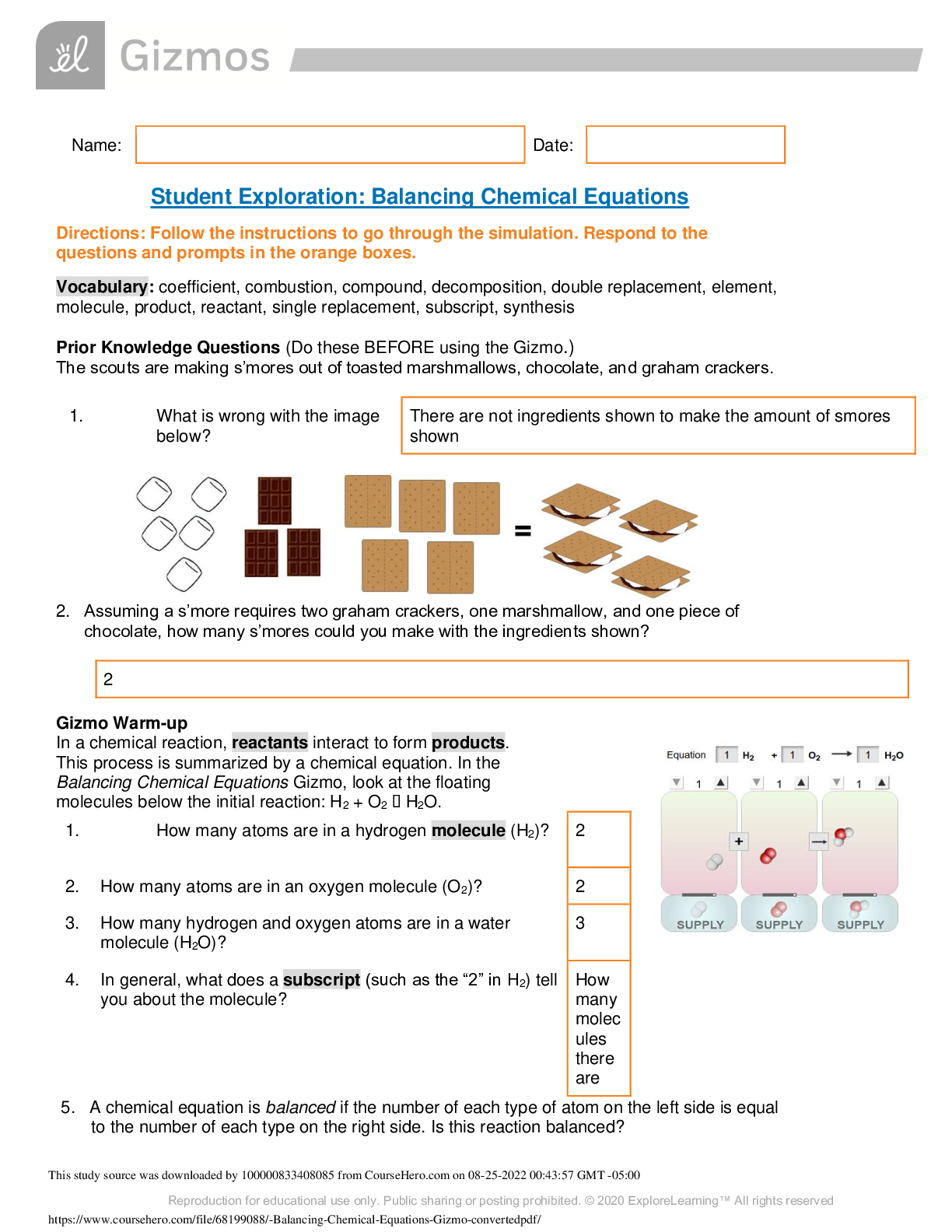
Student Exploration: Balancing Chemical Equations
Directions: Follow the instructions to go through the simulation. Respond to the
questions and prompts in the orange boxes.
Vocabulary: coefficient, combustion, compou
...
Student Exploration: Balancing Chemical Equations
Directions: Follow the instructions to go through the simulation. Respond to the
questions and prompts in the orange boxes.
Vocabulary: coefficient, combustion, compound, decomposition, double replacement, element,
molecule, product, reactant, single replacement, subscript, synthesis
Prior Knowledge Questions (Do these BEFORE using the Gizmo.)
The scouts are making s’mores out of toasted marshmallows, chocolate, and graham crackers
What is wrong with the image
below?2. Assuming a s’more requires two graham crackers, one marshmallow, and one piece of chocolate, how many s’mores could you make with the ingredients shown?
izmo Warm-up
In a chemical reaction, reactants interact to form products.
This process is summarized by a chemical equation. In the
Balancing Chemical Equations Gizmo, look at the floating
molecules below the initial reaction: H2 + O2 H2O.
1. How many atoms are in a hydrogen molecule (H2)?
2. How many atoms are in an oxygen molecule (O2)?
3. How many hydrogen and oxygen atoms are in a water
molecule (H2O)?4. In general, what does a subscript (such as the “2” in H2) tell
you about the molecule?A chemical equation is balanced if the number of each type of atom on the left side is equal
to the number of each type on the right side. Is this reaction balanced?Introduction: The equation H2 + O2 H2O is unbalanced because there are two oxygen
atoms on the reactants side of the equation, and only one on the products side of the
equation. To balance the equation, you cannot change the structure of any of the
molecules, but you can change the number of molecules that are used.
Question: How are chemical equations balanced?
1. Balance: Turn on Show histograms. The equation is balanced when there are equal
numbers of each type of atom represented on each side of the equation. In the Gizmo,
use the up and down arrows to adjust the numbers of hydrogen, oxygen, and water
molecules until the equation is balanced. When you are done, turn on Show summary
to check your answer
Solve: Turn off Show summary. Use the Choose reaction drop down menu to see other
equations, and balance them. Check your answers and then write the balanced equations.
3. Practice: Balance the following chemical equations. (These equations are not in the Gizmo.)
Introduction: Chemical equations show how compounds and elements react with one
another. An element is a substance consisting of one kind of atom, such as aluminum
(Al) or oxygen gas (O2). A compound is a substance made of more than one kind of
atom, such as water (H2O) or table salt (NaCl).
Question: How are chemical reactions classified?
1. Match: Most chemical reactions can be classified as one of four types. Using the
chemical equations in the Gizmo as a guide, match the following definitions to the
type of reaction.
One reactant is broken down into two or more products.
A fuel is combined with oxygen to produce carbon dioxide and water.
Two or more reactants combine to form one product.
Two compounds react to form two different compounds.
A compound reacts with an element to form a new compound and a
different element.
b e a d c
2. Practice: Balance each of the chemical equations below. (Some equations may already be
balanced.) In the spaces in #3, classify the reaction as a synthesis (Syn), decomposition
(Decomp), single replacement (SR), double replacement reaction (DR) or combustion (Comb)
[Show More]