1. The appropriate discount rate for valuing any bond is the
a. bond's coupon rate.
b. bond's coupon rate adjusted for the expected inflation rate over the life of the bond.
c. Treasury bill rate with an adjustment to
...
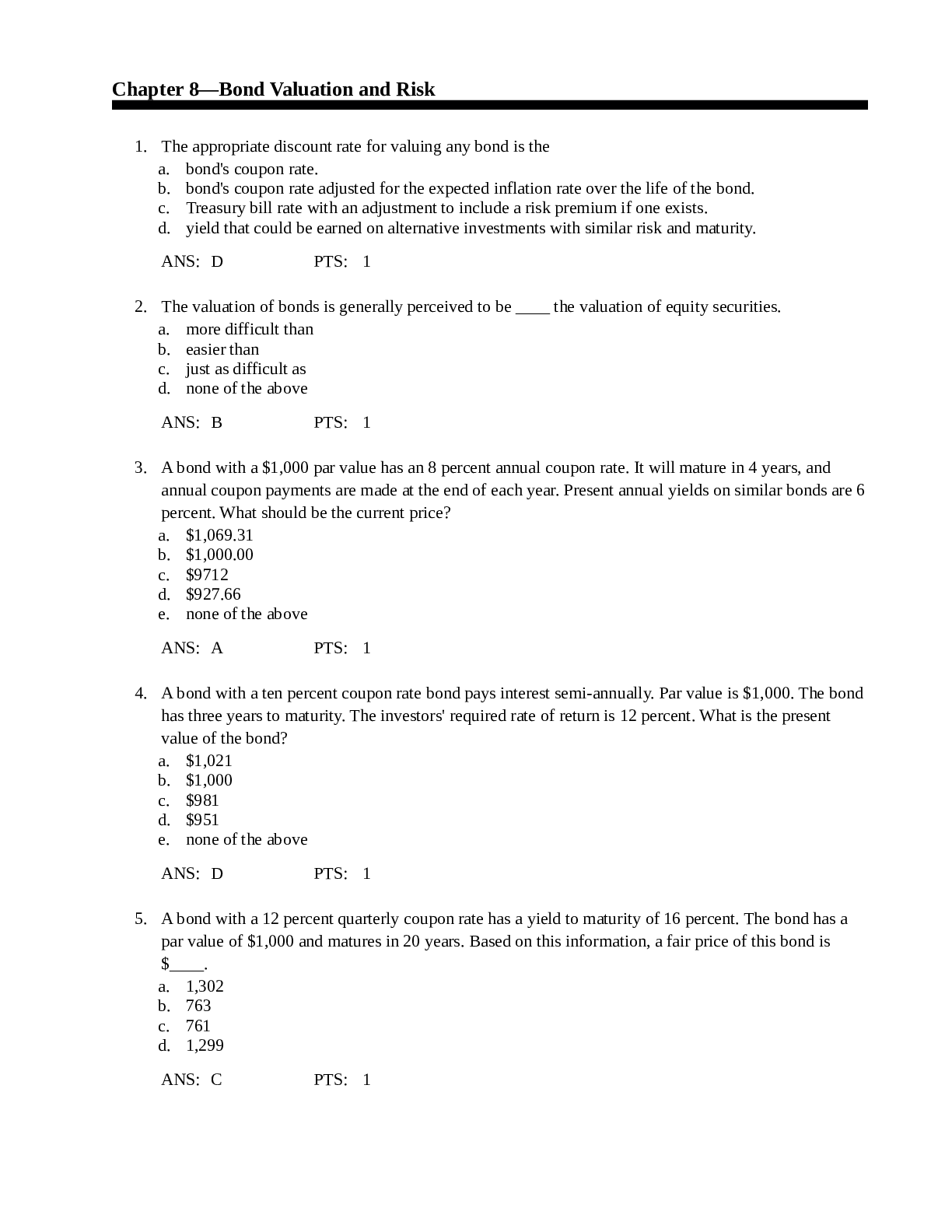
1. The appropriate discount rate for valuing any bond is the
a. bond's coupon rate.
b. bond's coupon rate adjusted for the expected inflation rate over the life of the bond.
c. Treasury bill rate with an adjustment to include a risk premium if one exists.
d. yield that could be earned on alternative investments with similar risk and maturity.
ANS: D PTS: 1
2. The valuation of bonds is generally perceived to be ____ the valuation of equity securities.
a. more difficult than
b. easier than
c. just as difficult as
d. none of the above
ANS: B PTS: 1
3. A bond with a $1,000 par value has an 8 percent annual coupon rate. It will mature in 4 years, and
annual coupon payments are made at the end of each year. Present annual yields on similar bonds are 6
percent. What should be the current price?
a. $1,069.31
b. $1,000.00
c. $9712
d. $927.66
e. none of the above
ANS: A PTS: 1
4. A bond with a ten percent coupon rate bond pays interest semi-annually. Par value is $1,000. The bond
has three years to maturity. The investors' required rate of return is 12 percent. What is the present
value of the bond?
a. $1,021
b. $1,000
c. $981
d. $951
e. none of the above
ANS: D PTS: 1
5. A bond with a 12 percent quarterly coupon rate has a yield to maturity of 16 percent. The bond has a
par value of $1,000 and matures in 20 years. Based on this information, a fair price of this bond is
$____.
a. 1,302
b. 763
c. 761
d. 1,299
ANS: C PTS: 16. From the perspective of investing institutions, the most attractive foreign bonds offer a ____ and are
denominated in a currency that ____ over the investment horizon.
a. high yield; appreciates
b. high yield; remains stable
c. low yield; appreciates
d. low yield; depreciates
ANS: A PTS: 1
7. The value of ____-risk securities will be relatively ____.
a. high; high
b. high; low
c. low; low
d. none of the above
ANS: B PTS: 1
8. The larger the investor's ____ relative to the ____, the larger the ____ of a bond with a particular par
value.
a. discount rate; required rate of return; discount
b. required rate of return; discount rate; discount
c. required rate of return; discount rate; premium
d. none of the above
ANS: B PTS: 1
9. If the coupon rate equals the required rate of return, the price of the bond
a. should be above its par value.
b. should be below its par value.
c. should be equal to its par value.
d. is negligible.
ANS: C PTS: 1
10. When financial institutions expect interest rates to ____, they may ____.
a. increase; sell bonds and buy short-term securities
b. increase; sell short-term securities and buy bonds
c. decrease; sell bonds and buy short-term securities
d. B and C
ANS: A PTS: 1
11. For a given par value of a bond, the higher the investor's required rate of return is above the coupon
rate, the
a. greater is the premium on the price.
b. greater is the discount on the price.
c. smaller is the premium on the price.
d. smaller is the discount on the price.
12. Zero coupon bonds with a par value of $1,000,000 have a maturity of 10 years, and a required rate of
return of 9 percent. What is the current price?
a. $363,212
b. $385,500
c. $422,400
d. $424,100
e. none of the above
ANS: C PTS: 1
13. If the coupon rate ____ the required rate of return, the price of a bond ____ par value.
a. equals; equals
b. exceeds; is less than
c. is less than; is greater than
d. B and C
e. none of the above
ANS: A PTS: 1
14. As interest rates increase, long-term bond prices
a. increase by a greater degree than short-term bond prices.
b. increase by an equal degree as short-term bond prices.
c. decrease by a greater degree than short-term bond prices.
d. decrease by an equal degree as short-term bond prices.
e. decrease by a smaller degree than short-term bond prices.
ANS: C PTS: 1
15. The prices of bonds with ____ are most sensitive to interest rate movements.
a. high coupon payments
b. zero-coupon payments
c. small coupon payments
d. none of the above (The size of the coupon payment does not affect sensitivity of bond
prices to interest rate movements.)
ANS: B PTS: 1
16. A(n) ____ in the expected level of inflation results in ____ pressure on bond prices.
a. increase; upward
b. increase; downward
c. decrease; downward
d. none of the above
ANS: B PTS: 1
17. Other things held constant, bond prices should increase when inflationary expectations rise.
a. True
b. False
ANS: F PTS: 1
[Show More]