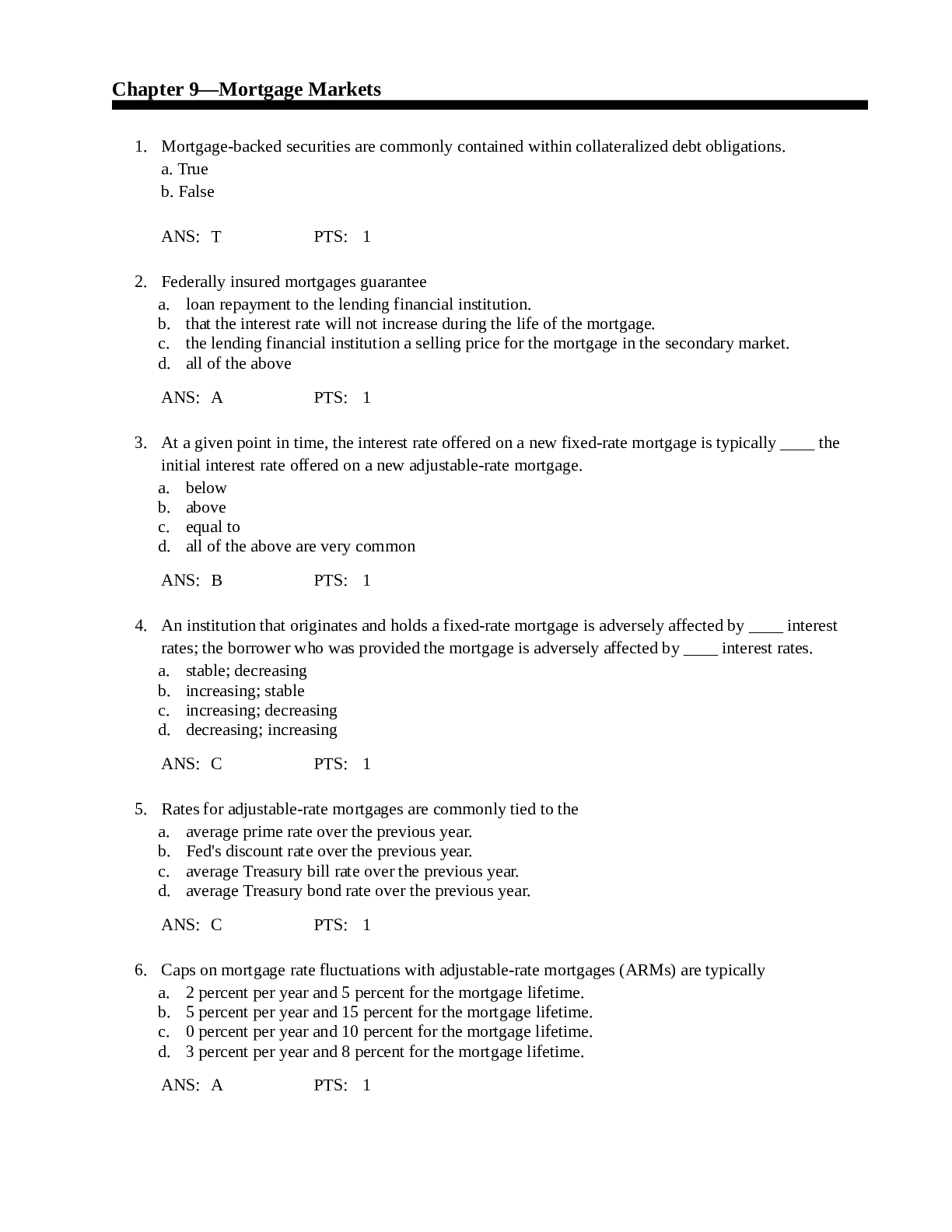
1. Mortgage-backed securities are commonly contained within collateralized debt obligations.
a. True
b. False
ANS: T PTS: 1
2. Federally insured mortgages guarantee
a. loan repayment to the lending financial institu
...
1. Mortgage-backed securities are commonly contained within collateralized debt obligations.
a. True
b. False
ANS: T PTS: 1
2. Federally insured mortgages guarantee
a. loan repayment to the lending financial institution.
b. that the interest rate will not increase during the life of the mortgage.
c. the lending financial institution a selling price for the mortgage in the secondary market.
d. all of the above
ANS: A PTS: 1
3. At a given point in time, the interest rate offered on a new fixed-rate mortgage is typically ____ the
initial interest rate offered on a new adjustable-rate mortgage.
a. below
b. above
c. equal to
d. all of the above are very common
ANS: B PTS: 1
4. An institution that originates and holds a fixed-rate mortgage is adversely affected by ____ interest
rates; the borrower who was provided the mortgage is adversely affected by ____ interest rates.
a. stable; decreasing
b. increasing; stable
c. increasing; decreasing
d. decreasing; increasing
ANS: C PTS: 1
5. Rates for adjustable-rate mortgages are commonly tied to the
a. average prime rate over the previous year.
b. Fed's discount rate over the previous year.
c. average Treasury bill rate over the previous year.
d. average Treasury bond rate over the previous year.
ANS: C PTS: 1
6. Caps on mortgage rate fluctuations with adjustable-rate mortgages (ARMs) are typically
a. 2 percent per year and 5 percent for the mortgage lifetime.
b. 5 percent per year and 15 percent for the mortgage lifetime.
c. 0 percent per year and 10 percent for the mortgage lifetime.
d. 3 percent per year and 8 percent for the mortgage lifetime.
ANS: A PTS: 17. From the perspective of the lending financial institution, interest rate risk is
a. lower on a 30-year fixed-rate mortgage than on a 15-year fixed-rate mortgage.
b. lower on a 15-year fixed-rate mortgage than on a 30-year fixed-rate mortgage.
c. higher on a 15-year fixed-rate mortgage than on a 30-year fixed-rate mortgage.
d. higher on a 15-year adjustable-rate mortgage than on a 30-year adjustable-rate mortgage.
ANS: B PTS: 1
8. Mortgage companies specialize in
a. purchasing mortgages originated by other financial institutions.
b. investing and maintaining mortgages that they create.
c. originating mortgages and selling those mortgages.
d. borrowing money through the creation of mortgages that is used to invest in real estate.
ANS: C PTS: 1
9. For any given interest rate, the shorter the life of the mortgage, the ____ the monthly payment and the
____ the total payments over the life of the mortgage.
a. greater; greater
b. greater; lower
c. lower; greater
d. lower; lower
ANS: B PTS: 1
10. A financial institution has a higher degree of interest rate risk on a ____ than a ____.
a. 30-year fixed-rate mortgage; 15-year fixed-rate mortgage
b. 30-year variable-rate mortgage; 30-year fixed-rate mortgage
c. 15-year fixed-rate mortgage; 30-year fixed-rate mortgage
d. 15-year variable-rate mortgage; 15-year fixed-rate mortgage
ANS: A PTS: 1
11. A balloon-payment mortgage requires interest payments for a 10- to 20-year period, at the end of
which the borrower must pay the full amount of the principal.
a. True
b. False
ANS: F PTS: 1
12. Use an amortization schedule. A 15-year $100,000 mortgage has a fixed mortgage rate of 9 percent. In
the first month, the total mortgage payment is $____, and $____ of this amount represents payment of
interest.
a. 1,014; 264
b. 1,241; 750
c. 1,014; 750
d. none of the above
ANS: C PTS: 113. A mortgage that requires interest payments for a three- to five-year period, then full payment of
principal, is a(n)
a. chattel mortgage.
b. balloon payment mortgage.
c. variable-rate mortgage.
d. open-ended mortgage bond.
ANS: B PTS: 1
14. In an amortization schedule of monthly mortgage payments
a. the amount of interest in each payment is equal to the principal paid.
b. interest payments exceed principal payments early on.
c. principal payments exceed interest payments early on.
d. B and C both occur with about equal frequency
ANS: B PTS: 1
15. A mortgage with low initial payments that increase over time without ever leveling off is a
a. graduated payment mortgage.
b. growing-equity mortgage.
c. second mortgage.
d. shared-appreciation mortgage.
ANS: B PTS: 1
16. The interest rate on a second mortgage is ____ on a first mortgage created at the same time, because
the second mortgage is ____ the existing first mortgage in priority claim against the property in the
event of default.
a. higher than; behind
b. equal to that; equal to
c. lower than; ahead of
d. higher than; ahead of
e. lower than; behind
ANS: A PTS: 1
17. Which of the following mortgages allows the home purchaser to obtain a mortgage at a below-market
interest rate throughout the life of the mortgage?
a. second mortgage
b. growing-equity mortgage
c. graduated payment mortgage
d. shared-appreciation mortgage
ANS: D PTS: 1
18. A ____ mortgage allows the borrower to initially make small payments on the mortgage. The
payments then increase over the first 5 to 10 years and then level off.
a. graduated payment mortgage
b. growing-equity mortgage
c. second mortgage
d. shared-appreciation mortgage
[Show More]