1. A(n) ____ is a standardized agreement to deliver or receive a specified amount of a specified financial
instrument at a specified price and date.
a. option contract
b. brokerage contract
c. financial futures contr
...
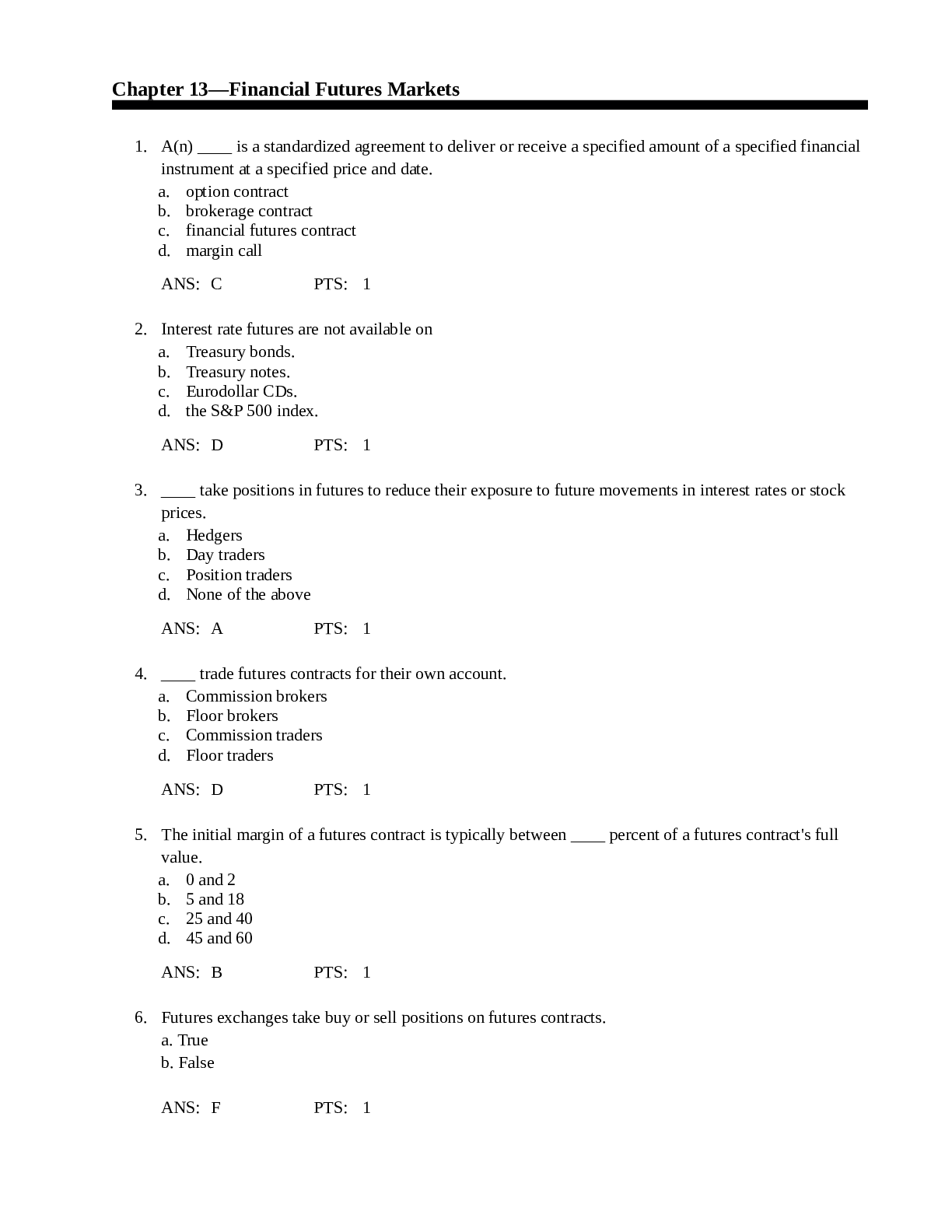
1. A(n) ____ is a standardized agreement to deliver or receive a specified amount of a specified financial
instrument at a specified price and date.
a. option contract
b. brokerage contract
c. financial futures contract
d. margin call
ANS: C PTS: 1
2. Interest rate futures are not available on
a. Treasury bonds.
b. Treasury notes.
c. Eurodollar CDs.
d. the S&P 500 index.
ANS: D PTS: 1
3. ____ take positions in futures to reduce their exposure to future movements in interest rates or stock
prices.
a. Hedgers
b. Day traders
c. Position traders
d. None of the above
ANS: A PTS: 1
4. ____ trade futures contracts for their own account.
a. Commission brokers
b. Floor brokers
c. Commission traders
d. Floor traders
ANS: D PTS: 1
5. The initial margin of a futures contract is typically between ____ percent of a futures contract's full
value.
a. 0 and 2
b. 5 and 18
c. 25 and 40
d. 45 and 60
ANS: B PTS: 1
6. Futures exchanges take buy or sell positions on futures contracts.
a. True
b. False
ANS: F PTS: 17. If the prices of Treasury bonds ____, the value of an existing Treasury bond futures contract should
____.
a. increase; be unaffected
b. decrease; be unaffected
c. A and B
d. decrease; decrease
e. decrease; increase
ANS: D PTS: 1
8. Assume that a T-bill futures contract with a face value of $1 million is purchased at a price of $95.00
per $100 face value. At settlement, the price of T-bills is $95.50. What is the difference between the
selling and purchase price of the futures contract?
a. $.50
b. $50
c. $500
d. $5,000
e. none of the above
ANS: D PTS: 1
9. If speculators believe interest rates will ____, they would consider ____ a T-bill futures contract today.
a. increase; selling
b. increase; buying
c. decrease, selling
d. decrease; purchasing a call option on
ANS: A PTS: 1
10. Financial futures contracts on U.S. securities are ____ by non-U.S. financial institutions.
a. not allowed to be traded
b. are rarely desired
c. are commonly traded
d. A and B
ANS: C PTS: 1
11. Assume that speculators had purchased a futures contract at the beginning of the year. If the price of a
security represented by a futures contract ____ over the year, then these speculators would likely have
purchased the futures contract for ____ than they can sell it for.
a. increased; more
b. decreased; less
c. remains the same; more
d. increased; less
ANS: D PTS: 1
12. Assume that a futures contract on Treasury bonds with a face value of $100,000 is purchased at 93-00.
If the same contract is later sold at 94-18, what is the gain, ignoring transactions costs?a. $1,180,000
b. $118
c. $11,800
d. $15,625
e. $1,562.50
ANS: E PTS: 1
13. The use of financial leverage
a. magnifies the positive returns of futures contracts.
b. magnifies losses of futures contracts.
c. both A and B
d. none of the above
ANS: C PTS: 1
14. According to the text, when a financial institution sells futures contracts on securities in order to hedge
against a change in interest rates, this is referred to as
a. a long hedge.
b. a short hedge.
c. a closed out position.
d. basis trading.
ANS: B PTS: 1
15. A financial institution that maintains some Treasury bond holdings sells Treasury bond futures
contracts. If interest rates increase, the market value of the bond holdings will ____ and the position in
futures contracts will result in a ____.
a. increase; gain
b. increase; loss
c. decrease; gain
d. decrease; loss
ANS: C PTS: 1
16. The basis is the
a. difference between the price of a security and the price of a futures contract on the
security.
b. gain or loss from hedging with futures contracts.
c. difference between a futures contract price and the initial deposit required.
d. price paid for a futures contract after accounting for transactions costs.
e. price paid for an option contract.
ANS: A PTS: 1
17. The profits of a financial institution with interest-rate sensitive liabilities and interest rate-insensitive
assets are ____ with hedging than without hedging if interest rates decrease.
a. higher
b. the same
c. lower
d. higher or the sameANS: C PTS: 1
18. Assume that a bank obtains most of its funds from large CDs with a one-year maturity. Its assets are in
the form of loans with rates that adjust every six months. The bank would be ____ affected if interest
rates increase. To partially hedge its position, it could ____ futures contracts.
a. adversely; purchase
b. favorably; sell
c. favorably; purchase
d. adversely; sell
ANS: C PTS: 1
[Show More]