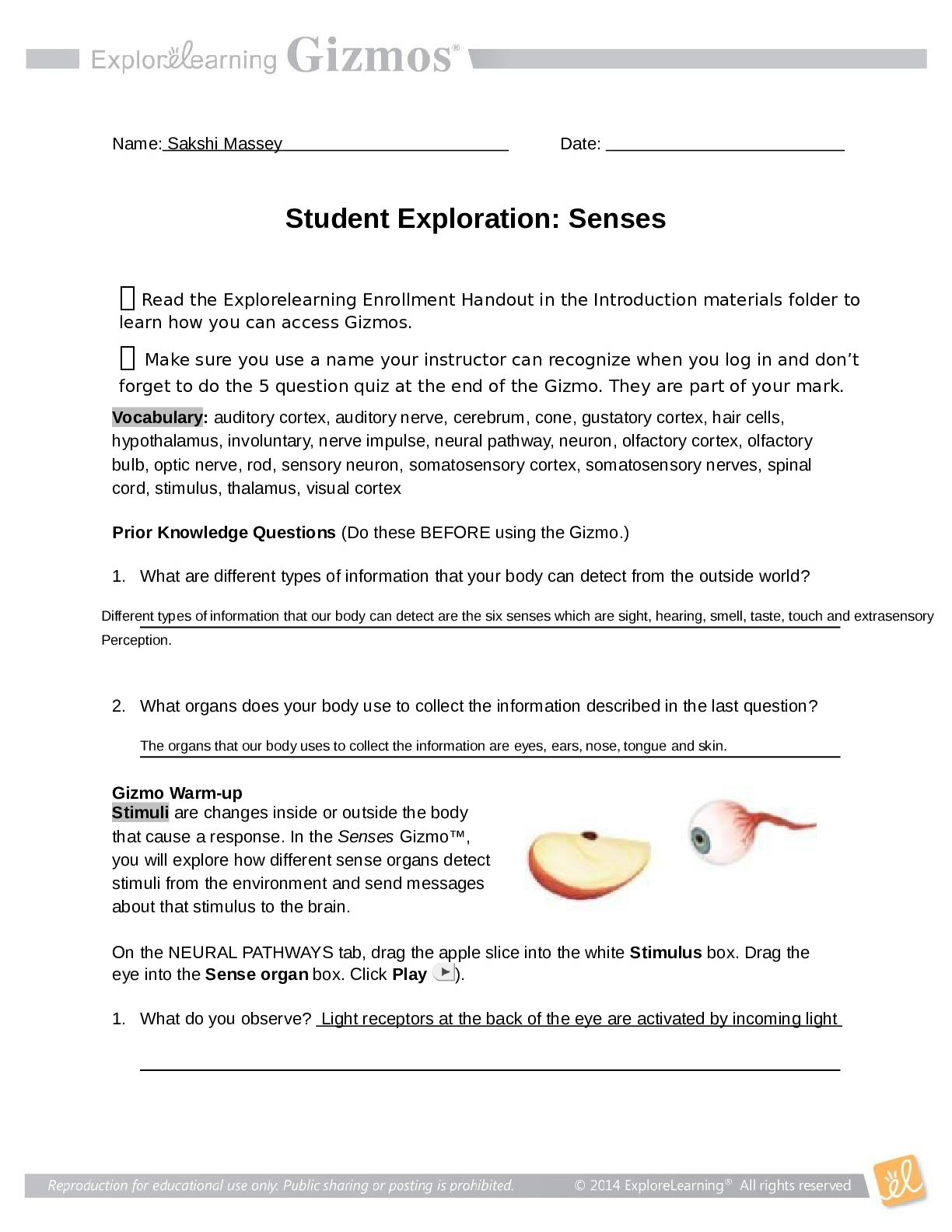
Student Exploration: Senses
Read the Explorelearning Enrollment Handout in the Introduction materials folder to
learn how you can access Gizmos.
Make sure you use a name your instructor can recognize when you log
...
Student Exploration: Senses
Read the Explorelearning Enrollment Handout in the Introduction materials folder to
learn how you can access Gizmos.
Make sure you use a name your instructor can recognize when you log in and don’t
forget to do the 5 question quiz at the end of the Gizmo. They are part of your mark.
Vocabulary: auditory cortex, auditory nerve, cerebrum, cone, gustatory cortex, hair cells,
hypothalamus, involuntary, nerve impulse, neural pathway, neuron, olfactory cortex, olfactory
bulb, optic nerve, rod, sensory neuron, somatosensory cortex, somatosensory nerves, spinal
cord, stimulus, thalamus, visual cortex
Prior Knowledge Questions (Do these BEFORE using the Gizmo.)
1. What are different types of information that your body can detect from the outside world?
Different types of information that our body can detect are the six senses which are sight, hearing, smell, taste, touch and extrasensory
Perception.
2. What organs does your body use to collect the information described in the last question?
The organs that our body uses to collect the information are eyes, ears, nose, tongue and skin.
Gizmo Warm-up
Stimuli are changes inside or outside the body
that cause a response. In the Senses Gizmo™,
you will explore how different sense organs detect
stimuli from the environment and send messages
about that stimulus to the brain.
On the NEURAL PATHWAYS tab, drag the apple slice into the white Stimulus box. Drag the
eye into the Sense organ box. Click Play ).
1. What do you observe? Light receptors at the back of the eye are activated by incoming light2. How do you know that the eye senses the apple? We know this as we can see that the nerve cells
transmit light signals to the brain.
3. The neural pathway represents the nerves that connect the sense organ to the brain. What
happens along the neural pathway when the eye sees the apple? The visual cortex in the
brain processes the signals to create the perception of vision.
Activity A:
Senses and the
brain
Get the Gizmo ready:
On the NEURAL PATHWAYS tab, click
Reset ).
Introduction: The brain is organized into different regions that have different functions. Most
sensory information is processed in the cerebrum, the “wrinkly” area that forms the outer part of
the brain. The nerves that connect a sense organ to the part of the brain responsible for that
sense is called the neural pathway.
Question: What happens when stimuli are detected by sense organs?
1. Observe: Drag the apple into the Stimulus box and the tongue into the Sense organ box.
Click Play.
A. What does the tongue detect?
The taste
B. What happens along the ne
[Show More]