SOPHIA Ancient Greek Philosophers Milestone | DeVry University
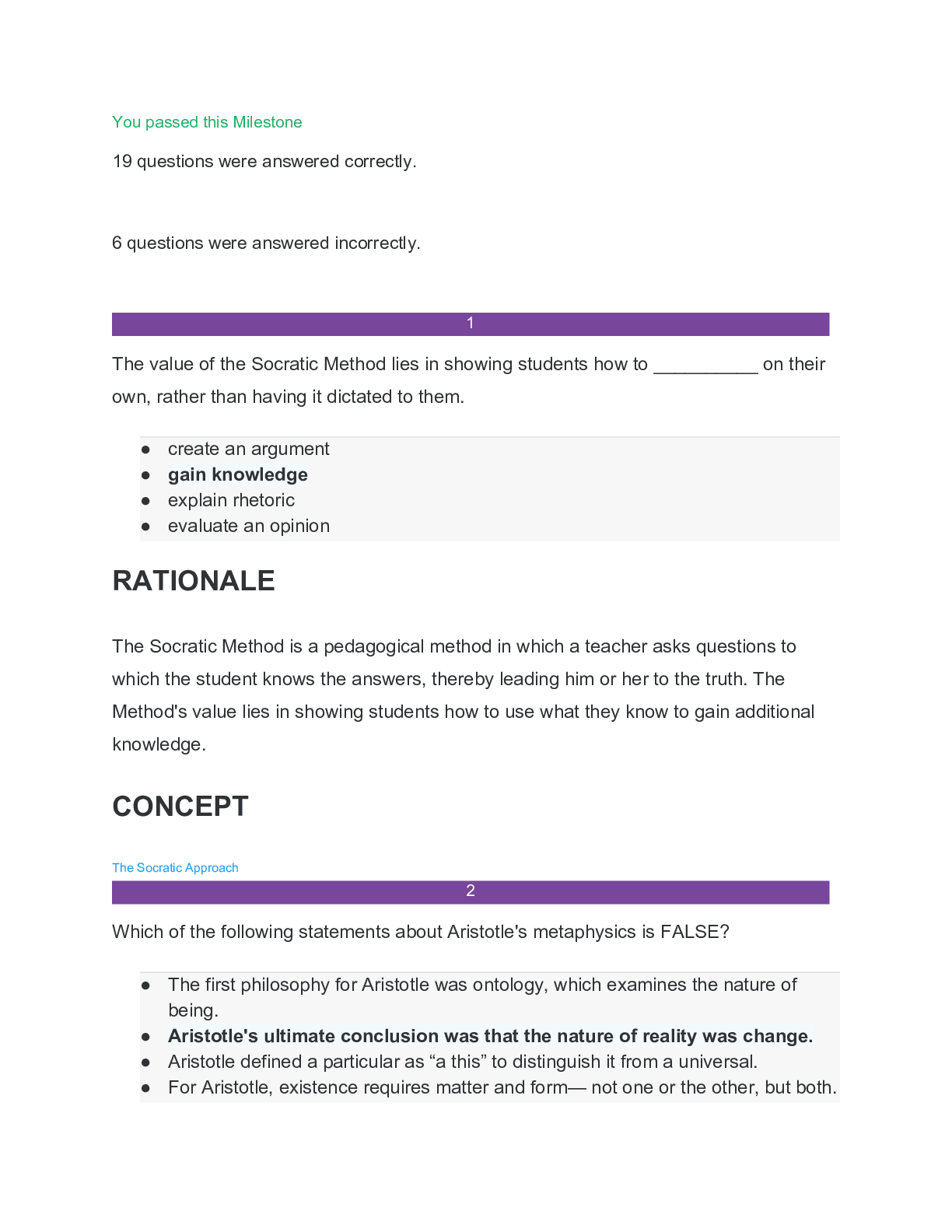
You passed this Milestone
19 questions were answered correctly.
6 questions were answered incorrectly.
1
The value of the Socratic Method lies in showi
...
SOPHIA Ancient Greek Philosophers Milestone | DeVry University
You passed this Milestone
19 questions were answered correctly.
6 questions were answered incorrectly.
1
The value of the Socratic Method lies in showing students how to __________ on their
own, rather than having it dictated to them.
● create an argument
● gain knowledge
● explain rhetoric
● evaluate an opinion
RATIONALE
The Socratic Method is a pedagogical method in which a teacher asks questions to
which the student knows the answers, thereby leading him or her to the truth. The
Method's value lies in showing students how to use what they know to gain additional
knowledge.
CONCEPT
The Socratic Approach
2
Which of the following statements about Aristotle's metaphysics is FALSE?
● The first philosophy for Aristotle was ontology, which examines the nature of
being.
● Aristotle's ultimate conclusion was that the nature of reality was change.
● Aristotle defined a particular as “a this” to distinguish it from a universal.
● For Aristotle, existence requires matter and form— not one or the other, but both.RATIONALE
Aristotle would agree with all of these statements except the suggestion that the
nature of reality is change. To Aristotle, reality is what we can observe. It can be
described as a substance and a way of being, or matter and form.
CONCEPT
Aristotle on What There Is
3
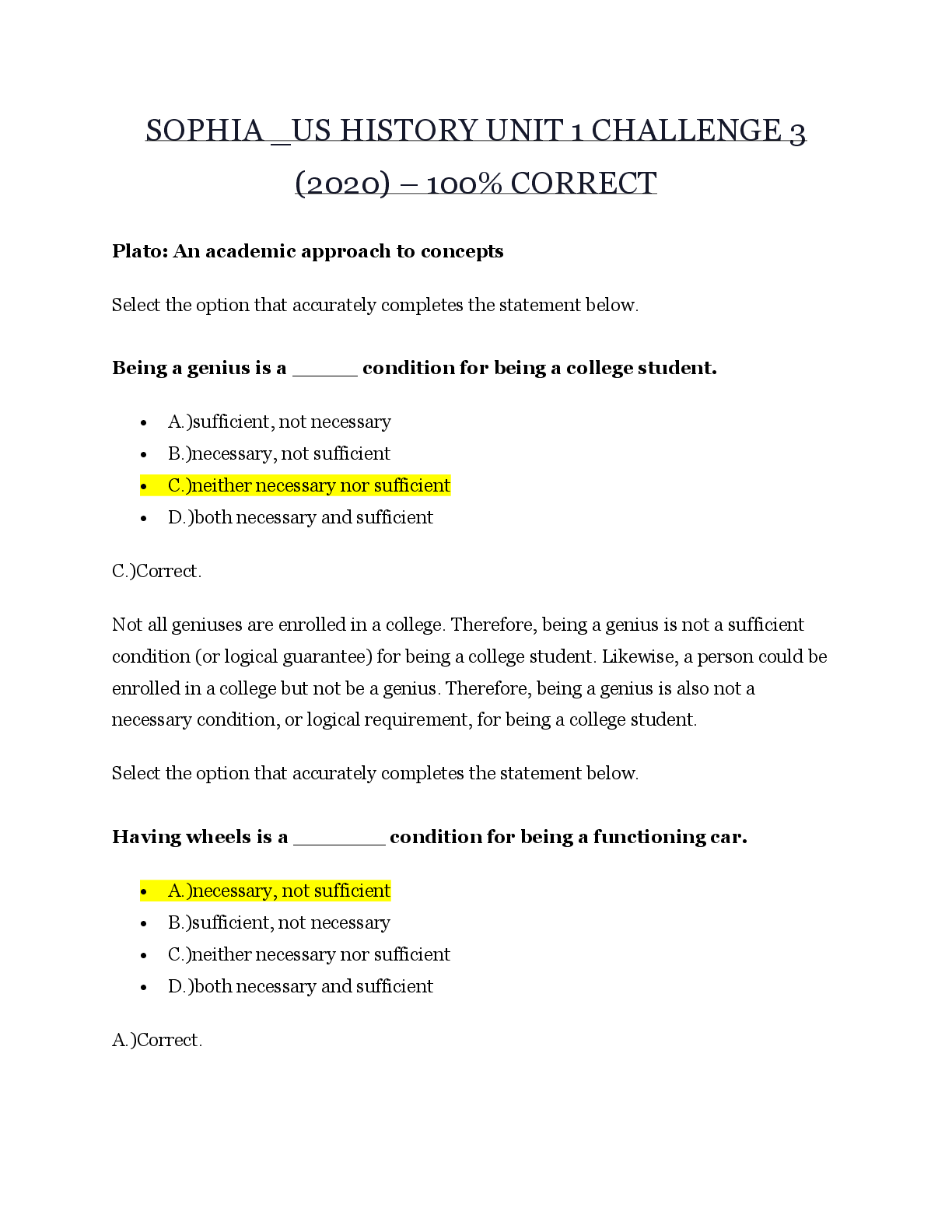
Water is a __________ condition for staying alive.
Apply conceptual analysis to this statement and choose the answer that correctly
describes the relationship.
● neither necessary nor sufficient
● necessary, not sufficient
● both necessary and sufficient
● sufficient, not necessary
RATIONALE
Water is a logical requirement for staying alive, therefore it is a necessary condition.
However, water is not a logical guarantee for staying alive, so it is not a sufficient
condition.
CONCEPT
Plato: An academic approach to concepts
4
According to Aristotle’s ethics, virtues should be pursued by __________.● thinking abstractly
● finding a rational mean between two extremes
● defining what is true
● determining the purest form of action
RATIONALE
Aristotle's Doctrine of the Mean states that virtue must be cultivated as a rational
mean between extremes. For example, the virtue of courage is found between the
vices of cowardice and foolhardiness.
CONCEPT
Aristotle's Highest Good
5
Choose the example that best demonstrates a central tenet of Stoicism.
● Carlene is devastated when her outdoor party is interrupted by a thunderstorm.
● Mr. Donovan insists that he begin each morning with pastry and a cup of sweet
tea.
● Bob is such a rabid Cubs fan that it isn’t fun to watch a baseball game with him.
● Stephanie is a good nurse because she is skillful and always remains
composed.
RATIONALE
Stoicism is a philosophy that encourages people to focus only on what they can
control (e.g., their desires, emotions, and reactions). Because Stoicism focuses on
eliminating desires, and emphasizes control of emotions, it leads people to perform
their assigned jobs (or roles) skillfully and dispassionately.
CONCEPT
Stoicism: The Ethics of Dispassion6
Kendra believes that women have a right to choose to have an abortion.
Select the statement that is consistent with Kendra's belief.
● “Some women use abortion as a form of birth control, which is wrong.”
● “Every woman should be a mother; it is our function and purpose as human
beings.”
● “I voted for this presidential candidate because she supports a woman's right to
have an abortion.”
● "The man should have an equal say in whether or not a woman ends her
pregnancy.”
RATIONALE
To live philosophically, a person must examine his or her beliefs to ground them in
knowledge, and then act according to those beliefs. By voting for a presidential
candidate who supports a woman's right to have an abortion, Kendra displays a
consistent philosophical worldview.
CONCEPT
Philosophical Analysis as a Way of Life
7
Which of the following is the most important tenet of Stoicism?
● To resist playing a role
● To let go of what we cannot control
● To feed our desires
● To understand that reality is either good or bad
RATIONALEStoicism is a philosophy that encourages us to focus only on what we can control
(e.g., our desires, emotions, judgments, and reactions). We should not be upset by
things that are beyond our control. Stoicism encourages us to reduce desire and to
view reality as neither good nor bad.
CONCEPT
Stoicism: The Ethics of Dispassion
8
In Plato's view, justified true beliefs must be related to his metaphysical notion of
__________, which he called the Forms.
● knowledge
● wisdom
● essence
● truth
RATIONALE
Plato's Forms are also referred to as "essences." An essence is that which makes an
object what it truly is. Essences provide the basis for knowledge (i.e., justified true
belief). For example, we can know what "goodness" truly is because a real thing that
is the essence of goodness, called the Form of Goodness, exists.
CONCEPT
Plato's Forms: The Objects of Knowledge
9
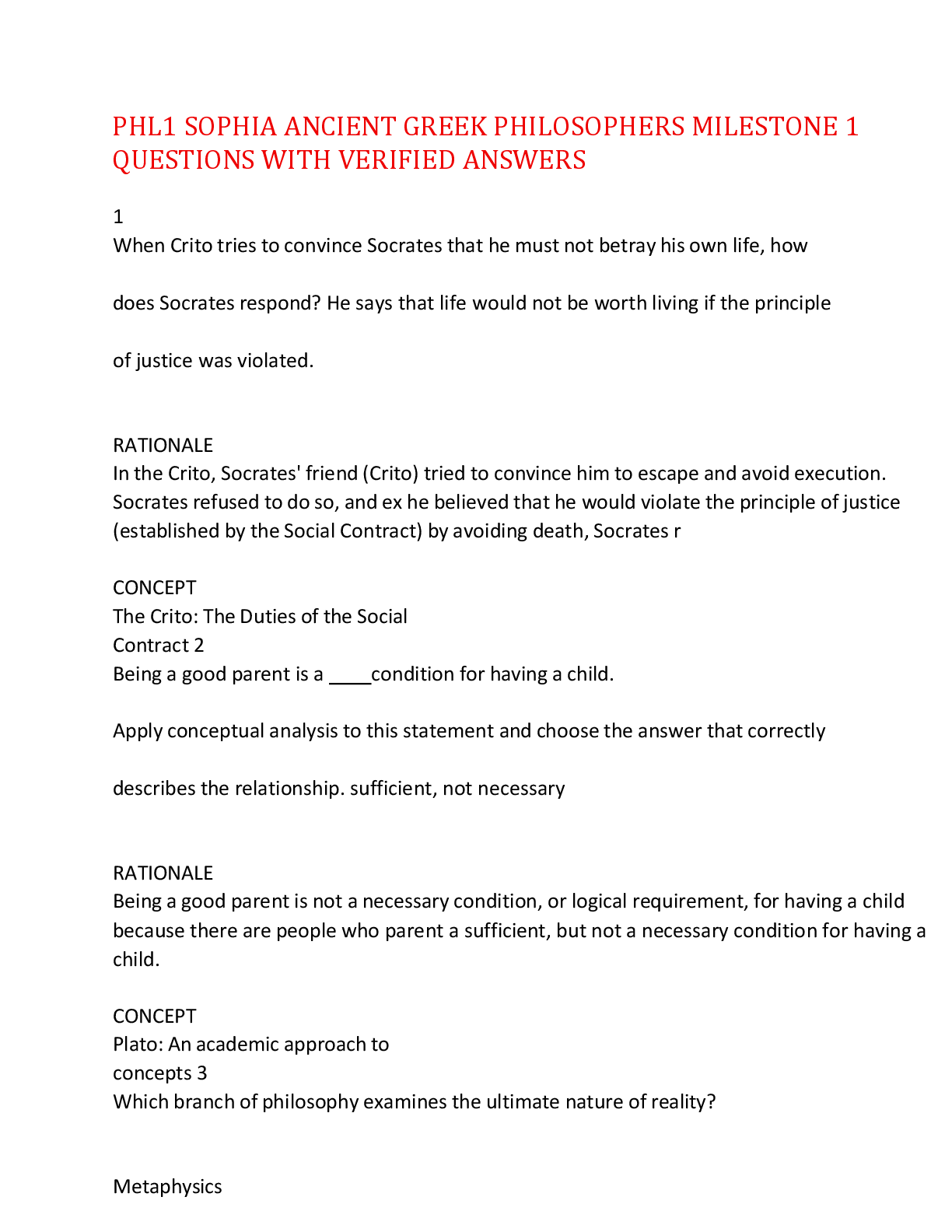
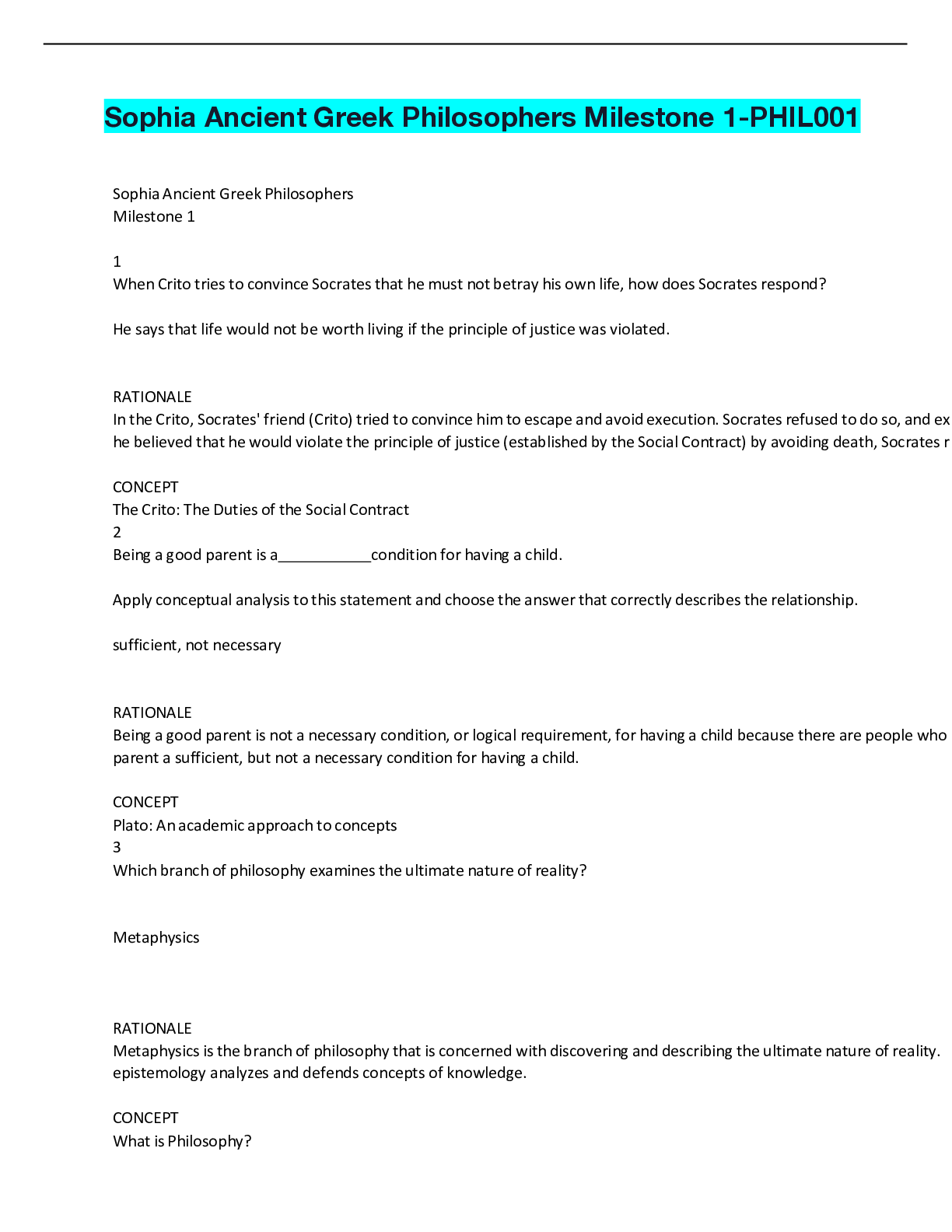
When Crito tries to convince Socrates that he must not betray his own life, how does
Socrates respond?● He says that he is not afraid of dying and knows that his followers will restore his
good name.
● He says that what is right is often misunderstood by mortals and must be left to
the gods.
● He says that life would not be worth living if the principle of justice was
violated.
● He says that all life has value, but society determines the fate of man.
RATIONALE
In the Crito, Socrates' friend (Crito) tried to convince him to escape and avoid
execution. Socrates refused to do so, and explained why escape would be wrong.
Socrates asserted that not all life has intrinsic value; only the good life does. Since he
believed that he would violate the principle of justice (established by the Social
Contract) by avoiding death, Socrates refused to avoid it.
CONCEPT
The Crito: The Duties of the Social Contract
10
Which of the following is NOT an example of Aristotle’s notion of hylomorphism?
● Bodily organs and a human being
● The soul and a human being
● A statue and a human being
● An unborn child and a human being
RATIONALE
Aristotle's notion of hylomorphism states that being is a relationship, a union of form
and matter. All of the examples that signify relationships are cases of hylomorphism:
bodily organs (matter) and human beings (form); an unborn child (matter) and a
human being (form); human beings (matter) and the soul (form). There is noontological relationship between a statue and a human being, so this is not an
example of hylomorphism.
CONCEPT
Aristotle on What There Is
11
“It is my belief that everything in the cosmos is made of water.”
Which ancient philosopher would most likely have made this statement?
● Pythagoras
● Thales
● Empedocles
● Protagoras
RATIONALE
Thales was the Pre-Socratic philosopher who believed that everything in the cosmos
was made of water. Thales and his pupils, Anaximander and Anaximenes, sought to
discover the nature of the cosmos.
CONCEPT
Cosmology and the First Philosophers
12
Lisa is considering whether it is morally permissible to eat meat.
Which branch of philosophy can help her answer this question?
● Metaphysics
● Epistemology
● Ethics
● CosmologyRATIONALE
Ethics is the branch of philosophy in which concepts of value (e.g., right and wrong
are considered). In epistemology, concepts of knowledge are analyzed and defended.
Metaphysics is concerned with discovering and describing the ultimate nature of
reality, and cosmology is the study of the universe in its totality.
CONCEPT
What is Philosophy?
13
Which of the following statements about the atomistic worldview is FALSE?
● Philosophical atoms of different shapes and consistencies are the fundamental
components of reality.
● The philosophical worldview of the early Greek atomists had great
influence on philosophical, scientific, and religious thinking, but only for a
brief period of time.
● Everything in the universe exists as a single atom, or a collection of atoms.
● The worldview of philosophical atomists, with some revisions, has been adopted
by contemporary science.
RATIONALE
The philosophical worldview of the early Greek atomists has continued to have an
impact throughout history. Atomism has been adopted and modified by contemporary
science, and has had a lasting influence on religion and theology.
CONCEPT
The Atomistic Worldview
14According to Socrates in the Phaedo, why might death be an advantage to the
philosopher?
● Death is the ultimate distinction between knowledge and opinion.
● Only humans can seek knowledge and truth, but their ability to do so ends with
death.
● In life, the Social Contract requires people to behave according to the needs and
wants of others.
● Eyes, ears, and other bodily organs can distract one from the attainment of
truth and knowledge.
RATIONALE
The Phaedo is a conversation between Socrates and his students about death. It
takes place just before his execution. During this conversation, Socrates explains why
philosophers should not fear death, which he defines as the end of the life of the
body, but not of the soul. Socrates views the body as an impediment to the acquisition
of wisdom and truth. Therefore, a philosopher may be able to find answers after death
that cannot be found during life.
CONCEPT
The Phaedo: The Death of Socrates
15
For Plato and his Doctrine of Forms, a person can determine whether an act is
courageous if he or she can __________.
● explain what courage means in the real world
● clearly understand the value of courage
● accurately describe the Form of Courage
● imagine an unambiguously courageous action
RATIONALEAccording to Plato, the Forms are the basis of our knowledge of reality. All worldly
objects participate in (i.e., imitate) their corresponding Form that exists in Platonic
Heaven. We can determine whether an act is courageous if we know, and can
describe, the Form of Courage.
CONCEPT
Applying Plato's Metaphysics
16
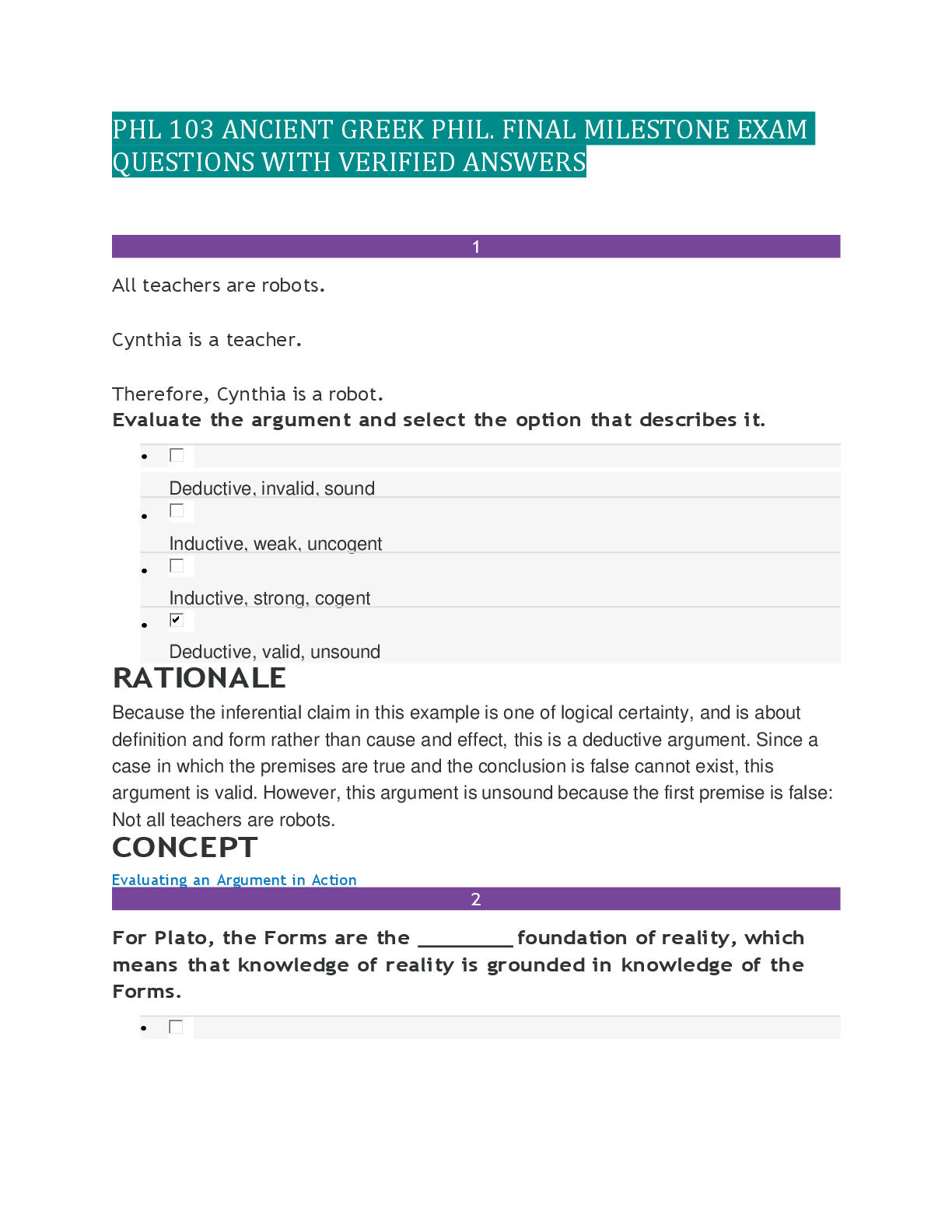
While I have lived in my home, my rent has increased every year.
My salary has remained the same for three years.
Next year, I will probably be in a better financial situation.
Evaluate the argument and select the option that describes it.
● Deductive, valid, sound
● Deductive, invalid, unsound
● Inductive, weak, uncogent
● Inductive, strong, cogent
RATIONALE
Because the inferential claim is of less-than-logical certainty, and is about probability,
this is an inductive argument. It is a weak argument because the conclusion isn't
probable if the premises are true. It is also an uncogent argument because an
argument must be strong to be cogent.
CONCEPT
Evaluating an Argument in Action17
Read the following statement by Socrates:
“In questions of just and unjust, fair and foul, good and evil, which are the subjects of
our present consultation, ought we to follow the opinion of the many and to fear them; or
the opinion of the one man who has understanding?”
Extract Socrates' argument from this text and choose the sentence that accurately
reflects it.
● Absolute justice can only be achieved when the state agrees with the opinion of
the masses.
● Non-experts have opinions, but the man who is an expert in a field has true
knowledge.
● He who has experienced the administration of justice will do as the majority
commands him to do.
● Any man who cares about ethics and wisdom has an obligation to listen to
himself over others.
RATIONALE
In this selection from the Crito, Socrates argues that we should consult experts (who
have "understanding," or knowledge) when we seek wisdom, and not the majority
(who have only opinion).
CONCEPT
The Apology — Socrates' Arguments
18
Select the statement that would most likely have been made by Aristotle.
● “What is true is always true, independent of wisdom, language, or knowledge.”
● “We must begin with the world we encounter every day, rather than with
the abstraction of metaphysics.”● “New things do not come into existence; rather, things change their organization.”
● “The world is unchanging and eternal, which conflicts with the illusion that life is
neither.”
RATIONALE
The statement that "We must begin with the world we encounter every day" reflects
Aristotle's philosophical approach. To Aristotle, all knowledge is grounded in human
experience, and flows from empirical evidence. The statements which involve change
are reflective of Parmenides and the Atomists. The statement about truth existing
independent of wisdom, language, or knowledge is reflective of Plato's philosophy.
CONCEPT
Aristotle: The Dissection of Reality
19
Choose the statement that both Plato and Aristotle would agree is true.
● “A human being is 'human' because he or she reflects the Form of a
Human.”
● “The physical sciences are a source of eternal knowledge."
● “Ideals are similar to mathematical objects or entities.”
● “The ideals of Beauty and Truth are not of this world.”
RATIONALE
Plato and Aristotle disagreed on all of these points except for the position that a
human being is "human" because he or she reflects the Form of a Human. Although
they also disagreed on where essences were located, Plato and Aristotle were both
metaphysicians who believed that essences, or Forms, were real entities that existed
and provided the basis for truth and knowledge.
CONCEPTPlato vs. Aristotle: The Mathematician or the Biologist
20
Choose the statement that describes a central theme of Parmenidean metaphysics.
● The universe consists of one, unchanging entity.
● Mortal and divine knowledge can be joined.
● The world is composed of linked opposites.
● The opinions of mortals are universally reliable.
RATIONALE
Parmenidean metaphysics includes the concept of "substance monism" — the belief
that all reality is one object. This object is called the “what-is.” The "what-is" is eternal
and unchanging. None of the other statements represent Parmenidean metaphysics.
CONCEPT
Parmenides and the Doctrine of Permanence
21
Nancy is a cashier at a grocery store. A boy from her school, who she knows is
underage, attempts to buy beer. Nancy hesitates before completing the transaction.
According to Aristotle’s ethics, which question should Nancy ask herself?
● How can I reach a compromise?
● What kind of person should I be?
● Why is this action right, and why is it wrong?
● Are there possible consequences of this action that could harm me?
RATIONALE
Aristotelian ethics are primarily concerned with character. As a result, Nancy should
ask herself “What kind of person should I be?” rather than “How should I act?”According to Aristotelian ethics, actions are evaluated based on how they inform your
character. Therefore, Nancy must determine what kind of person she wants to be and
what virtues she wants to cultivate, and then act accordingly.
CONCEPT
Applying Aristotle's Ethics
22
Which of the following statements about the metaphysical tenets of Plato’s Doctrine of
the Forms is FALSE?
● There is a cause and effect relationship between Forms and their earthly
counterparts.
● Forms must exist in order for knowledge to be possible.
● Perfection in the Forms does not exist in Platonic Heaven.
● The Forms exist in an intellectual realm that is fixed and never-ending.
RATIONALE
All of the statements about aspects of Plato's metaphysics are true, except for the
suggestion that perfect Forms do not exist in Platonic Heaven. This statement
describes Aristotle's metaphysics, not Plato's. Platonic Heaven is where Plato
believed Forms, or perfect metaphysical entities, exist.
CONCEPT
Plato Forms: The Foundations of Being
23
Heraclitus developed __________, which stated that all things change over time.
● Parmenidean Theory
● the Doctrine of Flux
● the Philosophical Atom● the Paradoxes of Zeno
RATIONALE
Heraclitus developed the Doctrine of Flux, and defined flux as "continuous change."
The doctrine maintains that everything is impermanent and in a constant state of
change.
CONCEPT
Heraclitus and the Doctrine of Impermanence
24
Perhaps the most important way in which Socrates changed the course of Western
philosophy was by focusing on __________.
● moral philosophy
● natural philosophy
● cosmology
● martyrdom
RATIONALE
Ethics and morality were the primary focus of Socrates's philosophical inquiry. He is
considered to have been the first "moral philosopher," who was deeply interested in
how to determine right and wrong.
CONCEPT
Socrates: The Father of Western Philosophy
25
In the Apology, Socrates states that a good person does what he knows to be right
despite __________.● risking fame and fortune
● negative personal consequences
● the laws of man
● the wisdom of the gods
RATIONALE
The Apology is Plato's transcription of the defense Socrates presented at his trial on
charges of "denying the gods" and "corrupting the youth of Athens." In it, Socrates
asserts that he does not fear death, because he has lived as he believed was right.
To Socrates, it is more important to live rightly than to avoid death and other negative
personal consequences.
CONCEPT
The Apology: A Defense of Philosophy
[Show More]





 – Chamberlain College of Nursing.png)
 – Chamberlain College of Nursing.png)