2019 PN Hesi Exit V1/v2 Exam Bank. Graded A
Question 1
A school-age client with diabetes is placed on an intermediate- acting insulin and regular insulin before breakfast and before dinner. She will receive a snack o
...
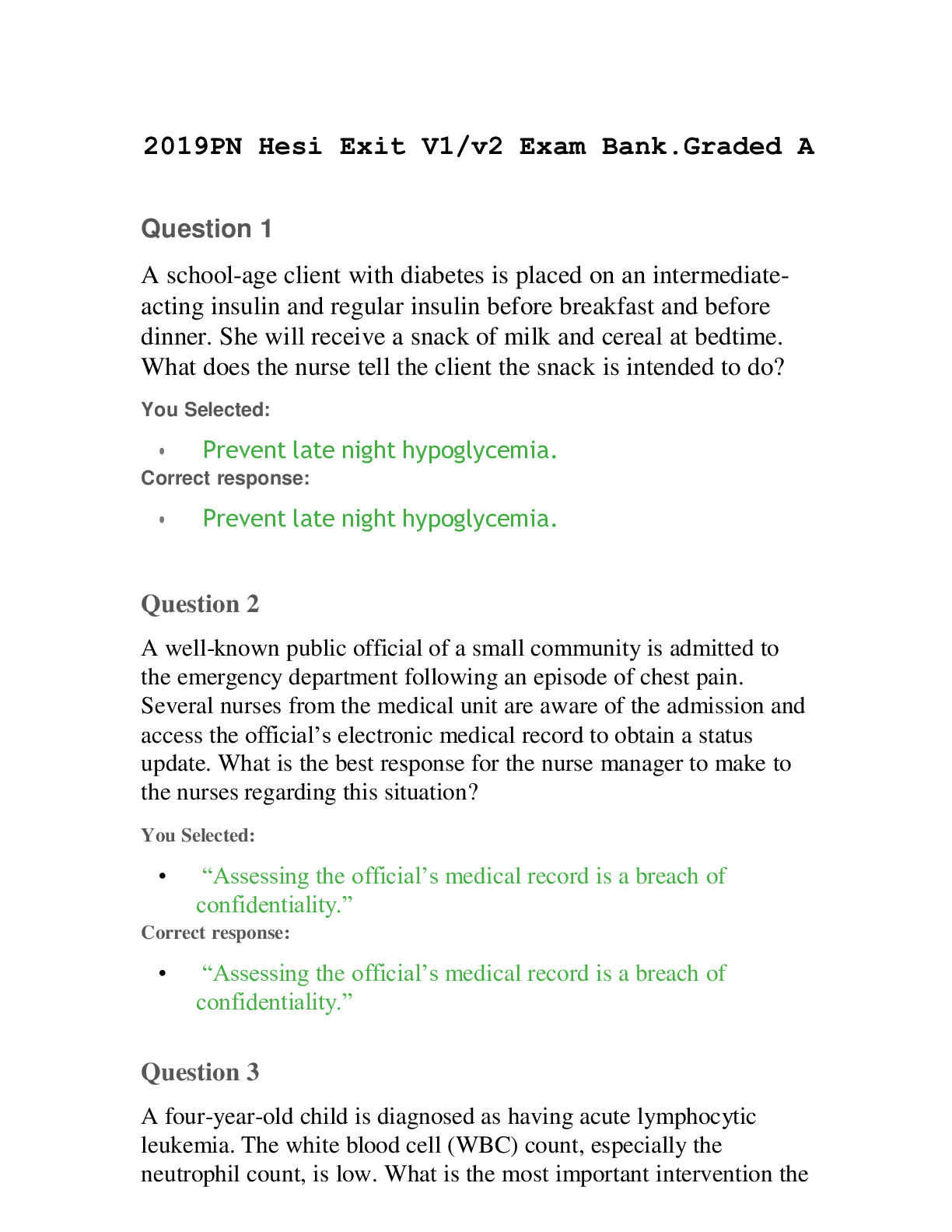
2019 PN Hesi Exit V1/v2 Exam Bank. Graded A
Question 1
A school-age client with diabetes is placed on an intermediate- acting insulin and regular insulin before breakfast and before dinner. She will receive a snack of milk and cereal at bedtime. What does the nurse tell the client the snack is intended to do?
You Selected:
• Prevent late night hypoglycemia.
Correct response:
• Prevent late night hypoglycemia.
Question 2
A well-known public official of a small community is admitted to the emergency department following an episode of chest pain.
Several nurses from the medical unit are aware of the admission and access the official’s electronic medical record to obtain a status update. What is the best response for the nurse manager to make to the nurses regarding this situation?
You Selected:
• “Assessing the official’s medical record is a breach of confidentiality.”
Correct response:
• “Assessing the official’s medical record is a breach of confidentiality.”
Question 3
A four-year-old child is diagnosed as having acute lymphocytic leukemia. The white blood cell (WBC) count, especially the neutrophil count, is low. What is the most important intervention the
nurse should teach the parents?
You Selected:
• Protect your child from infections because his resistance to infection is decreased
Correct response:
• Protect your child from infections because his resistance to infection is decreased
Question 4
The nurse is caring for a client with influenza. The most effective way to decrease the spread of microorganisms is:
You Selected:
• placing the client in isolation.
Correct response:
• washing the hands frequently.
Question 5
A client with a history of hypertension has been prescribed a new antihypertensive medication and is reporting dizziness. Which is the best way for the nurse to assess blood pressure?
You Selected:
• in the supine, sitting, and standing positions
Correct response:
• in the supine, sitting, and standing positions
Question 6
A client has a soft wrist-safety device. Which assessment finding should the nurse investigate further?
You Selected:
• cool, pale fingers
Correct response:
• cool, pale fingers
Question 7
A nurse is caring for a female client before surgery. The client states that she is glad that she will not be going through menopause as a result of her surgery and is only having her uterus removed. The nurse reviews the consent form and notes that the surgery is for a total abdominal hysterectomy with a salpingo-oophorectomy. What should the nurse do in this situation?
You Selected:
• Contact the surgeon to explain that the client needs further clarification regarding surgery.
Correct response:
• Contact the surgeon to explain that the client needs further clarification regarding surgery.
Question 8
A young client diagnosed with schizophrenia is talking with the nurse and says, "You know, when I thought everyone was out to get me, I was staying in my apartment all the time. Now, I would like to get out and do things again." What is the best initial response by the nurse?
You Selected:
• "What activities did you enjoy in the past?"
Correct response:
• "What activities did you enjoy in the past?"
Question 9
A client with anemia has been admitted to the medical-surgical unit. Which assessment findings are characteristic of iron deficiency anemia?
You Selected:
• nausea, vomiting, and anorexia
Correct response:
• dyspnea, tachycardia, and pallor
Question 10
The nurse is discontinuing an intravenous catheter on a 10-year-old client with hemophilia. What would be the most important intervention for this client?
You Selected:
• Apply firm pressure on the site for 5 minutes after removal.
Correct response:
• Apply firm pressure on the site for 5 minutes after removal.
Question 11
When a client returns from the recovery room postmastectomy, an initial postoperative assessment is performed by the nurse. What is the nurse’s priority assessment?
You Selected:
• checking the dressing, drain, and amount of drainage
Correct response:
• assessing the vital signs and oxygen saturation levels
Question 12
A client with an uncomplicated term pregnancy arrives at the labor- and-delivery unit in early labor saying that she thinks her water has broken. What is the nurse’s best action?
You Selected:
• Ask what time this happened and note the color, amount, and odor of the fluid.
Correct response:
• Ask what time this happened and note the color, amount, and odor of the fluid.
Question 13
When documenting the care of a client, the nurse is aware of the need to use abbreviations conscientiously and safely. This includes
You Selected:
• ensuring the abbreviations are understandable to clients who may seek access to their health records
Correct response:
• limiting abbreviations to those approved for use by the institution
Question 14
During routine prenatal screening, a nurse tells a client that her blood sample will be used for alpha fetoprotein (AFP) testing. Which statement best describes what AFP testing indicates?
You Selected:
• "This screening indicates if your baby's lungs are mature."
Correct response:
• "This test will screen for spina bifida, Down syndrome, or other genetic defects."
Question 15
A client is recovering from an infected abdominal wound. Which foods should the nurse encourage the client to eat to support wound healing and recovery from the infection?
You Selected:
• chicken and orange slices
Correct response:
• chicken and orange slices
1) The LPN/LVN is preparing to ambulate a postoperative client after cardiac surgery. The nurse plans to do which to enable the client to best tolerate the ambulation?
1. Provide the client with a walker.
2. Remove the telemetry equipment.
3. Encourage the client to cough and deep breathe.
4. Premedicate the client with an analgesic before ambulating.
Correct Answer: 4. Premedicate the client with an analgesic before ambulating.
2) A client is wearing a continuous cardiac monitor, which begins to alarm at the nurse's station. The nurse sees no electrocardiographic complexes on the screen. The nurse should do which first?
1. Call a code blue.
2. Call the health care provider.
3. Check the client status and lead placement.
4. Press the recorder button on the ECG console.
Correct Answer: 3. Check the client status and lead placement.
3) The LPN/LVN in a medical unit is caring for a client with heart failure. The client suddenly develops extreme dyspnea, tachycardia, and lung crackles, and the nurse suspects pulmonary edema. The nurse immediately notifies the registered nurse and expects which interventions to be prescribed? Select all that apply.
1. Administering oxygen
2. Inserting a Foley catheter
3. Administering furosemide (Lasix)
4. Administering morphine sulfate intravenously
5. Transporting the client to the coronary care unit
6. Placing the client in a low-Fowler's side-lying position
Correct Answer:
1. Administering oxygen
2. Inserting a Foley catheter
3. Administering furosemide (Lasix)
4) The nurse is monitoring a client following cardioversion. Which observations should be of highest priority to the nurse?
1. Blood pressure
2. Status of airway
3. Oxygen flow rate
4. Level of consciousness
Correct Answer: 2. Status of airway
5) The nurse is assisting in caring for the client immediately after insertion of a permanent demand pacemaker via the right subclavian vein. The nurse prevents dislodgement of the pacing catheter by implementing which intervention?
1. Limiting movement and abduction of the left arm
2. Limiting movement and abduction of the right arm
3. Assisting the client to get out of bed and ambulate with a walker
4. Having the physical therapist do active range of motion to the right arm
Correct Answer: 2. Limiting movement and abduction of the right arm
6) A client diagnosed with thrombophlebitis 1 day ago suddenly complains of chest pain and shortness of breath, and the client is visibly anxious. The LPN/LVN understands that a life-threatening complication of this condition is which?
1. Pneumonia
2. Pulmonary edema
3. Pulmonary embolism
4. Myocardial infarction
Correct Answer: 3. Pulmonary embolism
7) A 24-year-old man seeks medical attention for complaints of claudication in the arch of the foot. The nurse also notes superficial thrombophlebitis of the lower leg. The nurse should check the client for which next?
1. Smoking history
2. Recent exposure to allergens
3. History of recent insect bites
4. Familial tendency toward peripheral vascular disease Correct Answer: 1. Smoking history
8) The nurse has reinforced instructions to the client with Raynaud's disease about self-management of the disease process. The nurse determines that the client needs further teaching if the client states which?
1. "Smoking cessation is very important."
2. "Moving to a warmer climate should help."
3. "Sources of caffeine should be eliminated from the diet."
4. "Taking nifedipine (Procardia) as prescribed will decrease vessel spasm."
Correct Answer: 2. "Moving to a warmer climate should help."
9) A client with myocardial infarction suddenly becomes tachycardic, shows signs of air hunger, and begins coughing frothy, pink-tinged sputum. The nurse listens to breath sounds, expecting to hear which breath sounds bilaterally?
[Show More]













.png)