SITXFSA004 DEVELOP AND IMPLEMENT A FOOD SAFETY PROGRAM – Short answer
ASSESSMENT B – SHORT ANSWER
INSTRUCTIONS
You are to answer all questions.
Read each question carefully. Ensure you have provided all required
...
SITXFSA004 DEVELOP AND IMPLEMENT A FOOD SAFETY PROGRAM – Short answer
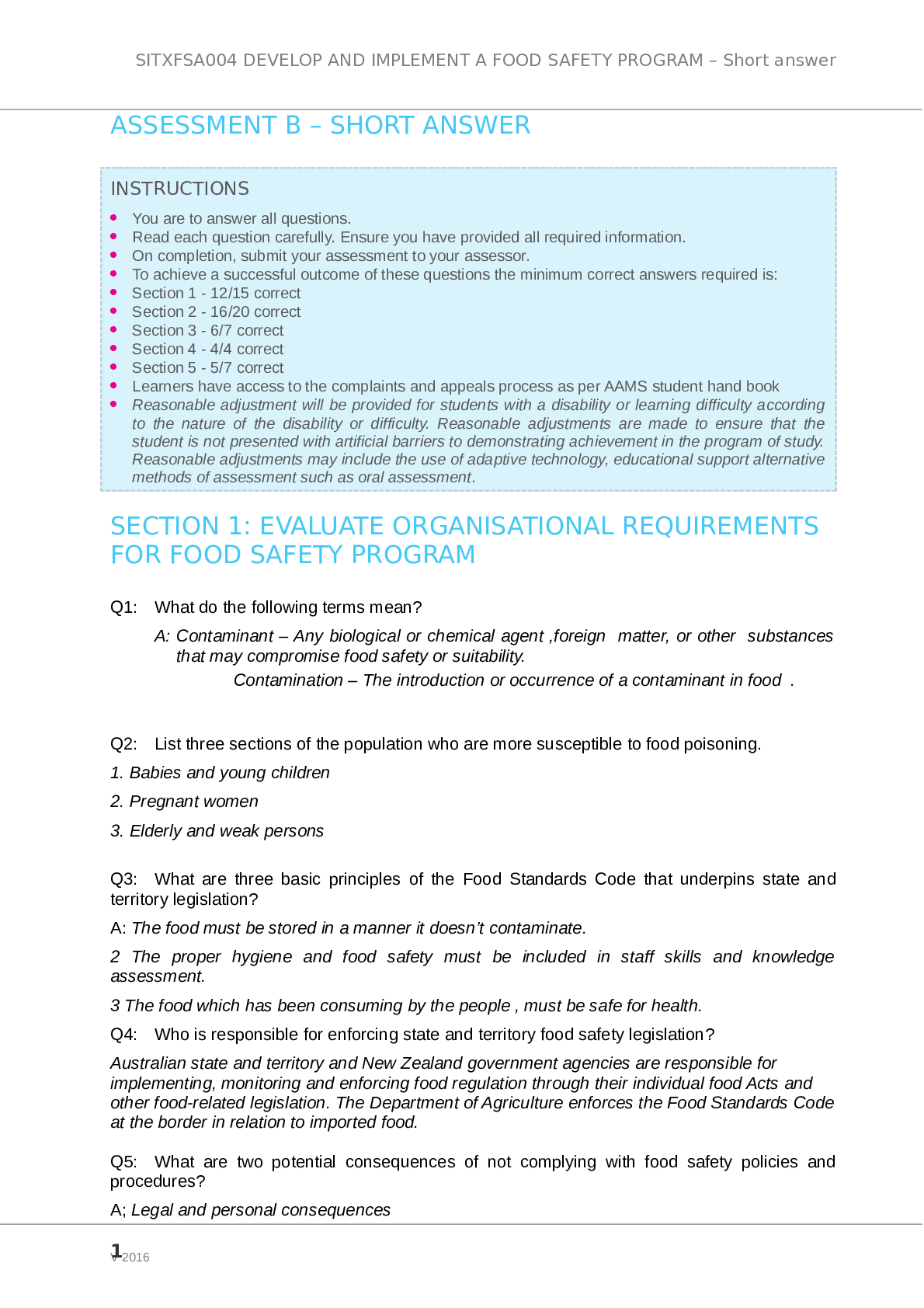
ASSESSMENT B – SHORT ANSWER
INSTRUCTIONS
You are to answer all questions.
Read each question carefully. Ensure you have provided all required information.
On completion, submit your assessment to your assessor.
To achieve a successful outcome of these questions the minimum correct answers required is:
Section 1 - 12/15 correct
Section 2 - 16/20 correct
Section 3 - 6/7 correct
Section 4 - 4/4 correct
Section 5 - 5/7 correct
Learners have access to the complaints and appeals process as per AAMS student hand book
Reasonable adjustment will be provided for students with a disability or learning difficulty according
to the nature of the disability or difficulty. Reasonable adjustments are made to ensure that the
student is not presented with artificial barriers to demonstrating achievement in the program of study.
Reasonable adjustments may include the use of adaptive technology, educational support alternative
methods of assessment such as oral assessment.
SECTION 1: EVALUATE ORGANISATIONAL REQUIREMENTS
FOR FOOD SAFETY PROGRAM
Q1: What do the following terms mean?
A: Contaminant – Any biological or chemical agent ,foreign matter, or other substances
that may compromise food safety or suitability.
Contamination – The introduction or occurrence of a contaminant in food .
Q2: List three sections of the population who are more susceptible to food poisoning.
1. Babies and young children
2. Pregnant women
3. Elderly and weak persons
Q3: What are three basic principles of the Food Standards Code that underpins state and
territory legislation?
A: The food must be stored in a manner it doesn’t contaminate.
2 The proper hygiene and food safety must be included in staff skills and knowledge
assessment.
3 The food which has been consuming by the people , must be safe for health.
Q4: Who is responsible for enforcing state and territory food safety legislation?
Australian state and territory and New Zealand government agencies are responsible for
implementing, monitoring and enforcing food regulation through their individual food Acts and
other food-related legislation. The Department of Agriculture enforces the Food Standards Code
at the border in relation to imported food.
Q5: What are two potential consequences of not complying with food safety policies and
procedures?
A; Legal and personal consequences
V 2016 1SITXFSA004 DEVELOP AND IMPLEMENT A FOOD SAFETY PROGRAM – Short answer
Q6: The characteristics of a business affect a food safety program. Give an example of each
main characteristic based on your workplace or training environment.
A: Size and nature of organisation- While the basic principles of food safety are the same
the content of FSPs will vary.eg the program for a large ,multi –outlet hotel,
Layout of food storage, preparation, display and service areas-the layout or floor plan of a
business must be considered when developing your food safety program. E.g. water,
electricity
Q7: What are the seven principles of the HACCP system?
[Show More]