Chapter 35: Sexuality
Chapter 35: Sexuality
Potter et al.: Fundamentals of Nursing, 9th Edition
MULTIPLE CHOICE
1. A nurse is caring for a 15-year-old who in the past 6 months has had multiple male and female sexual
...
Chapter 35: Sexuality
Chapter 35: Sexuality
Potter et al.: Fundamentals of Nursing, 9th Edition
MULTIPLE CHOICE
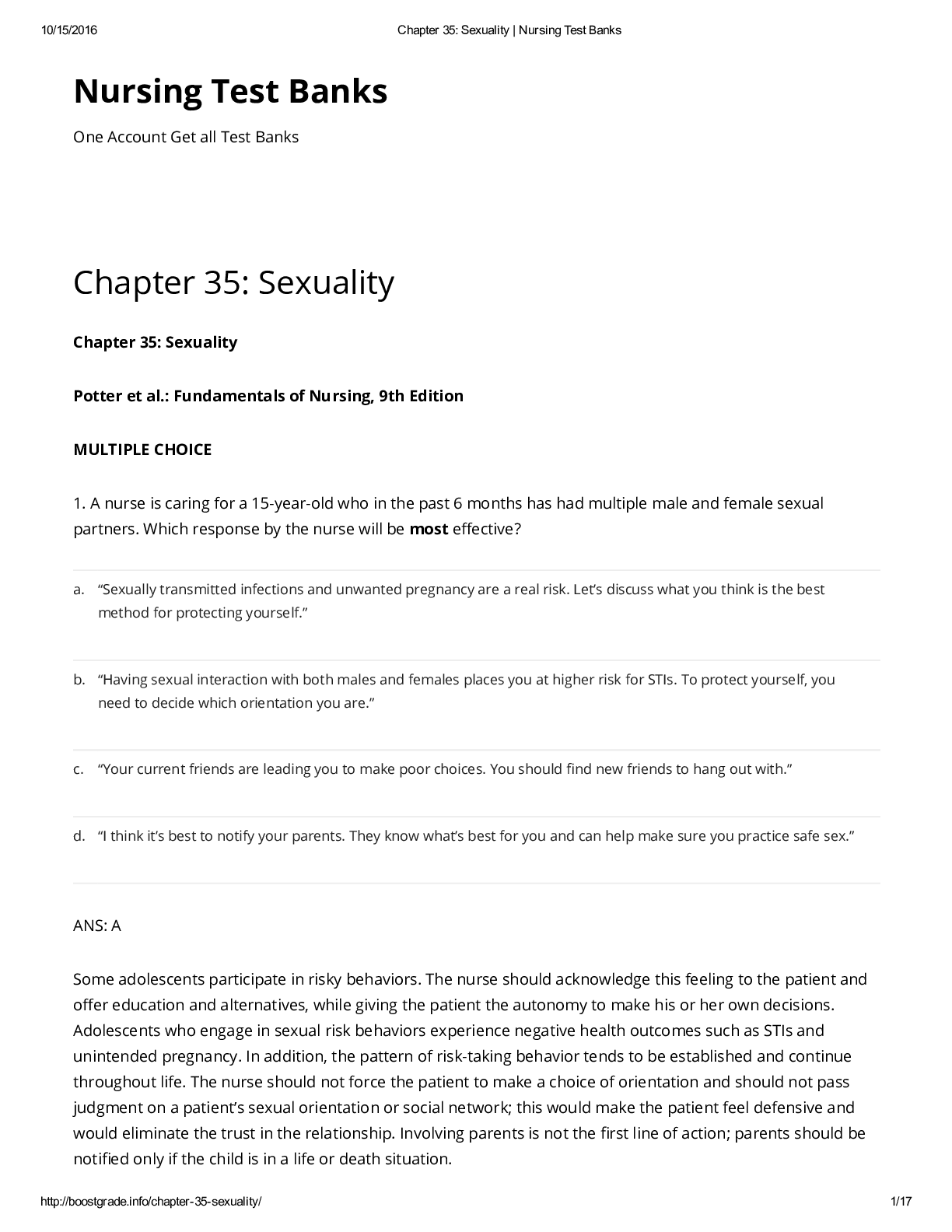
1. A nurse is caring for a 15-year-old who in the past 6 months has had multiple male and female sexual
partners. Which response by the nurse will be most eᴀ洅ective?
a. “Sexually transmitted infections and unwanted pregnancy are a real risk. Let’s discuss what you think is the best
method for protecting yourself.”
b. “Having sexual interaction with both males and females places you at higher risk for STIs. To protect yourself, you
need to decide which orientation you are.”
c. “Your current friends are leading you to make poor choices. You should ᴀ밄nd new friends to hang out with.”
d. “I think it’s best to notify your parents. They know what’s best for you and can help make sure you practice safe sex.”
ANS: A
Some adolescents participate in risky behaviors. The nurse should acknowledge this feeling to the patient and
oᴀ洅er education and alternatives, while giving the patient the autonomy to make his or her own decisions.
Adolescents who engage in sexual risk behaviors experience negative health outcomes such as STIs and
unintended pregnancy. In addition, the pattern of risk-taking behavior tends to be established and continue
throughout life. The nurse should not force the patient to make a choice of orientation and should not pass
judgment on a patient’s sexual orientation or social network; this would make the patient feel defensive and
would eliminate the trust in the relationship. Involving parents is not the ᴀ밄rst line of action; parents should be
notiᴀ밄ed only if the child is in a life or death situation.
10/15/2016 Chapter 35: Sexuality | Nursing Test Banks
http://boostgrade.info/chapter35sexuality/ 2/17
DIF:Apply (application)REF:717 | 720 | 728
OBJ:Identify patient risk factors in the area of sexual health.
TOP: Communication and Documentation MSC: Psychosocial Integrity
2. A nurse is caring for a patient who expresses a desire to have an elective abortion. The nurse’s religious and
ethical values are strongly opposed. How should the nurse best handle the situation?
a. Attempt to educate the patient about the consequences of abortion.
b. Refer the patient to a family planning center or another health professional.
c. Continue to care for the patient, and limit conversation as much as possible.
d. Inform the patient that, because of immoral issues, another nurse will have to care for her.
ANS: B
The nurse must be aware of personal beliefs and values and is not required to participate in counseling or
procedures that compromise those values. However, the patient is entitled to nonjudgmental care and should
be referred to someone who can create a trusting environment. The nurse should not care for a patient if the
quality of care could be jeopardized. The nurse should not attempt to push personal values onto a patient. The
nurse also should not create tension by informing the patient that he or she does not have the same morals;
this could cause the patient to feel guilty or defensive when receiving care from any health care professional.
DIF:Analyze (analysis)REF:720-721
OBJ:Identify personal attitudes, beliefs, and biases related to sexuality.
TOP:ImplementationMSC:Management of Care
3. Which patient is most in need of a nurse’s referral to adoption services?
a. A woman considering abortion for an unwanted pregnancy
b. An infertile couple religiously opposed to artiᴀ밄cial insemination
10/15/2016 Chapter 35: Sexuality | Nursing Test Banks
http://boostgrade.info/chapter35sexuality/ 3/17
c. A woman who suᴀ洅ered miscarriage during her ᴀ밄rst pregnancy
d. An infertile couple who has been attempting conception for 3 months
ANS: B
Adoption is an option for someone with infertility, especially if infertility treatments are unavailable owing to
religious or ᴀ밄nancial constraints. A patient who wishes to have an elective abortion may be educated about all
the possibilities, but the nurse should approach the patient in a nonjudgmental manner and should accept the
patient’s decision. When a patient has recently miscarried, the nurse should assess the patient’s feelings about
the loss and should address any concerns the patient may have about fertility. Infertility is the inability to
conceive after 1 year of unprotected intercourse; therefore, talking about adoption after one miscarriage or
after only 3 months of attempting conception would be too soon.
DIF:Analyze (analysis)REF:721
OBJ: Identify health care providers and community resources available to help patients resolve sexual concerns
that are outside the nurse’s level of expertise. TOP: Assessment
MSC:Management of Care
4. The nurse is caring for a patient who recently had unprotected sex with a partner who has HIV. Which
response by the nurse is best?
a. “You should have your blood drawn today to see if you were infected.”
b. “If you have the virus, you will have ᴀ밄u-like symptoms in 6 months.”
c. “Highly active antiretroviral therapy has been shown eᴀ洅ective in slowing the disease process.”
d. “I will set you up with a support group to help you cope with dying within the next 10 years.”
ANS: C
Highly active retroviral therapy increases the survival time of a person with HIV or AIDS. HIV antibodies will not
show up in blood work for 6 weeks to 3 months. The infection stage of HIV lasts for about a month after the
virus is contracted; during that time, the patient may experience ᴀ밄u-like symptoms. A support group may be
10/15/2016 Chapter 35: Sexuality | Nursing Test Banks
http://boostgrade.info/chapter35sexuality/ 4/17
beneᴀ밄cial for a patient who contracts HIV; however, it is unknown whether the patient has contracted HIV, and
antiretroviral therapy has helped people live beyond the 10 years expected if HIV goes untreated.
DIF:Apply (application)REF:719
OBJ: Identify and describe nursing interventions to promote sexual health.
TOP: Communication and Documentation MSC: Physiological Adaptation
5. An 18-year-old male patient informs the nurse that he isn’t sure if he is homosexual because he is attracted
to both genders. Which response by the nurse will help establish a trusting relationship?
a. “Don’t worry. It’s just a phase you will grow out of.”
b. “Those are abnormal impulses. You should seek therapy.”
c. “At your age, it is normal to be curious about both genders.”
d. “Having questions about sexuality is normal but if these sexual activities make you feel bad you should stop.”
ANS: C
Adolescents have questions about sexuality. The patient will feel most comfortable discussing his sexual
concerns further if the nurse establishes that it is normal to ask questions about sexuality. The nurse can then
discuss in greater detail. Although it is normal for young adults to be curious about sexuality, the nurse should
use caution in giving advice on taking sexual action. The nurse should promote safe sex practices. Telling the
patient not to worry dismisses his concern. Telling the patient that he is abnormal might oᴀ洅end the patient and
prevent him from establishing an open relationship.
DIF:Apply (application)REF:717 | 723
OBJ escribe key concepts of sexual development across the life span.
TOP:Communication and Documentation
MSC:Health Promotion and Maintenance
6. A nurse is caring for a 35-year-old female patient who recently started taking antidepressants after repeated
attempts at fertility treatment. The patient tells the nurse, “I feel happier, but my sex drive is gone.” Which
10/15/2016 Chapter 35: Sexuality | Nursing Test Banks
http://boostgrade.info/chapter35sexuality/ 5/17
nursing diagnosis has the highest priority?
a. Sexual dysfunction
b. Ineᴀ洅ective coping
c. Risk for self-directed violence
d. Deᴀ밄cient knowledge about contraception
ANS: A
Antidepressants have adverse eᴀ洅ects on sexual desire and response. The nurse should be sure to educate the
patient on the potential for these side eᴀ洅ects and how to correct for them, for example, using lubricant to ease
discomfort. The patient has taken steps toward eᴀ洅ective coping by seeking therapy. The patient has not
expressed a reason for the nurse to be concerned about contraceptives. The nurse should always assess for
concerns about violence in a patient’s life. Although some antidepressants have been related to self-directed
violence, this patient focus is on becoming pregnant (fertility treatments) but sex drive is gone.
DIF:Apply (application)REF:721 | 724 | 725
OBJ: Formulate appropriate nursing diagnoses for patients with alterations in sexuality.
TOP lanningMSC:Management of Care
7. A nurse is using the PLISSIT model when caring for a patient with dyspareunia from diminished vaginal
secretions. The nurse suggests using water-soluble lubricants. Which component of PLISSIT is the nurse using?
a. P
b. LI
c. SS
d. IT
10/15/2016 Chapter 35: Sexuality | Nursing Test Banks
http://boostgrade.info/chapter35sexuality/ 6/17
ANS: C
The nurse is using the speciᴀ밄c suggestions (SS). The PLISSIT model is as follows:
Permission to discuss sexuality issues
Limited Information related to sexual health problems being experienced
Speciᴀ밄c Suggestions—only when the nurse is clear about the problem
Intensive Therapy—referral to professional with advanced training if necessary
DIF:Apply (application)REF:723
OBJ: Identify and describe nursing interventions to promote sexual health.
TOP: Implementation MSC: Health Promotion and Maintenance
8. A patient who has had several sexual partners in the past month expresses a desire to use a contraceptive.
Which contraceptive method should the nurse recommend?
a. Condom
b. Diaphragm
c. Spermicide
d. Oral contraceptive
[Show More]