The Nursing Process
in Psychiatric/Mental
Health Nursing
1
Nursing has struggled for many years to achieve recognition as a
profession. Out of this struggle has emerged an awareness of the
need to do the following:
...
The Nursing Process
in Psychiatric/Mental
Health Nursing
1
Nursing has struggled for many years to achieve recognition as a
profession. Out of this struggle has emerged an awareness of the
need to do the following:
1. Define the boundaries of nursing (What is nursing?).
2. Identify a scientific method for delivering nursing care.
In its statement on social policy, the American Nurses Association
(ANA) presented the following definition:
Nursing is the protection, promotion, and optimization of health and
abilities, prevention of illness and injury, alleviation of suffering
through the diagnosis and treatment of human response, and advocacy
in the care of individuals, families, communities, and populations
(ANA, 2010a, p. 10).
The nursing process has been identified as nursing’s scientific
methodology for the delivery of nursing care. The curricula of most
nursing schools include nursing process as a component of their
conceptual frameworks. The National Council of State Boards of
4237_Ch01_001-013 10/07/14 10:34 AM Page 1
Nursing (NCSBN) has integrated the nursing process throughout
the test plan for the National Council Licensure Examination for
Registered Nurses (NCSBN, 2013). Questions that relate to nursing behaviors in a variety of client situations are presented according
to the steps of the nursing process:
1. Assessment: Establishing a database on a client.
2. Diagnosis: Identifying the client’s health-care needs and
selecting goals of care.
3. Outcome Identification: Establishing criteria for measuring
achievement of desired outcomes.
4. Planning: Designing a strategy to achieve the goals established
for client care.
5. Implementation: Initiating and completing actions necessary
to accomplish the goals.
6. Evaluation: Determining the extent to which the goals of care
have been achieved.
By following these six steps, the nurse has a systematic framework for decision-making and problem-solving in the delivery of
nursing care. The nursing process is dynamic, not static. It is an
ongoing process that continues for as long as the nurse and client
have interactions directed toward change in the client’s physical
or behavioral responses. Figure 1-1 presents a schematic of the
ongoing nursing process.
Diagnosis is an integral part of the nursing process. In this step,
the nurse identifies the human responses to actual or potential
health problems. In some states, diagnosing is identified within
2 ■ THE FOUNDATION FOR PLANNING PSYCHIATRIC NURSING CARE
(Re)Assessment
Diagnosis
Outcome Identification
Implementation
Planning
Evaluation
Figure 1-1: The ongoing nursing process.
4237_Ch01_001-013 10/07/14 10:34 AM Page 2
the Nurse Practice Acts as a legal responsibility of the professional
nurse. Nursing diagnosis provides the basis for prescribing the
specific interventions for which the nurse is accountable.
As an inherent part of the nursing process, nursing diagnosis
is included in the ANA Standards of Practice. These standards
provide one broad basis for evaluating practice and reflect recognition of the rights of the person receiving nursing care (ANA,
2010b).
■ CONCEPT MAPPING
Concept mapping is a diagrammatic teaching and learning strategy that allows students and faculty to visualize interrelationships
between medical diagnoses, nursing diagnoses, assessment data,
and treatments. The concept map care plan is an innovative
approach to planning and organizing nursing care. Basically, it is
a diagram of client problems and interventions. Compared to the
commonly used column format care plans, concept map care plans
are more succinct. They are practical, realistic, and time-saving,
and they serve to enhance critical-thinking skills and clinical reasoning ability.
The nursing process is foundational to developing and using
the concept map care plan, just as it is with all types of nursing
care plans. Client data is collected and analyzed, nursing diagnoses
are formulated, outcome criteria are identified, nursing actions are
planned and implemented, and the success of the interventions in
meeting the outcome criteria is evaluated.
The concept map care plan may be presented in its entirety on
one page, or the assessment data and nursing diagnoses may
appear in diagram format on one page, with outcomes, interventions, and evaluation written on a second page. Additionally, the
diagram may appear in circular format, with nursing diagnoses
and interventions branching off the “client” in the center of the
diagram. Or, it may begin with the “client” at the top of the diagram, with branches emanating in a linear fashion downward.
As stated previously, the concept map care plan is based on the
components of the nursing process. Accordingly, the diagram is
assembled in the nursing process stepwise fashion, beginning with
the client and his or her reason for needing care, nursing diagnoses
with subjective and objective clinical evidence for each, nursing
interventions, and outcome criteria for evaluation.
Various colors may be used in the diagram to designate various
components of the care plan. Lines are drawn to connect the various components to indicate any relationships that exist. For example, there may be a relationship between two nursing diagnoses
(e.g., There may be a relationship between the nursing diagnoses
of pain and anxiety and disturbed sleep pattern). A line between
these nursing diagnoses should be drawn to show the relationship.
The Nursing Process in Psychiatric/Mental Health Nursing ■ 3
4237_Ch01_001-013 10/07/14 10:34 AM Page 3
Concept map care plans allow for a great deal of creativity on
the part of the user, and they permit viewing the “whole picture”
without generating a great deal of paperwork. Because they reflect the steps of the nursing process, concept map care plans also
are valuable guides for documentation of client care. Doenges,
Moorhouse, & Murr (2010) state:
As students, you are asked to develop plans of care that often contain
more detail than what you see in the hospital plans of care. This is to
help you learn how to apply the nursing process and create individualized client care plans. However, even though much time and energy
may be spent focusing on filling the columns of traditional clinical care
plan forms, some students never develop a holistic view of their clients
and fail to visualize how each client need interacts with other identified
needs. A new technique or learning tool [concept mapping] has been
developed to assist you in visualizing the linkages, to enhance your critical thinking skills, and to facilitate the creative process of planning
client care (p. 32).
An example of one format for a concept map care plan is presented in Figure 1-2.
The purpose of this book is to assist students and staff nurses
as they endeavor to provide high-quality nursing care to their psychiatric clients. Following is an example of a nursing history and
assessment tool that may be used to gather information about the
client during the assessment phase of the nursing process.
■ NURSING HISTORY AND ASSESSMENT TOOL
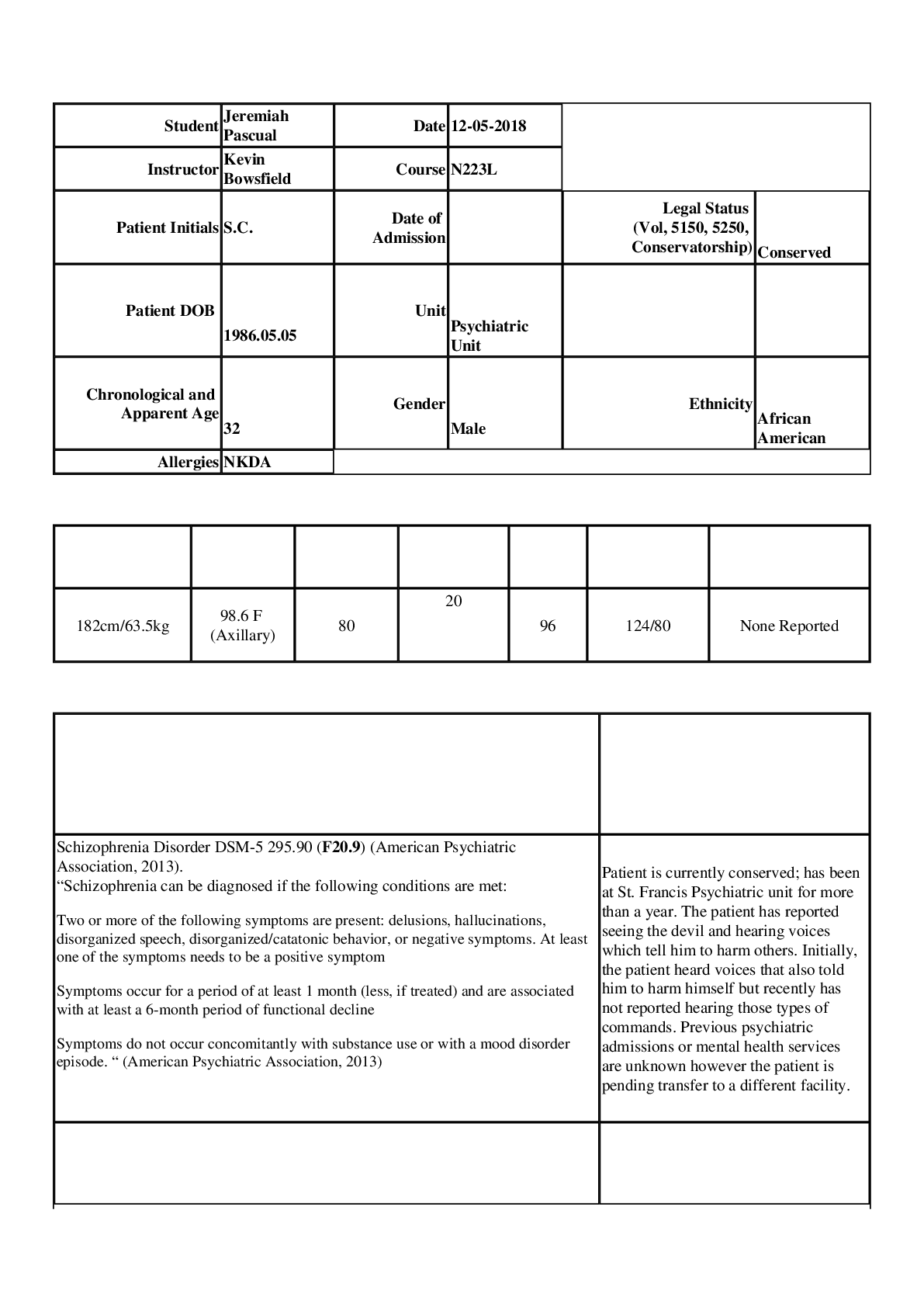
I. General Information
Client name: Allergies:
Room number: Diet:
Doctor: Height/weight:
Age: Vital signs: TPR/BP
Sex: Name and phone no. of
significant other:
Race:
Dominant language: City of residence:
Marital status: Diagnosis (admitting
& current):
Chief complaint:
II. Conditions of admission
Date: Time:
Accompanied by:
Route of admission (wheelchair; ambulatory; cart):
Admitted from:
4 ■ THE FOUNDATION FOR PLANNING PSYCHIATRIC NURSING CARE
4237_Ch01_001-013 10/07/14 10:34 AM Page 4
The Nursing Process in Psychiatric/Mental Health
[Show More]