CSE 551 Graded Quiz 3 Solutions
Jamison Weber
June 2019
Question 1
For which of the following problems would amortized analysis be applicable?
i.) Queue operations
ii.) Sorting
iii.) Stable Matching
Correct Respo
...
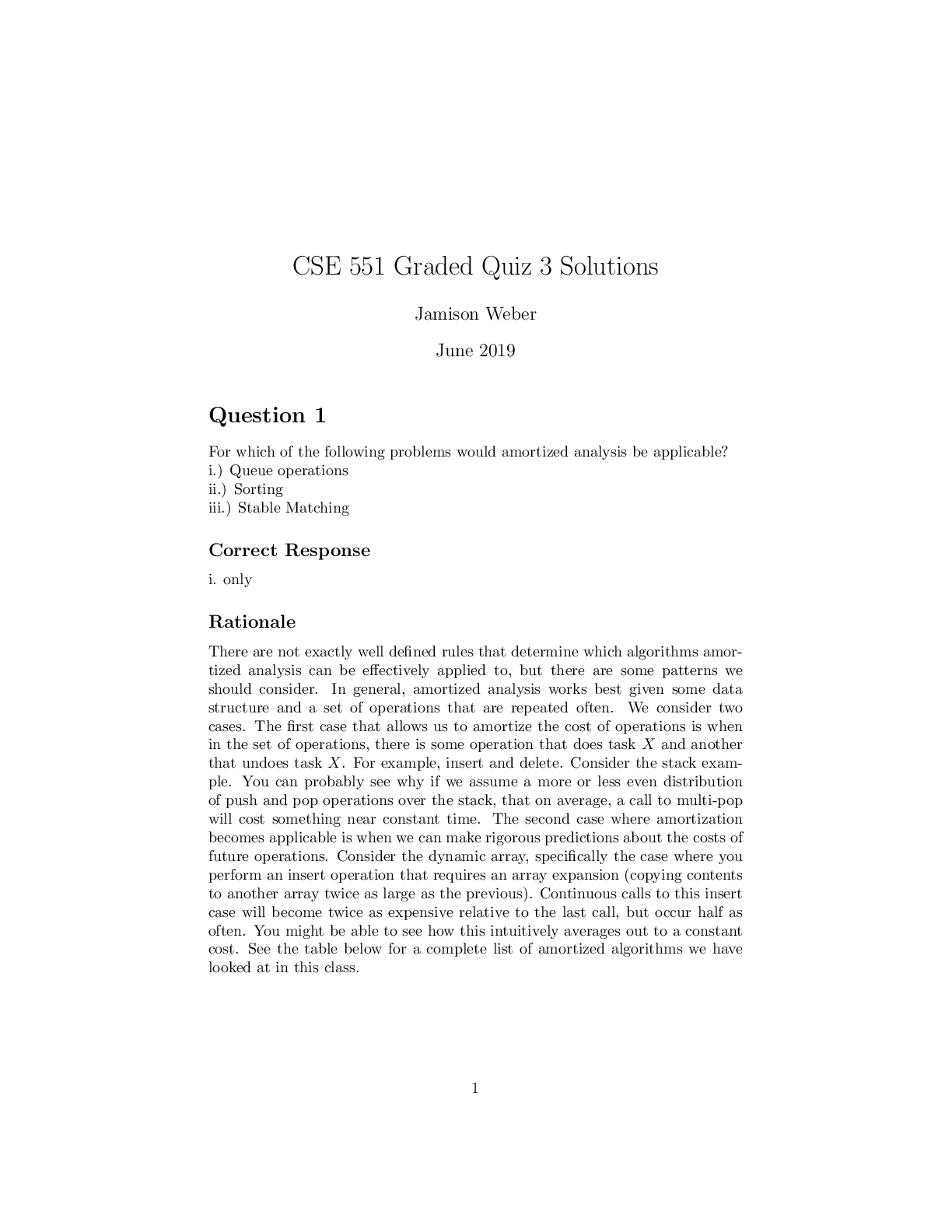
CSE 551 Graded Quiz 3 Solutions
Jamison Weber
June 2019
Question 1
For which of the following problems would amortized analysis be applicable?
i.) Queue operations
ii.) Sorting
iii.) Stable Matching
Correct Response
i. only
Rationale
There are not exactly well defined rules that determine which algorithms amortized analysis can be effectively applied to, but there are some patterns we
should consider. In general, amortized analysis works best given some data
structure and a set of operations that are repeated often. We consider two
cases. The first case that allows us to amortize the cost of operations is when
in the set of operations, there is some operation that does task X and another
that undoes task X. For example, insert and delete. Consider the stack example. You can probably see why if we assume a more or less even distribution
of push and pop operations over the stack, that on average, a call to multi-pop
will cost something near constant time. The second case where amortization
becomes applicable is when we can make rigorous predictions about the costs of
future operations. Consider the dynamic array, specifically the case where you
perform an insert operation that requires an array expansion (copying contents
to another array twice as large as the previous). Continuous calls to this insert
case will become twice as expensive relative to the last call, but occur half as
often. You might be able to see how this intuitively averages out to a constant
cost. See the table below for a complete list of amortized algorithms we have
looked at in this class.
1With regard to stable matching and sorting, however, there are some concrete reasons why amortized analysis won’t give us any improved bounds. The
main reason is that after a single call to sort, or a single call to propose-andreject, our problem instance is solved. We do not require any additional calls
to these operations to solve their respective instances. The reason amortized
analysis works on the examples above is that we can assume a distribution over
a series of operations and we can make rigorous predictions about the cost of
future operations, as seen with the case of the binary counter (i.e. bit position
3 flips every 4 calls, etc...). We cannot do anything like this with sorting or
stable matching. There are other methods of calculating averages for sorting.
For example, randomized quick-sort runs in O(n2) time in the worst case, but
has an expected run time of O(nlogn). Calculating the expected run time of a
randomized algorithm is not amortized analysis, but rather another technique
called random analysis, which is not covered in this course. Amortized analysis has nothing to do with calculating probabilities and does not make any
assumptions about the input.
Question 2
Suppose you are tasked with performing the aggregate method to determine an
amortized bound for an operation O whose cost function is defined below: Let
k be the iteration index for the number of times O has been called.
Cost(Ok) = �k; if k is a power of 1; otherwise 3
What is the total cost T(n) of performing 27 iterations?
Correct Response
63
Rationale
We simply sum the cost function given over 27 iterations:
27
X k
=1
Cost(k) = 1+1+3+1+1+1+1+1+9+1+1+1+1+1+1+1+1+1+1+1+1+1+1+1+1+1+27
2= 63
Question 3
From the following list, identify which of the following potential functions are
valid.
i.) The number of elements in a linear data structure
ii.) The summation over the depth of each node in a binary heap
iii.) The number of nodes minus the square of the tree-height of a binary search
tree
Correct Response
i. and ii.
Rationale
We consider three criteria for the validity of a potential function Φ. a.) The
function Φ reflects some quantifiable aspect of the data structure the operations
are being applied to. b.) Φ(0) = 0. c.) Φ(i) ≥ 0 for all i > 0. Now we consider
each potential function given:
i. satisfies all of a,b,c.
ii. satisfies all of a,b,c
iii. satisfies a,b only. This function has negative values in its range. Consider
the following binary search tree:
[Show More]




.png)






 Charles Herrick - 100 Q&A About Alcoholism & Drug Addiction-Jones and Bartlett Publishers, Inc.png)