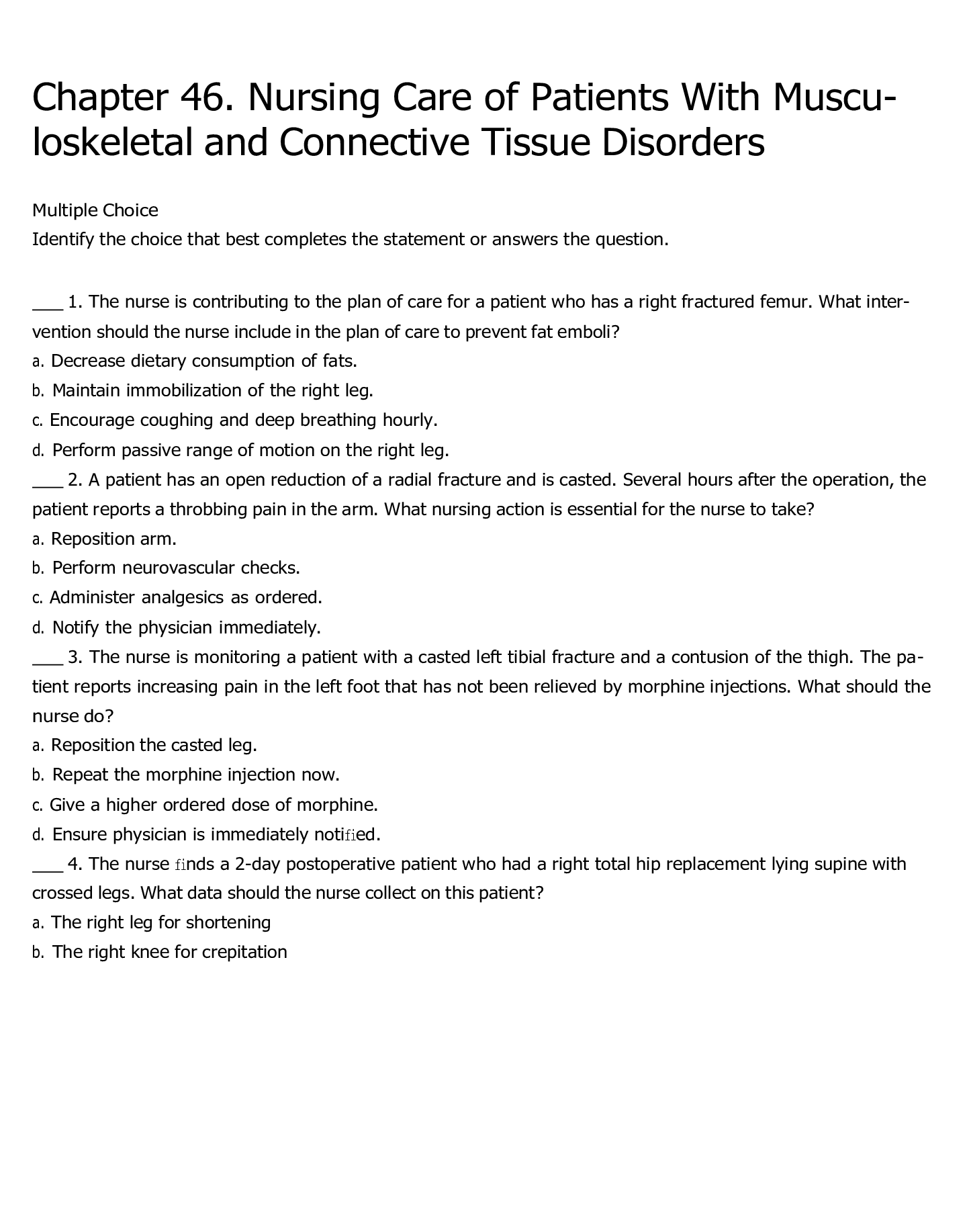
Bates’ Guide To Physical Examination and History Taking 13th Edition
Bickley Test Bank
CHAPTER 1 Foundations for Clinical
ProficiencyMULTIPLE CHOICE
1. After completing an initial assessment of a patient, the nurs
...
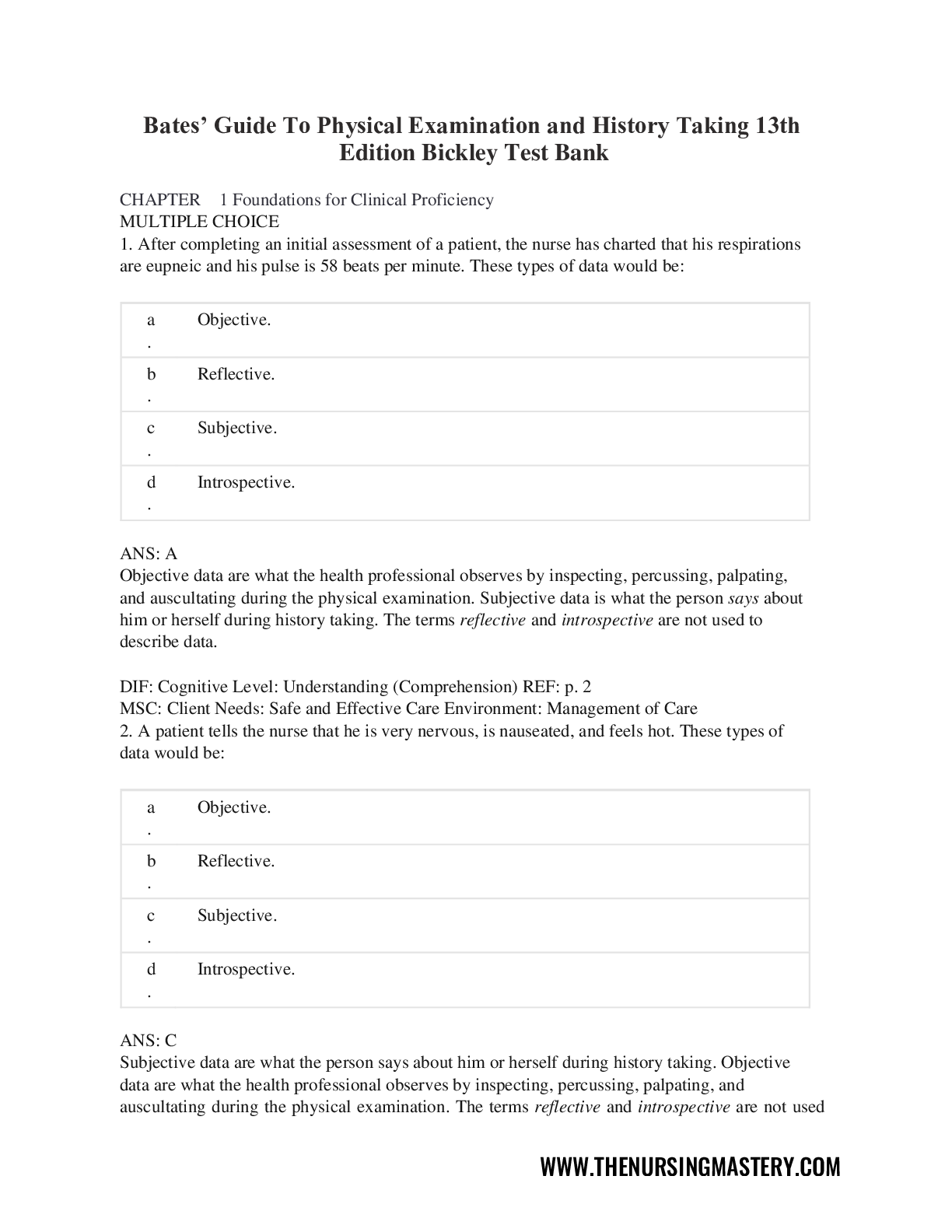
Bates’ Guide To Physical Examination and History Taking 13th Edition
Bickley Test Bank
CHAPTER 1 Foundations for Clinical
ProficiencyMULTIPLE CHOICE
1. After completing an initial assessment of a patient, the nurse has charted
that his respirationsare eupneic and his pulse is 58 beats per minute.
These types of data would be:
a
.
Objective.
b
.
Reflective.
c
.
Subjective.
d
.
Introspective.
ANS: A
Objective data are what the health professional observes by inspecting,
percussing, palpating, and auscultating during the physical examination.
Subjective data is what the person says abouthim or herself during history
taking. The terms reflective and introspective are not used to describe
data.
DIF: Cognitive Level: Understanding (Comprehension) REF: p. 2
MSC: Client Needs: Safe and Effective Care Environment: Management of Care
2. A patient tells the nurse that he is very nervous, is nauseated, and feels
hot. These types ofdata would be:
a
.
Objective.
b
.
Reflective.
c
.
Subjective.
d
.
Introspective.
ANS: C
Subjective data are what the person says about him or herself during
history taking. Objectivedata are what the health professional observes
by inspecting, percussing, palpating, and
auscultating during the physical examination. The terms reflective and
introspective are not used
to describe data.
DIF: Cognitive Level: Understanding (Comprehension) REF: p. 2
MSC: Client Needs: Safe and Effective Care Environment: Management of Care
3. The patients record, laboratory studies, objective data, and subjective
data combine to formthe:
a
.
Data base.
b
.
Admitting data.
c
.
Financial statement.
d
.
Discharge summary.
ANS: A
Together with the patients record and laboratory studies, the objective and
subjective data form the data base. The other items are not part of the
patients record, laboratory studies, or data.
DIF: Cognitive Level: Remembering (Knowledge) REF: p. 2
MSC: Client Needs: Safe and Effective Care Environment: Management of Care
4. When listening to a patients breath sounds, the nurse is unsure of a
sound that is heard. Thenurses next action should be to:
a
.
Immediately notify the patients physician.
b
.
Document the sound exactly as it was heard.
c
.
Validate the data by asking a coworker to listen to the breath
sounds.
d
.
Assess again in 20 minutes to note whether the sound is still
present.
ANS: C
When unsure of a sound heard while listening to a patients breath sounds,
the nurse validates the data to ensure accuracy. If the nurse has less
experience in an area, then he or she asks an expertto listen.
DIF: Cognitive Level: Analyzing (Analysis) REF: p. 2
MSC: Client Needs: Safe and Effective Care Environment: Management of Care
5. The nurse is conducting a class for new graduate nurses. During the
teaching session, the nurse should keep in mind that novice nurses,
without a background of skills and experiencefrom which to draw, are
more likely to make their decisions using:
a
.
Intuition.
b
.
A set of rules.
c
.
Articles in journals.
d
.
Advice from supervisors.
ANS: B
Novice nurses operate from a set of defined, structured rules. The
expert practitioner usesintuitive links.
DIF: Cognitive Level: Understanding
(Comprehension) REF: p. 3 MSC: Client Needs:
General
6. Expert nurses learn to attend to a pattern of assessment data and act
without consciouslylabeling it. These responses are referred to as:
a Intuition.
.
b
.
The nursing process.
c
.
Clinical knowledge.
d
.
Diagnostic reasoning.
ANS: A
Intuition is characterized by pattern recognitionexpert nurses learn to
attend to a pattern of assessment data and act without consciously
labeling it. The other options are not correct.
DIF: Cognitive Level: Understanding
(Comprehension) REF: p. 4 MSC: Client Needs:
General
7. The nurse is reviewing information about evidence-based practice
(EBP). Which statementbest reflects EBP?
a
.
EBP relies on tradition for support of best practices.
b
.
EBP is simply the use of best practice techniques for the treatment
of patients.
c
.
EBP emphasizes the use of best evidence with the clinicians
experience.
d
.
The patients own preferences are not important with EBP.
ANS: C
EBP is a systematic approach to practice that emphasizes the use of best
evidence in combinationwith the clinicians experience, as well as patient
preferences and values, when making decisions about care and treatment.
EBP is more than simply using the best practice techniques to treat patients,
and questioning tradition is important when no compelling and supportive
research evidence exists.
DIF: Cognitive Level: Applying (Application) REF: p. 5
MSC: Client Needs: Safe and Effective Care Environment: Management of Care
8. The nurse is conducting a class on priority setting for a group of new
graduate nurses. Whichis an example of a first-level priority problem?
a
.
Patient with postoperative pain
b Newly diagnosed patient with diabetes who needs diabetic
. teaching
c
.
Individual with a small laceration on the sole of the foot
d
.
Individual with shortness of breath and respiratory distress
ANS: D
First-level priority problems are those that are emergent, life threatening,
and immediate (e.g., establishing an airway, supporting breathing,
maintaining circulation, monitoring abnormal vitalsigns) (see Table 1-1).
DIF: Cognitive Level: Understanding (Comprehension) REF: p. 4
MSC: Client Needs: Safe and Effective Care Environment: Management of Care
9. When considering priority setting of problems, the nurse keeps in
mind that second-level priority problems include which of these
aspects?
a
.
Low self-esteem
b
.
Lack of knowledge
c
.
Abnormal laboratory values
d
.
Severely abnormal vital signs
ANS: C
Second-level priority problems are those that require prompt intervention
to forestall further deterioration (e.g., mental status change, acute pain,
abnormal laboratory values, risks to safetyor security) (see Table 1-1).
DIF: Cognitive Level: Understanding (Comprehension) REF: p. 4
MSC: Client Needs: Safe and Effective Care Environment: Management of Care
10. Which critical thinking skill helps the nurse see relationships among the
data?
a
.
Validation
b
.
Clustering related cues
c
.
Identifying gaps in data
d
.
Distinguishing relevant from irrelevant
ANS: B
Clustering related cues helps the nurse see relationships among the data.
DIF: Cognitive Level: Understanding (Comprehension) REF: p. 2
MSC: Client Needs: Safe and Effective Care Environment: Management of Care
11. The nurse knows that developing appropriate nursing interventions for
a patient relies on theappropriateness of the diagnosis.
a Nursing
.
b Medical
.
c Admission
.
d Collaborative
.
ANS: A
An accurate nursing diagnosis provides the basis for the selection of
nursing interventions to achieve outcomes for which the nurse is
accountable. The other items do not contribute to thedevelopment of
appropriate nursing interventions.
DIF: Cognitive Level: Understanding (Comprehension) REF: p. 6
MSC: Client Needs: Safe and Effective Care Environment: Management of Care
12. The nursing process is a sequential method of problem solving that
nurses use and includeswhich steps?
a Assessment, treatment, planning, evaluation, discharge, and
follow-up
.
b Admission, assessment, diagnosis, treatment, and discharge
planning
.
c Admission, diagnosis, treatment, evaluation, and discharge
planning
.
d Assessment, diagnosis, outcome identification, planning,
implementation, and
. evaluation
ANS: D
The nursing process is a method of problem solving that includes
assessment, diagnosis, outcome identification, planning,
implementation, and evaluation.
DIF: Cognitive Level: Understanding (Comprehension) REF: p. 3
MSC: Client Needs: Safe and Effective Care Environment: Management of Care
13. A newly admitted patient is in acute pain, has not been sleeping well
lately, and is havingdifficulty breathing. How should the nurse prioritize
these problems?
a
.
Breathing, pain, and sleep
b
.
Breathing, sleep, and pain
c
.
Sleep, breathing, and pain
[Show More]









.png)
.png)