MULTIPLE CHOICE
1. Which of the following is not a consequence of the Law of Conservation of Matter?
a. It provides a basis for balancing chemical equations.
b. It means that there will be no observable change in the
...
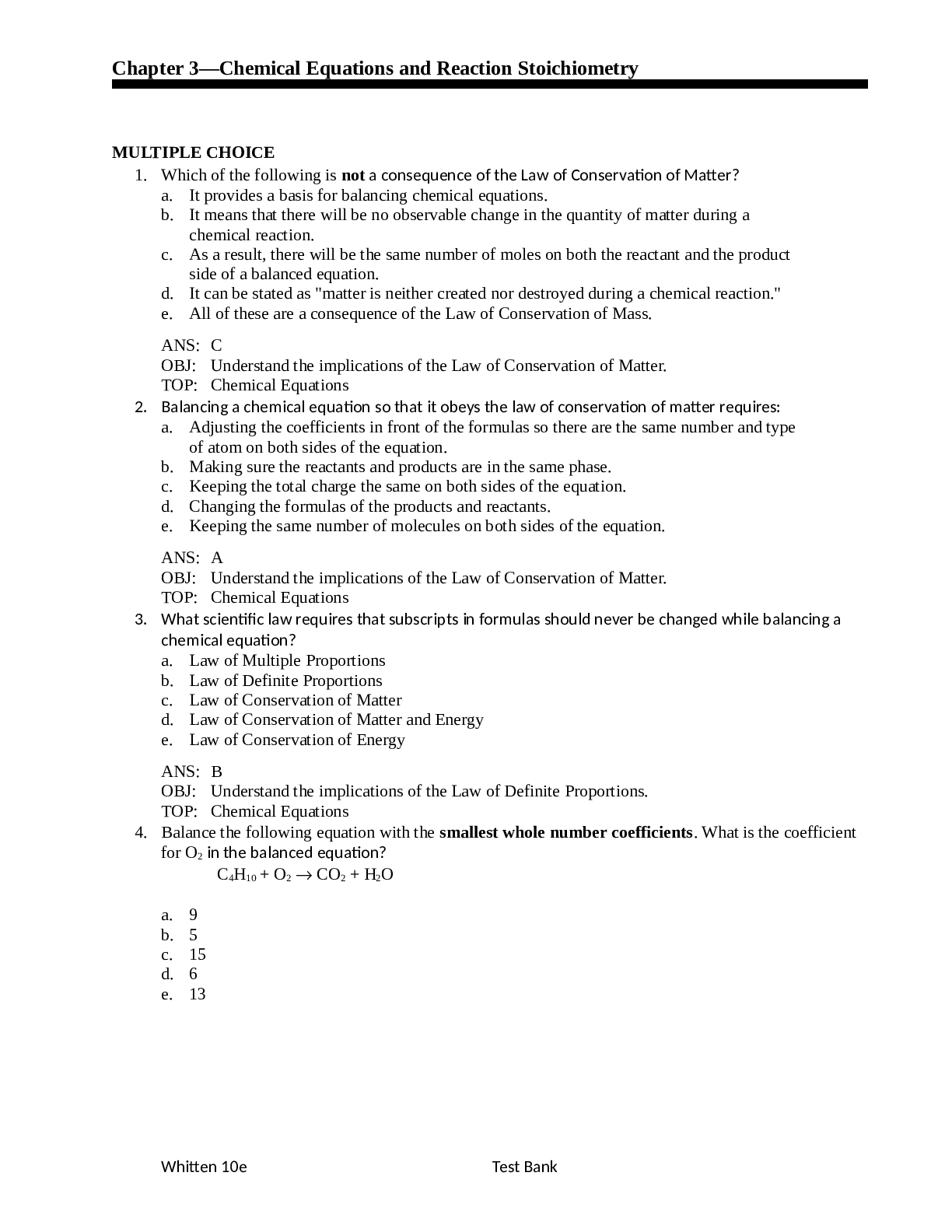
MULTIPLE CHOICE
1. Which of the following is not a consequence of the Law of Conservation of Matter?
a. It provides a basis for balancing chemical equations.
b. It means that there will be no observable change in the quantity of matter during a
chemical reaction.
c. As a result, there will be the same number of moles on both the reactant and the product
side of a balanced equation.
d. It can be stated as "matter is neither created nor destroyed during a chemical reaction."
e. All of these are a consequence of the Law of Conservation of Mass.
ANS: C
OBJ: Understand the implications of the Law of Conservation of Matter.
TOP: Chemical Equations
2. Balancing a chemical equation so that it obeys the law of conservation of matter requires:
a. Adjusting the coefficients in front of the formulas so there are the same number and type
of atom on both sides of the equation.
b. Making sure the reactants and products are in the same phase.
c. Keeping the total charge the same on both sides of the equation.
d. Changing the formulas of the products and reactants.
e. Keeping the same number of molecules on both sides of the equation.
ANS: A
OBJ: Understand the implications of the Law of Conservation of Matter.
TOP: Chemical Equations
3. What scientific law requires that subscripts in formulas should never be changed while balancing a
chemical equation?
a. Law of Multiple Proportions
b. Law of Definite Proportions
c. Law of Conservation of Matter
d. Law of Conservation of Matter and Energy
e. Law of Conservation of Energy
ANS: B
OBJ: Understand the implications of the Law of Definite Proportions.
TOP: Chemical Equations
4. Balance the following equation with the smallest whole number coefficients. What is the coefficient
for O2 in the balanced equation?
C4H10 + O2 CO2 + H2O
a. 9
b. 5
c. 15
d. 6
e. 13
Whitten 10e Test Bank
ANS: E
OBJ: Balance a chemical equation.
TOP: Chemical Equations
5. Balance the following equation with the smallest whole number coefficients. What is the coefficient
for O2 in the balanced equation?
C4H9SO + O2 CO2 + SO2 + H2O
a. 54
b. 29
c. 23
d. 32
e. 27
ANS: E
DIF: Harder Question
OBJ: Balance a chemical equation.
TOP: Chemical Equations
6. What is the coefficient for carbon dioxide when the following equation showing the combustion of
isopropyl alcohol is balanced with the smallest whole number coefficients?
C3H8O + O2 CO2 + H2O
a. 3
b. 6
c. 13
d. 4
e. 1
ANS: B
OBJ: Balance a chemical equation.
TOP: Chemical Equations
7. Balance the following equation with the smallest whole number coefficients. What is the coefficient
for H2O in the balanced equation?
Al(OH)3 + HCl AlCl3 + H2O
a. 1
b. 2
c. 3
d. 14
e. 5
ANS: C
OBJ: Balance a chemical equation.
TOP: Chemical Equations
Whitten 10e Test Bank
8. Balance the following equation with the smallest whole number coefficients. What is the coefficient
for H2O in the balanced equation?
LiBF4 + H2O H3BO3 + HF + LiF
a. 3
b. 2
c. 5
d. 6
e. 8
ANS: A
OBJ: Balance a chemical equation.
TOP: Chemical Equations
9. What is the coefficient for HBr when the following equation is balanced with the smallest whole
number coefficients?
Br2 + H2O HBr + HBrO3
a. 5
b. 7
c. 8
d. 3
e. 6
ANS: A
OBJ: Balance a chemical equation.
TOP: Chemical Equations
10. Balance the following equation with the smallest whole number coefficients. What is the coefficient
for NH3 in the balanced equation?
Fe(NO3)3 + NH3 + H2O Fe(OH)3 + NH4NO3
a. 1
b. 3
c. 2
d. 6
e. 4
ANS: B
OBJ: Balance a chemical equation.
TOP: Chemical Equations
11. Elemental phosphorus is produced from calcium phosphate in the following reaction. What is the
coefficient for C when this equation is balanced with the smallest whole number coefficients?
Ca3(PO4)2 + SiO2 + C P4 + CO + CaSiO3
a. 10
b. 3
c. 1
d. 6
e. 4
ANS: A
OBJ: Balance a chemical equation.
TOP: Chemical Equations
[Show More]


.png)