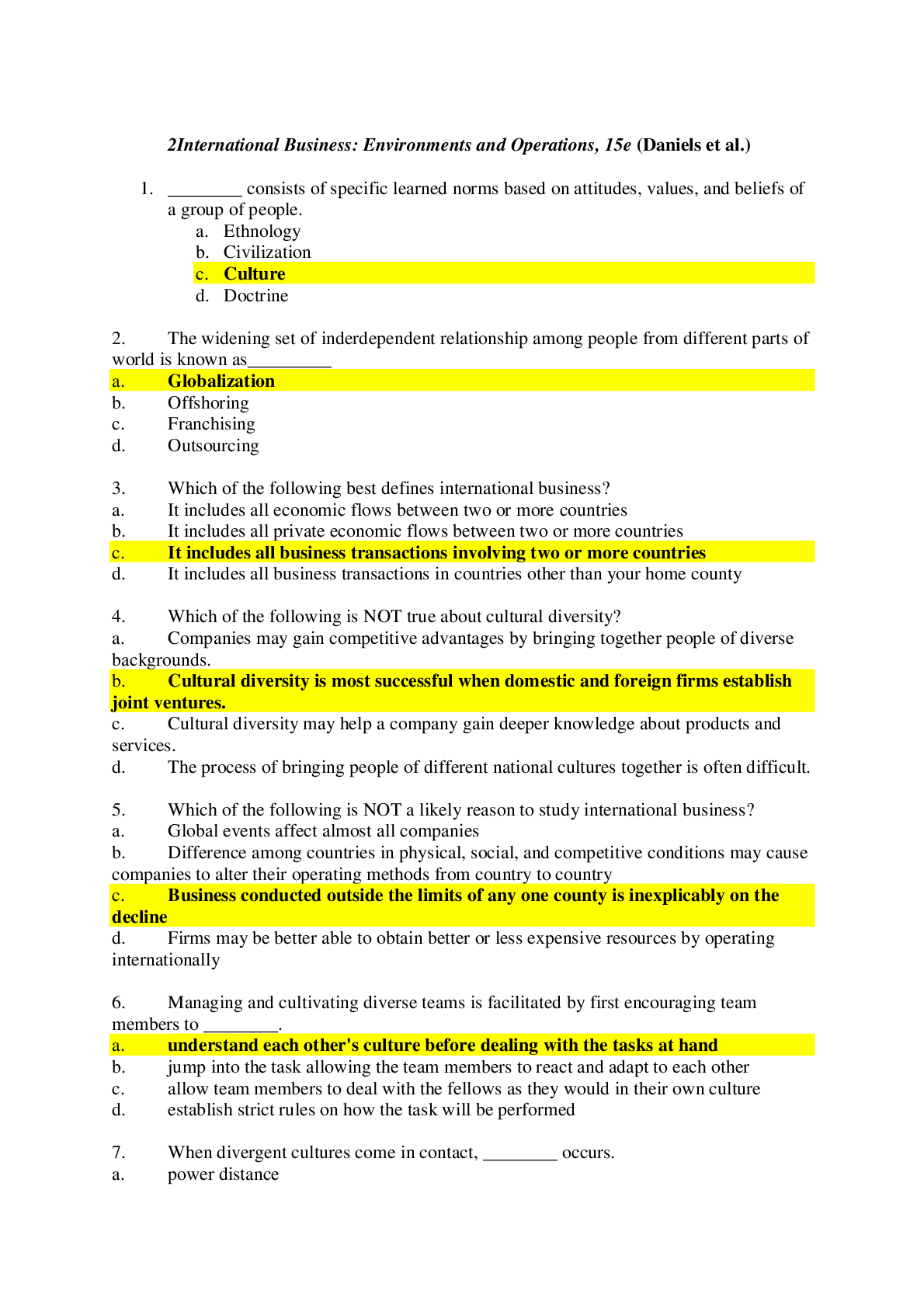
1. ________ consists of specific learned norms based on attitudes, values, and beliefs of
a group of people.
a. Ethnology
b. Civilization
c. Culture
d. Doctrine
2. The widening set of inderdependent relationship am
...
1. ________ consists of specific learned norms based on attitudes, values, and beliefs of
a group of people.
a. Ethnology
b. Civilization
c. Culture
d. Doctrine
2. The widening set of inderdependent relationship among people from different parts of
world is known as_________
a. Globalization
b. Offshoring
c. Franchising
d. Outsourcing
3. Which of the following best defines international business?
a. It includes all economic flows between two or more countries
b. It includes all private economic flows between two or more countries
c. It includes all business transactions involving two or more countries
d. It includes all business transactions in countries other than your home county
4. Which of the following is NOT true about cultural diversity?
a. Companies may gain competitive advantages by bringing together people of diverse
backgrounds.
b. Cultural diversity is most successful when domestic and foreign firms establish
joint ventures.
c. Cultural diversity may help a company gain deeper knowledge about products and
services.
d. The process of bringing people of different national cultures together is often difficult.
5. Which of the following is NOT a likely reason to study international business?
a. Global events affect almost all companies
b. Difference among countries in physical, social, and competitive conditions may cause
companies to alter their operating methods from country to country
c. Business conducted outside the limits of any one county is inexplicably on the
decline
d. Firms may be better able to obtain better or less expensive resources by operating
internationally
6. Managing and cultivating diverse teams is facilitated by first encouraging team
members to ________.
a. understand each other's culture before dealing with the tasks at hand
b. jump into the task allowing the team members to react and adapt to each other
c. allow team members to deal with the fellows as they would in their own culture
d. establish strict rules on how the task will be performed
7. When divergent cultures come in contact, ________ occurs.
a. power distance
b. culture shock
c. cultural collision
d. group membership
8. The shifting of national borders has most likely created which of the following
situations for international business?
a. It has left rural residents more isolated from technology
b. It has complicated the understanding of behavioral factors affecting business
c. It has increased physical barriers to exporting
d. It has slowed communications between a company’s headquarters and foreign
operations
9. Which of the following is an indication of the increased globalization of business
since the end of World War II?
a. Foreign trade has largely replaced foreign ownership as a mean of conducting
international business
b. World trade has grown more rapidly than world production
c. Globally, consumers now depend on foreign output for more than half their
consumption
d. Countries have increased their import restriction to counter the rising tide of imports
10. Most of the world’s goods and services are sold_________
a. In international markets
b. In the countries where they are produced
c. Through exports to small countries
d. Through exports to large countries
11. Which of the following has NOT been a major force increasing globalization in recent
decades?
a. Liberalization of cross-border trade
b. Increase in and expansion of technology
c. Growing pressure from consumers
d. Decreasing prices of natural resources
12. Institutional development of services by business and government has aided the
expansion of international business by___________
a. Providing a universally agreed upon language for conducting international
transactions
b. Removing immigration restrictions so that global firms can move personnel easily
c. Developing means to ease the flow of goods among countries
d. Spurring competition among domestic producers
13. Which of the following has MOST influenced consumers to demand access to
foreign-made products?
a. Declining global affluence has caused consumers to seek out lower-priced products
from abroad?
b. Consumers have become more efficient in using media and technologies to
compare prices worldwide
c. Fearing that their governments winn enact restrictive policies on imports consumers
are stocking up on foreign products before restrictions are put in place
[Show More]