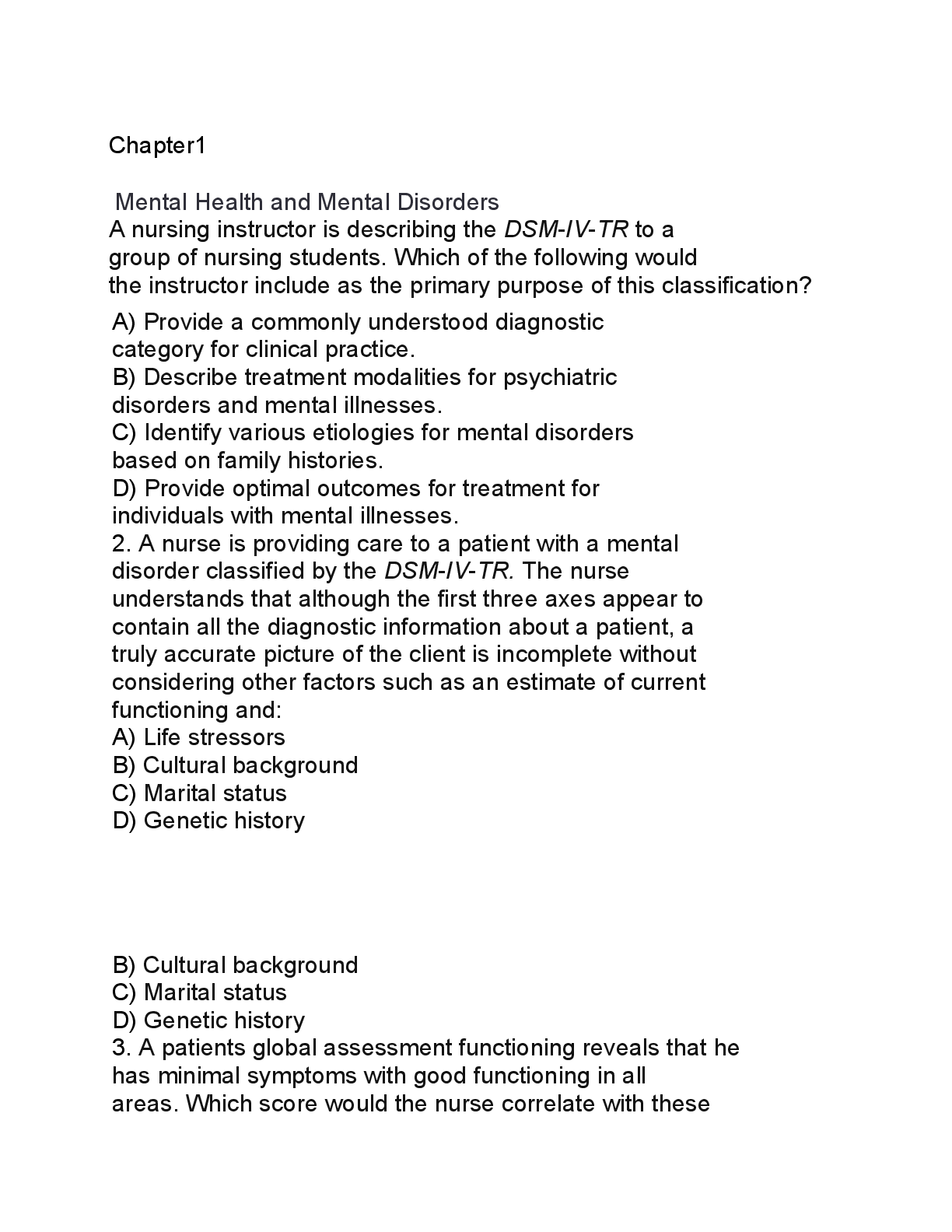
1. Two nursing students discuss their career plans after graduation. One student wants to enter
psychiatric nursing. The other asks, “Why would you want to be a psychiatric nurse? The only thing
they do is talk. You’ll
...
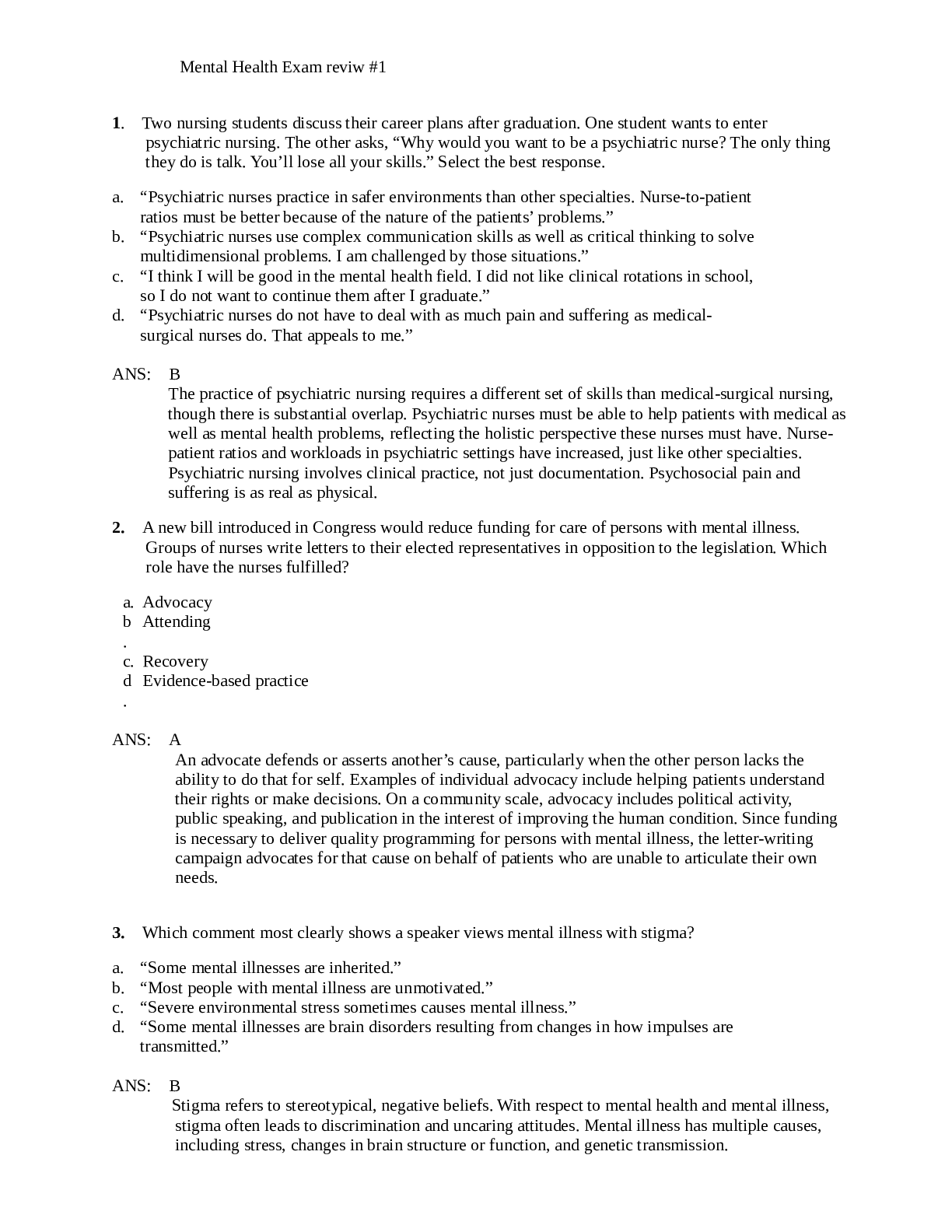
1. Two nursing students discuss their career plans after graduation. One student wants to enter
psychiatric nursing. The other asks, “Why would you want to be a psychiatric nurse? The only thing
they do is talk. You’ll lose all your skills.” Select the best response.
a. “Psychiatric nurses practice in safer environments than other specialties. Nurse-to-patient
ratios must be better because of the nature of the patients’ problems.”
b. “Psychiatric nurses use complex communication skills as well as critical thinking to solve
multidimensional problems. I am challenged by those situations.”
c. “I think I will be good in the mental health field. I did not like clinical rotations in school,
so I do not want to continue them after I graduate.”
d. “Psychiatric nurses do not have to deal with as much pain and suffering as medicalsurgical nurses do. That appeals to me.”
ANS: B
The practice of psychiatric nursing requires a different set of skills than medical-surgical nursing,
though there is substantial overlap. Psychiatric nurses must be able to help patients with medical as
well as mental health problems, reflecting the holistic perspective these nurses must have. Nursepatient ratios and workloads in psychiatric settings have increased, just like other specialties.
Psychiatric nursing involves clinical practice, not just documentation. Psychosocial pain and
suffering is as real as physical.
2. A new bill introduced in Congress would reduce funding for care of persons with mental illness.
Groups of nurses write letters to their elected representatives in opposition to the legislation. Which
role have the nurses fulfilled?
a. Advocacy
b
.
Attending
c. Recovery
d
.
Evidence-based practice
ANS: A
An advocate defends or asserts another’s cause, particularly when the other person lacks the
ability to do that for self. Examples of individual advocacy include helping patients understand
their rights or make decisions. On a community scale, advocacy includes political activity,
public speaking, and publication in the interest of improving the human condition. Since funding
is necessary to deliver quality programming for persons with mental illness, the letter-writing
campaign advocates for that cause on behalf of patients who are unable to articulate their own
needs.
[Show More]