NUR 326 Perioperative Online Practice ATI_Complete solution.
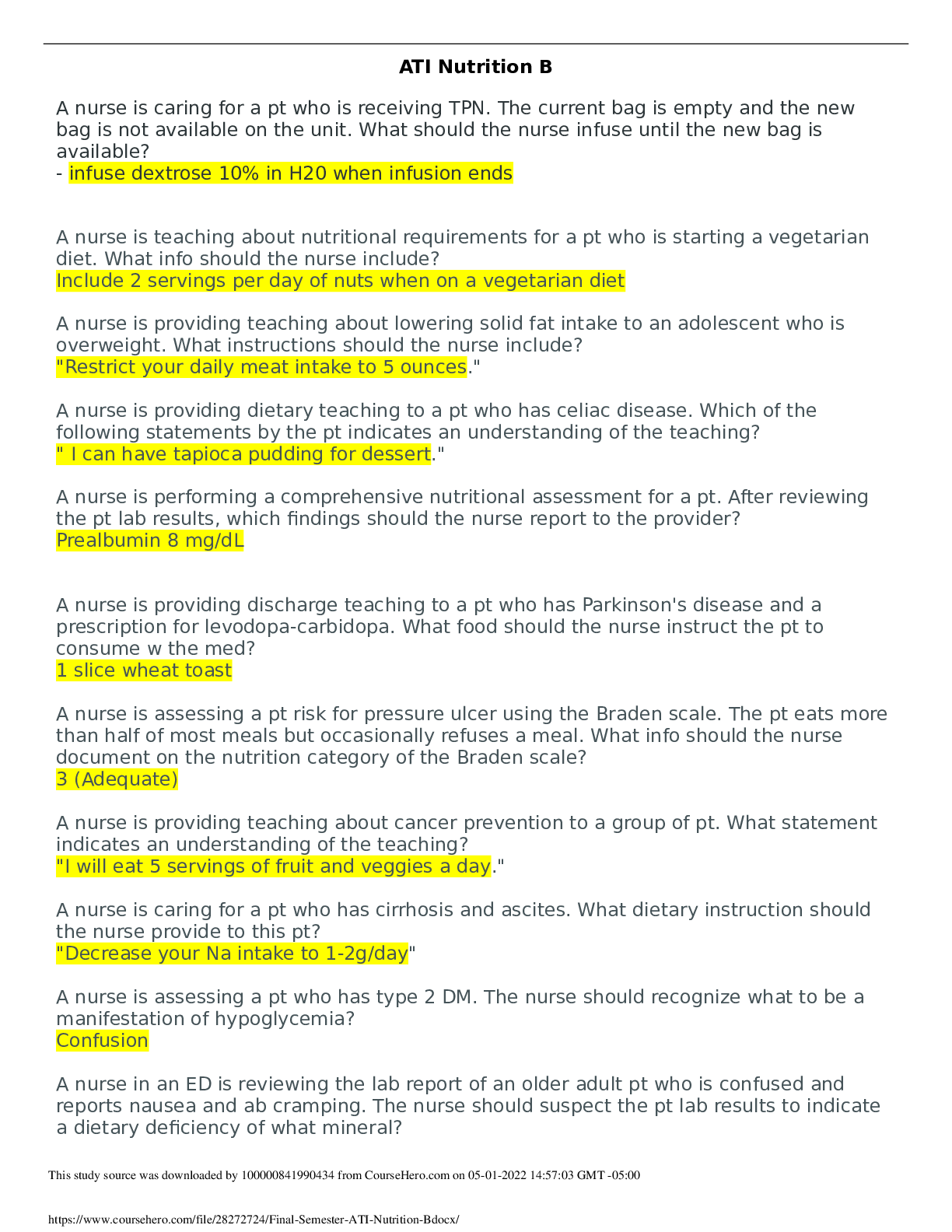
1. A surgical nurse enters a surgical suite to ensure surgical asepsis is maintained. For which of the following
findings should the nurse intervene?
a. The
...
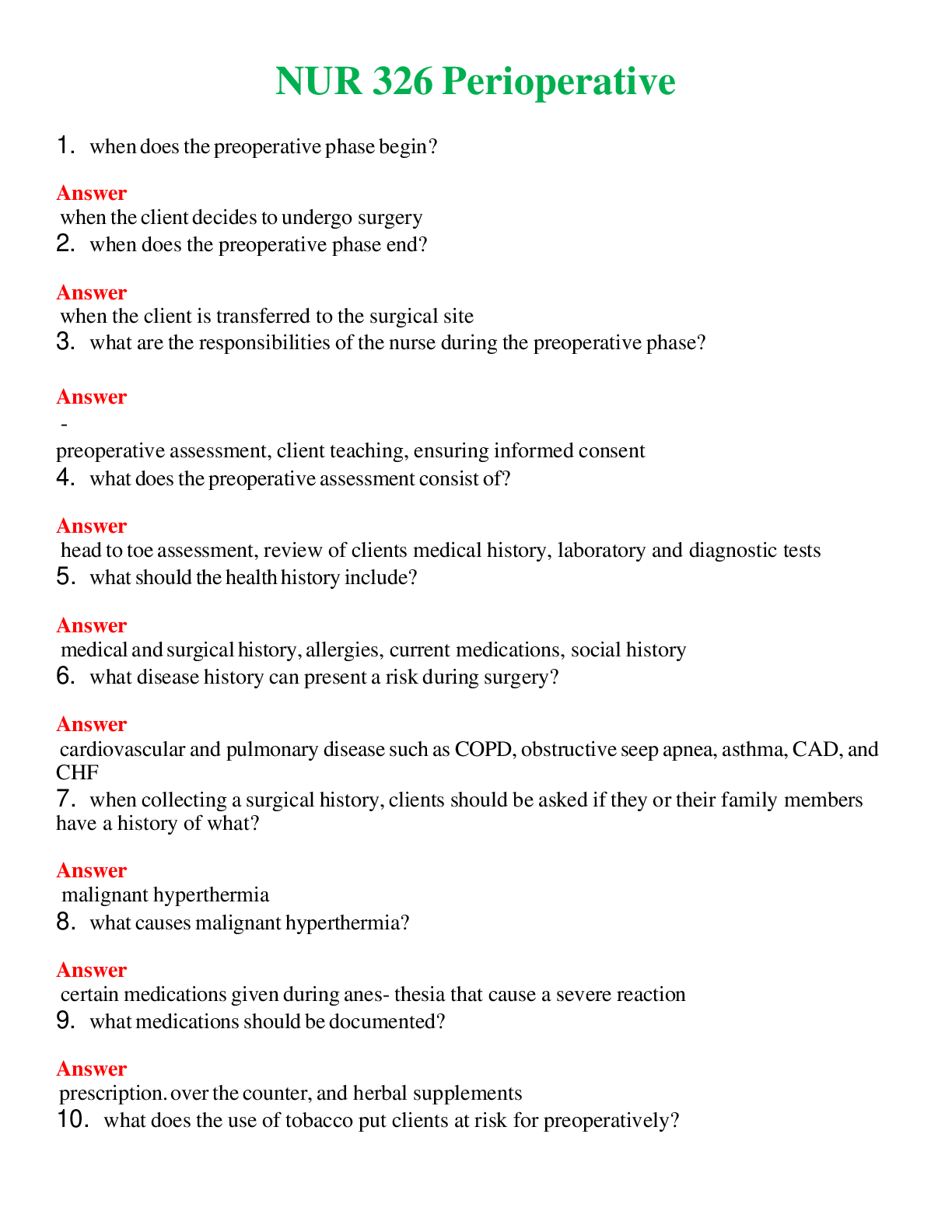
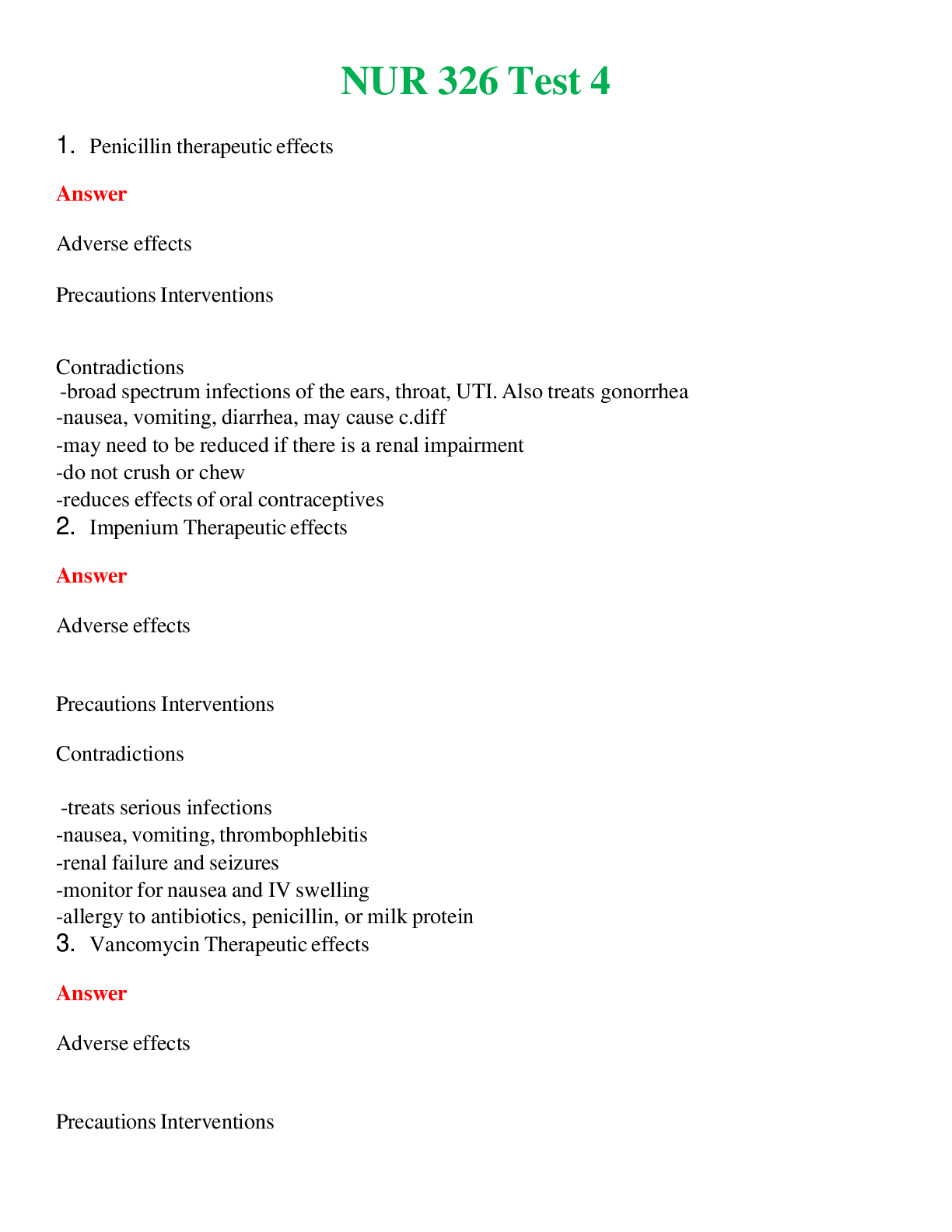
NUR 326 Perioperative Online Practice ATI_Complete solution.
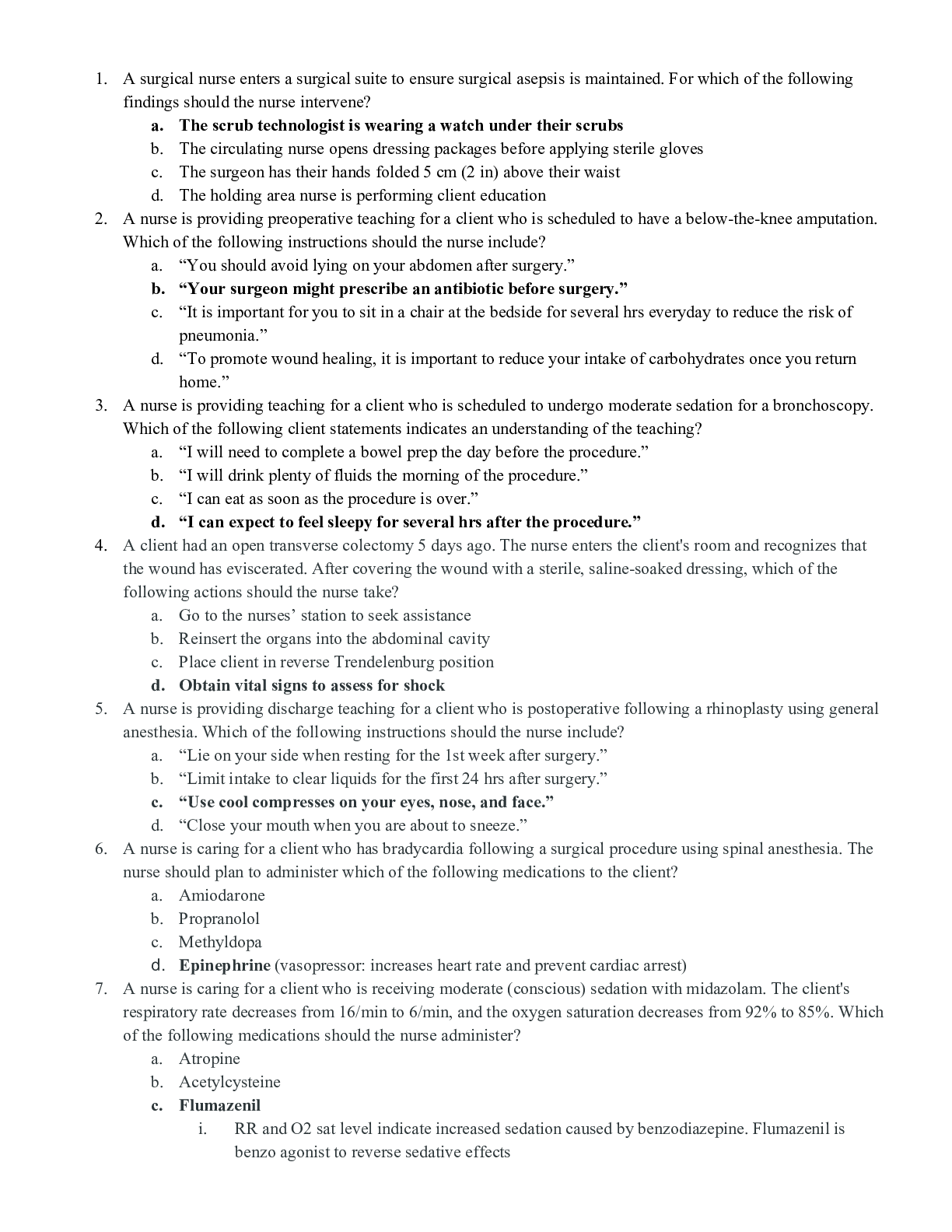
1. A surgical nurse enters a surgical suite to ensure surgical asepsis is maintained. For which of the following
findings should the nurse intervene?
a. The scrub technologist is wearing a watch under their scrubs
b. The circulating nurse opens dressing packages before applying sterile gloves
c. The surgeon has their hands folded 5 cm (2 in) above their waist
d. The holding area nurse is performing client education
2. A nurse is providing preoperative teaching for a client who is scheduled to have a below-the-knee amputation.
Which of the following instructions should the nurse include?
a. “You should avoid lying on your abdomen after surgery.”
b. “Your surgeon might prescribe an antibiotic before surgery.”
c. “It is important for you to sit in a chair at the bedside for several hrs everyday to reduce the risk of
pneumonia.”
d. “To promote wound healing, it is important to reduce your intake of carbohydrates once you return
home.”
3. A nurse is providing teaching for a client who is scheduled to undergo moderate sedation for a bronchoscopy.
Which of the following client statements indicates an understanding of the teaching?
a. “I will need to complete a bowel prep the day before the procedure.”
b. “I will drink plenty of fluids the morning of the procedure.”
c. “I can eat as soon as the procedure is over.”
d. “I can expect to feel sleepy for several hrs after the procedure.”
4. A client had an open transverse colectomy 5 days ago. The nurse enters the client's room and recognizes that
the wound has eviscerated. After covering the wound with a sterile, saline-soaked dressing, which of the
following actions should the nurse take?
a. Go to the nurses’ station to seek assistance
b. Reinsert the organs into the abdominal cavity
c. Place client in reverse Trendelenburg position
d. Obtain vital signs to assess for shock
5. A nurse is providing discharge teaching for a client who is postoperative following a rhinoplasty using general
anesthesia. Which of the following instructions should the nurse include?
a. “Lie on your side when resting for the 1st week after surgery.”
b. “Limit intake to clear liquids for the first 24 hrs after surgery.”
c. “Use cool compresses on your eyes, nose, and face.”
d. “Close your mouth when you are about to sneeze.”
6. A nurse is caring for a client who has bradycardia following a surgical procedure using spinal anesthesia. The
nurse should plan to administer which of the following medications to the client?
a. Amiodarone
b. Propranolol
c. Methyldopa
d. Epinephrine (vasopressor: increases heart rate and prevent cardiac arrest)
7. A nurse is caring for a client who is receiving moderate (conscious) sedation with midazolam. The client's
respiratory rate decreases from 16/min to 6/min, and the oxygen saturation decreases from 92% to 85%. Which
of the following medications should the nurse administer?
a. Atropine
b. Acetylcysteine
c. Flumazenil
i. RR and O2 sat level indicate increased sedation caused by benzodiazepine. Flumazenil is
benzo agonist to reverse sedative effectsd. Protamine sulfate
8. A nurse is providing teaching for a client who is in the immediate postoperative period and has a PCA pump.
Which of the following statements should the nurse include in the teaching?
a. “You will receive a dose of medication every time you push the button.”
b. “Do not allow visitors to push the PCA button if you are sleeping.”
c. “You cannot receive too much medication by pushing the button.”
d. “Do not push the PCA button until your pain reaches a severe level.”
9. A circulating nurse is monitoring the temperature in a surgical suite. The nurse should identify that cool
temperatures reduce a client's risk for which of the following potential complications of surgery?
a. Malignant hyperthermia
b. Blood clots
c. Infection
d. Hypoxia
10. A nurse is providing preoperative teaching to a client who is scheduled for a gastrectomy in 1 week. The client
is anxious about the upcoming surgery. Which of the following actions should the nurse take?
a. Sympathize w/ client’s feelings
b. Reassure the client that the surgery will go fine
c. Change the topic of discussion
d. Provide concise, factual information
11. A nurse is assessing a client's recovery from spinal anesthesia. Which of the following sensations should the
nurse expect to return to the client first?
a. Pain
b. Cold
c. Touch (sensation order: touch, pain, warmth, cold)
d. Warmth
12. A nurse is providing preoperative teaching to a client who is scheduled to have a mastectomy with
reconstructive surgery. Which of the following statements by the client indicates an understanding of the
teaching?
a. “I should wait to take my pain medication until after I have completed my ROM exercises.”
i. If they experience pain while ROM, they should take pain meds 30 min prior
b. “I should wait until a week after surgery to start my hand strengthening exercises.”
i. Nurse should encourage hand-strengthening exercises first day after
c. “I will be able to lift an object that weighs 10 lbs 2 weeks after my surgery.”
i. Avoid for at least 4 weeks
d. “I will be able to shower after the dr removes the drain.”
13. A nurse is reviewing the medical record of a client who is scheduled for an elective surgery. Which of the
following medications should the nurse expect the provider to discontinue prior to surgery to minimize the risk
of complications?
a. Cefazolin
b. Digoxin
c. Ondansetron
d. Warfarin (increases risk of bleeding during and following surgery)
14. A nurse is assessing a client who is 2 days postoperative following a total prostatectomy. The nurse notes that
the client's right is red, edematous, and warm to the touch. Which of the following actions should the nurse
take?
a. Apply an ice pack to client’s right calfb. Elevate client’s right extremity (client suggests deep-vein thrombosis; keep elevated to promote
venous return)
c. Administer testosterone to client
d. Gently massage the client’s right calf
15. A nurse is caring for a client who is postoperative following abdominal surgery. Which of the following
nursing interventions should the nurse perform to prevent respiratory complications?
a. Instruct client to exhale into incentive spirometer every 1 to 2 hr
b. Minimize amount of pain medication the client receives to prevent sedation
c. Advise client to splint the surgical incision when coughing and deep breathing
d. Reposition the client every 8 hr for first 48 hrs
16. A nurse is planning care for a client who is postoperative and has a closed-wound drainage system in place.
Which of the following interventions should the nurse plan to include?
a. Check patency of drain every 12 hr (should check every 8 hr)
b. Clamp drain while client is ambulating
c. Cleanse drain plug w/ alcohol after emptying
i. After emptying drain, nurse should compress top and bottom of device together w/ 1
hand, while cleansing plug w/ other
d. Secure drain to client’s bed sheet
17. A nurse is caring for a client who is preoperative and is asking multiple questions about risks of the procedure.
Which of the following actions should the nurse take?
a. Explain the risks and benefits of the surgery to the client
b. Ask the surgeon to speak to the client for clarification
c. Reassure the client that the procedure is necessary for recovery
d. Notify circulating nurse that client has questions about procedure
18. A nurse in the PACU is assessing a client who is postoperative. Which of the following findings should the
nurse report to the provider?
a. Blood pressure 10% lower than baseline
i. Nurse should report 25% above or below baseline
b. Pain level of 4 on a 0 to 10 scale
c. Presence of inspiratory stridor (it is manifestation of tracheal edema)
d. Small amount of sanguineous drainage on dressings
19. A client is transferred from the surgical suite to the PACU following oral surgery. While monitoring the
client's vital signs, the nurse finds that the client's tongue has become swollen and is obstructing the airway.
Which of the following actions should the nurse take first?
a. Contact anesthesiologist
b. Assist w/ endotracheal intubation
c. Increase client’s flow of O2
d. Use the head-tilt, chin-lift method to open the airway
20. A nurse is assessing a client who received a preoperative IV dose of metoclopramide 1 hr ago. For which of
the following findings should the nurse notify the provider?
a. Dry mouth
b. Muscle rigidity
c. Tinnitus
d. Diarrhea
21. A nurse is caring for a client who is 12 hours postoperative from a gastrectomy and has an NG tube set to
continuous low suction. Which of the following findings requires intervention by the nurse?a. Gastric distention (indication NG tube is not patent. Nurse should check tubing for kinks,
blockages, and loose connections. Nurse should reposition client to facilitate drainage)
b. Absent bowel sounds
c. Urine output of 150 ml over the last 4 hr
d. Yellow drainage in the NG tube (expected)
22. A nurse is providing discharge instructions for a client who is postoperative following abdominal surgery.
Which of the following client statements indicates an understanding of the teaching?
a. “I will have an increase in yellow-colored drainage from my incision for 2 weeks.”
b. “I will eat foods that are high in protein and vitamin C during my recovery”
c. “I should avoid taking OTC pain meds if my pain is not severe.”
d. “I will remain on bed rest until my follow-up appt w/ my doctor.”
23. A nurse is reviewing the medical record of a client who is to undergo general anesthesia for surgery. The nurse
should report which of the following findings to the provider?
a. Potassium 2.8 mEq/L
b. Sodium 140 mEq/L
c. INR 1.5
d. BUN 12 mg/dL
24. A nurse is receiving evening shift report on four clients who returned from the PACU that morning. The nurse
should assess which of the following clients first?
a. A client who is postoperative following a thoracotomy and has a chest tube with 150mL of
bright-red blood in the collection chamber from the past 1 hr.
b. A client who is postoperative following a small bowel resection and has a temporary colostomy along
w/ absent bowel sounds in all 4 quadrants
c. A client who is postoperative following a tonsillectomy and has had one episode of coffee-ground
emesis
d. A client who is postoperative following a total knee arthroplasty and is reporting a pain level of 7 on a
scale from 0 to 10.
25. A nurse is assessing a client who is 2 hr postoperative following an appendectomy. Which of the following
findings should the nurse report to the provider?
a. Urine output of 20ml/hr (report of <30 ml/hr)
b. Temperature of 36.5C (97.7F)
c. A 2cm x 2 cm (0.79 in x 0.79 in) area of bloody drainage on the dressing
d. WBC count 9,000mm^3
26. A nurse is monitoring a client who received succinylcholine during a surgical procedure. Which of the
following actions should the nurse take if the client develops manifestations of malignant hyperthermia?
a. Administer dantrolene
b. Institute seizure precautions
c. Remove endotracheal tube
d. Administer IV atropine
27. A nurse is creating a plan of care for a client who is preoperative for a total hip arthroplasty, practices Judaism,
and adheres to a kosher diet. Which of the following interventions is the nurse's priority?
a. Listen and allow the client to express feelings about the surgery
b. Determine if the client’s faith conflicts w/ the treatment plan (priority intervention is assessment.
Nurse should determine if client’s faith conflicts w/ treatment plan or surgery so they can take
necessary steps to inform provider and prevent issues during or after surgical procedure)
c. Ensure the client’s meal plan serves only kosher food following surgery
d. Teach the client how to perform various relaxation exercises28. A nurse is caring for a client who has a surgical wound with a Penrose drain in place. Which of the following
interventions should the nurse plan to perform?
a. Cut a slit in a 4in square gauze pad to place around the drain
b. Use the sterile technique when performing dressing changes
c. Establish a clamping schedule prior to removal
d. Apply negative pressure when emptying in the drain
29. A nurse is assessing a client who is preoperative. The nurse should identify that which of the following factors
reported by the client increases the risk for a postoperative wound infection?
a. Frequent use of echinacea
b. Long-term use of corticosteroids (inhibits leukocyte response, which increases client’s risk for
infection)
c. History of osteoporosis
d. Diet high in vitamin C
30. A nurse is caring for a client who is 2 days postoperative following a cholecystectomy. The client has been
vomiting for the past 24 hr and reports a pain level of 8 on a scale from 0 to 10. The nurse notes a hard,
distended abdomen and absent bowel sounds. After conferring with the provider, which of the following
actions should the nurse take first?
a. Draw the client’s blood for electrolytes
b. Insert an NG tube (greatest risk to client is fluid and electrolyte imbalance as result of
accumulated fluid and gas in GI tract. First action is insert NG tube to begin decompression of
bowel)
c. Administer pain medication
d. Initiate intake and output
[Show More]









.png)