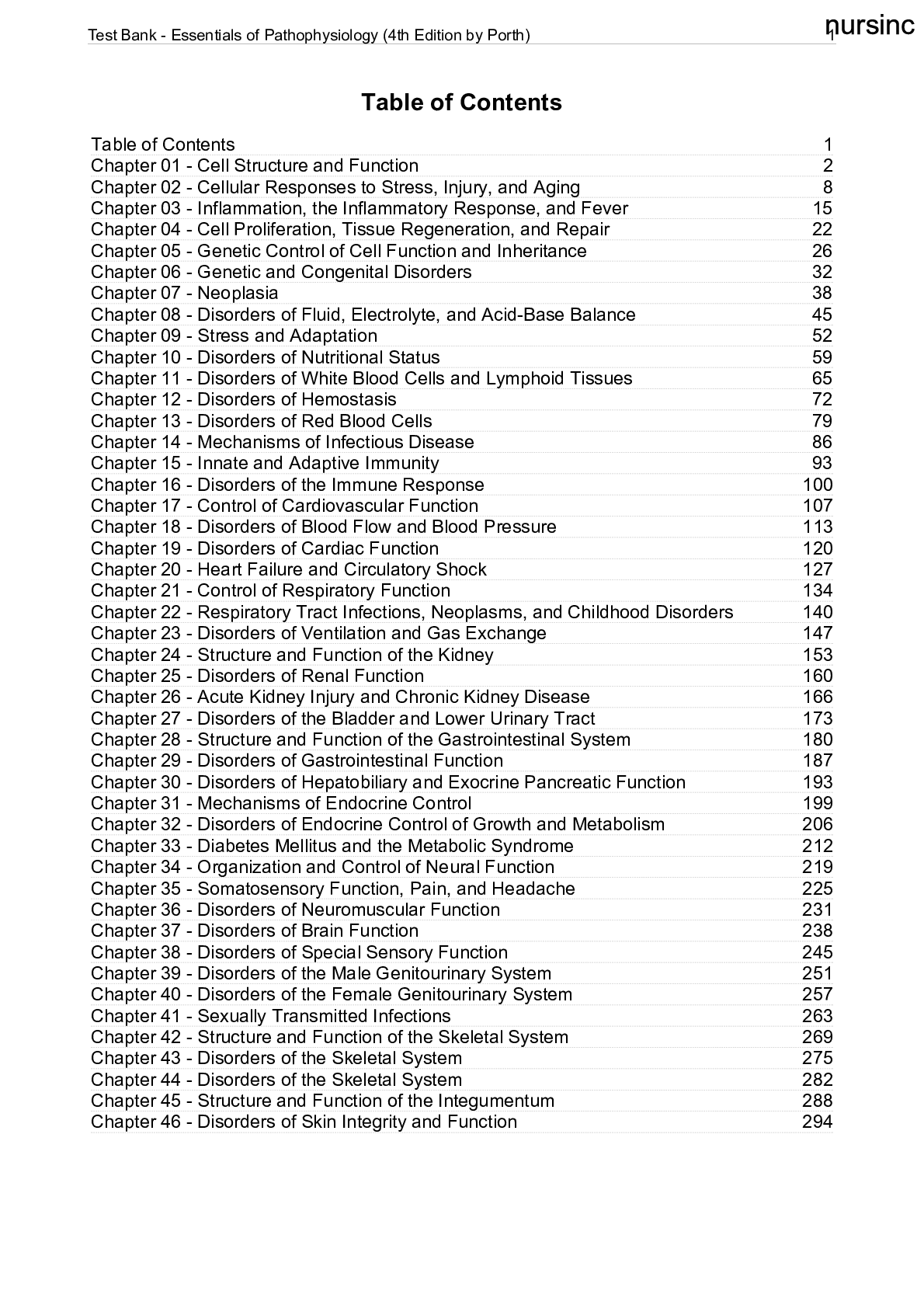
Chapter 01 - Cell Structure and Function
1. The nucleus , which is essential for function and survival of the cell.
A) is the site of protein synthesis
B) contains the genetic code
C) transforms cellular en
...
Chapter 01 - Cell Structure and Function
1. The nucleus , which is essential for function and survival of the cell.
A) is the site of protein synthesis
B) contains the genetic code
C) transforms cellular energy
D) initiates aerobic metabolism
2. Although energy is not made in mitochondria, they are known as the power plants of the cell because they:
A) contain RNA for protein synthesis.
B) utilize glycolysis for oxidative energy.
C) extract energy from organic compounds.
D) store calcium bonds for muscle contractions.
3. Although the basic structure of the cell plasma membrane is formed by a lipid bilayer, most of the specific membrane functions are carried out by:
A) bound and transmembrane proteins.
B) complex, long carbohydrate chains.
C) surface antigens and hormone receptors.
D) a gating system of selective ion channels.
4. To effectively relay signals, cell-to-cell communication utilizes chemical messenger systems that:
A) displace surface receptor proteins.
B) accumulate within cell gap junctions.
C) bind to contractile microfilaments.
D) release secretions into extracellular fluid.
5. Aerobic metabolism, also known as oxidative metabolism, provides energy by:
A) removing the phosphate bonds from ATP.
B) combining hydrogen and oxygen to form water.
C) activating pyruvate stored in the cytoplasm.
D) breaking down glucose to form lactic acid.
6. Exocytosis, the reverse of endocytosis, is important in into the extracellular fluid.
A) Engulfing and ingesting fluid and proteins for transport
B) Killing, degrading, and dissolving harmful microorganisms
C) Removing cellular debris and releasing synthesized substances
D) Destruction of particles by lysosomal enzymes for secretion
7. The process responsible for generating and conducting membrane potentials is:
A) diffusion of current-carrying ions.
B) millivoltage of electrical potential.
C) polarization of charged particles.
D) ion channel neurotransmission.
8. Epithelial tissues are classified according to the shape of the cells and the number of layers. Which of the following is a correctly matched description and type of epithelial tissue?
A) Simple epithelium: cells in contact with intercellular matrix; some do not extend to surface
B) Stratified epithelium: single layer of cells; all cells rest on basement membrane
C) Glandular epithelium: arise from surface epithelia and underlying connective tissue
D) Pseudostratified epithelium: multiple layers of cells; deepest layer rests on basement membrane
9. Connective tissue contains fibroblasts that are responsible for:
A) providing a fibrous framework for capillaries.
B) synthesis of collagen, elastin, and reticular fibers.
C) forming tendons and the fascia that covers muscles.
D) filling spaces between tissues to keep organs in place.
10. Although all muscle tissue cells have some similarities, smooth muscle (also known as involuntary muscle) differs by:
A) having dense bodies attached to actin filaments.
B) containing sarcomeres between Z lines and M bands.
C) having rapid contractions and abundant cross-striations.
D) contracting in response to increased intracellular calcium.
11. Which of the following aspects of the function of the nucleus is performed by ribosomal RNA (rRNA)?
A) Copying and carrying DNA instructions for protein synthesis
B) Carrying amino acids to the site of protein synthesis
C) Providing the site where protein synthesis occurs
D) Regulating and controlling protein synthesis
12. Breakdown and removal of foreign substances and worn-out cell parts are performed by which of the following organelles?
A) Lysosomes
B) Golgi apparatus
C) Ribosomes
D) Endoplasmic reticulum (ER)
13. Impairment in the function of peroxisomes would result in:
A) inadequate sites for protein synthesis.
B) an inability to transport cellular products across the cell membrane.
C) insufficient energy production within a cell.
D) accumulation of free radicals in the cytoplasm.
14. After several months of trying to conceive, a couple is undergoing fertility testing. Semen analysis indicates that the man’s sperm have decreased motility, a finding that is thought to underlie the couple’s inability to become pregnant. Which of the following cellular components may be defective within the man’s sperm?
A) Ribosomes
B) Microtubules
C) Mitochondria
D) Microfilaments
15. Which of the following statements is true of glycolysis?
A) Glycolysis requires oxygen.
B) Glycolysis occurs in cells without mitochondria.
C) Glycolysis provides the majority of the body’s energy needs.
D) Glycolysis produces energy, water, and carbon dioxide.
16. Which of the following membrane transport mechanisms requires the greatest amount of energy?
A) Facilitated diffusion
B) Passive transport
C) Vesicular transport
D) Simple diffusion
17. A male patient with a diagnosis of type 1 diabetes mellitus is experiencing hyperglycemia because he lacks sufficient insulin to increase the availability of glucose transporters in his cell membranes. Consequently, his cells lack intracellular glucose and it accumulates in his blood. Which of the
following processes would best allow glucose to cross his cell membranes?
A) Facilitated diffusion
B) Simple diffusion
C) Secondary active transport
D) Endocytosis
18. Which of the following statements is true of skeletal muscle cells?
A) Skeletal muscle cells each have an apical, lateral, and basal surface.
B) They are closely apposed and are joined by cell-to-cell adhesion molecules.
C) Their basal surface is attached to a basement membrane.
D) Skeletal muscle is multinucleated, lacking true cell boundaries.
19. Which of the following body tissues exhibits the highest rate of turnover and renewal?
A) The squamous epithelial cells of the skin
B) The connective tissue supporting blood vessels
C) The skeletal muscle that facilitates movement
D) The nervous tissue that constitutes the central nervous system
20. A patient with a pathophysiologic condition that affects the desmosomes is most likely to exhibit:
A) impaired contraction of skeletal and smooth muscle.
B) weakness of the collagen and elastin fibers in the extracellular space.
C) impaired communication between neurons and effector organs.
D) separation at the junctions between epithelial cells.
Chapter 03 - Inflammation, the Inflammatory Response, and Fever
1. The characteristic, localized cardinal signs of acute inflammation include:
A) fever.
B) fatigue.
C) redness.
D) granuloma.
2. The vascular, hemodynamic stage of acute inflammation is initiated by momentary vasoconstriction followed by vasodilation that causes localized:
A) bleeding.
B) congestion.
C) pale skin.
D) coolness.
3. The cellular stage of acute inflammation is marked by the movement of leukocytes into the area. Which of the following cells arrives early in great numbers?
A) Basophils
B) Lymphocytes
C) Neutrophils
D) Platelets
4. The phagocytosis process involves three distinct steps. What is the initial step in the process?
A) Engulfment
B) Intracellular killing
C) Antigen margination
D) Recognition and adherence
5. Which of the following mediators of inflammation causes increased capillary permeability and pain?
A) Serotonin
B) Histamine
C) Bradykinin
D) Nitric oxide
6. Inflammatory exudates are a combination of several types. Which of the following exudates is composed of enmeshed necrotic cells?
A) Serous
B) Fibrinous
C) Suppurative
D) Membranous
7. The acute-phase systemic response usually begins within hours of the onset of inflammation and includes:
A) fever and lethargy.
B) decreased C-reactive protein.
C) positive nitrogen balance.
D) low erythrocyte sedimentation rate.
8. In contrast to acute inflammation, chronic inflammation is characterized by which of the following phenomena?
A) Profuse fibrinous exudation
B) A shift to the left of granulocytes
C) Metabolic and respiratory alkalosis
D) Lymphocytosis and activated macrophages
9. Exogenous pyrogens (interleukin-1) and the presence of bacteria in the blood lead to the release of endogenous pyrogens that:
A) stabilize thermal control in the brain.
B) produce leukocytosis and anorexia.
C) block viral replication in cells.
D) inhibit prostaglandin release.
10. An older adult patient has just sheared the skin on her elbow while attempted to boost herself up in bed, an event that has precipitated acute inflammation in the region surrounding the wound. Which of the following events will occur during the vascular stage of the patient’s inflammation?
A) Outpouring of exudate into interstitial spaces
B) Chemotaxis
C) Accumulation of leukocytes along the epithelium
D) Phagocytosis of cellular debris
11. Which of the following individuals most likely has the highest risk of experiencing chronic inflammation?
A) A patient who has recently been diagnosed with type 2 diabetes
B) A patient who is a carrier of an antibiotic-resistant organism
C) A patient who is taking oral antibiotics for an upper respiratory infection
D) A patient who is morbidly obese and who has a sedentary lifestyle
12. Which of the following core body temperatures is within normal range?
A) 35.9°C (96.6°F)
B) 38.0°C (100.4°F)
C) 35.5°C (95.9°F)
D) 37.3°C (99.1°F)
13. A postsurgical patient who is recovering in the postanesthetic recovery unit states that she is freezing cold. Which of the following measures is likely to be initiated in the patient’s hypothalamus in an effort to reduce heat loss?
A) Opening of arteriovenous (AV) shunts
B) Reduced exhalation of warmed air
C) Contraction of pilomotor muscles
D) Decreased urine production
14. An elderly patient is dressed only in a hospital gown and complains of a draft in her room. Consequently, she has requested a warm blanket while she sits in her wheelchair. Which of the following mechanisms of heat loss is most likely the primary cause of her request?
A) Evaporation and conduction
B) Radiation and convection
C) Conduction and convection
D) Convection and evaporation
15. Which of the following pathophysiologic processes are capable of inducing the production of pyrogens? Select all that apply.
A) Acute inflammation
B) Obesity
C) Myocardial infarction
D) Malignancy
E) Renal failure
16. Which of the following patients is most likely to be susceptible to developing a neurogenic fever?
A) A patient who has stage II Alzheimer disease
B) A patient who has sustained a head injury in a bicycle crash
C) A patient who has become delirious after the administration of a benzodiazepine
D) A patient who has begun taking a selective serotonin-reuptake inhibitor (SSRI) for the treatment of depression
17. Patients are commonly administered antipyretics when their oral temperature exceeds 37.5°C (99.5°F). Which of the following statements related to the rationale for this action is most accurate?
A) Temperatures in excess of 37.5°C (99.5°F) can result in seizure activity.
B) Lower temperatures inhibit the protein synthesis of bacteria.
C) There is little empirical evidence for this treatment modality.
D) Most common antipyretics have been shown to have little effect on core temperature.
18. A patient has sought care because of recent malaise and high fever. Upon assessment, the patient states that his current fever began two days earlier, although he states that for the last 2 weeks he is in a cycle of high fever for a couple of days followed by a day or two of normal temperature. Which of the following fever patterns is this patient experiencing?
A) Recurrent fever
B) Remittent fever
C) Sustained fever
D) Intermittent fever
19. A febrile, 3-week-old infant has been brought to the emergency department by his parents and is currently undergoing a diagnostic workup to determine the cause of his fever. Which of the following statements best conveys the rationale for this careful examination?
A) The immature hypothalamus is unable to perform normal thermoregulation.
B) Infants are susceptible to serious infections because of their decreased immune function.
C) Commonly used antipyretics often have no effect on the core temperature of infants.
D) Fever in neonates is often evidence of a congenital disorder rather than an infection.
20. An 84-year-old patient’s blood cultures have come back positive, despite the fact that his oral temperature has remained within normal range. Which of the following phenomena underlies the alterations in fever response that occur in the elderly?
A) Disturbance in the functioning of the thermoregulatory center
B) Increased heat loss by evaporation
C) The presence of comorbidities that are associated with lowered core temperature
D) Persistent closure of arteriovenous shunts
[Show More]







.png)
.png)