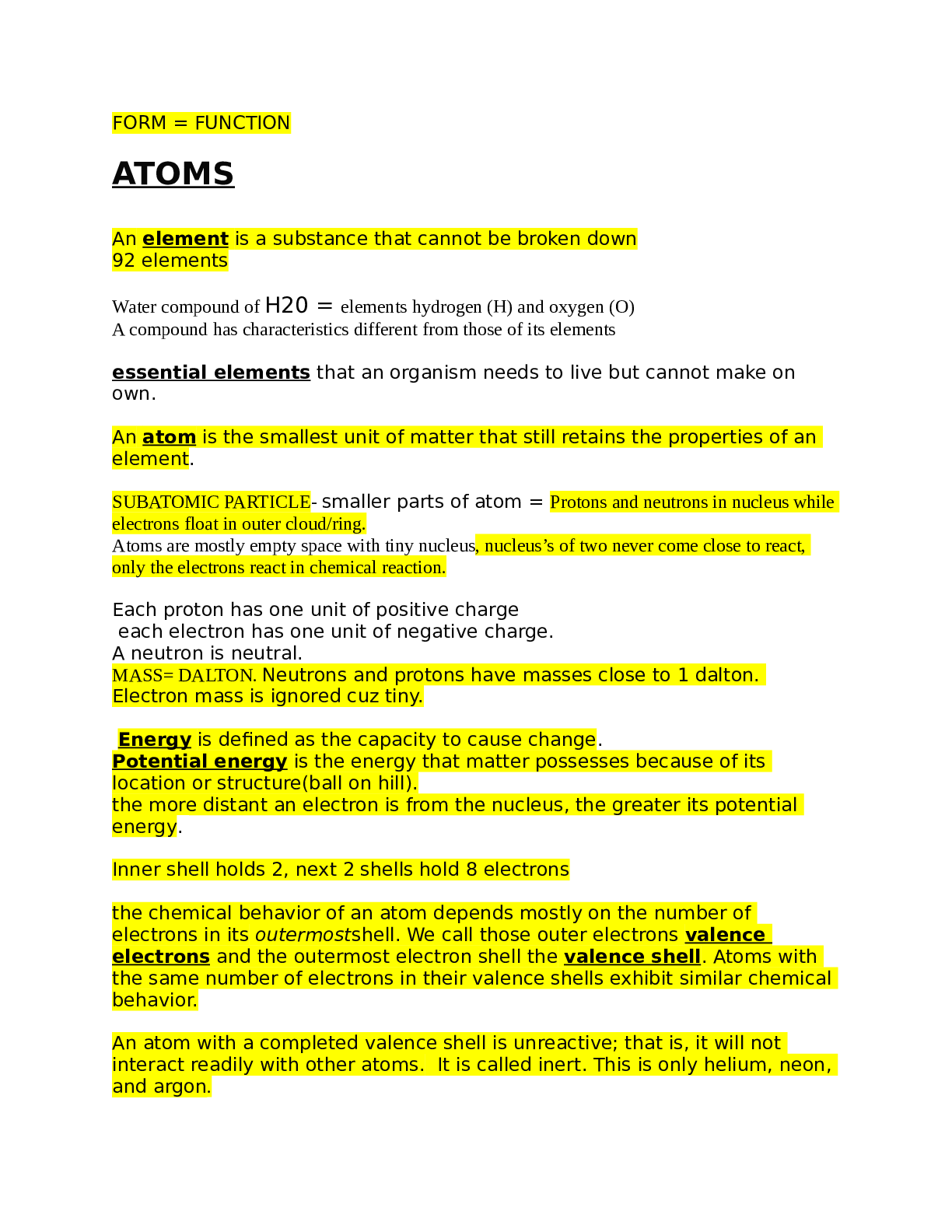
FORM = FUNCTION
ATOMS
An element is a substance that cannot be broken down
92 elements
Water compound of H20 = elements hydrogen (H) and oxygen (O)
A compound has characteristics different from those of its elements
...
FORM = FUNCTION
ATOMS
An element is a substance that cannot be broken down
92 elements
Water compound of H20 = elements hydrogen (H) and oxygen (O)
A compound has characteristics different from those of its elements
essential elements that an organism needs to live but cannot make on
own.
An atom is the smallest unit of matter that still retains the properties of an
element.
SUBATOMIC PARTICLE- smaller parts of atom = Protons and neutrons in nucleus while
electrons float in outer cloud/ring.
Atoms are mostly empty space with tiny nucleus, nucleus’s of two never come close to react,
only the electrons react in chemical reaction.
Each proton has one unit of positive charge
each electron has one unit of negative charge.
A neutron is neutral.
MASS= DALTON. Neutrons and protons have masses close to 1 dalton.
Electron mass is ignored cuz tiny.
Energy is defined as the capacity to cause change.
Potential energy is the energy that matter possesses because of its
location or structure(ball on hill).
the more distant an electron is from the nucleus, the greater its potential
energy.
Inner shell holds 2, next 2 shells hold 8 electrons
the chemical behavior of an atom depends mostly on the number of
electrons in its outermostshell. We call those outer electrons valence
electrons and the outermost electron shell the valence shell. Atoms with
the same number of electrons in their valence shells exhibit similar chemical
behavior.
An atom with a completed valence shell is unreactive; that is, it will not
interact readily with other atoms. It is called inert. This is only helium, neon,
and argon.AMINO ACIDS / PROTEINS
Ionic bond- between positive and negation ions when attracted to each other.
Covalent bond - bonds occur when atoms share electrons
Hydrogen bond- portion of a polar molecule that is partially positive interacts
with a portion of a polar molecule that is partially negative. Broken by ph and
salt.
Van der Waals cond- interactions occur due to random, weak, transient
movements of electrons
** amino acids form polypeptides with fold to make functional
proteins.
**bond between amino acids is called a peptide bond, so a polymer of amino
acids is called a polypeptide.
**Protein = one or more polypeptide each folded and coiled into a specific three-dimensional structure
AMINO ACIDS – . 20 different amino acids in your body used to make
proteins.
ONLY ACTIVE PROTEIN WHEN IT FOLDS.
Can be roughly spherical (globular proteins) or long fibers (fibrous proteins)
1. Hydrophilic (polar)= oxygen or nitrogen, or both. Can be positive
(basic) or negative(acidic)
End in o-h, n-h, or sh.
Have hydrogen bond, can be broken by ph or salt. SH endings are disulfide bonds
broken by reducing agent.
2. Hydrophobic (nonpolar)- end in CH, disrupted by heat. Weakest interaction.
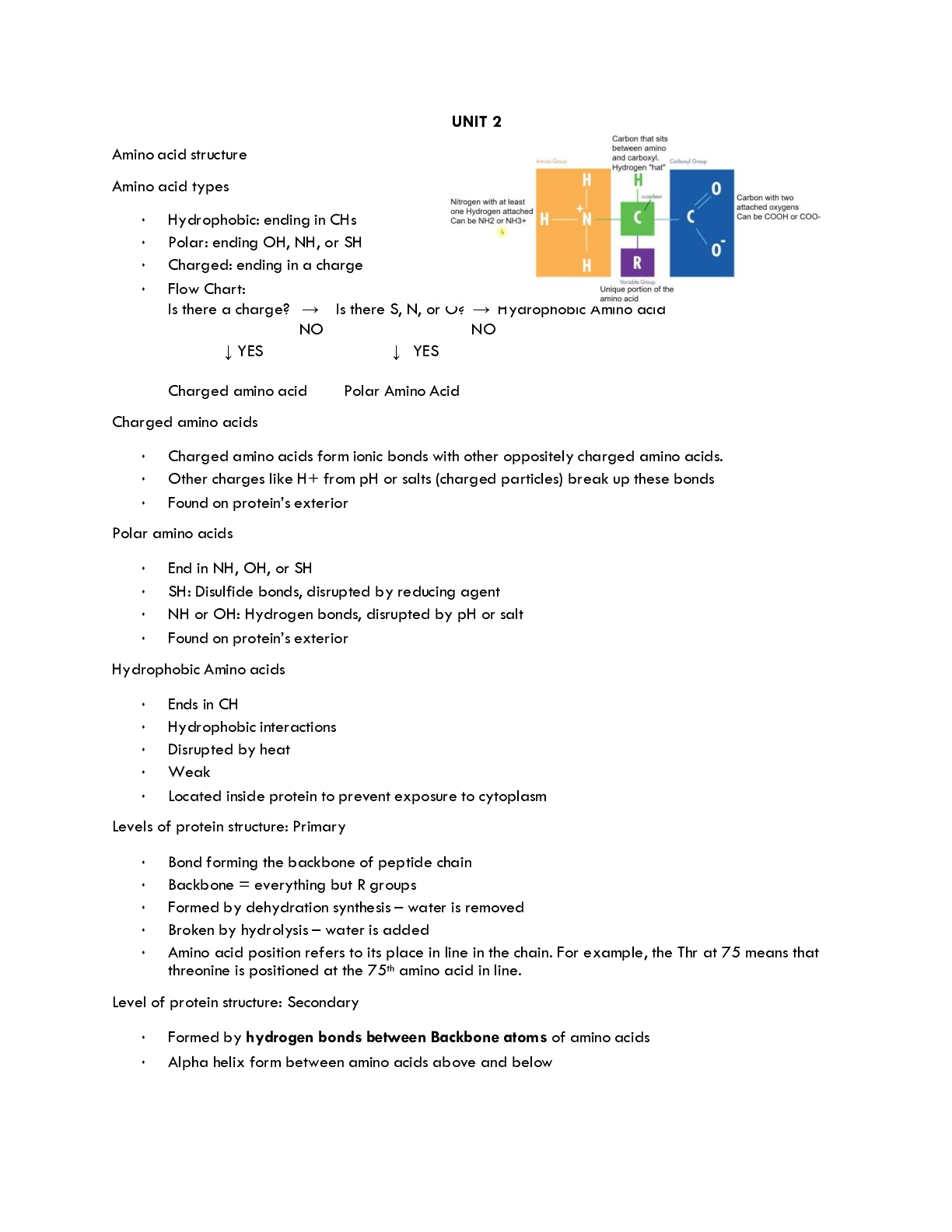
AMINO ACID STRUCTURE
1. alpha Carbon
2. Amino group – nitrogen with a hydrogen
3. Carboxyl group- carbon with 2x oxygen
4. Variable group- side chain (not apart of backbone
[Show More]