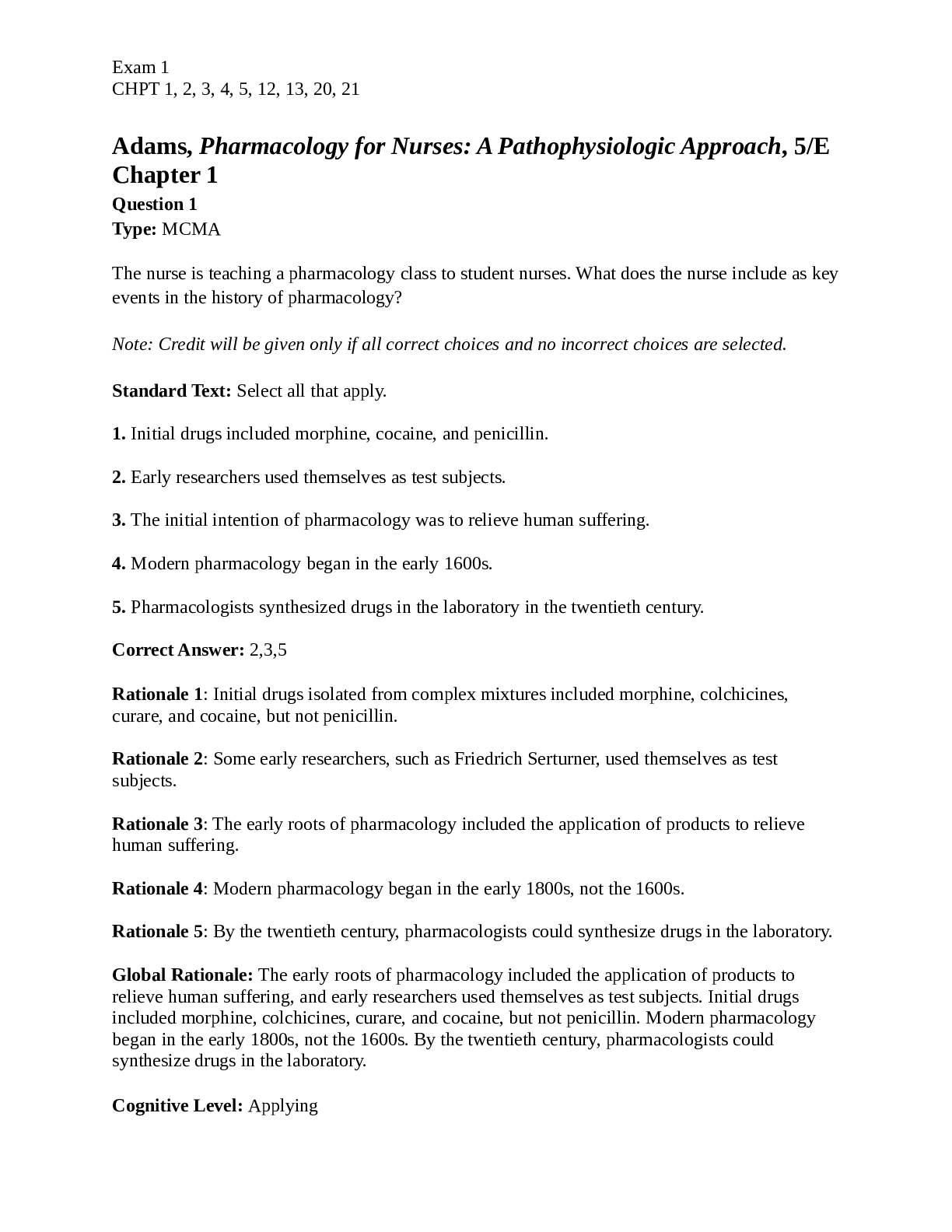
Question 1
Type: MCMA
The nurse is teaching a pharmacology class to student nurses. What does the nurse include as key events in the history of pharmacology?
Note: Credit will be given only if all correct choices
...
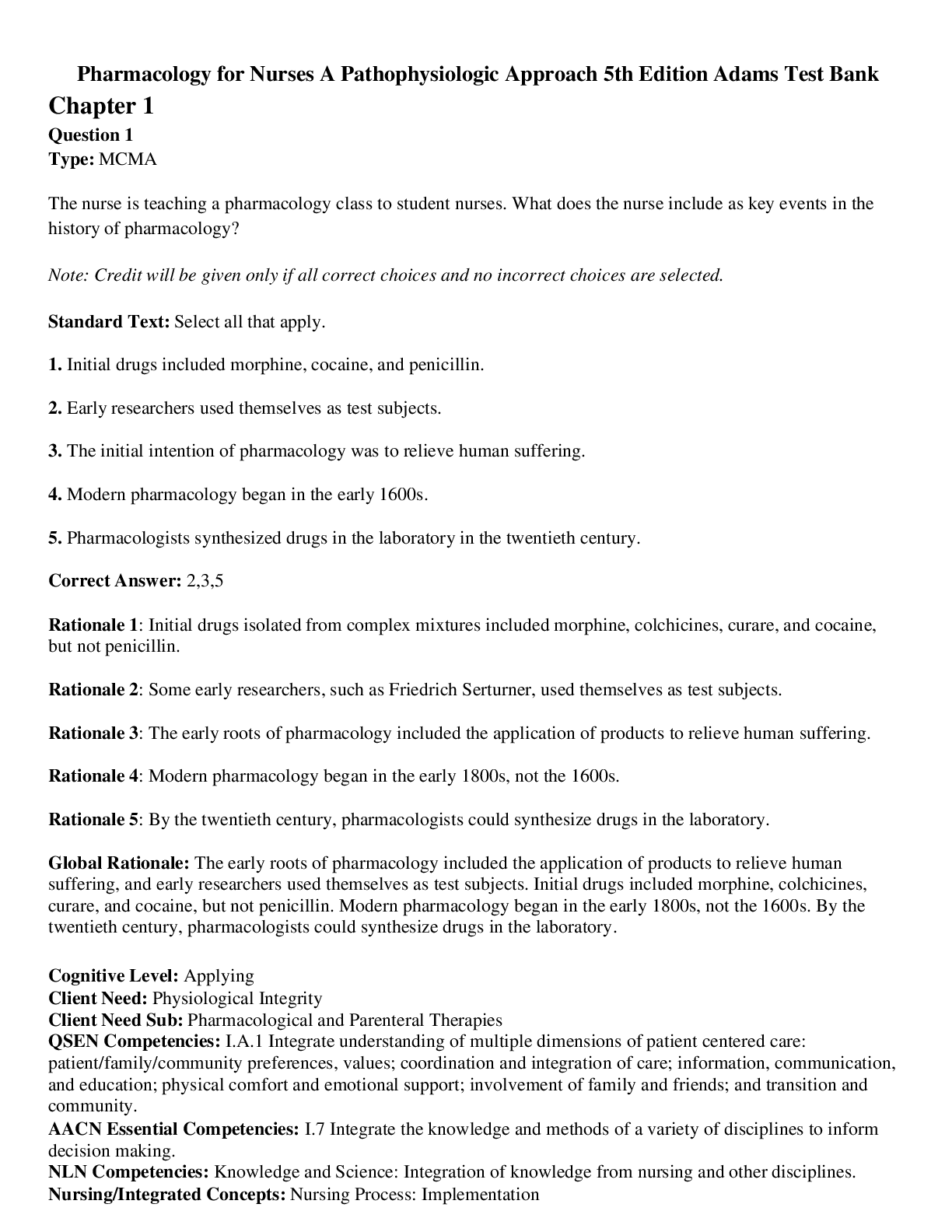
Question 1
Type: MCMA
The nurse is teaching a pharmacology class to student nurses. What does the nurse include as key events in the history of pharmacology?
Note: Credit will be given only if all correct choices and no incorrect choices are selected.
Standard Text: Select all that apply.
1. Initial drugs included morphine, cocaine, and penicillin.
2. Early researchers used themselves as test subjects.
3. The initial intention of pharmacology was to relieve human suffering.
4. Modern pharmacology began in the early 1600s.
5. Pharmacologists synthesized drugs in the laboratory in the twentieth century.
Question 2 Type: MCSA
The student nurse asks the nursing instructor why he needs to take anatomy and physiology, as well as microbiology, when he only wants to learn about pharmacology. What is the best response by the instructor?
1. "Because pharmacology is an outgrowth of those subjects."
2. "You must learn all, since those subjects, as well as pharmacology, are part of the curriculum."
3. "Knowledge of all those subjects will prepare you to provide the best patient care, including the administration of medications."
4. "Because an understanding of those subjects is essential to understanding pharmacology."
Question 3 Type: MCMA
The nursing instructor is teaching a pharmacology class to student nurses. The current focus is pharmacology and therapeutics. The nursing instructor determines that learning has occurred when the students make which comments?
Note: Credit will be given only if all correct choices and no incorrect choices are selected.
Standard Text: Select all that apply.
1. "Pharmacology is the development of medicines."
2. "Pharmacology is the study of medicines."
3. "Therapeutics relates to drug use to treat suffering."
4. "Therapeutics is the study of drug interactions."
5. "Pharmacology is the study of drugs to prevent disease."
Question 4 Type: MCSA
The nurse administers a vaccine to a child. What is the best understanding of the nurse as it relates to the manufacture of this vaccine?
1. The vaccine is produced by natural plant extracts in the laboratory.
2. The vaccine is naturally produced in animal cells or microorganisms.
3. The vaccine is produced by a combination of animal and plant products.
4. The vaccine is most commonly synthesized in a laboratory.
Question 5 Type: MCSA
The older adult client has gastrointestinal bleeding. The client says to the nurse, "I don't understand this. All I did was take ibuprofen (Advil) for my arthritis." Which plan would be best as it relates to the nurse's education of this client?
1. A plan to teach the client to use drugs that bypass the gastrointestinal system, like topical drugs
2. A plan to teach the client to substitute safer drugs like acetaminophen (Tylenol)
3. A plan to teach the client to obtain physician approval prior to the use of over-the-counter
(OTC) medications
4. A plan to teach the advantages and disadvantages of ibuprofen (Advil)
Question 6 Type: MCSA
The nursing instructor teaches the student nurses about the pharmacological classification of drugs. The instructor evaluates that learning has occurred when the students make which response?
1. "An anti-anginal treats angina."
2. "A calcium channel blocker blocks heart calcium channels."
3. "An antihypertensive lowers blood pressure."
4. "An anticoagulant influences blood clotting."
Question 7 Type: MCSA
The nurse is providing medication education to a client with hypertension. The nurse teaches the client that the physician ordered a diuretic to decrease the amount of fluid in the client’s body. Which statement best describes the nurse's instruction?
1. The nurse provided appropriate medication education.
2. The nurse explained the drug's mechanism of action.
3. The nurse taught the client about a prototype drug.
4. The nurse explained the consequences of not using the drug.
Question 8 Type: MCSA
During pharmacology class, the student nurse asks the nursing instructor how students will ever learn about the individual antibiotic drugs since there are so many. What is the best response by the nursing instructor?
1. "You will learn a little trick called mnemonics."
2. "You will learn how to do a flow chart to enhance memory."
3. "You will learn how to categorize the individual drugs."
4. "You will learn a representative drug from each class."
Question 9 Type: MCSA
The physician ordered a brand name drug for the client, paroxetine (Paxil). After taking this medication for a year, the client tells the nurse that it is no longer working. What is the best assessment of the nurse at this time?
1. "This sounds like your medication needs changing."
2. "Let's look for interactions with other medications you are taking."
3. "Are you taking Paxil or paroxetine?"
4. "It is time for us to do the Beck Depression assessment again."
Question 10 Type: MCSA
The student nurse has completed an initial pharmacology course and tells the nursing instructor that it was difficult and she is glad it is over. What is the best response by the nursing instructor?
1. "It may be over, but now you must apply what you have learned to patient care."
2. "Learning is gradual and continuous; we never completely master all areas of pharmacology."
3. "Learning is always painful, but we must continue anyway."
4. "It really isn't over; you should take a graduate course next."
Question 11 Type: MCSA
The client says to the nurse, "My wife and I take the same drug, but we have different side effects. Are we doing something wrong?" What is the best response by the nurse?
1. "No. Differences such as your sex can result in different side effects."
2. "I'll have to check. What is the name of the drug you were using?"
3. "Possibly. This could happen if one uses generic or brand name drugs."
4. "I'm not sure. Maybe the drug is not the same; you should check it."
Question 12 Type: MCSA
The client comes to the emergency department with a myocardial infarction. The client's husband tells the nurse that his wife has been taking calcium carbonate (Tums) for years for what she thought was indigestion. What is the best response by the nurse?
1. "Your wife should not have self-diagnosed herself. I hope she will be okay."
2. "Why did you let her do that? She should have seen a doctor."
3. "Well, I am glad she is here, as it certainly wasn't indigestion."
4. "Your wife was self-diagnosing, which is generally not a good idea."
Question 13 Type: MCSA
The nurse is teaching a class for clients about over-the-counter (OTC) medications. The nurse determines that education has been effective when the clients make which statement?
1. "We should not take any over-the-counter (OTC) medicine without first calling and checking with the doctor's office."
2. "We should always ask the pharmacist about how to take the over-the-counter (OTC) medicine."
3. "We must read all the directions on the label and call the doctor's office if they are not clear."
4. "Medicines that are available over-the-counter (OTC) are really safe, or they would be
prescription medicines."
Question 14 Type: MCSA
The physician has prescribed a brand name drug for the client. The client tells the nurse that the medication is too expensive. What is the best plan by the nurse?
1. Help the client receive free medicine through a "patient assistance" program.
2. Ask the physician if a cheaper brand name drug may be substituted.
3. Ask the physician if a generic drug may be substituted.
4. Maintain the client on samples of the brand name drug from the physician's office.
[Show More]












.png)


