Introduction to Strategic Analysis
Quiz, 12 questions
Question 1
1
point
1. Question 1
An organization's strategy is embodied in its ...
Mission statement
Mission, plan, and actions
Chief executive officer
Decl
...
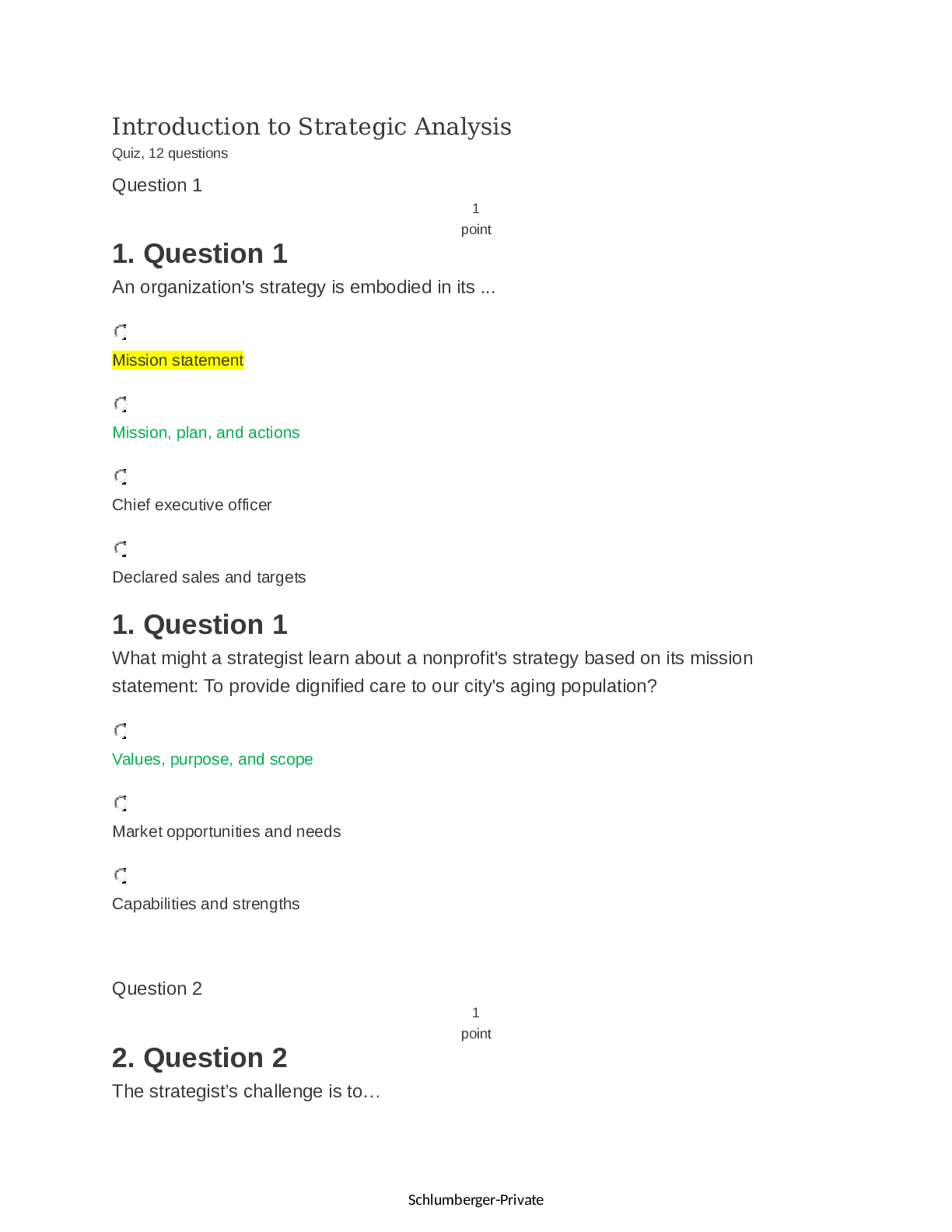
Introduction to Strategic Analysis
Quiz, 12 questions
Question 1
1
point
1. Question 1
An organization's strategy is embodied in its ...
Mission statement
Mission, plan, and actions
Chief executive officer
Declared sales and targets
1. Question 1
What might a strategist learn about a nonprofit's strategy based on its mission
statement: To provide dignified care to our city's aging population?
Values, purpose, and scope
Market opportunities and needs
Capabilities and strengths
Question 2
1
point
2. Question 2
The strategist’s challenge is to…
Schlumberger-Private
Build bridges between operations and outside investors
Balance workload with other commitments
Determine the most effective marketing plan for an organization
Identify valuable competitive positions at the intersection of values, capabilities, and opportunities
2. Question 2
Which of the following best describes a strategist's main challenge?
Understand answers to the three fundamental questions in order to recognize a firm's best
competitive position
Understand the capabilities of firms and industries in order to maximize their future profits
Understand opportunities within an industry to improve a firm's competitive position
Understand a firm's values and how they affect decision-making
Question 3
1
point
3. Question 3
A new firm enters a perfectly competitive market. What impact will this have on average
profits in the industry?
Schlumberger-Private
Economic profits increase industry-wide.
No economic profits are earned.
It earns high economic profits.
Economic profits decrease industry-wide before rising again.
3. Question 3
How might entry impact a perfectly competitive market?
As an industry, prices rise.
Entry increases capacity constraints.
Entry increases both accounting and economic profits.
As an industry, the amount of output increases.
Question 4
1
point
4. Question 4
In a perfectly competitive market, economic profits…
Schlumberger-Private
Are competed away as new entrants imitate incumbent firms
Will increase as firms learn about customer preferences
Are a byproduct of low cost, efficient production processes
May persist for long periods
4. Question 4
Imagine several potato farmers operate in a competitive market. Farmer Jane decides
to enter the market, shifting her 500 acre farm from corn to potatoes. What impact will
her entry have on the profitability of the potato market?
The profitability of the potato market will decrease.
The profitability of the potato market will increase.
The profitability of the potato market will remain the same.
Question 5
1
point
5. Question 5
Which of the following cases BEST illustrates the generation of rents/economic profits?
A firm has the greatest market share in its industry
A firm has higher returns than an investment of similar risk
A firm’s revenues exceed its costs
Schlumberger-Private
A firm has higher returns than an established, less risky competitor
5. Question 5
Economic profits--or rents--are present when...
A firm has higher returns than an established, less risky competitor
A firm has the greatest market share in its industry
A firm has higher returns compared to an investment of similar risk
A firm’s revenues exceed its costs
Question 6
1
point
6. Question 6
What type of profits are earned by a firm whose return on equity is higher than its
opportunity cost of capital?
The firm earns neither positive economic profits nor positive accounting profits.
The firm earns positive economic profits but not positive accounting profits.
The firm earns positive accounting profits but not positive economic profits.
The firm earns both positive accounting profits and positive economic profits.
6. Question 6
Schlumberger-Private
Why do strategy analysts care about economic profits and not just accounting profits?
Economic profits reflect the opportunity cost of deploying capital.
Economic profits are the same as accounting profits.
Economic profits reveal a firm's market share.
Economic profits calculate a firm's profits after operating costs.
Question 7
1
point
7. Question 7
Which of the following best describes who conducts a strategic analysis?
Strategic analysts could be a wide variety of individuals within or associated with a firm as well as
secondary stakeholders.
Most strategic analyses are conducted by business unit general managers, such as a manager
reviewing a marketing plan.
Strategic analyses are conducted by a range of primary stakeholders.
Strategic analyses are performed within a company by leadership and other employees.
7. Question 7
Why might a CEO, a consultant, or an investor conduct a strategic analysis?
To assess an organization's current competitive position
Schlumberger-Private
To choose a single method of analyzing data
To determine future profitability
To better understand and make decisions about an industry
Question 8
1
point
8. Question 8
In the real world...
Profits are consistent over time
Businesses rarely have a competitive advantage.
Product markets are perfectly competitive.
Average industry returns vary even after controlling for risk.
Question 9
1
point
9. Question 9
When is a firm more likely to earn higher profits?
There are barriers to entry or imitation
Another firm holds a patent to a unique process or product
Schlumberger-Private
The firm's key resources and capabilities are easily imitated
A firm and its rivals produces similarly designed products as that of a rival firm
Question 10
1
point
10. Question 10
Would you complete a SWOT, competitor or environmental analysis to understand at
the broadest level a firm's internal capabilities and its external competitive environment?
Competitor analysis
Environmental analysis
SWOT analysis
Question 11
1
point
11. Question 11
A pharmaceutical company is issued a patent on a powerful new arthritis medication.
What impact might that patent have on its profitability in the pharmaceutical industry?
A patent makes it less likely the firm will earn a profit.
A patent likely will have little impact on the firm's profitability.
A patent makes it more likely the firm will earn a profit.
Question 12
1
point
Schlumberger-Private
12. Question 12
How might an analyst use the environmental analysis tool?
To understand the broad societal forces that impact a firm
To understand and evaluate current or potential competitors
To understand a firm's competitive strengths
To test a strategic position
I, Arijit Paul, understand that submitting work that isn’t my own may result in permanent failure of
this course or deactivation of my Coursera account.
Schlumberger-Private
Analyzing Industry Structure
Quiz, 12 questions
Question 1
1
point
1. Question 1
Which of the following is a deterrent to entry into an industry?
Incumbent firms are not aggressive
The absence of learning curves in the industry
Minimum efficient scale is relatively unimportant
Excess capacity within the industry
1. Question 1
A firm with a large customer base relocates its order processing facility to take
advantage of local pro-industry tax rates and sees increased profits as a result.
Which of the five forces most threatens this company's competitive position?
The bargaining power of buyers, since this company's large customer base gives consumers
greater bargaining power
Threat of entry, since there are no barriers to keep other firms who wish to enter the industry
from locating in the same area and sharing the same tax advantage
The bargaining power of suppliers, since right now only one firm has a production advantage
(although that will diminish when other firms relocate)
Schlumberger-Private
The threat of substitutes, since firms can choose from among a variety of producers in the
industry
Question 2
1
point
2. Question 2
In which scenario is the threat of entry greatest?
A firm holds a patent on a healthy and delicious no-cal ice cream.
A firm is first out with gourmet, organic ice cream--and it's making great returns!
A firm secures contracts with several national grocery store chains to be the sole producer of their
store-brand ice cream.
Customers are loyal to a firm's brand of indulgent ice cream and are willing to pay a premium for it.
Question 3
1
point
3. Question 3
When are firms more likely to earn profits?
When one very large firm dominates the market
They are able to segment buyers on their willingness to pay for a good.
When they engage in price wars.
Schlumberger-Private
When their customers can easily switch to another brand.
3. Question 3
A customer purchasing a mobile phone for personal use has ________ buying
power than when purchasing mobile phones for __________.
more, their family
Less, a large team at a Fortune 500 company
More, a sales team at a Fortune 500 company
Question 4
1
point
4. Question 4
Which of the following is likely to lead to weaker bargaining power for buyers?
Buyers are concentrated
Buyers may backward integrate
Buyers face low switching costs
Buyers are unaware of the prices fellow buyers are paying
Question 5
1
point
Schlumberger-Private
5. Question 5
Imagine you run a higher-end, fast food chain that emphasizes freshness. You rely on
various suppliers for everything from paper goods to food products. These same
producers sell to other fast food chains and markets. For some items, such as paper
goods and dry goods, you have several supplier options. For other items, such as
ketchup and soda, getting the name brand matters to your customers. For still others,
such as organic produce and meats, you rely on a few select suppliers. What might an
analysis of the power of suppliers reveal?
The power of your suppliers is relatively high overall, since there are so many of them. You need to
consolidate to one vendor who can supply all your needs, since that will enhance your bargaining
position.
The power of your suppliers is relatively high in some key areas and relatively low in others. You
might wish to explore alternatives for your organic produce and meats to ensure a more diverse
supply.
The power of your suppliers is relatively low overall, since you work with a diversity of vendors and
can pick among them based on a balance of price and quality. Since organic produce and meats are
a part of your brand, you need to stick with those suppliers.
Question 6
1
point
6. Question 6
Gasoline prices fluctuate significantly over time, but these price changes have little
effect on car travel. This indicates that demand is _____ and the threat of substitutes is
_____.
Inelastic, low
Elastic, low
Elastic, high
Schlumberger-Private
Inelastic, high
Question 7
1
point
7. Question 7
Levi's jeans once dominated the denim market, but the company has increasingly lost
market share to smaller companies who have gone after its consumers. Which factor
most likely contributed to the intensity of this industry rivalry?
Customers can't easily switch from one brand of jeans to another.
There aren't very many ways to differentiate jeans.
The denim market is vibrant and growing.
Fixed production costs in manufacturing jeans are relatively low.
All else being equal, which of the following is likely to lead to less intense rivalry
in an industry?
High degree of product differentiation
Many competitors
Heterogeneous yet similarly sized competitors
High exit barriers
Schlumberger-Private
Question 8
1
point
8. Question 8
Why does a large number of competitors reduce industry profits?
The threat of retaliation against entrants is higher.
Each firm will compete for market share based on price.
Customers are more likely to switch to a substitute product.
Incumbent firms are more likely to benefit from economies of scale.
. Question 8
Earthbound Farm dominates the growing organic produce market in the United
States, selling nationally at markets such as Costco and Whole Foods. As an
analyst, how might you describe their threat of rivalry within the organic
produce market?
Low
Average
High
Question 9
Schlumberger-Private
1
point
9. Question 9
A small town has a thriving restaurant scene, with over a 150 dining establishments.
Seeking to reduce costs, several restaurants join together to negotiate for table linen
supplies and laundering. How might that impact firms in the table linen industry?
Firms have decreased bargaining power, because the service they provide is cyclical (more around
the holidays and during festivals and sporting events) rather than steady.
Firms have decreased bargaining power, since they are negotiating with a larger block of buyers and
competing against each other.
Firms have increased bargaining power relative to the restaurants since they control valuable and
necessary services.
Firms have increased bargaining power, since there are so many of them.
Question 10
1
point
10. Question 10
Why might an analyst complete a five forces analysis?
To increase bargaining power
To understand the profit potential in an industry
To dominate the market
To understand an individual firm's competitive advantage
Question 11
Schlumberger-Private
1
point
11. Question 11
Review question: In the real world...
Profits are consistent over time.
Product markets are perfectly competitive.
Average industry returns vary even after controlling for risk.
Businesses rarely have a competitive advantage.
11. Question 11
Review question: Which of the following describes a perfectly competitive
market?
Knowledge is limited.
Products are varied.
There are few firms competing in an industry.
Barriers to entry and exit a
[Show More]














.png)

.png)


