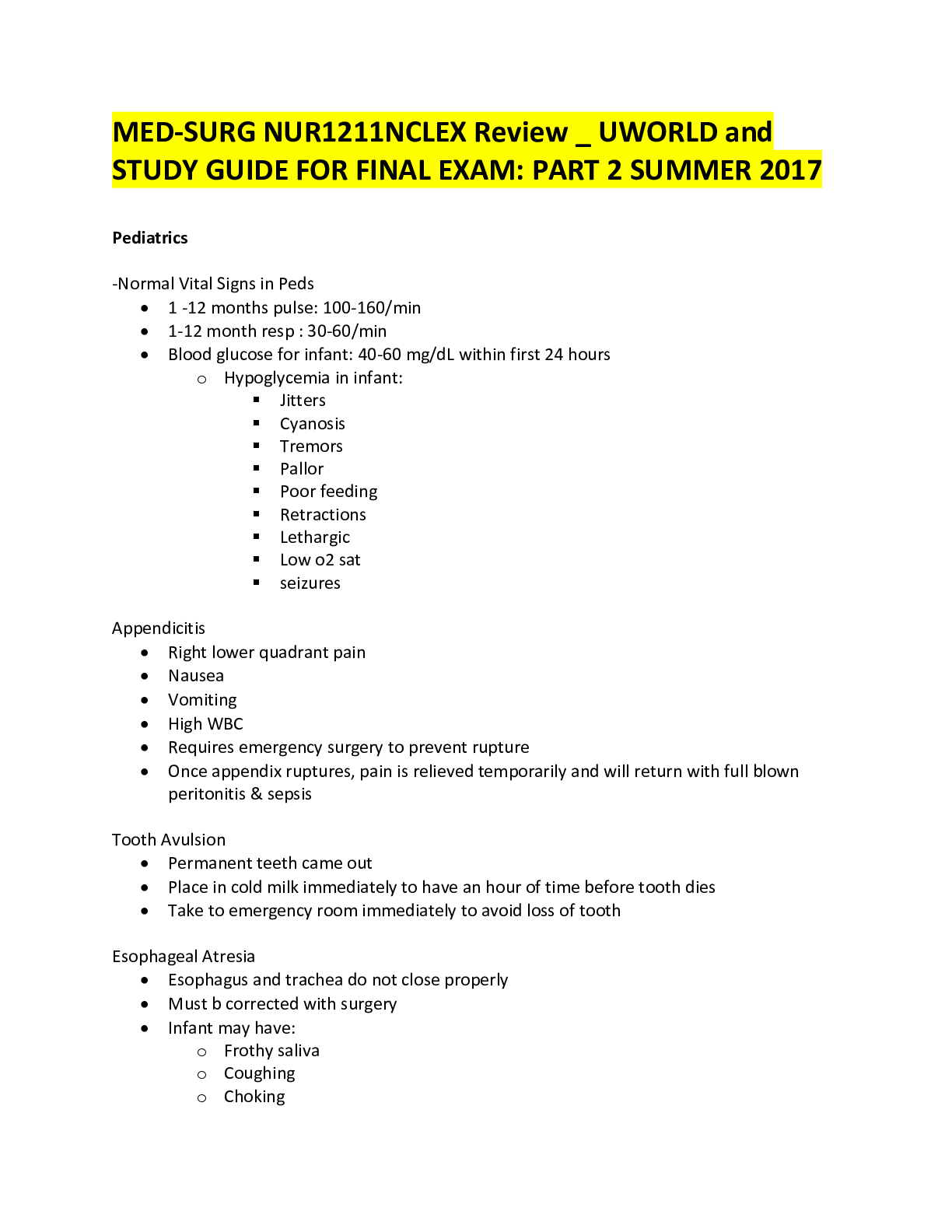
NUR 1211 - NCLEX Review _ UWORLD
Pediatrics
-Normal Vital Signs in Peds
• 1 -12 months pulse: 100-160/min
• 1-12 month resp : 30-60/min
• Blood glucose for infant: 40-60 mg/dL within first 24 hours
o Hypoglycem
...
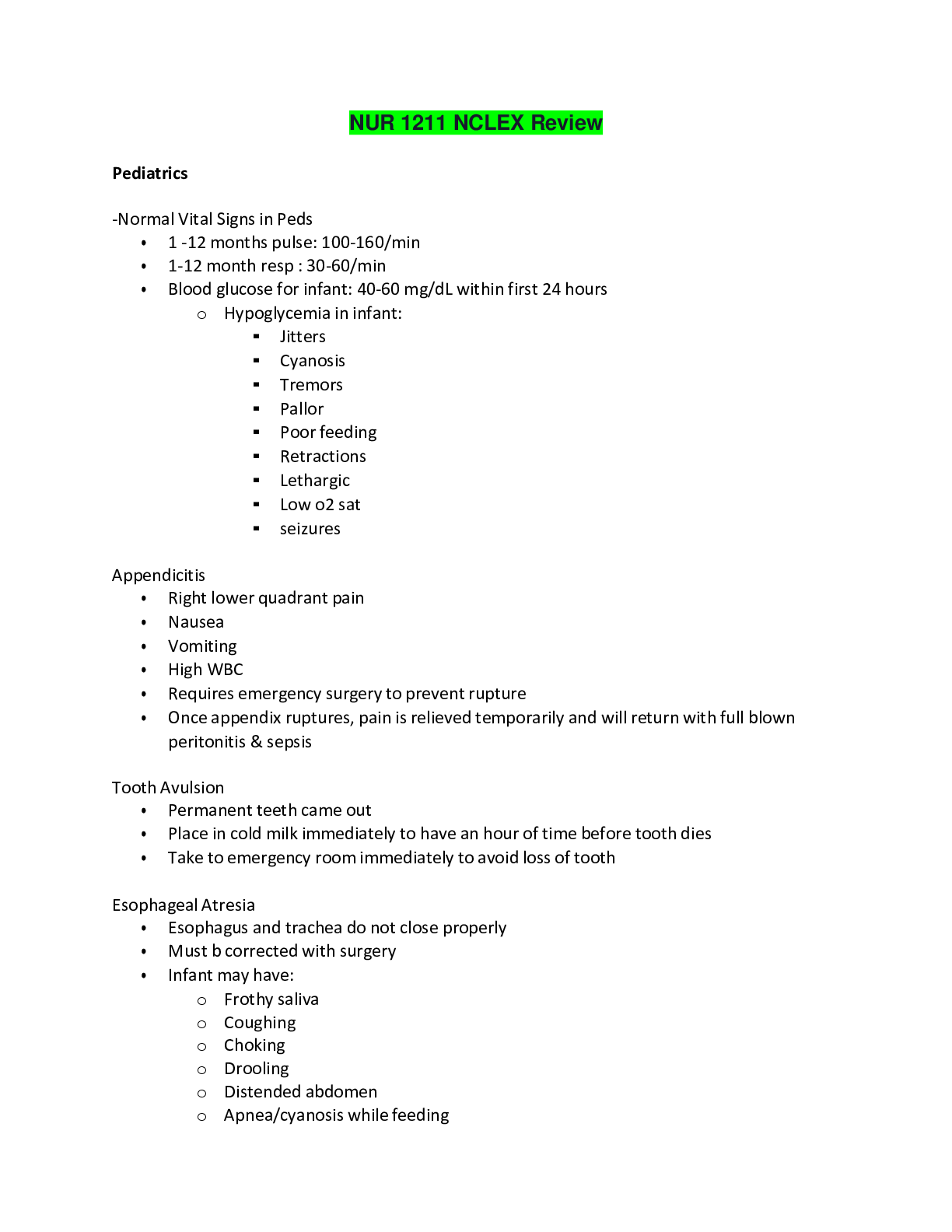
NUR 1211 - NCLEX Review _ UWORLD
Pediatrics
-Normal Vital Signs in Peds
• 1 -12 months pulse: 100-160/min
• 1-12 month resp : 30-60/min
• Blood glucose for infant: 40-60 mg/dL within first 24 hours
o Hypoglycemia in infant:
▪ Jitters
▪ Cyanosis
▪ Tremors
▪ Pallor
▪ Poor feeding
▪ Retractions
▪ Lethargic
▪ Low o2 sat
▪ seizures
Appendicitis
• Right lower quadrant pain
• Nausea
• Vomiting
• High WBC
• Requires emergency surgery to prevent rupture
• Once appendix ruptures, pain is relieved temporarily and will return with full blown peritonitis & sepsis
Tooth Avulsion
• Permanent teeth came out
• Place in cold milk immediately to have an hour of time before tooth dies
• Take to emergency room immediately to avoid loss of tooth
Esophageal Atresia
• Esophagus and trachea do not close properly
• Must b corrected with surgery
• Infant may have:
o Frothy saliva
o Coughing
o Choking
o Drooling
o Distended abdomen
o Apnea/cyanosis while feeding
Hypertrophic Pyloric Stenosis
• Apnea
• Choking
• Cyanosis due to aspiration of fluid while eating
• Projectile vomiting is CLASSIC manifestation
Retinoblastoma
• Tumor in childhood
• Intraocular malignancy occurring in kids less than 2
• Recognized when parents report white glow of pupil while taking photograph
• Absent red reflex
• Strabismus is another common sign
• Visual impairment is late sign indicating advance disease
• Tx:
o Radiation
o Enucleation (removal of eye) & fit for prosthesis
o May be hereditary
Neonatal Abstinence Syndrome
• Born to opioid dependent mother
• Experiences withdrawal 24-48 hrs after birth
• Baby is irritiable, jittery, high pitch cry, sneezes, diarrhea, vomit, poor feeding
• Place baby in side lying position while swaddled to minimize stimulation
• Use pacifier between feedings
• Place in quiet, dim lit part of nursery
• Tx with opioid therapy
Chicken Pox
• Airborne spread of secretions and direct contact of open lesions
• Most contagious 1-2 before rash and after onset but before crusted lesions
• Negative air flow room
• Antihistamine for itchy and acetaminophen for fever…no aspirin!
Strabismus
• Disorder of misalignment of eye from birth defect or acquired weakness
• Crosseyed
• Common treatment is to wear patch over strong eye; surgery may be required if this is not successful
RSV
• Common cause of infection in infants and kids
• Winter time
• Bronchiolar swelling and a lot of mucus
• Rhinorrhea, fever, cough, lethargy irritability, poor feeding
• Severe causing tachypnea, dyspnea, poor air exchange Treatment:
• Supplemental oxygen & suction
• Elevate head of bed to improve breathing and secretion clearance
• Antipyretics for fever and comfort
• IV fluids for dehydration from fever, tachypnea, poor oral intake
• Transmitted via direct contact with respiratory secretions; contact isolation required w/ droplet precautions if 3 ft from client
• Palivizumab is given IM once monthly during winter/ spring to prevent RSV in kids with high risk
CPR in kids
• Kids often develop resp distress & bradycardia before cardiac arrest
• Perform rescue breathing for 2 min
• If pulse still less than 60 with signs of poor perfusion, treat as pulseless; start compressions
• Rescue breaths: 1 breath every 3-5 secs / 12-20 breaths/min
-Intusuception in 6-36 months: one section of bowel telescopes over another blocking passage of intestinal contents, interrupts blood supply, intestinal tears; EMERGENCY
• Inconsolable crying
• Drawing up of legs towards abdomen
• Stools with mucus & blood (currant jelly stools)
• Vomiting
• Peritonitis can occur
o Fever
o Abdominal rigidity
o Guarding
o Rebound tenderness
o Fatal if not treated quickly!!
-Hirschprung disease: kid is born with missing nerve cells in large intestine making anal spincter unable to relax
o Bilious vomit
o Abdominal distension
o Failure to pass meconium within 24-48 hrs
o Tight anal sphincter
o Tx:
o Surgical removal of defective section
o Colostomy
o Complications:
o Enterocolitis sepsis and death; fever, lethargy, explosive, foul smelling diarrhea, worsening abdominal distension
-ADHD inattentive type
o Trouble holding attention; easily distracted
o Provide calm, structured, organized, consistent environment
o Written chart/list of daily activities helps remind child of what to expect
o Helps child organize thoughts
o Core symptoms are:
o Hyperactivity
o Impulsiveness
o Inattention
o Low self esteem & impaired social skills
o Academic or work failure
o Trouble interacting with peers
-Bed bugs
• Can inhabit clean or dirty environments
• Travel and spread in clothing, bags, furniture, bedding
• Itchy red rash
• Must call pest control and exterminate in entire home
• Pets and other family members are at risk of bed bugs
-Pediculosis capitis (head lice)
• Female lice eggs hatch in 7-10 days
• Adult lice can not survive away from host head for >48 hours
• Nits (baby lice) can live away from host on brushes, carpet and hats for up to 10 days
Tx:
• Pediculicide (permethrin 1% cream) with nit comb or by hand for 2-3 days for 2 weeks
• Carpets, rugs, furniture must be vacuumed often to remove lice/nits and bedding should be washed in hot water and dried in hottest dryer setting
• Brush, comb, ornaments soaked in boiling water for 10 min or in lice-killing product for 10 min
• Pets do not transmit lice
Ventriculoperitoneal shunt
• Used to treat hydrocephalus and placed at age 3-4 months
• Blockage and infection are complications
• Blockage results in signs of increased ICP
• Cushings triad can occur (bradycardia, slowed respiration, widened pulse pressure) signs of increased ICP
Developmental dysplasia of the hip (DDH)
• Risk factors include breech birth, large infant size, family history
• Proper swaddle technique: should be swaddled with hips bent up (flexion) and out (abduction)
• Infant car seats with wide basis – hips always abducted; avoiding having feet straight
together
Tetralogy of Fallot
• Cyanotic heart defect
• Will maintain o2 levels of 65%-85% until surgically corrected
• Polycythemia may occur
o Normal hgb in 1 month old is 12.5-20.5
o May occur as compensatory mechanism due to hypoxia
o Place infant at risk for stroke or thromboembolism
• Poor weight gain
Normal Finding in Term newborn
• Many/deep plantar creases; indicates maturity
• Babinski reflex toes hyperextend and fan out when foot is stroked in upward motion; disappears at 1 year; absent Babinski may indicate neurological defect
• Epstein pearls are white, pearl like epithelial cysts on gums and palate; disappear in few weeks
• Cord should have two arteries and one vein and covered with wharton’s jelly; one artery
& one vein is associated with heart/kidney malformation
• Jaundice within first 24 hours is pathological; after first 24 hours its physiological jaundice
Tonsillectomy/adenoidectomy signs of bleeding
• At risk for hemorrhage 14 days after surgery
• May lead to airway compromise
• Restlessness
• Frequent swallowing/clearing of throat
• Vomiting of blood
• Pallor
Signs of Heart Failure in kids
• Rapid breathing
• Rapid hr at rest
• Dyspnea
• Activity intolerance (during feedings in infants)
• Pale cool extremities
• Weight gain
• Reduction in wet diapers
• Puffy around eyes
Phenylketonuria
• Inborn error where they lack phenylalanine hydroxylase that converts phenylalanine to tyrosine
• Neurologic damage may occur
• Low phenylalaline diet needed
• Safe range 2-6 for kids less than 12
• Special formula required
• Eliminate eggs, meat , milk (high in phenylalanine)
• Eat more fruits and veggies (low in phenyl)
Epistaxis
• Tilt head forward and apply pressure to nose 5-10 min
• Apply pressure to nose and hold cold cloth to nasal bridge for vasoconstriction
• Keep calm
• Never tilt head back to avoid swallowing or aspiration
Absence Seizures
• Usually occur in kids
• Daydreaming/staring spells
• Unresponsive
• No memory of it
• No tonic clonic
• No warning
Basilar Skull Fracture
• Battle sign: bruising behind ear
• Blood behind tympanice membraine
• Periorbital hematomas (raccoon eyes)
• CSF leakage
• Requires cervical spine immobilization, monitor neuro, support ABC
Autism Spectrum Disorder
• Impaired social interaction/behavior
• Provide brief, concrete communication that is age appropriate
• Caregivers should remain by child
• Reduce staff in room/stimulation
• Introduce staff/ equipment slowly with caregivers nearby
• Limit physical contact until u know what is soothing and what will trigger outburst
ICU/ Critical Care
Positive end expiratory pressure
• Applies pressure at end of expiration during mechanic ventilation
• Counteracts small air way collapse & keeps alveoli open
• Usually kept at 5 cm H2o but higher levels is good for ARDS
• High levels can cause over distension and rupture of alveoli causing barotrauma (10-20 ) to lung
o May result in pneumothorax & subcutaneous emphysema
-Mechanical Ventilator
High Pressure Alarm (obstruction):
• Kinked vent tubing
• Kinked endotracheal tube
• Secretions (obstruction) in tube
• Biting endotracheal tube
• Excessive secretions in client
• Decrease lung compliance (pneumothorax, atelectasis, pulmonary edema, ARDS)
• Anxiety, pain, coughing Low Pressure Alarm (leaks):
• Tube disconnect or leak
• Endo-trach cuff leak
• Loss of airway
• When getting ABG from client on mechanical ventilator after a ventilator setting change, avoid suctioning the client, administering ABG or reducing amount of sedation as these will all affect the ABG results. After a change in settings, ABG’s are drawn to evaluate how the patient is tolerating it.
• Monitor level of sedation; minimum sedation necessary for comfort
• Maintain semi-fowler position
• Oral care with chlorhexidine & endotracheal suctioning
-Chest tubes: to drain air, blood or other fluids
• Water seal chamber:
o Filled with sterile water & is one way valve preventing air entering chest cavity
o Rises and falls with clients inspiration & expiration tidaling which indicates its functioning properly
• Suction control chamber:
o Usually set at -20 cm H2O
o Bubbling occurs when suction is applied
• Air leak gauge:
o Part of water seal chamber
o Assess this for leaks
o Continuous bubbling here means air leak in system
• Drainage collection chamber:
o Fluid from clients pleural cavity will collect here; assess color and amount and record
• If chest tube becomes dislodged, a sterile occlusive dressing must be placed over insertion site until health care provider arrives; if one not available, cover with something clean and occlusive to prevent air from entering then reassess; may cause pneumothorax; tape only on 3 sides to prevent tension pneumothorax
Cardiac Tamponade: life threatening complication of pericardial effusion where fluid builds up in pericardial sac & compresses heart
• Narrowed pulse pressure
• Hypotension
• JVD
• Unable to contract effectively
• Cardiac output drops drastically
• Muffled or distant heart tones
• Pulsus paradoxus
• Dyspnea
• Tachypnea
• tachycardia
Tx: emergency pericardiocentesis
Bacterial Meningitis: inflammation of the membranes that cover brain and spinal cord; bacterial infection
You must:
• Assign client to private room
• Don mask before entering
• Elevate bed only 10-30 degrees
• Maintain dim lighting Signs & Symptoms
o Headache
o Neck stiffness
o Nausea
o Vomiting
o Photophobia
o Fever
o Altered mental status
o At risk for seizure
o Requires strict droplet precautions (caused by Neisseria meningitides): surgical mask, private room, client mask during transport
Seizure Precautions
o Padded bed rails
o Oxygen at bed side
o Suction equipment at bedside
o NO!!! PADDED TONGUE BLADE
Increased Intracranial Pressure
• ICP should not exceed 25 mm hg
• Elevate head of bed to 30 degrees and maintain head in neutral position
• Stool softeners to reduce straining
• Manage pain
• Manage fever/prevent shivers
• Maintain calm environment
• Adequate o2
• Avoid clustering care
• Suction no more than 10 secs
Adults Miscellaneous
Lab Values
• Hematocrit: 39%-50% males; 35%-47% females
• Hemoglobin: 13.2-17.3 in male; 11.7-15.5 females
• BUN: 6-20
• Creatinine: 0.6-1.3
• Albumin: 3.5-5.0
o Maintains intravascular oncotic pressure and prevents fluid from leaking out vessels
o Severe liver disease develop hypoalbuminemia fluid leaks from intravascular space to interstitial causing pitting edema of Lower extrem., periorbital edema, ascites
• Potassium: 3.5-5.0
• Calcium: 8.6-10.2
• Platelet: 150,000 – 400,000
• aPTT: 46-70 sec
• INR: 2-3 Sec
• Hemoglobin A1C: should be <7%
Causes of metabolic acidosis
• GI bicarbonate loss (diarrhea)
• Ketoacidosis (diabetes, alcoholism, starvation)
• Lactic acidosis ( sepsis, hypoperfusion)
• Renal failure
• Salicylate toxicity
Meniere disease
• Excess fluid accumulation in inner ear
• Client may experience:
o Vertigo
o Tinnitus
o Hearing loss
o Aural fullness
o Reports of being pulled to the ground
Central Venous Catheter
• Inserted by doctor in central vein ( subclavian, internal jugular, femoral)
• Administer fluids, meds, TPN
• Disinfect hubs and wash hands
• Multiple hubs used to administer incompatible drugs simultaneously, blood draws, hemodynamic monitoring
• 10 units/mL OR 100 units/mL heparin are standard of care for flushing CVC
Open Angle Glaucoma
• Increased intraocular pressure
• Loss of peripheral vision (tunnel vision)
• Normal central vision
• Difficulty with vision in dim lighting
• Sensitivity to glare
• Halos around bright lights
• Can lead to blindness if untreated
Guillan Barre Syndrome
• Immune-mediated polyneuropathy
• Ascending muscle weakness
• Absent deep tendon reflex
• Hx of respiratory tract or GI infection
• Resp failure most life threatening complication
o Inability to cough
o Shallow respiration
o Dyspnea/hypoxia
o Inability to lift head or eye brows
• Measurement of forced vital capacity is gold standard for assessing ventilation
o Decline may indicate impending resp arrest
o May require endotracheal intubation
Addisons Disease
• Adrenocortical insufficiency of adrenal cortex
• Addisonion crisis
o Life threatening complication of addisons disease
o Hypotension & tachycardia
o Dehydration
o Hyperkalemia & hyponatremia
o Hypoglycemia
o Fever
o Weakness/ confusion
• Management
o Shock management
o Fluid resuscitation w/ 0.9% NS and 5% dextrose
o High dose hydrocortisone IV push
Pessary
• Vaginal device to support bladder
• Can remain sexually active while wearing
• Client may be able to insert themselves
Malignant Hyperthermia
• Rare, life threatening inherited muscle abnormality triggered by drugs used to induce anesthesia
• Excess release of calcium from muscles leading to muscle rigidity
• Hypercapnia, generalized muscle rigidity, hyperthermia
• Immediate tx with dantrolene, cool blanket, fluid resuscitation
2nd degree AV block type 2
• more p waves than QRS
• rapidly deteriorate to complete heart block = 3 rd degree which is life threatening
• assess for bradycardia, hypotension, syncope
• get transcutaneous pacemaker
Psoriasis
• chronic autoimmune causing rapid turnover of epidermal cells
• silver plaque on reddened skin on elbows, knees, scalp, lower back, buttocks
• no cure; mgmt. includes avoiding triggers like stress, trauma, infection.
• Topical therapy like corticosteroids and moisturizers
• Phototherapy is good (sunlight)
• Systemic meds like cytotoxic methotrexate & biologic infliximab
• Avoid alcohol which worsen psoriasis
PPD skin test
• Screening for TB
• Assessed 48-72 hrs after administration
• Positive results > 15 mm induration in healthy people; > 10 mm in mild immunosuppression; redness without induration is negative
• Sometimes the Calmette-Guerin vaccine from other countries cause false positive
• Obtain chest xray
Hypoglycemia
• Low blood glucose
• Serious complication
• Epinephrine released during hypoglycemic reaction causing symptoms like trembling, palpitations, anxiety/ arousal, restlessness
• Diaphoresis/pallor
• If prolonged, confusion, seizure, coma occur
Informed Consent
• Mentally competent adult; understand procedure, risks, benefits, alternatives, sign voluntarily
• Can only give consent if effects of sedation have worn off
Venous Thromboembolism
• Thrombus forms and embolizes to bloodstream
• Risks are venous stasis from prolonged immobility, endothelial damage from surgery, IV catheter placement
• Prophylaxis includes:
o Anticoagulants
o Compression devices
o Frequent ambulation 4-6 times daily as tolerated for circulation and venous return
o Activate calf muscles with foot/leg exercise
o No crossing legs
Emphysema
• Alveolar wall destruction
• Lung tissue recoils/lose elasticity due to enlarged, floppy alveoli
• Hyperinflation of lung occurs/ air trapping manifested by hyper resonance on percussion
• Prolonged expiration
• Barrel chest
• Activity intolerance/ anxiety
• Tripod position; accessory muscle use; pursed lip breathing
Potassium IV administration
• Cardiac monitoring
• Vesicant; may cause extravasation and tissue necrosis; monitor site frequently
• Max infusion rate in peripheral line is 10 mEq/hr/ max concentration is 40 mEq/LL (HIGHER RATES only in central line)
• Assess renal function
• Always dilute never bolus
Blood Transfusions
• Do not delay transfusion more than 30 min due to risk of bacterial growth
• If it is delayed, send back to blood bank to be refrigerated at precise temp
• Transfusions should not be interrupted except with reaction to blood due to increased risk of infection
• Transfuse within 4 hours of removal from fridge
Thrombolytic Therapy (tissue plasminogen activator tpa)
• Dissolves blood clots & restore perfusion in clients with ischemic stroke
• Must be given within 3-4.5 hour windw from onset of symptoms
• Surgery in past 14 days, coagulation disorders, hemorrhagic stroke, uncontrolled htn, stroke/ head trauma in past 3 months are contraindications
Anaphylactic Shock
• 20-30 min onset caused by IgE-mediated sensitivity
• Results in circulatory failure, laryngeal edema, broncho-restriction Management
• Stop infusion and call for help (rapid response)
• Ensure patent airway and administer oxygen & prepare for intubation
• Give IM epinephrine & maintain BP with normal saline IV Fluid
• Administer adjunctive therapies like Benadryl, corticosteroids, or bronchodilator
• Reassess vitals
EEG teachings
• Wash hair to remove oils and accessories should be removed. Hair may need to be washed after to remove electrode gel
• Avoid caffeine, stimulants CNS depressants
• Not painful MRI
• Screen clients for contraindications before exposure to magnetic field to avoid damage to implanted device or metallic implants like:
o Cardiac pacemaker
o Implanted cardiodefribilator
o Cochlear implant
o Retained metallic foreign body
o Prosthetic heart valve
o Verify metal plate, pin, brain aneurysm clip, joint prosthesis
o Implanted device insulin pump, medication port
• Transdermal patches are not contraindications but should be removed prior to MRI to avoid burns; replace after testing
Alcoholic Cirrhosis/ esophageal varices
• Associated with gastritis, clotting abnormalities and esophageal varices that increase risk of bleeding; signs of blood bloss:
o Coffee ground emesis from oxidized blood
o Hypotension
o Tachycardia
• Hemodynamic instability:
o Hypotension
o Decreased urine output
o Peripheral constriction
o Pallor
• Treatment
o Esophagogastroduodenoscopy to determine bleeding site
o Heat probe or sclerotherapy
Cirrhosis
• Pt may be given lactulose to decrease intestinal ammonia absorption to avoid and tx hepatic encephalopathy
o Encephalopathy occurs when liver does not detox ammonia leading to mental
status change or death
o Lactulose to ensure 2-3 soft stools per day
o Sweet breath - fetor hepaticus
Paralytic Ileus
• Non-mechanical intestinal obstruction that can occur after surgery
• Absent or hypoactive bowel sounds due to lack of bowel motility/peristalsis
• Abdominal distension
• Nausea due to accumulated gas and fluids in bowel Hospice Care
• Assists clients who have terminal illness to improve quality of life through comfort measures
• Medicare benefit usually provided in client’s home, hospice inpatient unit or skilled
nursing facility
• Must have 6 months or less to live
• Curative tx not allowed but if clients condition improves or client chooses additional tx to cure disease, they may be discharged from hospice
Hospital-Acquired Pressure injuries
-Risk Factors:
• Advanced age
• Impaired sensation
• Nutritional deficits
o Decreased albumin level: (3.5-5); decreased prealbumin: (16-35)
o Anemia
o Decreased intake/weight loss
• Perfusion/oxygenation deficits
• Skin moisture
Facilitating airway clearance (Pneumonia)
• Hydration; fluids, oral intake (2-3 L per day) humidification
• Huff coughing technique: used to raise secretions from lower to upper airway for excretion
• Chest physiotherapy: percussion, vibration, postural drainage
• Fowlers position: promotes lung expansion
Abdominal Aortic Aneurism
• Blood-filled bulge in abdominal aorta caused by weakening in vessel wall due to increased pressure
• Risk factor:
o Male
o Age >65
o Coronary artery & peripheral vascular disease
o HTN
o Family and smoking history
• Signs may include:
o Acute-onset abdominal pain radiating to back
o Hemorrhagic shock symptoms: decreased systolic pressure, weak pulse, pallor
o May indicate impending rupture life threatening hemorrhage
• Monitor for kidney injury after abdominal aneurysm repair
o Hypotension, dehydration, prolonged aortic clamping during surgery, blood loss, embolization can lead to injury
o Monitor BUN and creatinine and urine output
o Should be at least 30 mL/hr
Hypokalemia
• Muscle cramps
• Weakness
• Paralysis
• And talks with leg muscles
Gout
• Inflammatory condition caused by ineffective metabolism of purines which causes uric acid accumulation in blood
• Forms in joints
• Risk factors:
o Obesity
o HTN
o Dyslipidemia
o Insulin resistance
o Poor diet
o Alcohol consumption
o Sedentary life style
• Uric acid control will be done with:
o Weight loss
o Increase fluid intake to eliminate uric acid
o Low-purine diet; avoid organ meats and sardines, shellfish
o Limit alcohol intake; beer especially
o Healthy low fat diet
o Allopurinol works to prevent gout attacks not treat acute; may need ibuprofen or colchicine
Pharmacologic Nuclear Stress Test
• Uses vasodilators to simulate exercise when clients can’t tolerate continuous physical activity ot target hr isn’t achieved with exrcise
• Used in clients suspected with coronary artery disease
• Used radioactive dye Pre-Procedure:
• Do not eat, drink, smoke on day of test (NPO for at least 4 hours)
• Avoid caffeine for 24 hrs
• Avoid decaffeinated products too may have trace amounts of caffeine
• Don’t take theophylline
• Hypoglycemia may occur if they take insulin since not eating
• Do not take these cardiac meds:
o Nitrates
o Dipyridamole
o Beta blockers Pneumothorax
• Hyperresonance to percussion
• Diminished breath sounds
• Decreased tactile vocal fremitus
• Hypotension; decreased venous return
• Tracheal deviation
• Mediastinal shift towards left side
• Increased respiratory effort
• Respiratory distress
• Low o2 sat
• Altered loc due to decreased o2 to brain
Thoracentesis
• Complications are pneumothorax
• Bleeding
SIADH: too much ADH is produced causing:
• Water retention
• Increased total body water
• Dilutional hyponatremia (low serum Na) Causes are:
• CNS disruption
• Malignancies
• Drugs
• Pulmonary disorders
Thyroid Storm
• Life threatening condition that may occur in uncontrolled hyperthyroidism when stressful incident occurs
• Rapid onset of fever
• Tachycardia
• Elevated BP
• Anxious, tremulous, restless
• Rapid tx necessary
Diverticular Disease
• Sac like protrusions that happen because of extra intraabdominal pressure like strain, lift, tight clothes, constipation
• The sacs may get infected causing diverticulitis
• Tx with NPO to rest bowel
• IV for hydration while NPO
• Pain relief IV to maintain NPO
• No straining
• Avoid laxative/enemas
IV Lines in Mastectomy Patients
• Insert IV in most distal site on unaffected site
• Signs above bed for precautions
• No bp on affected arm
Mastectomy
o Immediately after, place in semi fowler with arm elevated on pillows to promote drainage and prevent lymph pooling
Near Drowning Hypothermia
• Airway management; patent airway possible mechanical ventilation
• Continuous cardiac monitoring in vase of v fib which may occur with frequent handling of patient
• Rewarming IV fluids
• Cover in warm blankets; remove wet clothing and replace with dry clothing
Myasthenia Gravis
• Neuro autoimmune disorder involving damaged acetylcholine receptors at neuromuscular junction
• Initial symptoms ocular ptosis, weak facial muscle, muscle for chewing and swallowing
• May progress to weak resp muscles
• Tx with pyridostigmine which inhibits acetylcholine break down to temporarily increase muscle strength in clients with MG
• Infection, undermedication, stress can precipitate life-threatening myasthenic crisis
o Oropharyngeal/ respiratory muscle weakness
o Respiratory failure
o This needs immediate intervention
Urine Specimens
• Must be collected aseptically from port on catheter tubing not from collection bag
• Clean collection port with alcohol swab
• Aspirate with sterile syringe
• Use aseptic technique to transfer to specimen cup
Peripheral Arterial Disease
• Hais loss
• Thick, brittle nails
• Gangrene
• Sool, dry, shiny skin
• Intermittent claudication (ischemic muscle pain)
• Reduce blood flow because of atherosclerotic plaque
For good bone healing:
• Adequate nutrition
• Adequate circulation
• Age
Ventricular Trigemeny
• PVC occur every 3rd heart beat
Percutaneous Coronary Intervention
• Stent placement
• Increased risk for retroperitoneal hemorrhage signs:
o Hypotension
o Back pain
o Flank ecchymosis
o Hematoma formation
o Diminished distal pulses
Sickle Cell Crisis
• Inadequate oxygenation or hydration exacerbates sickling
• RBC clumps together causing vasoocclusion ischemic pain, hypoxia, organ dysfunction if untreated
• Priority is fluids because RBC cannot carry enough oxygen even with supplemented oxygen if not rehydrated
Total Parenteral Nutrition
• Glucose is primary component
• Monitor for signs of hyperglycemia: polyuria, polydipsia, headache, blurry vision
• Hyperglycemia may lead to seizures, coma, or death; treat immediately
• If not available asap when ran out, use dextrose in water until ptn available
Colostomy Care
• Make sure appliance opening fits well around the stoma to prevent skin irritation
• Do not change appliance too frequently as it also causes irritation; change every 5-10 days
• Encourage fluids to prevent dehydration
• Avoid gas forming stools like beans, onion, broccoli
• Empty when 1/3 full; to avoid leaking or pulling on skin from heaviness
Ulcerative Colitis
• Inflammation/ ulcerations in large intestine
• Urgent/ bloody diarrhea
• Abd pain
• Fever
• Fatigue
• Hyperactive bowel sounds
Psych
Psychomotor Retardation
• Clinical symptom of major depressive disorder
• Slowed speech, decreased movement, impaired cognitive function
• Movement impairment
• Downcast gaze
• Lack of facial expression
• Downcast gaze
• Speech impairment: reduced voice volume, slurred speech, delayed response
• Reduced/no interaction
Seratonin Syndrome
• Caused by excessive serotonin intake
• Mild symptoms like shivering and diarrhea
• To severe muscle rigidity, fever, seizures
• Fatal if not treated
• Taking st john wort with other antidepressant may cause this
Neuroleptic malignant syndrome: uncommon life threatening adverse reaction to anti-psychotic medications
• High fever
• Muscular rigidity
• Altered mental status
• Autonomic dysfunction
Tx:
• Supportive care including rehydration
• Cooling body temperature
• Immediate discontinuation of medication
Extrapyramidal Symptoms
• Acute dystonia reaction: sudden onset, sustained muscle contraction
• Akathisia: restlessness w/ inability to stay still
• Parkinsonism: tremor, rigidity, bradykinesia, masked face
• May treat with Benzodiazepine or benadryl
Tardive Dyskinesia
• Involuntary movements after chronic use
o Lip smacking
o Choreoathetoid movements
Electroconvulsive Therapy
• Induces seizure with electrical currents to the scalp
• Treats mood disorders like major depression, bipolar and schizophrenia
• Client should be NPO 6-8 before tx except water
• Anesthesia and muscle relaxant given; client is unconscious & will not feel pain
• Driving not permitted
• Temporary memory loss and confusion during immediate recovery
• Do not have anticonvulsant med before therapy
• Post treatment nurse must: monitor vitals, ensure patent airway, assess mental status, reorient patient
Schizophrenia
• Types of impaired thought processes seen in schizophrenia individuals:
• Neologisms: made up words or phrases of bizarre nature; may have meaning to client only
• Concrete thinking: literal interpretation of data; difficulty with abstract thinking
• Loose associations: rapid shift form one idea to the other with no connection or logic
• Echolalia: repetition of words
• Tangentiality: going from one topic to next w/o getting to the point
• Word salad: mix of words/phrases having no meaning except to client
• Clang associations: rhyming words in meaningless, illogical manner
• Preservation: repeating same words or phrases in response to different questions
Bipolar Disorder- acute manic episodes are characterized by:
• Excessive psychomotor activity
• Euphoric mood
• Imbalanced nutrition because wont sit long enough to eat
• Poor impulse control
• Flight of ideas/ non stop talking
• Poor attention span/ distractibility
• Hallucinations & delusions
• Insomnia
• Wear bizarre and inappropriate clothing, jewelery, make up
• Neglected hygiene & inadequate nutritional intake Care Plan for manic episode client
• Reduce environmental stimuli; one on one interaction
• Structured schedule of activities to keep focus
• Physical activities to relieve excess energy
• High protein, high calorie meal and snacks easy to eat
• Setting limits on behavior
Social Anxiety Disorder
• Excessive fear of social or performance situation
• Fear criticism, embarrassment, humiliation, rejection
• Pt may sweat, tremble, palpitations, diarrhea, blushing
• May experience anticipatory anxiety days / weeks before feared event
Risk for Suicide
• Client suddenly feels more energetic
• Prior attempts/ psych issues
• Hopelessness
• Alone
• Elderly white man
• Unemployed/unskilled
• Physical illness
• Fire arm access
• Substance abuse
L/D & Woman’s Health
Heart Attack signs in women
• Atypical symptoms like:
o Nausea
o Vomit
o Belching
o Indigestion
o Dizzy
o Fatigue
Tachysystole
• More than 5 contractions in 10 min
• Adverse effect of oxytocin
• Excess uterine contraction can decrease placental blood flow & compromise fetal oxygen
• Must decrease/ stop oxytocin and giving IV fluid bolus/ tocolytic drug like terbutaline
Meds with teratogenic effects
• ACE inhibitors (Lisinopril, enalipril) and ARB (losartan) have black box warnings
• Renal and cardiac defects to baby
• Labetalol and methyldopa are SAFE to take in pregnancy
Back Labor
• Client may experience lower back pain w/ contraction when fetus is in right occiput posterior
• Right occiput anterior is the best for birthing baby
Rubin theory (Phases of postpartum adaptation)
• Taking in: 24-48 hours post partum, the mother is more dependant on health care team
• Taking hold: 2-10 days postpartum, learning skills of motherhood but may feel inadequate
• Letting go: 10 days post partum, mother is comfortable with new role
Abruptio Placentae
• Possible complication of preeclampsia; life threatening to mom and baby
• Placenta tears away from wall of uterus due to stress causing bleeding and deprive baby of oxygen
• May require immediate delivery of baby
• May be concealed or visible bleeding
Placental Previa
• Do not perform vaginal examination
• Painless vaginal bleeding
• Previa is completely or partially covering cervical os
Preeclampsia
• Manifests with high BP and protein in urine
• Edema is present and expected but still should be assess frequently
• Complications include eclampsia, placental abruption and HELLP (Hemolysis, Elevated Liver enzymes, Low Platelets
• Place on seizure precautions
• End organ dysfunction(cerebral/visual symptoms; pulmonary edema; impaired liver dysfunction etc)
• Give magnesium sulfate to prevent seizures; cns depressant
• Deep tendon reflexes should be assessed
o Hyperreflexia/clonus indicates impending seizure
o Hyporeflexia is magnesium toxicity
• Calcium gluconate available in case of toxicity
HELLP (Hemolysis, Elevated Liver enzymes, Low Platelets)
• Complication of preeclampsia
• Additional lab work needed
• If diagnosed, only tx is immediate delivery
• Often mistaken for viral gastroenteritis
• RUQ pain, nausea, vomiting, malaise
Vaginal Hematoma
• Trauma to tissues of perineum occurs during delivery
• May occur after forceps or vacuum assisted birth or episiotomy
• Severe vaginal bleeding/ feeling of fullness
• Unchanged bleeding
• Uterus is firm and at midline on palpation
• Hgb and vital signs change significantly
Inversion of uterus
• Large, red mass protruding from introitus
• Severe pain
• Uterus not at midline
• Hemorrhage
HPV
• Associated with genital warts and cervical cancer
• Usually asymptomatic; genital warts are painless; can reoccur; treated w/ topical podophyllin, cryotherapy, laser surgery
• Prevention with vaccination against HPV before sex from age 9-12 and up to age 26
• Can be spread through skin to skin contact even w/ condoms
• Pap done at 21 regardless of sexual history
Bishop Score
• Assessment & rating of cervical favorability & readiness for induction of labor
• Scored 0-3 on:
o Consistency
o Position
o Dilation
o Effacement
o Station
• Nulliparious woman score of > 8 indicated induction will be successful
Non-stress Test
• Reactive; indicates fetus is well-oxygenated & establish fetal well-being
o Baseline hr 110-160/min
o Moderate variability 6-25 min
o > acceleration in 20 min lasting 15 secs
• non reactive; doesn’t meet above criteria
Medications
• Antibiotics
o Prolonged or high dose tx with antibiotics put client at increased risk for oral thrush since normal flora in mouth is reduced giving rise to opportunistic infections
• Antidiabetic
o Metformin
▪ Manage hyperglycemia in type 2 diabetics
▪ Increases sensitivity of insulin receptors and reduces glucose production by liver
▪ Increases efficacy of insulin already in body
• Abciximab
o Platelet inhibitors that prevent occlusion of treated coronary arteries during percutaneous coronary intervention procedures and prevent acute ischemic complications
o May cause bleeding:
▪ Bleeding at puncture sites
▪ Hypotension
▪ Tachycardia
▪ Changes in heart ryhtym
▪ Blood in urine
▪ Abd/back pain
▪ Mental status change
▪ Black tarry stools
o Nursing assessments:
▪ Assess invasive sites for bleeding
▪ Assess baseline CBC
▪ Continuous cardiac monitoring
▪ Report signs of bleeding
• Epinephrine
o Counteracts the effects histamines released
o Dilates bronchial smooth muscles and providing vasocontriction
o Most deaths occur from delay of epinephrine administration
• Trimenthoprim-sulfomethoxazole (Bactrim)
o Sulfonamide antibiotic referred to as sulfa drug
o Contraindication include hypersenetivity to sulfa drugs, pregnancy and breast feeding; prescribe alternate antibiotics if possible
o Sulfa derived drugs may cause cross sensitivity (sulfonylurea like glyburide and diuretics like thiazides and furosemide which have sulfa)
• Nitroglycerin
o Vasodilator to treat stable angina
o Placed under clients tongue to relieve pain in about 3 min lasting 30-40 min
o If symptoms are unchanged or worse 5 min after first dose, call EMS
o Store away from light and heat sources to prevent degradation
o Keep in original container
o Once opened, must be replaced every 6 months as they lose potency
• Clozapine
o Atypical antipsychotic medication used to tx schizophrenia for clients who has not responded to traditional tx
o Risk for agranulocytosis so only used with tx-resistant schizo
o Client MUST have WBC of > 3500/mm3 and absolute neutrophil count > 2000/mm3 before starting clozapine; obtain baseline CBC & ANC and checked once a week
o Agranulocytosis is reversible if caught early
o Contact health care provider if fever or sore throat develops (indication of underlying infection from neutropenia)
o seizures
o Assess for weight gain, hyperglycemia, dyslipidemia metabolic syndrome
• Enoxaparin
o Low-molecular weight heparin used to prevent and treat DVT
o Administered in deep subcutaneous given in abdomen
o Right or left side of abdomen, 2 in from umbilicus
o Inch of skin pinched up and insert needle in 90 degree angle
• Ketorolac (toradol)
o Highly potent NSAID
o Nephrotoxic and should be avoided in clients with kidney disease
o Avoid giving 2 NSAIDS as once as can be toxic to stomach and kidney
• Medications commonly prescribed for open fracture:
o Cefazolin: bone penetrating cephalosporin antibiotic active against skin flora; prophylactic before and after surgery to prevent infection
o Cyclobenzaprine (flexeril): muscle relaxant given to tx pain associated with muscle spasm
o Tetanus/diphtheria toxoid: vaccine given prophylactic to prevent tetanus infection if not up to date or unknown; within last 10 yrs
o Ketorolac: nsaid to decrease inflammation/pain
o Opioids: for analgesia
• Benzodiazepines
o Antianxiety drugs
o May cause sedation; give at bedtime
• Monoamine oxidase inhibitors
o For depressive disorders
o Eliminate foods with tyramine like aged cheese and processed meats
• Digoxin
o Cardiac glycoside that increases heart contractility/ slows hr & conduction
o HF & AFib patients
o Excreted exclusively by kidney
o Take apical hr for full minute Early signs of toxicity
o Nausea
o Vomit
Late signs of toxicity
o Arrhythmias including heart blocks
-azithromycin
• Macrolide antibiotic
• Can cause prolonged QT interval which can lead to torsades de pointes
• Monitor ekg
• May cause hepatotoxicity
-methotrexate
o Antirheumatic drug for rheumatoid arthritis
o Can cause bone marrow suppression, hepatotoxicity, GI irritation
o Can cause anemia, leukopenia, thrombocytopenia
o Low platelet may give signs like petechiae , pupura etc
o immunosuppresant
-lithium
• Mood stabilizer for bipolar affective disorders
• Therapeutic index 0.6-1.2
• Thiazide diuretics, nsaids, antidepressant can cause increased lithium levels especially thiazides
• Lithium toxicity
o Nausea, vomit
o Diarrhea, neuro symptoms
o Ataxia, sluggish, confusion
o Agitation, coarse tremor
• Avoid sodium depletion which precipitates toxicity
Dabigatran (pradaxa)
• Thrombin inhibitor anticoagulant
• For a fib thrombotic event prevention
• Risk for bleeding
Oxybutynin (Ditropan)
• Anticholinergic frequently used for overactive bladder
• May cause s/e like:
o New onset constipation
o Dry mouth
o Flushing
o Heat intolerance
o Blurry vision
o Drowsy
o Decreased sweat production avoid real hot places
Heparin & Warfarin
• Warfarin takes effect 48-72 hrs & takes several more days to achieve max effect
• Overlap of parenteral anticoagulant heparin/warfarin required
• Typical overlap is 5 days or when INR is therapeutic
• They do not dissolve clots prevent clots; tpa dissolve clots
Aripiprazole (abilify)
• Atypical antipsychotic acts as dopamine system stabilizer
• For agitation & hallucination in client with dementia
Donepezil (Aricept)
• Prevent alzheimers dementia; does not decrease agitiation
• Preventative medication
Sildenafil (Viagra)
• Treat erectile dysfunction
• Cannot be used concurrently with nitrate drugs; causes life threatening hypotension
Carbidopa Levodopa
• Treats bradykinesia slow movement
• Never stop suddenly to avoid akinetic crisis which is complete loss of movement
• Prolonged use can result in dyskinesia (spontaneous involuntary movement)
• Carbidopa prevents breakdown of levodopa before It gets to brain
Sucralfate
• Protective layer in GI mucosa providing barrier against stomach acid and enzymes
• For stomach/ duodenal ulcers
• Give 1 hour before meals and at bed time
• Give on empty stomac with glass of water
• Give all other meds 1-2 hours before or after this med
• Constipation is common s/e
SSRI
• For major depressive/ anxiety disorders
• Well tolerated except for sexual dysfunction
• Fluoxetine, paroxetine, citalopram, escitalopram, sertraline
Phenytoin
• Avoid excess alcohol, sleep deprivation
• Do not stop abruptly
• Practice good oral hygiene to avoid hyperplasia from phenytoin
• Do not take w/ oral contraceptive
• Wear medic alert
• Therapeutic range: 10-20 mcg
• For tonic-clonic seizures
• Signs of toxicity:
o Horizontal nystagmus
o Gait unsteadiness
o Slurred speech
o Lethargy
o Confusion
o coma
Fondaparinux
• Anticoagulant commonly used for deep vein thrombosis & pulmonary embolism prophylaxis after hip/knee replacement or abd surgery
• Can not be administered until 6 hours after surgery
• NEVER give with epidural in place
o Associated with epidural hematoma
o Bleeding in epidural space can cause cord compression
o Signs of this are severe back pain and paralysis
Theophylline
• Therapeutic range is 10-20 mcg
• Can cause seizures and life threatening arrhythmias
• Stay away from cimetidine and ciprofloxacin because they increase serum theophylline levels
• Signs of toxicity:
o Anorexia
o Nausea
o Vomit
o Restlessness
o insomnia
[Show More]




 Correct Study Guide, Download to Score A.png)





 (1).png)


.png)
.png)

