NTRS 4150
(ASSURED A)
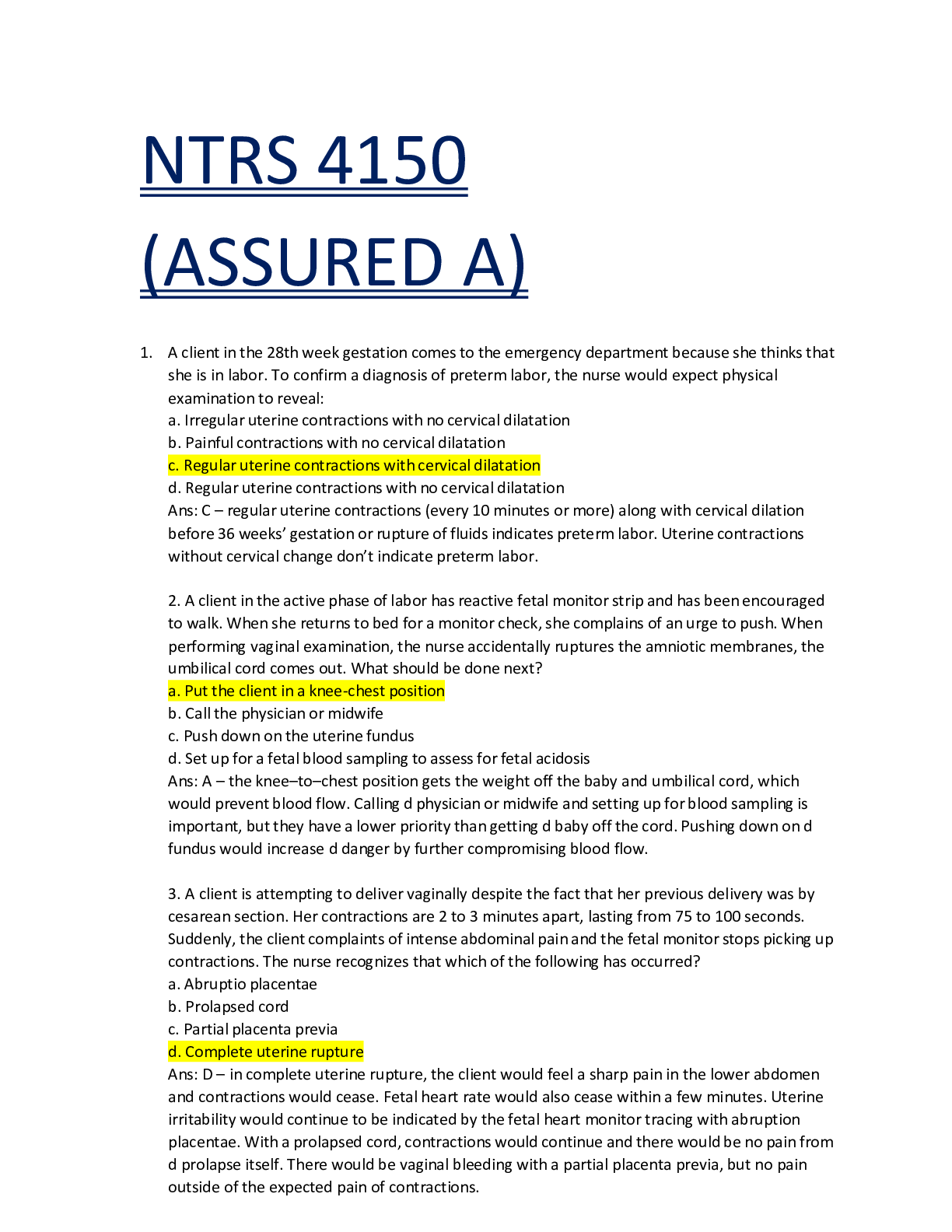
1. A client in the 28th week gestation comes to the emergency department because she thinks that
she is in labor. To confirm a diagnosis of preterm labor, the nurse would expect physical
examina
...
NTRS 4150
(ASSURED A)
1. A client in the 28th week gestation comes to the emergency department because she thinks that
she is in labor. To confirm a diagnosis of preterm labor, the nurse would expect physical
examination to reveal:
a. Irregular uterine contractions with no cervical dilatation
b. Painful contractions with no cervical dilatation
c. Regular uterine contractions with cervical dilatation
d. Regular uterine contractions with no cervical dilatation
Ans: C – regular uterine contractions (every 10 minutes or more) along with cervical dilation
before 36 weeks’ gestation or rupture of fluids indicates preterm labor. Uterine contractions
without cervical change don’t indicate preterm labor.
2. A client in the active phase of labor hasreactive fetal monitor strip and has been encouraged
to walk. When she returns to bed for a monitor check, she complains of an urge to push. When
performing vaginal examination, the nurse accidentally ruptures the amniotic membranes, the
umbilical cord comes out. What should be done next?
a. Put the client in a knee-chest position
b. Call the physician or midwife
c. Push down on the uterine fundus
d. Set up for a fetal blood sampling to assess for fetal acidosis
Ans: A – the knee–to–chest position gets the weight off the baby and umbilical cord, which
would prevent blood flow. Calling d physician or midwife and setting up for blood sampling is
important, but they have a lower priority than getting d baby off the cord. Pushing down on d
fundus would increase d danger by further compromising blood flow.
3. A client is attempting to deliver vaginally despite the fact that her previous delivery was by
cesarean section. Her contractions are 2 to 3 minutes apart, lasting from 75 to 100 seconds.
Suddenly, the client complaints of intense abdominal pain and the fetal monitorstops picking up
contractions. The nurse recognizes that which of the following has occurred?
a. Abruptio placentae
b. Prolapsed cord
c. Partial placenta previa
d. Complete uterine rupture
Ans: D – in complete uterine rupture, the client would feel a sharp pain in the lower abdomen
and contractions would cease. Fetal heart rate would also cease within a few minutes. Uterine
irritability would continue to be indicated by the fetal heart monitor tracing with abruption
placentae. With a prolapsed cord, contractions would continue and there would be no pain from
d prolapse itself. There would be vaginal bleeding with a partial placenta previa, but no pain
outside of the expected pain of contractions.
4. A client with gravida 3 para 2 at 40 weeks gestation is admitted with spontaneous
contractions. The physician performs an amniotomy to augment her labor. The priority nursing
action is to:
a. Explain the rationale for the amniotomy to the client
b. Assessfetal heart tones after the amniotomy
c. Ambulate the client to strengthen the contraction pattern
d. Position the client in a lithotomy position to administer perineal care
Ans: B - the nurse should assess fetal heart tones. After an amniotomy is performed, the
umbilical cord may be washed down below the presenting part and cause umbilical cord
compression, which would be indicated by variable deceleration on the fetal heart tracing. An
explanation of the rationale for amniotomy would be given before d procedure. After assessing
the fetal response to the amniotomy, perineal care s provided. The nurse would ambulate client
only if the presenting part were engaged.
5. The nurse can consider the fetus’s head to be engaged when:
a. The presenting part moves through the pelvis
b. The fetal head rotates to pass through the ischialspines
c. The fetal head extends as it passes under the symphysis pubis
d. The biparietal diameter passes the pelvic inlet
Ans: D – d fetus’s head s considered engaged when the biparietal diameter passes d pelvic inlet.
The presenting part moving through d pelvis s called descent. The head flexing so that the chin
moves closer to d chest s called flexion. Rotation of the head to pass through the ischial spines is
called internal rotation. Extension of the head as it passes under d symphysis pubis s called
extension.
6. A client is experiencing true labor when her contraction pattern shows:
a. Occasional irregular contractions
b. Irregular contractionsthat increase in intensity
c. Regular contractionsthat remain the same
d. Regular contractionsthat increase in frequency and duration
Ans: D- regular contractions that increase in frequency and duration as well as intensity indicate
true labor. The other choices don’t describe d contraction pattern of true labor.
7. A client is admitted to the hospital with contractions that are about 1 to 2 minutes apart and
reveal that her cervix is dilated 8 cm. The client is in which stage of labor?
a. Latent phase
b. Active phase
c. Third stage
d. Transitional phase
Ans: D- d client is in d transitional phase of labor. This phase of labor is characterized by cervical
dilation of 8 to 10 cm and contractions that are about 1 to 2 minutes apart and last for 60 to 90
seconds with strong intensity. In the latent phase, the cervix is dilated 0 to 3 cm and contractions
are irregular. During the active phase, the cervix is dilated to 4 to 7 cm and contractions are
about 5 to 8 minutes apart and last 45 to 60 seconds with moderate to strong intensity. The 3rd
stage of labor extends from delivery of the neonate to expulsion of the placenta and lasts from 5
to 30 minutes.
8. A client in the second stage of labor experiences rupture of membranes. The most appropriate
intervention by the nurse is to:
a. Assess the client’s vitalsigns immediately
b. Observe for prolapsed cord and monitor fetal heart rate
c. Administer oxygen through a face mask at 6-10 L per min
d. Position the client on her side
Ans: B – the nurse should immediately check for prolapsed cord and monitor FHR. When the
membranes rupture, the cord may become compressed between the fetus and maternal cervix
or pelvis, thus compromising fetoplacental perfusion. It isn’t necessary to position the client on
her left side, monitor maternal vital signs, or administer oxygen when the client’s membrane
rupture.
9. A client in labor is being monitored by an internal electronic device to evaluate fetalstation.
The nurse measures the duration of her contractions by:
a. Measuring from the beginning of the increment to the end of the decrement
b. Measuring from the beginning of one contraction to the beginning of the next
c. Measuring from the beginning of the decrement to the end of the increment
d. Using an intrauterine catheter that measuresincreasesin contraction
Ans: A- the duration of a contraction is measured from the beginning of the increment to the
end of the decrement. Measuring from the beginning of one contraction to the beginning of the
next reveals frequency. Measuring from the beginning of one contraction to the beginning of the
next reveals frequency. Measuring during the acme phase of a contraction reveals intensity
(measured with an intrauterine catheter or by palpation).
10. A client isreceiving magnesium sulfate to help suppress preterm labor. The nurse should
watch for which sign of magnesium toxicity?
a. Headache
b. Loss of deep tendon reflexes
c. Palpitations
d. Dyspepsia
Ans: B – magnesium toxicity causes signs of central nervous system depression, such as loss of
deep tendon reflexes, paralysis, respiratory depression, drowsiness, lethargy, blurred vision,
slurred speech, and confusion. Headache may be an adverse effect of calcium channel blockers,
which are sometimes used to treat preterm labor. Palpitations are an adverse effect of
terbutaline and ritodrine, which are also used to treat preterm labor. Dyspepsin may occur as an
adverse effect of indomethacin, a prostaglandin synthesize inhibitor, used to suppress preterm
labor.
[Show More]