NURS 6670 Final Exam 1. Mrs. Johnson is a 79-year-old lady who has been managed for Alzheimer’s dementia with a variety of nonpharmacologic management strategies such as promoting a clear household routine, timed toileti
...
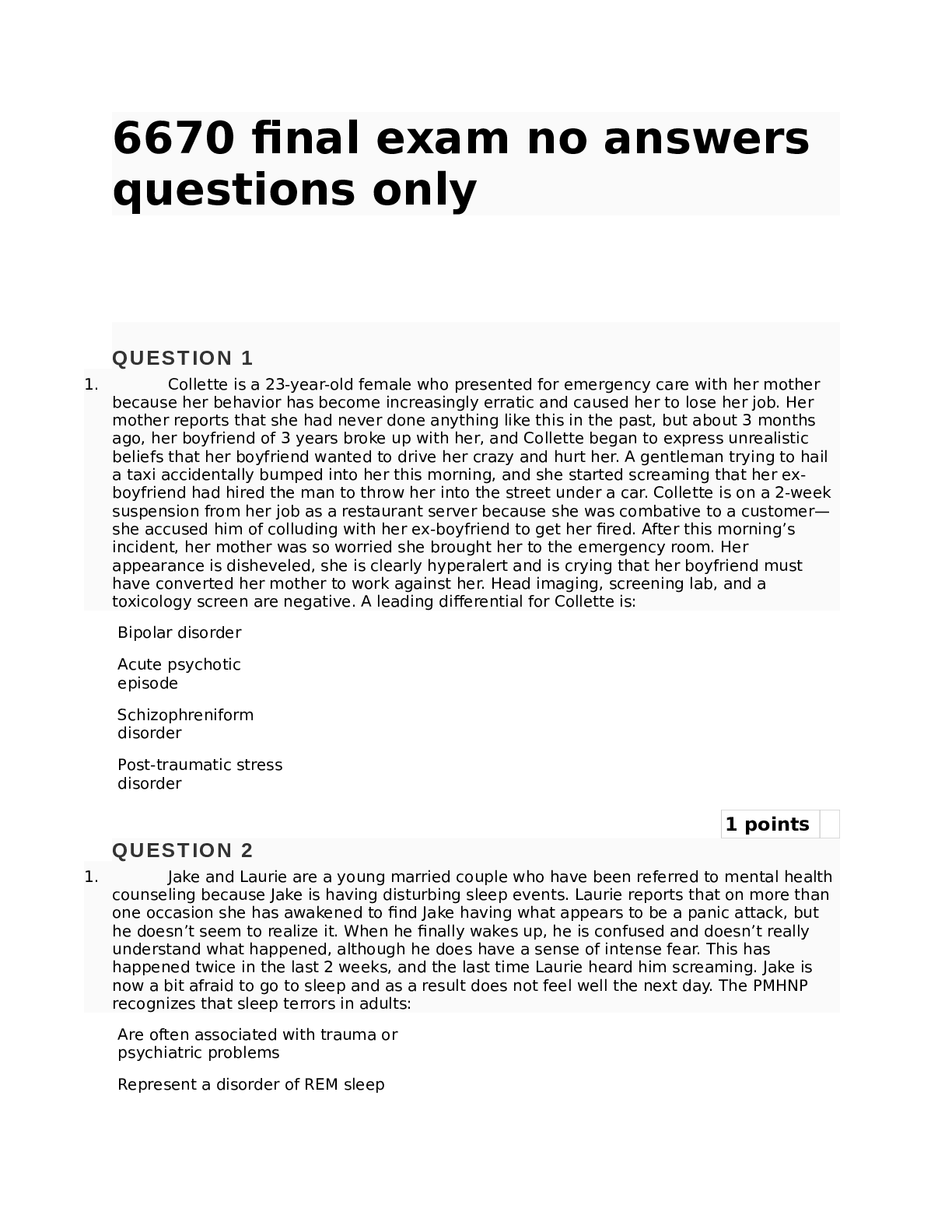
NURS 6670 Final Exam 1. Mrs. Johnson is a 79-year-old lady who has been managed for Alzheimer’s dementia with a variety of nonpharmacologic management strategies such as promoting a clear household routine, timed toileting, pet therapy, and other strategies to provide structure. However, she was finally started on donepezil 10 mg daily at bedtime to try and maximize cognitive function and memory. When following up for medication tolerance and adverse effects, the PMHNP recognizes that the most common patient complaints include: 2. Mr. and Mrs. Comstock are both patients of your practice; Mr. Comstock is treated for depression, which is largely secondary to his wife’s progressive dementia. He is trying to take care of her but finds it very emotionally difficult. Previously very active, they have become socially isolated as their friends are not comfortable around Mrs. Comstock’s progressively obvious dementia symptoms. Mr. Comstock’s brother and his wife were visiting yesterday, and it became very uncomfortable. Mr. Comstock said they were having a conversation about a recent election and his wife suddenly became extremely agitated and started acting out inappropriately; she was yelling and broke a figurine from the table; she finally left the room. He said this has not happened before—that usually she participates in conversations, even if sometimes she jokes too much or changes the subject. The PMHNP discusses with Mr. Comstock that it sounds as though his wife: 3. Valerie is a 27-year-old woman who has been referred by her primary care provider. She was initially diagnosed with major depressive episode following a breakup with her boyfriend of 7 years. They moved into a house together 1 year ago, but within a few months the boyfriend moved out. Valerie was unresponsive to medication for depression and was referred to the mental health clinic. During this initial psychiatric evaluation, the PMHNP learns that a primary reason for the breakup was that Valerie had an extensive routine every night of repeatedly checking every door and window in the home to ensure that they were locked. Valerie’s nighttime routine is exhaustive and involves checking every door and window at least four times. She has a remote history of being attacked in her home while alone and states that she is unable to go to bed until she is certain that every door and window is locked. When considering diagnostic criteria for OCD, the PMHNP needs further assessment to ascertain which diagnostic criteria? 4. Camille is a PMHNP student preparing a presentation for a group of primary care providers on common signs and symptoms of psychiatric disorders often first seen in primary care offices. The goal is to increase awareness of early indicators for mental health referral. When discussing obsessive-compulsive disorder, Camille discusses that the most common pattern of obsession is: 5. All of the following strategies are used successfully to manage paradoxical insomnia except: 6. The PMHNP is formulating a diagnosis for Peter, a 24-year-old man who was admitted for management of acute psychoses. He believed that he was the Holy Ghost of the Christian Trinity. According to his mother and father, he did not have any psychiatric symptoms or history throughout childhood and adolescence, but after college, he began to develop “issues” characterized by extremes of mood in which he would be too depressed to attend classes for weeks at a time followed by a rebound in which he would go partying, stay awake for days at a time, and go on ridiculous shopping sprees. When considering a diagnosis of schizoaffective disorder, the PMHNP attempts to establish that: 7. Nava is a 47-year-old female who has been in care for the last 9 months for a major depressive episode. She has struggled with depression intermittently since her 20s, but at this point she is on combination therapy with sertraline and bupropion and has achieved an excellent remission. However, she is asking for some help with her sleep. She says she has always had insomnia to some degree, mostly trouble falling asleep, but she thought that once she felt better from her depression it would improve. A review of Nava’s sleep hygiene habits reveals that there are numerous areas that could benefit from improvement. Nava’s sleep hygiene habits should ultimately be improved to include all the following except: 8. Amnestic disorders have a wide variety of potential causes, including vitamin and mineral deficiencies, infectious diseases, substance-related causes, and structural damage. The shared feature is that many of these causes tend to affect the: 9. Donna is a 41-year-old woman who is being evaluated at the request of her primary care provider for obsessive compulsive disorder. Which of the following aspects of Donna’s family medical history should prompt an immediate referral to a neurologist? 10. Shireen is a 21-year-old transgender female who has been through an exhaustive counseling program and is ready to start hormone therapy with estrogen, progesterone, and testosterone-blocking agents. When counseling her specifically about the risks, benefits, and required monitoring of hormonal therapy, the PMHNP advises Shireen that: 11. John is a 19-year-old male who is self-referred for care after being prematurely discharged from the military. He is vague as to the details of his discharge, but it appears he had difficulty with performance evaluations and was apparently arrested for several incidences of illegal substance abuse. Comprehensive evaluation of John reveals that he thinks he “is really a woman,” but he cannot accept this and joined the Army to try and “be a real man.” John indicates that he has always felt like he was really a girl, and he says that he “hates that he has a penis.” When considering a diagnosis of gender dysphoria, the PMHNP knows that which of the following would be most consistent with John’s history? 12. Dual-sex therapy is a therapeutic approach to sexual dysfunction in a marital dyad or relationship that is believed to result from disharmony or misunderstanding in the relationship. This is most effective in couples when: 13. The PMHNP is preparing a community-based presentation for both the staff and residents of a local life-care facility. The facility offers a continuum of care from independent apartment living to assisted living to nursing home care.
[Show More]









.png)










 (1).png)