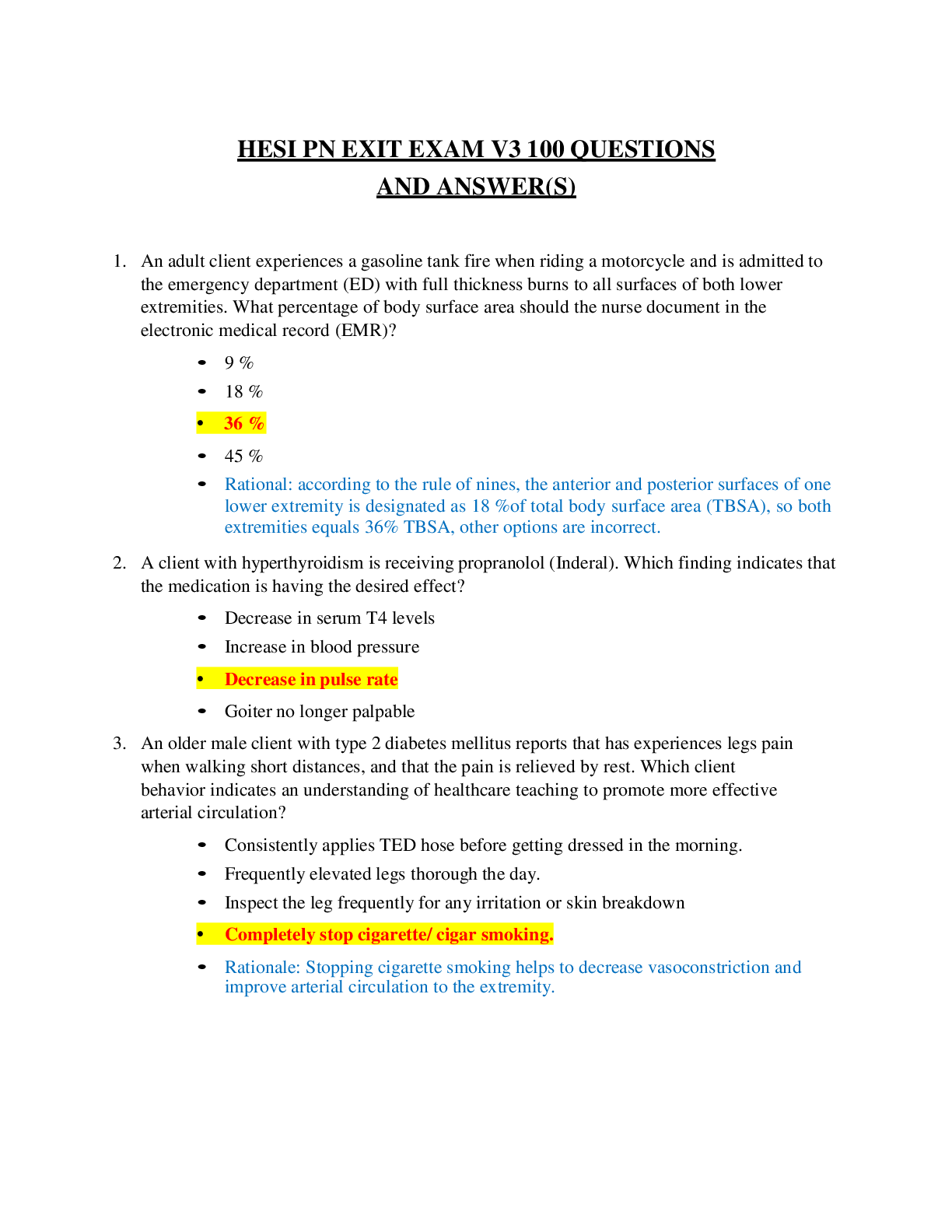
1. An adult client experiences a gasoline tank fire when riding a motorcycle and is admitted to
the emergency department (ED) with full thickness burns to all surfaces of both lower
extremities. What percentage of body
...
1. An adult client experiences a gasoline tank fire when riding a motorcycle and is admitted to
the emergency department (ED) with full thickness burns to all surfaces of both lower
extremities. What percentage of body surface area should the nurse document in the
electronic medical record (EMR)?
• 9 %
• 18 %
• 36 %
• 45 %
• Rational: according to the rule of nines, the anterior and posterior surfaces of one
lower extremity is designated as 18 %of total body surface area (TBSA), so both
extremities equals 36% TBSA, other options are incorrect.
2. A client with hyperthyroidism is receiving propranolol (Inderal). Which finding indicates that
the medication is having the desired effect?
• Decrease in serum T4 levels
• Increase in blood pressure
• Decrease in pulse rate
• Goiter no longer palpable
3. An older male client with type 2 diabetes mellitus reports that has experiences legs pain
when walking short distances, and that the pain is relieved by rest. Which client behavior
indicates an understanding of healthcare teaching to promote more effective arterial
circulation?
• Consistently applies TED hose before getting dressed in the morning.
• Frequently elevated legs thorough the day.
• Inspect the leg frequently for any irritation or skin breakdown
• Completely stop cigarette/ cigar smoking.
• Rationale: Stopping cigarette smoking helps to decrease vasoconstriction and
improve arterial circulation to the extremity.4. A community health nurse is concerned about the spread of communicable diseases among
migrant farm workers in a rural community. What action should the nurse take to promote the
success of a healthcare program designed to address this problem?
• Establish trust with community leaders and respect cultural and family
values
5. The nurse performs a prescribed neurological check at the beginning of the shift on a client
who was admitted to the hospital with a subarachnoid brain attack (stroke). The client’s
Glasgow Coma Scale (GCS) score is 9. What information is most important for the nurse to
determine?
• The client’s previous GCS score
• When the client’s stroke symptoms started
• If the client is oriented to time
• The client’s blood pressure and respiration rate
• Rationale: The normal GCS is 15, and it is most important for the nurse to
determine if it abnormal score a sign of improvement or a deterioration in the
client’s condition
[Show More]




![Preview of HESI Critical Care TEST BANK RN 2021 [50 Questions /Answers]](https://scholarfriends.com/storage/Critical_Care_HESI_notes___.png)







hesi.png)
hesi.png)