Pharmacology and Pharmacotherapeutics in Advanced Nursing Practice
NGR6172
Chapter 1: Prescriptive Authority and Role Implementation: Tradition vs Change
o Primary Care is provided by clinicians who address "personal
...
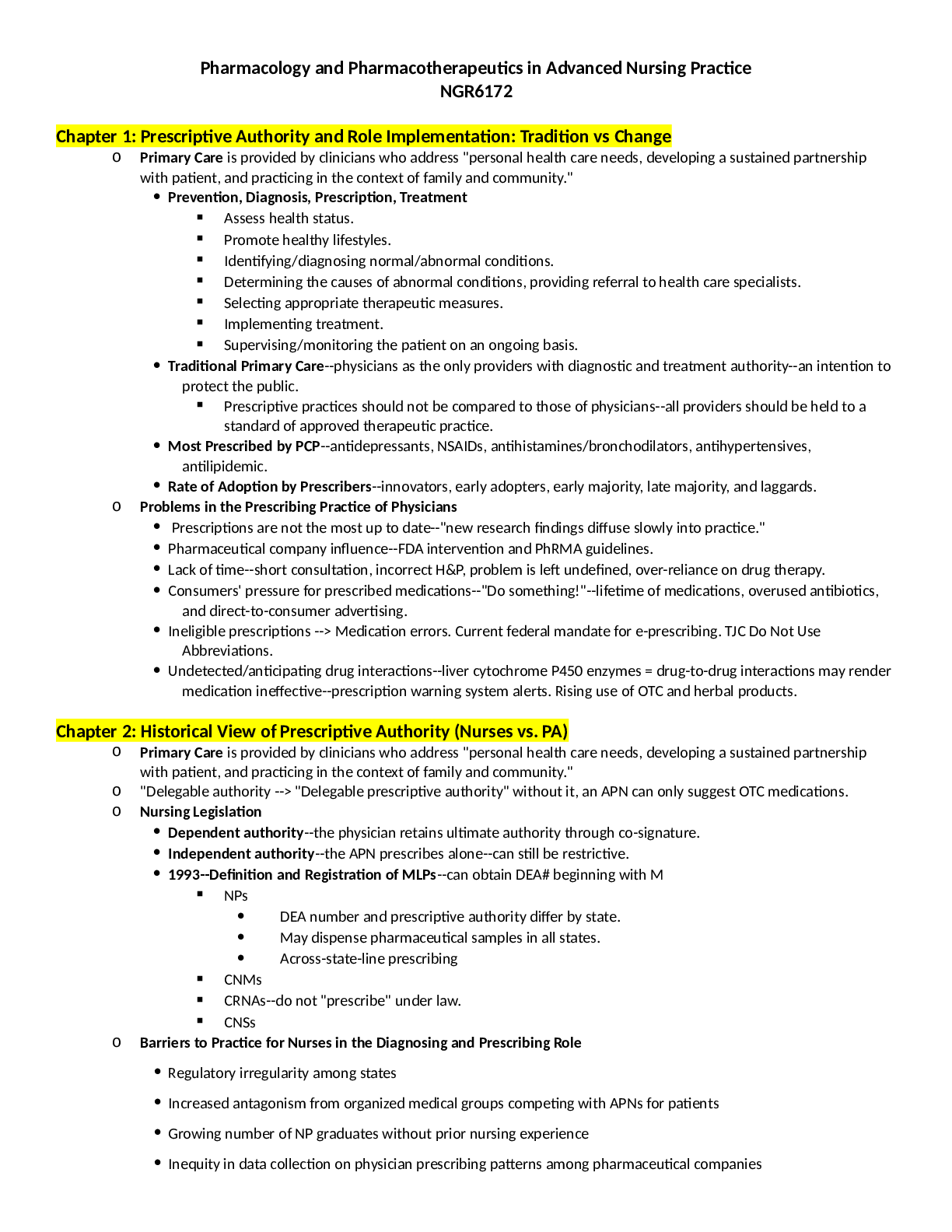
Pharmacology and Pharmacotherapeutics in Advanced Nursing Practice
NGR6172
Chapter 1: Prescriptive Authority and Role Implementation: Tradition vs Change
o Primary Care is provided by clinicians who address "personal health care needs, developing a sustained partnership
with patient, and practicing in the context of family and community."
Prevention, Diagnosis, Prescription, Treatment
Assess health status.
Promote healthy lifestyles.
Identifying/diagnosing normal/abnormal conditions.
Determining the causes of abnormal conditions, providing referral to health care specialists.
Selecting appropriate therapeutic measures.
Implementing treatment.
Supervising/monitoring the patient on an ongoing basis.
Traditional Primary Care--physicians as the only providers with diagnostic and treatment authority--an intention to
protect the public.
Prescriptive practices should not be compared to those of physicians--all providers should be held to a
standard of approved therapeutic practice.
Most Prescribed by PCP--antidepressants, NSAIDs, antihistamines/bronchodilators, antihypertensives,
antilipidemic.
Rate of Adoption by Prescribers--innovators, early adopters, early majority, late majority, and laggards.
o Problems in the Prescribing Practice of Physicians
Prescriptions are not the most up to date--"new research findings diffuse slowly into practice."
Pharmaceutical company influence--FDA intervention and PhRMA guidelines.
Lack of time--short consultation, incorrect H&P, problem is left undefined, over-reliance on drug therapy.
Consumers' pressure for prescribed medications--"Do something!"--lifetime of medications, overused antibiotics,
and direct-to-consumer advertising.
Ineligible prescriptions --> Medication errors. Current federal mandate for e-prescribing. TJC Do Not Use
Abbreviations.
Undetected/anticipating drug interactions--liver cytochrome P450 enzymes = drug-to-drug interactions may render
medication ineffective--prescription warning system alerts. Rising use of OTC and herbal products.
Chapter 2: Historical View of Prescriptive Authority (Nurses vs. PA)
o Primary Care is provided by clinicians who address "personal health care needs, developing a sustained partnership
with patient, and practicing in the context of family and community."
o "Delegable authority --> "Delegable prescriptive authority" without it, an APN can only suggest OTC medications.
o Nursing Legislation
Dependent authority--the physician retains ultimate authority through co-signature.
Independent authority--the APN prescribes alone--can still be restrictive.
1993--Definition and Registration of MLPs--can obtain DEA# beginning with M
NPs
DEA number and prescriptive authority differ by state.
May dispense pharmaceutical samples in all states.
Across-state-line prescribing
CNMs
CRNAs--do not "prescribe" under law.
CNSs
o Barriers to Practice for Nurses in the Diagnosing and Prescribing Role
Regulatory irregularity among states
Increased antagonism from organized medical groups competing with APNs for patients
Growing number of NP graduates without prior nursing experience
Inequity in data collection on physician prescribing patterns among pharmaceutical companies Difficulty in obtaining prescribing data from Prescription Drug Marketing Act
[Show More]