Pharmacology 6521 week 5 quiz
Question 1
1 out of 1 points
A 4-year-old child is brought to the emergency department by her mother.
The mother reports that the child has been vomiting, and the nurse notes
th
...
Pharmacology 6521 week 5 quiz
Question 1
1 out of 1 points
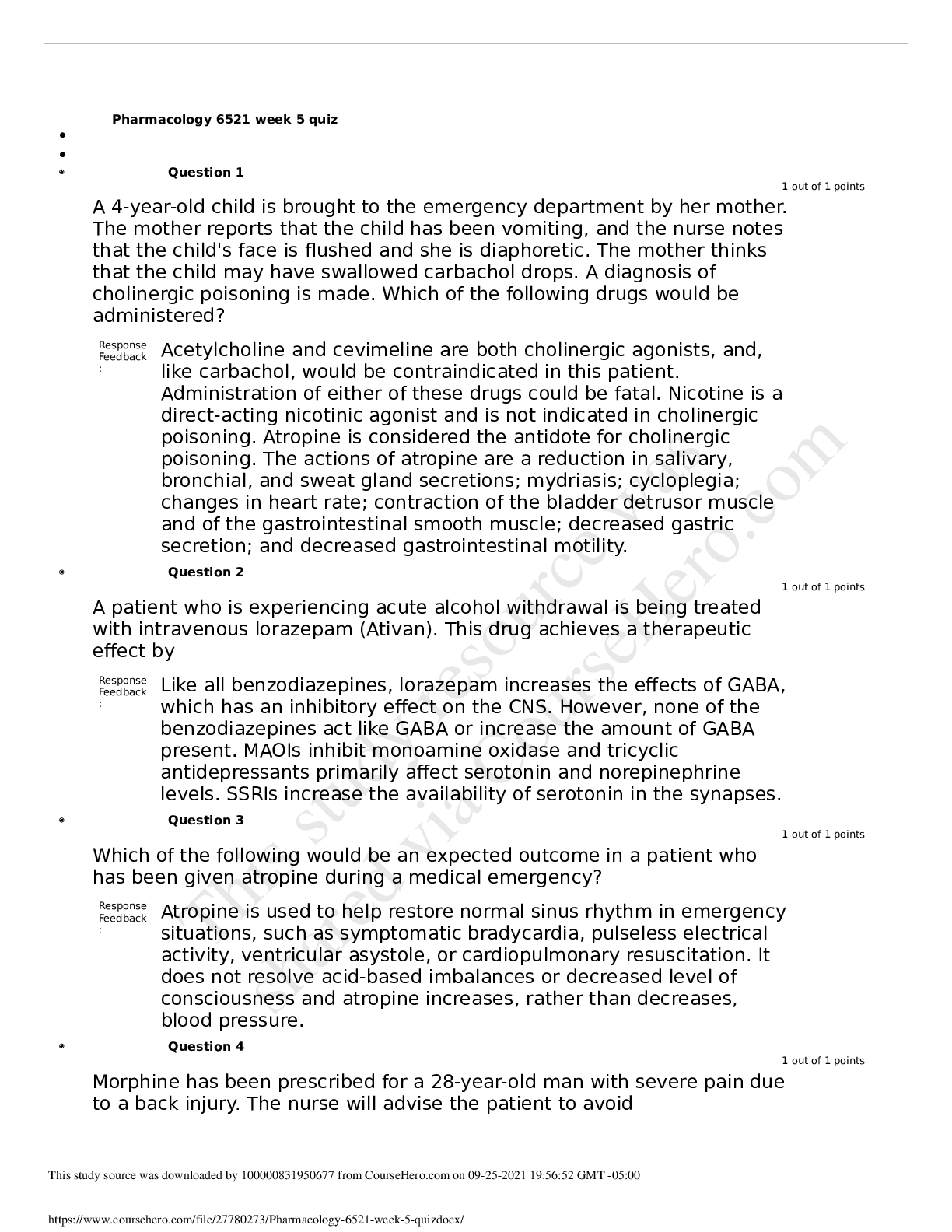
A 4-year-old child is brought to the emergency department by her mother.
The mother reports that the child has been vomiting, and the nurse notes
that the child's face is flushed and she is diaphoretic. The mother thinks
that the child may have swallowed carbachol drops. A diagnosis of
cholinergic poisoning is made. Which of the following drugs would be
administered?
Response
Feedback
:
Acetylcholine and cevimeline are both cholinergic agonists, and,
like carbachol, would be contraindicated in this patient.
Administration of either of these drugs could be fatal. Nicotine is a
direct-acting nicotinic agonist and is not indicated in cholinergic
poisoning. Atropine is considered the antidote for cholinergic
poisoning. The actions of atropine are a reduction in salivary,
bronchial, and sweat gland secretions; mydriasis; cycloplegia;
changes in heart rate; contraction of the bladder detrusor muscle
and of the gastrointestinal smooth muscle; decreased gastric
secretion; and decreased gastrointestinal motility.
Question 2
1 out of 1 points
A patient who is experiencing acute alcohol withdrawal is being treated
with intravenous lorazepam (Ativan). This drug achieves a therapeutic
effect by
Response
Feedback
:
Like all benzodiazepines, lorazepam increases the effects of GABA,
which has an inhibitory effect on the CNS. However, none of the
benzodiazepines act like GABA or increase the amount of GABA
present. MAOIs inhibit monoamine oxidase and tricyclic
antidepressants primarily affect serotonin and norepinephrine
levels. SSRIs increase the availability of serotonin in the synapses.
Question 3
1 out of 1 points
Which of the following would be an expected outcome in a patient who
has been given atropine during a medical emergency?
Response
Feedback
:
Atropine is used to help restore normal sinus rhythm in emergency
situations, such as symptomatic bradycardia, pulseless electrical
activity, ventricular asystole, or cardiopulmonary resuscitation. It
does not resolve acid-based imbalances or decreased level of
consciousness and atropine increases, rather than decreases,
blood pressure.
Question 4
1 out of 1 points
Morphine has been prescribed for a 28-year-old man with severe pain due
to a back injury. The nurse will advise the patient to avoid
[Show More]